
Beneficiary designations are an important but sometimes overlooked part of a workplace retirement plan.
An employee may participate in a plan for many years without reviewing who is currently named to receive plan proceeds after their death.
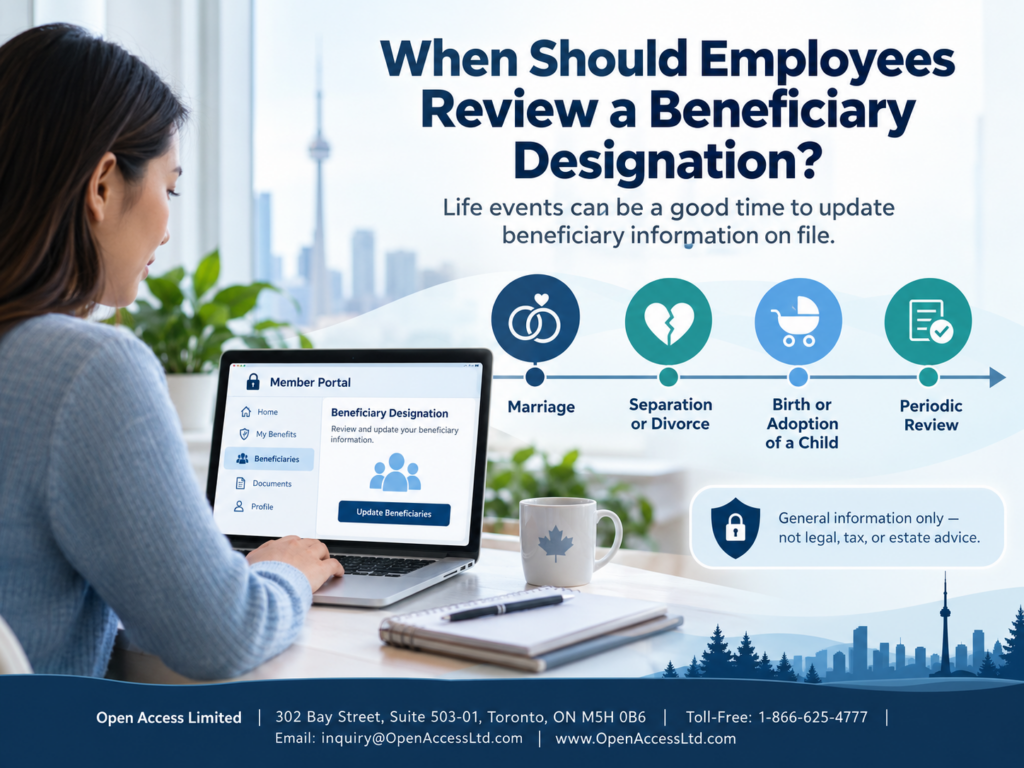
Marriage, separation, divorce, the birth or adoption of a child, changes in family circumstances, or simply the passage of time can make it appropriate for an employee to review the information on file.
For Canadian employers, the objective is not to tell employees whom to name.
A better approach is to explain where beneficiary designations are recorded, how employees can review or update them, where official forms and plan documents are available, and when legal, tax, estate, or financial questions should be referred to qualified professionals.
Importantly, a beneficiary designation does not necessarily determine the outcome by itself. The plan type, applicable legislation, official plan documents, and individual circumstances may also matter. OpenAccess_Q55_QA_with_Resource…
Quick Answer: What Should Employers Explain About Beneficiary Designations?
Canadian employers can help employees understand beneficiary designations by explaining what a designation is, where the information is recorded, how employees can review and update it, why major life events may be a useful reminder to review it, and where official plan forms and provider support are available.
Employers should provide general education rather than personal legal, tax, estate, or financial advice and should avoid telling employees whom to name or guaranteeing who will ultimately receive plan proceeds.
On This Page
- Why Beneficiary Designations Matter
- 7 Smart Employer Steps
- When Employees May Want to Review a Designation
- How Rules Can Differ by Plan Type
- Group RRSP Beneficiary Considerations
- Ontario Pension Plan Example
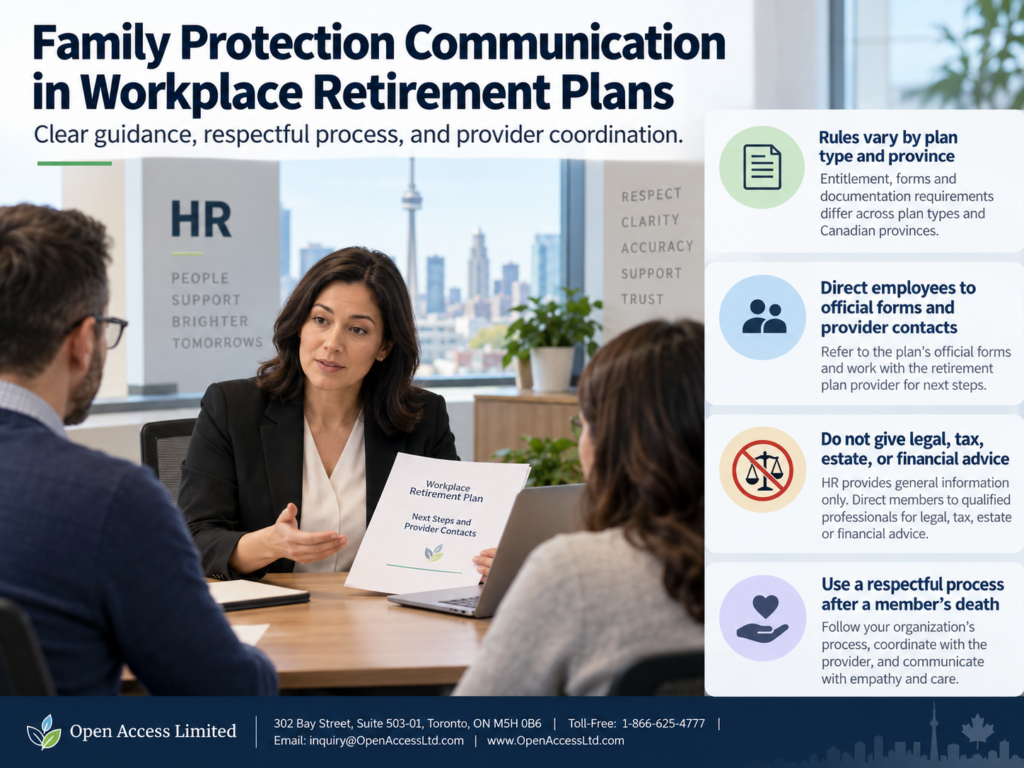
- Family Protection: What Employers Should and Should Not Say
- Privacy and Beneficiary Information
- What Happens After a Member’s Death
- Ongoing Employee Education
- How Open Access Limited May Support Employers
- Frequently Asked Questions
- Final Thoughts
- References
Why Beneficiary Designations Matter
A beneficiary designation is generally an instruction on file with a plan identifying who is intended to receive plan proceeds after a member’s death.
That sounds simple, but beneficiary designations can interact with several other factors.
These may include:
- The type of workplace retirement plan
- Official plan documents
- Provincial or territorial law
- Pension legislation
- Family law
- Succession and estate law
- Tax rules
- The employee’s individual circumstances
For that reason, employers should avoid telling employees:
“If you name this person, they will definitely receive the money.”
The employer’s role is better framed as:
Explain the process → Provide official resources → Encourage review → Refer personal questions appropriately

7 Smart Steps for Employers to Explain Beneficiary Designations
1. Explain What a Beneficiary Designation Is
Start with plain language.
Employees should understand that beneficiary designations identify the person or persons intended to receive applicable plan proceeds after the member’s death, subject to the plan terms and applicable law.
Employers do not need to interpret succession law or determine entitlement.
A simple explanation can be:
“Your workplace retirement plan may have beneficiary information on file. You can review the designation and the applicable plan forms through the plan provider.”
This gives employees useful information without making legal conclusions.
2. Encourage Periodic Review Without Making Assumptions
An employer can periodically remind all employees that beneficiary information may need to be reviewed.
Possible review points may include:
- Marriage
- Separation
- Divorce
- Birth of a child
- Adoption
- Changes in personal circumstances
- Pre-retirement planning
- Periodic benefit reviews
The employer should not assume or ask employees about private family circumstances.
The source specifically recommends general life-event reminders rather than making assumptions about an individual employee’s family situation. OpenAccess_Q55_QA_with_Resource…
A respectful message might simply say:
“Please consider reviewing the beneficiary information currently on file for your workplace retirement plan.”
3. Show Employees Where Official Forms and Instructions Are Located
A reminder is only useful if employees know what to do next.
Employers should explain where employees can find:
- Beneficiary forms
- Information-change forms
- Plan documents
- Member portal access
- Provider contact information
- Account details
- Submission instructions
This makes beneficiary designations easier to review and reduces the likelihood that employees rely on outdated or unofficial instructions.
Where possible, link directly to the current provider form rather than copying an old form into an internal HR folder.
4. Explain That Rules Differ by Plan Type and Jurisdiction
This is essential.
A Group RRSP, Registered Pension Plan, DPSP, PRPP, locked-in account, or another workplace arrangement may not follow identical rules.
The effect of beneficiary designations may also depend on provincial or territorial law.
An Ontario pension-plan example should not automatically be applied to a Group RRSP or to an employee in another province.
The source specifically notes that succession law is provincial and territorial and that pension legislation can create rights that do not depend solely on a beneficiary designation. OpenAccess_Q55_QA_with_Resource…
Employers should therefore use plan-specific wording.
5. Keep Education Separate From Personal Advice
Employees may ask:
“Should I name my spouse?”
“Should I name my children?”
“Should I name my estate?”
“Does my will override this form?”
“Which option gives my family the lowest tax?”
These are personal questions.
Employers can explain:
- Where the designation is held
- How to access the form
- How to submit an update
- Where plan documents are located
- Who the provider contact is
Employers should not advise:
- Whom to name
- What creates the best tax result
- How an estate should be structured
- Whether a will overrides a designation
- Who is legally entitled in a particular case
This boundary is particularly important because beneficiary questions can involve family, succession, pension, tax, and estate law.
6. Coordinate Instructions With the Plan Provider
HR and the provider should not give employees conflicting directions.
Employers should confirm with the provider:
- How a designation is made
- How it is changed
- What form is required
- Whether electronic updates are available
- How instructions are recorded
- Where employees can confirm information on file
- Who handles plan-specific questions
Clear provider coordination strengthens retirement plan governance and can reduce inconsistent instructions.
The employer should use current plan materials rather than relying on memory or an outdated internal process.
7. Have a Respectful Process After a Member’s Death
A member’s death is a sensitive event.
Employers should have a documented and respectful process for directing family members, an estate representative, or another authorized person to the appropriate provider contact.
The employer should avoid making statements about who is entitled to the proceeds.
For example, HR should not say:
“You are the beneficiary, so the money will be paid to you.”
Instead:
“We can connect you with the retirement-plan provider, who can explain the required process and documentation.”
The source recommends a documented process and cautions employers against making statements about entitlement. OpenAccess_Q55_QA_with_Resource…
When Should Employees Review a Beneficiary Designation?
There is no single life event that automatically means a designation must be changed.
However, employers can remind employees that certain changes may be good times to review the information currently on file.
Marriage or a New Partnership
Employees may wish to confirm whether their existing designation still reflects their intentions and applicable plan requirements.
Separation or Divorce
Employees may wish to review plan information and obtain qualified legal advice where needed.
Birth or Adoption of a Child
A family change may prompt an employee to review existing information.
Changes in Personal Circumstances
An employee’s preferences or circumstances may change even without a major formal life event.
Periodic Review
Even when nothing significant has changed, periodically reviewing beneficiary designations can help employees confirm that the information recorded by the plan remains current.
The employer should provide the reminder—not determine whether a change is necessary.
How Group RRSP Beneficiary Rules Can Differ
For RRSPs, including Group RRSPs, CRA guidance states that a beneficiary may be designated in the RRSP contract or in the annuitant’s will.
Where a designation is valid under applicable succession law, the amount may be paid to the beneficiary.
Where there is no beneficiary or the designation is not valid, the amount may instead be paid to the estate. OpenAccess_Q55_QA_with_Resource…
However, succession law differs by province and territory.
This is why employers should avoid presenting a general Group RRSP explanation as individualized legal advice.
What About Tax After the Death of an RRSP Annuitant?
CRA guidance generally provides that the fair market value of RRSP property at death is included in the deceased annuitant’s income for the year of death.
Different treatment may be available in certain situations involving qualifying survivors, such as a spouse or common-law partner or certain financially dependent children or grandchildren.
How those rules apply depends on individual circumstances. OpenAccess_Q55_QA_with_Resource…
Employers should therefore avoid promising a particular tax outcome.
Tax questions should be directed to CRA information or qualified tax and estate professionals.
Registered Pension Plans Can Follow Different Rules
Pension plans introduce another important distinction.
For example, FSRA publishes an Ontario form allowing certain spouses of pension-plan members or former members to waive entitlement to a pre-retirement death benefit.
That illustrates that in an Ontario-registered pension plan, a spouse may have rights that do not depend solely on whether that spouse is named as beneficiary. OpenAccess_Q55_QA_with_Resource…
This is an Ontario example—not a Canada-wide rule.
Other jurisdictions and plan types can operate differently.
Why “Family Protection” Needs Careful Wording
The phrase family protection may sound reassuring, but employers should use it carefully.
A beneficiary designation does not guarantee:
- Who ultimately receives plan proceeds
- A particular tax result
- A particular estate outcome
- That a spouse has or does not have separate rights
- That a designation overrides other applicable legal requirements
A better employer message is:
“Reviewing beneficiary information is an important part of keeping your workplace retirement-plan records current.”
This is accurate without promising an outcome.
Protect Beneficiary Information as Personal Information
Beneficiary information can reveal sensitive information about an employee’s personal relationships and preferences.
Employers should avoid unnecessary access or casual discussion of beneficiary designations.
Information should be handled according to the employer’s applicable privacy and plan-administration processes.
Employees should also be directed to secure official channels when updating information.
This connects naturally with broader retirement plan data security practices.
A Neutral Beneficiary Reminder Employers Can Use
A professional employee reminder could say:
Please review the beneficiary information on file for your workplace retirement plan from time to time, including after a change in your personal circumstances. Forms and instructions are available from the plan provider. This reminder is general information only. If you have personal legal, tax, estate, or financial questions, you may wish to speak with an appropriately qualified professional.
This wording should be adapted to the employer’s actual plan and checked against current provider materials before use.
Beneficiary Education Should Continue Beyond Onboarding
Employees may complete beneficiary information when they first enrol in a retirement plan and then not look at it for many years.
That is why beneficiary designations should not be treated as a one-time onboarding topic.
Employers can reinforce the reminder through:
- Annual benefits communication
- Periodic retirement-plan reviews
- Pre-retirement education
- Life-event reminder campaigns
- Member portal reminders
- Financial-wellness education
CAPSA’s Guideline No. 3 identifies ongoing accuracy of personal/contact information and beneficiary designations as part of member responsibilities within capital accumulation plans. OpenAccess_Q55_QA_with_Resource…
The employer’s role is to make review easier—not to decide what the employee should choose.
What Employers Should Avoid
Employers should avoid:
- Telling an employee whom to name
- Interpreting a beneficiary designation
- Promising who will receive the proceeds
- Giving personal estate-planning advice
- Giving personal tax advice
- Assuming an employee’s family situation
- Asking unnecessary personal questions
- Treating all Canadian jurisdictions the same
- Assuming a Group RRSP and pension plan follow identical rules
- Using outdated beneficiary forms
- Making entitlement statements after an employee’s death
These boundaries protect both the employee and the employer.
Important Implementation Boundaries
Beneficiary designations can involve:
- Succession law
- Estate law
- Family law
- Pension legislation
- Tax law
- Insurance law
- Privacy obligations
Rules can differ significantly by plan type, province, and territory, and Quebec may have rules that differ from other Canadian jurisdictions.
Employers should not interpret a designation, advise an employee whom to name, or state who is legally entitled to proceeds. OpenAccess_Q55_QA_with_Resource…
Before implementing a beneficiary-reminder program or a process for dealing with a member’s death, employers should confirm the approach with the plan administrator or provider and obtain qualified legal advice where appropriate.
Need Help Make Beneficiary Information Easier for Employees to Review?
Where a workplace retirement plan is provided through Open Access Limited, employers may direct employees to official Open Access forms and member-support resources.
Open Access Limited’s public resources include member forms for information changes, including beneficiary updates, as well as member resources, a portal, and Client Relations support. OpenAccess_Q55_QA_with_Resource…
Depending on the applicable plan, Open Access Limited may support employees with:
- Finding the appropriate beneficiary or information-change form
- Understanding how to submit plan-related information
- Accessing member resources
- Navigating the member portal
- Locating plan-specific information
- Contacting Client Relations with plan-administration questions
Open Access Limited should not be positioned as providing individualized legal, tax, estate, or financial advice.
Questions about the legal or tax effect of beneficiary designations should be referred to appropriately qualified professionals.
Open Access Limited
302 Bay Street, Suite 503-01
Toronto, ON M5H 0B6, Canada
Toll-Free: 1 (866) 625 4777
General: 416 364 8877
Fax: 416 955 4878
Email: inquiry@OpenAccessLtd.com
Website: www.OpenAccessLtd.com
Frequently Asked Questions About Beneficiary Designations
What Is a Beneficiary Designation?
A beneficiary designation is information recorded with a plan identifying who is intended to receive applicable plan proceeds after a member’s death, subject to plan terms and applicable law.
Should Employees Review Their Beneficiary After Marriage or Divorce?
A major change in personal circumstances can be an appropriate reminder to review the information on file. Whether a change should actually be made depends on the employee’s circumstances and applicable requirements.
What Happens if No Beneficiary Is Named?
The result depends on the type of plan and applicable law. For certain RRSP situations, proceeds may be paid to the estate when there is no valid beneficiary designation.
Does a Beneficiary Designation Override a Will?
Employers should not provide a general legal answer to this question. The interaction between a designation, will, plan documents, and applicable succession law can depend on the jurisdiction and circumstances.
Does a Spouse Automatically Receive Pension Benefits?
Not necessarily in every plan or jurisdiction. Pension legislation may provide specific spousal rights, and employers should rely on the applicable plan documents and legislation.
Can an Employer Tell an Employee Whom to Name?
No. Employers can explain the process and provide official forms but should not recommend whom an employee should designate.
How Often Should Beneficiary Designations Be Reviewed?
There is no universal schedule, but employees may benefit from reviewing information periodically and after significant changes in personal circumstances.
Final Thoughts
Beneficiary designations are an important part of workplace retirement-plan administration, but they should not be presented as a simple guarantee of who will ultimately receive plan proceeds.
For Canadian employers, a stronger communication model is:
Explain the Designation → Encourage Periodic Review → Provide Official Forms → Respect Privacy → Coordinate With the Provider → Keep Education Separate From Advice → Refer Personal Questions Appropriately
The goal is not for HR to make estate or family decisions for employees.
It is to help employees keep plan information current, understand where to find reliable resources, and know when their personal circumstances require qualified professional advice.
References
- Canada Revenue Agency — Who Is the Beneficiary and How Is the Beneficiary Designated?
- Canada Revenue Agency — Death of an RRSP Annuitant (RC4177).
- Financial Services Regulatory Authority of Ontario — Form 4: Waiver of Pre-Retirement Death Benefit.
- Canadian Association of Pension Supervisory Authorities — Guideline No. 3: Guideline for Capital Accumulation Plans.
- Financial Consumer Agency of Canada — Choosing a Financial Advisor.
- Open Access Limited — Member Forms; Member Resources.