Tag: DPSP

  • How Can Canadian Businesses Reduce Payroll and Contribution Errors in Workplace Retirement Plans as They Grow?

    How Can Canadian Businesses Reduce Payroll and Contribution Errors in Workplace Retirement Plans as They Grow?

    Retirement plan payroll errors can become more likely as a business grows and its workplace retirement plan becomes more complex.

    More employees, additional locations, different payroll schedules, bonuses, commissions, part-time arrangements, eligibility rules, employer contribution formulas, and new service providers can all create additional administrative touchpoints.

    The risk is not simply a payroll calculation being wrong. Problems can arise when the official plan terms, payroll configuration, employee records, provider records, and employee communication no longer match.

    Examples may include an eligible employee being enrolled late, an incorrect contribution percentage being entered, employer matching being calculated differently from the plan terms, or bonuses and commissions being treated inconsistently.

    For Canadian employers, the objective should not be to promise an error-free system.

    A stronger approach is to establish controls that reduce the likelihood of errors, identify discrepancies earlier, document corrections, and make responsibilities clear across HR, payroll, the employer, and the retirement-plan provider.


    As organizations expand, retirement plan payroll errors can become harder to detect when HR, payroll, provider records, and official plan terms are not reviewed together.

    
Retirement plan payroll errors prevention workflow connecting HR, payroll, plan records, provider records, and employee contribution information.

    Quick Answer: How Can Employers Reduce Retirement Plan Payroll Errors?

    Canadian businesses can reduce retirement plan payroll errors by translating official plan terms into clear payroll instructions, defining responsibilities, reviewing employee eligibility, testing contribution formulas, reconciling payroll with provider records, controlling plan changes, communicating deductions clearly, documenting corrections, and reassessing processes as the organization grows.

    The goal is not perfection. It is earlier detection, clearer ownership, more consistent records, and stronger retirement-plan governance.


    Why Payroll and Retirement Plan Records Can Fall Out of Sync

    As a business grows, different systems may hold different pieces of employee information.

    HR may manage employment status and eligibility.

    Payroll may calculate deductions and employer contributions.

    A retirement-plan provider may maintain member and contribution records.

    Management may approve plan amendments.

    Employees may receive information through another communication channel.

    If these processes are not coordinated, retirement plan payroll errors may arise even when each team believes it is following the correct procedure.

    Common examples include:

    • Eligible employees not being enrolled when expected
    • Incorrect employee contribution percentages
    • Employer contributions calculated differently from plan terms
    • Bonuses or commissions handled inconsistently
    • Different eligibility dates across systems
    • Plan amendments implemented in one system but not another
    • Incorrect contribution-limit or reporting treatment
    • Unclear employee communication about deductions or matching

    The control objective is therefore alignment.


    9 Proven Controls to Reduce Retirement Plan Payroll Errors

    1. Translate Official Plan Terms Into Payroll Instructions

    Payroll teams should not have to interpret retirement-plan documents every time a contribution is calculated.

    Employers can document how the plan’s official terms translate into operational payroll instructions.

    This may include:

    • Eligibility
    • Waiting periods
    • Employee contributions
    • Employer contributions
    • Matching formulas
    • Contribution caps
    • Definition of eligible compensation
    • Contribution timing
    • Effective dates

    For example, if the plan uses a specific definition of compensation, payroll configuration should reflect that definition accurately.

    This becomes particularly important where salaries, bonuses, commissions, or other forms of compensation are treated differently.

    A written bridge between plan documents and payroll processes can help reduce inconsistencies.


    2. Define Who Is Responsible for What

    One of the easiest ways for an administrative task to be missed is when everyone assumes someone else owns it.

    Employers should clearly establish which responsibilities belong to:

    • HR
    • Payroll
    • Finance
    • Management
    • The plan administrator
    • The retirement-plan provider
    • External service providers

    The process should also identify:

    Who approves a change?
    Who enters it?
    Who checks it?
    Who resolves discrepancies?

    Clear ownership can help prevent both duplicated work and missed steps.

    As the organization grows, these responsibilities should be documented rather than relying only on informal knowledge.


    Clear ownership can also reduce retirement plan payroll errors by ensuring that changes, approvals, calculations, and corrections have a defined responsible party.


    3. Review Employee Eligibility Regularly

    Employee eligibility is not always static.

    An employee’s status may change because of:

    • Hours worked
    • Employment status
    • Compensation
    • Waiting periods
    • Location
    • Plan amendments
    • Changes in employment arrangements

    Employers should establish a process for identifying when employees become eligible under the official plan terms.

    This is closely connected with retirement plan eligibility governance.

    Eligibility information should also be compared across HR, payroll, and plan-provider records.

    That can help identify missed enrolments or inconsistent eligibility dates earlier.


    Regular eligibility reviews can help prevent retirement plan payroll errors caused by missed enrolment dates, changing work status, or inconsistent employee records.


    4. Test Contribution Calculations Before Going Live

    A contribution formula should be tested before it affects the entire workforce.

    Testing is especially valuable:

    • When launching a plan
    • When changing employer matching
    • When changing eligibility
    • When changing payroll systems
    • When adding new compensation types
    • When implementing a material plan amendment

    Employers can create representative payroll scenarios that include:

    Regular salary → bonus → commission → different eligibility dates → employee contribution → employer match

    The purpose is to see whether payroll produces the result required by the plan terms.

    This type of testing may identify retirement plan payroll errors before they affect multiple employees.


    5. Reconcile Payroll and Provider Records

    Reconciliation is one of the strongest controls in the entire process.

    Payroll processing and retirement-plan administration may take place in different systems.

    Employers can periodically compare four things:

    1. What payroll says was deducted or contributed
    2. What was transmitted to the provider
    3. What appears in member records
    4. What the official plan formula requires

    These figures should logically align.

    When they do not, the difference should be investigated using an established escalation process.

    Examples may include:

    • Missing contributions
    • Duplicate transactions
    • Delayed transactions
    • Incorrect amounts
    • Incorrect employee records
    • Contribution timing differences

    CAPSA’s guidance emphasizes accurate member records and periodic review of identified errors, controls, processes, and systems.

    A Simple Reconciliation Question

    Payroll → Provider → Member Account → Plan Document

    Do all four tell the same story?

    If not, investigate.


    6. Use Controlled Procedures for Plan Changes

    Plan changes create a particularly important period of administrative risk.

    When eligibility, matching formulas, compensation definitions, or contribution rules change, employers should document:

    • What is changing
    • Effective date
    • Who approved it
    • Which systems need updating
    • Who updates each system
    • Employee communication
    • Provider communication
    • Testing
    • Final confirmation

    Without a controlled process, one system may start using new information while another continues using the previous rules.

    For example:

    Plan document updated ✓
    Payroll updated ✓
    Provider updated ✓
    Employee communication updated ✓

    All four matter.

    Controlled implementation can significantly reduce avoidable retirement plan payroll errors.


    7. Communicate Contributions and Deductions Clearly

    Employees can also act as an additional source of early detection when they understand what should appear on their pay and retirement-plan records.

    Employers should clearly explain:

    • Employee contribution options
    • Employer matching or contributions
    • Eligibility
    • Applicable limits
    • Contribution timing
    • Changes employees can make
    • Important deadlines
    • Where account information can be reviewed
    • Who to contact with questions

    This is particularly important for employer matching contributions, because employees should understand both their contribution and the employer-funded portion of the arrangement.

    Communication should continue after onboarding.

    Employees receive large amounts of information when starting a new position, so retirement-plan education should be reinforced throughout employment.


    8. Document Errors and Corrections

    Errors can still occur even when good controls exist.

    The important question becomes:

    What happens next?

    When a discrepancy is identified, employers should document:

    • What happened
    • When it occurred
    • Who was affected
    • How it was identified
    • What corrective action was taken
    • Who approved the correction
    • Whether employee communication was required
    • Whether a process change was implemented

    This creates an audit trail and can help prevent the same issue from happening again.

    Employers should not automatically assume that simply adjusting the next payroll is the appropriate correction.

    The required approach may depend on the plan type, nature of the error, period affected, tax treatment, plan documents, and applicable regulatory requirements.

    Material errors should be reviewed with appropriately qualified professionals.


    9. Review the Process as the Business Grows

    A process designed for 20 employees may not remain appropriate for 200 employees.

    Administrative controls should be reassessed when there are material changes involving:

    • Workforce size
    • Locations
    • Payroll systems
    • Compensation structures
    • Eligibility
    • Providers
    • Plan design
    • Employer contribution formulas
    • Internal responsibilities

    Growth should trigger a review of the process—not simply more transactions through the same workflow.

    Strong retirement plan governance includes asking whether existing controls remain appropriate for the organization’s current operating environment.


    Why Reconciliation Is One of the Most Important Controls

    Reconciliation deserves additional attention because payroll and retirement-plan records may exist in different systems.

    A practical reconciliation process can compare:

    Payroll Record

    What amount was deducted from the employee or calculated as the employer contribution?

    Amount Transmitted

    What amount was actually sent to the applicable provider or retirement plan?

    Provider Record

    What amount appears in the member account?

    Official Plan Formula

    What amount should have been calculated under the plan terms?

    When these amounts do not align, the organization should investigate the difference promptly.

    This process can help identify missing, duplicated, delayed, or inconsistent transactions before they remain unresolved for an extended period.

    
Retirement plan payroll errors reconciliation comparing payroll deductions, transmitted contributions, provider records, and official plan formulas

    Plan Type Matters

    Not every retirement arrangement follows the same tax, reporting, contribution, or administrative rules.

    Examples include:

    • Registered Pension Plan — RPP
    • Deferred Profit Sharing Plan — DPSP
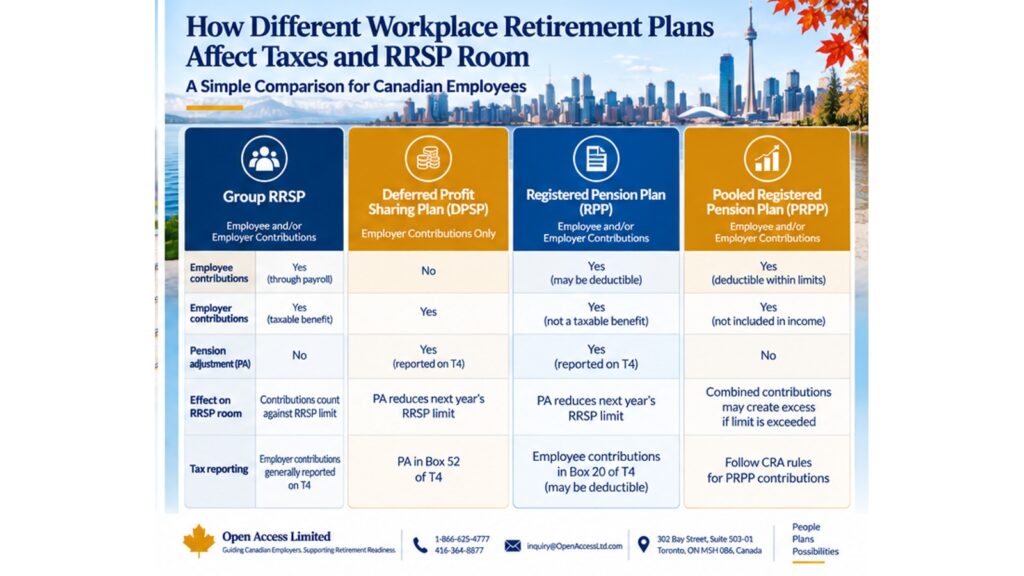
    • Group Registered Retirement Savings Plan — Group RRSP
    • Pooled Registered Pension Plan — PRPP

    Employers should not automatically apply the requirements of one arrangement to another.

    Pension Adjustments Are One Example

    CRA guidance distinguishes between plan structures when determining whether a pension adjustment may be required.

    Employers participating in certain RPPs or DPSPs may need to calculate and report a pension adjustment.

    The original source also notes that a pension adjustment is not reported for an individual or Group RRSP or for a PRPP.

    This demonstrates why payroll administration should begin with the specific plan structure rather than a generic retirement-plan assumption.


    Compensation Type Can Affect Payroll Configuration

    Payroll treatment can also vary depending on the type of payment.

    Examples include:

    • Regular salary
    • Bonuses
    • Commissions
    • Retroactive pay
    • Other remuneration

    However, an important distinction must be maintained.

    How payroll treats compensation does not automatically determine whether that compensation should be included when calculating retirement-plan contributions.

    The applicable plan terms should determine the contribution calculation.

    For example, if the employer contribution formula uses a defined category of eligible compensation, payroll should be configured according to that definition.


    Additional Considerations for Registered Pension Plans

    Registered pension plans may involve additional statutory administration and contribution requirements depending on jurisdiction.

    For Ontario-registered pension plans, FSRA identifies contribution oversight as one of the administrator’s responsibilities and uses Form 7 contribution reporting within the applicable Ontario framework.

    These requirements should not automatically be applied to Group RRSPs, DPSPs, PRPPs, or arrangements governed under another jurisdiction.

    This is why employers should identify:

    Plan Type + Jurisdiction + Plan Terms + Payroll Treatment

    before establishing an administrative process.


    Why Retirement Plan Education Should Continue After Onboarding

    Contribution information should not disappear after an employee’s first week.

    Employers may reinforce:

    • Employee contribution choices
    • Employer matching
    • Eligibility
    • Changes employees can make
    • Deadlines
    • Plan amendments
    • Account access
    • Member support

    Ongoing communication can also complement broader retirement income education by helping employees understand how workplace contributions fit within their retirement planning.

    The purpose is not to recommend how much an individual should contribute.

    It is to make the workplace plan easier to understand.


    How Can Employers Keep Payroll and Plan Information Accurate?

    A strong process should be built around authoritative information.

    Employers can:

    • Use current official plan documents
    • Keep payroll instructions documented
    • Verify provider information
    • Maintain clear approval processes
    • Test material changes
    • Reconcile records
    • Record corrections
    • Update employee communication
    • Review controls periodically

    This is the accuracy and authenticity layer of the article.

    Do not call the heading “Authenticity Layer” in WordPress.
    The reader-facing heading above — How Can Employers Keep Payroll and Plan Information Accurate? — is much more natural.


    Why This Matters to Growing Businesses

    Administrative discrepancies create more than an accounting inconvenience.

    They may require additional work from:

    • HR
    • Payroll
    • Finance
    • Management
    • The retirement-plan provider
    • External advisers

    A structured administration process may help businesses:

    • Identify discrepancies earlier
    • Clarify responsibilities
    • Maintain consistent records
    • Coordinate system changes
    • Document corrective actions
    • Improve employee communication

    However, these controls should not be presented as guaranteeing:

    • Error-free administration
    • Higher participation
    • Better retention
    • Increased employee trust
    • Better investment outcomes

    Their appropriate purpose is supporting consistent administration, stronger governance, and clearer communication.

    
Retirement plan payroll errors controls for a growing Canadian business with multiple employees, locations, payroll schedules, eligibility rules, and contribution processes.

    Important Implementation Boundaries

    Payroll and retirement-plan administration can involve:

    • Tax
    • Payroll
    • Pension requirements
    • Employment requirements
    • Privacy
    • Recordkeeping
    • Plan documents
    • Service-provider contracts
    • Regulatory obligations

    The applicable approach can depend on:

    • Plan type
    • Jurisdiction
    • Contribution formula
    • Compensation definition
    • Employee classification
    • Payroll system
    • Provider arrangement
    • Nature of an error

    Employers should obtain appropriately qualified payroll, tax, pension, legal, HR, and retirement-plan advice before making material contribution changes or correcting significant errors.


    Need Help Coordinate Your Workplace Retirement Plan More Clearly?

    Open Access Limited may support employers with the retirement-plan side of administration, including:

    • Documenting plan-specific eligibility and contribution provisions
    • Providing contribution and enrolment materials
    • Communicating employer and employee contribution rules
    • Supporting member education
    • Coordinating retirement-plan information with the employer
    • Supporting ongoing review of the group retirement arrangement

    Open Access Limited should be positioned as supporting plan design, contribution information, enrolment, education, and retirement-plan administration coordination.

    The employer remains responsible for its payroll processes and for obtaining appropriate payroll, tax, legal, pension, and regulatory advice where required.

    Open Access Limited
    302 Bay Street, Suite 503-01
    Toronto, ON M5H 0B6, Canada

    Toll-Free: 1-866-625-4777
    General: 416-364-8877
    Fax: 416-955-4878
    Email: inquiry@OpenAccessLtd.com
    Website: www.OpenAccessLtd.com


    Frequently Asked Questions

    What Is a Common Cause of Retirement Plan Payroll Errors?

    One common cause is inconsistency between official plan terms and payroll configuration. Eligibility rules, contribution formulas, compensation definitions, and effective dates should be reflected accurately across systems.

    How Often Should Payroll and Provider Records Be Reconciled?

    The appropriate frequency depends on the arrangement and operating environment. Employers should establish a periodic reconciliation process appropriate to their plan and review it as the organization grows.

    Should Bonuses and Commissions Always Be Included in Retirement Contributions?

    Not necessarily. Whether particular compensation is included should be determined by the applicable plan terms and relevant requirements rather than assumed from payroll treatment alone.

    Are Group RRSP, DPSP, RPP, and PRPP Payroll Rules the Same?

    No. Tax, reporting, contribution, and administrative requirements can differ by plan structure.

    Can Employers Simply Correct a Contribution Error on the Next Payroll?

    Not necessarily. The appropriate correction may depend on the type of plan, nature and period of the error, tax treatment, plan documents, and regulatory requirements.

    Can Open Access Limited Guarantee Payroll Accuracy?

    No. Open Access Limited may support plan design, contribution information, enrolment, employee education, and retirement-plan coordination, while employers remain responsible for their own payroll processes.


    Final Thoughts

    As a company grows, retirement plan payroll errors can become more difficult to prevent through informal processes alone.

    A stronger approach is systematic:

    Translate the plan → Define responsibility → Test calculations → Reconcile records → Control changes → Communicate clearly → Document corrections → Review again as the business grows.

    The goal is not to claim that errors will never happen.

    The goal is to make discrepancies easier to prevent, easier to identify, and easier to address through clear processes, reliable records, and appropriate governance.


    References

    1. Canadian Association of Pension Supervisory Authorities (CAPSA) (2024). Guideline No. 3: Guideline for Capital Accumulation Plans.
    2. Canada Revenue Agency (2026). T4001 Employers’ Guide — Payroll Deductions and Remittances.
    3. Canada Revenue Agency (2026). Payroll Deductions Formulas.
    4. Canada Revenue Agency. Pension Adjustment Guide.
    5. Canada Revenue Agency (2026). Pension Adjustment — Personal Income Tax.
    6. Financial Services Regulatory Authority of Ontario (FSRA). Pension Plan Administrator Roles and Responsibilities.
    7. Financial Services Regulatory Authority of Ontario (FSRA). Form 7 — Summary of Contributions.
    8. Open Access Limited. Current Group Retirement Plan and Plan-Specific Enrolment Materials.

  • How Can Canadian Businesses Structure Employer Matching Contributions While Managing Long-Term Costs?

    How Can Canadian Businesses Structure Employer Matching Contributions While Managing Long-Term Costs?

    Employer matching contributions can be a valuable part of a workplace retirement plan, but the strongest contribution strategy is not necessarily the one with the highest percentage.

    Canadian employers may use a percentage of employee pay, a contribution tied to employee savings, a fixed-dollar formula, or another structure permitted under the applicable retirement plan.

    The more important question is whether the contribution formula is clear to employees, aligned with the purpose of the plan, financially sustainable, and administratively workable.

    A well-designed approach to employer matching contributions should therefore balance employee participation with budget capacity, payroll administration, plan structure, eligibility rules, communication, and ongoing governance.

    Quick Answer: How Should Employers Structure Matching Contributions?

    Canadian businesses can structure employer matching contributions by first defining the purpose of the retirement plan, modelling employer costs under different participation scenarios, choosing an appropriate plan structure, keeping the formula easy to understand, coordinating payroll and administration, communicating requirements clearly, and reviewing the arrangement periodically.

    The goal should be a clear and sustainable contribution structure—not simply the highest possible employer match.

    Why Employer Matching Contributions Require Careful Planning

    Employer contributions represent a real compensation and plan cost.

    Before introducing or changing a formula, employers may need to consider:

    • The purpose of the retirement plan
    • Budget and cash-flow capacity
    • Workforce characteristics
    • Eligibility rules
    • Payroll requirements
    • Contribution timing
    • Applicable tax rules
    • Plan type
    • Employee participation
    • Contribution caps
    • Administrative complexity
    • Future workforce growth

    The source file specifically recommends considering different participation scenarios because an arrangement that appears affordable at today’s participation level may cost substantially more if more employees begin contributing or payroll grows.

    There is no single formula that works for every Canadian employer.

    8 Smart Ways to Structure Employer Matching Contributions

    1. Define the Purpose of the Employer Contribution

    Start by deciding what the contribution structure is intended to support.

    The objective may include:

    • Encouraging retirement saving
    • Supporting employee participation
    • Strengthening total compensation
    • Supporting a profit-sharing philosophy
    • Providing a structured workplace savings benefit
    • Supporting another clearly documented plan objective

    This matters because employer matching contributions should be designed around the purpose of the plan—not added simply because another employer offers a particular percentage.

    A documented purpose also helps future governance reviews.

    2. Build a Sustainable Employer Budget

    Before finalizing a formula, model the potential cost using actual payroll information.

    Consider several scenarios:

    • Current participation
    • Higher employee participation
    • Workforce growth
    • Higher average compensation
    • Changes in eligibility
    • Different contribution caps
    • Different matching formulas

    For example, a formula that is manageable when 40% of eligible employees participate may produce a very different employer cost if participation rises to 75%.

    The objective is not to predict employee behaviour.

    It is to understand the range of possible costs before committing to employer matching contributions.

    3. Choose the Right Retirement Plan Structure

    Employer contributions can work differently depending on the type of retirement arrangement.

    For example, a Group RRSP and a DPSP are not interchangeable.

    The source file notes that employer-made Group RRSP contributions may have specific payroll and tax treatment, while a DPSP has its own rules and only participating employers contribute to it.

    Depending on the organization, a structure might involve:

    • Group RRSP
    • DPSP
    • Registered pension plan
    • PRPP
    • Another permitted group retirement arrangement

    The appropriate structure depends on plan objectives, payroll, tax treatment, legal requirements, and administration.

    4. Keep the Matching Formula Easy to Understand

    Employees should be able to understand the employer contribution without needing to decode a complicated formula.

    Communication should explain:

    • What percentage or dollar amount applies
    • Whether an employee contribution is required
    • The maximum employer contribution
    • Eligibility requirements
    • Waiting periods
    • Contribution timing
    • Any applicable limits

    A simple employer matching contributions formula can be easier for employees to understand and easier for HR and payroll teams to administer.

    Complexity should only be added when there is a clear plan reason for it.

    5. Explain Exactly What Employees Need to Do

    Employees should know what actions are required to receive the employer contribution.

    A clear explanation might answer:

    • Do I need to contribute first?
    • What percentage do I need to contribute?
    • What is the maximum employer contribution?
    • When does matching begin?
    • When are contributions deposited?
    • Is there a waiting period?
    • Can the formula change?
    • Where are the official plan terms?

    Clear communication reduces uncertainty around employer matching contributions and prevents employees from relying on assumptions.

    6. Coordinate Payroll and Administration Before Launch

    Contribution design and payroll administration need to match.

    Employers should confirm:

    • Payroll coding
    • Contribution calculations
    • Eligibility dates
    • Provider requirements
    • Contribution timing
    • Reporting
    • Reconciliation
    • Employee records
    • Plan administration responsibilities

    Even a strong matching formula can create problems if payroll and provider processes are not aligned.

    This is why contribution design should connect with broader retirement plan governance rather than being treated only as an HR benefit decision.

    For example, when an employee becomes eligible, there should be a clear process showing:

    1. When eligibility begins
    2. When payroll deductions start
    3. How the employer match is calculated
    4. When funds are transmitted
    5. How errors are identified and corrected

    Clear administration helps ensure employer matching contributions operate as described to employees.

    7. Review the Contribution Structure Regularly

    A contribution formula should not automatically remain unchanged forever.

    The employer should periodically consider whether the arrangement still fits:

    • Plan objectives
    • Financial capacity
    • Workforce size
    • Payroll levels
    • Employee participation
    • Compensation strategy
    • Plan structure
    • Administrative requirements

    A formula that worked for a business with 25 employees may need a different review when that organization grows to 100 employees.

    Similarly, changing salaries or eligibility rules may alter employer costs even when the matching percentage stays the same.

    Regular review helps keep employer matching contributions aligned with both the retirement plan and the organization’s financial capacity.


    How Can Employers Balance Participation and Cost?

    This is where the strategy becomes particularly important.

    An employer may want employees to understand and use the benefit while also avoiding an unpredictable long-term cost commitment.

    The answer is not necessarily to reduce the benefit.

    Instead, employers can improve the quality of the design through:

    • Clearly defined contribution limits
    • Sustainable caps
    • Eligibility rules
    • Accurate cost modelling
    • Clear employee communication
    • Payroll controls
    • Periodic review

    The employer can model several participation levels before implementation.

    For example:

    Current Participation → Higher Participation → Workforce Growth → Higher Payroll

    The key question is:

    Can the organization continue funding the contribution formula if more eligible employees actually use the benefit?

    That is a healthier question than designing the plan around today’s lowest-cost scenario.


    Cost Modelling Should Include More Than Today’s Payroll

    A common planning mistake is to calculate employer cost using current payroll and current participation only.

    That provides only one snapshot.

    A stronger analysis should consider how employer matching contributions may change when:

    Employee Participation Increases

    More eligible employees may decide to participate after improved education or communication.

    Compensation Increases

    If the employer contribution is tied to salary, cost may increase as compensation increases.

    The Workforce Expands

    Hiring can increase the number of eligible plan members.

    Eligibility Changes

    Expanding eligibility may affect the number of employees receiving employer contributions.

    Contribution Caps Change

    A higher maximum employer contribution can materially affect future cost.

    Scenario modelling helps management understand the range of potential commitments before changing the plan.


    How Should Employer Matching Be Explained to Employees?

    Employee communication should answer practical questions quickly.

    How Much Does the Employer Contribute?

    Explain the formula clearly using the plan’s actual terms.

    What Must the Employee Do?

    If the employee must contribute to receive the match, say so clearly.

    Is There a Maximum?

    Employees should understand applicable contribution caps.

    When Do Contributions Begin?

    Clearly explain eligibility dates and waiting periods.

    Can the Formula Change?

    Where appropriate, explain that the contribution structure is governed by plan documents and may be subject to permitted amendments.

    Where Can Employees Get Help?

    Provide a clear member-support contact and access to official plan documents.

    Clear communication makes the employer contribution easier to value.


    Why Education Should Continue After Enrolment

    Employees may first hear about the retirement plan during onboarding—when they are also processing payroll information, workplace policies, training, benefits, technology, and job expectations.

    That is a lot of information at once.

    Employers can reinforce employer matching contributions later through:

    • Annual benefit communication
    • Plan reminders
    • Member education sessions
    • Digital plan materials
    • Portal resources
    • Financial-wellness education
    • Communications when plan features change

    CAPSA’s guidance emphasizes ongoing member education rather than treating enrolment as the only communication event.

    Repeated education gives employees another opportunity to understand the employer-funded portion of their retirement plan.


    How Can Employers Keep Contribution Information Accurate and Reliable?

    The communication process should always be grounded in current information.

    Employers should:

    • Use current official plan documents
    • Confirm contribution formulas with the provider
    • Verify payroll treatment
    • Avoid unsupported promises
    • Update materials after plan changes
    • Document decisions
    • Review employee-facing explanations
    • Provide a clear contact point for questions

    If a plain-language summary conflicts with the official plan document, the plan document should govern.

    This authenticity layer is especially important when contribution formulas are adjusted over time.


    How Employer Matching Fits With Retirement Plan Governance

    Employer matching contributions should be part of the broader retirement plan governance process.

    Employers should document:

    • Why the contribution formula was selected
    • What cost scenarios were considered
    • Who approved the arrangement
    • How payroll implementation was reviewed
    • How employees were informed
    • When the structure will be reviewed again

    This creates accountability and makes future plan reviews easier.

    It also reduces reliance on institutional memory when HR, finance, management, or provider contacts change.


    Employer Matching and Inclusive Retirement Benefits

    Employers should also consider how employees across different career stages and income levels understand the matching formula.

    This does not mean recommending different personal contribution amounts.

    Instead, an inclusive retirement benefits approach can ensure employees receive:

    • Clear eligibility information
    • Plain-language matching explanations
    • Accessible education
    • Multiple learning formats
    • Ongoing support

    Employees should be able to understand how the benefit works even if they make different personal contribution decisions.


    Employer Matching and Retirement Income Education

    The employer contribution can also be explained within the employee’s broader retirement income education.

    For example, employees can learn that retirement income may come from several sources, including:

    • Government programs
    • Workplace retirement benefits
    • Personal savings
    • Investments

    The employer matching contribution is one component within that broader picture.

    Employers should explain the workplace plan clearly without estimating an employee’s future retirement income or promising a particular outcome.

    Employer matching contributions for Canadian businesses with clear plan design, employee participation, payroll coordination, and sustainable long-term costs.

    What Employers Should Avoid

    When designing or communicating employer matching contributions, employers should avoid:

    • Selecting a formula without modelling future cost
    • Making the formula unnecessarily complicated
    • Treating different retirement structures as interchangeable
    • Promising that the match will never change when plan terms permit changes
    • Guaranteeing increased participation
    • Guaranteeing improved retention
    • Recommending a personal contribution level
    • Allowing payroll and plan documents to conflict
    • Relying only on onboarding for employee education

    The strongest approach is clear, documented, administratively workable, and financially sustainable.


    Why This Matters to Business Owners

    Employer contributions are both a retirement-plan feature and a compensation cost.

    That means decisions about employer matching contributions should be considered alongside:

    • Cash flow
    • Compensation strategy
    • Workforce growth
    • Payroll
    • Employee communication
    • Plan administration
    • Long-term business planning

    The objective should not be to maximize the percentage simply because a higher number appears more attractive.

    A more useful objective is:

    Create a contribution arrangement employees can understand and the business can sustain.

    That is a stronger foundation for long-term plan management.


    Important Implementation Boundaries

    Employer contribution arrangements can involve:

    • Tax
    • Payroll
    • Pension
    • Employment requirements
    • Plan documents
    • Contribution limits
    • Governance
    • Communication

    Treatment can differ materially depending on whether the arrangement involves a:

    • Group RRSP
    • DPSP
    • Registered pension plan
    • Pooled registered pension plan
    • Other retirement-savings structure

    Employers should obtain appropriately qualified retirement-plan, legal, tax, payroll, pension, and compliance advice before introducing or materially changing employer matching contributions.

    This includes changes to eligibility, contribution caps, payroll treatment, plan combinations, or material employee communication.

    Employees who require individualized financial or tax advice should be directed to qualified professionals.


    Need Help Structuring Employer Contributions More Clearly?

    A well-designed employer contribution arrangement should align the workplace retirement plan with the organization’s objectives, administration, employee communication, and financial capacity.

    Open Access Limited may support employers with the retirement-plan component of this process, including:

    • Reviewing available group retirement structures
    • Establishing plan-specific eligibility and contribution provisions
    • Documenting employer matching rules
    • Coordinating plan administration
    • Preparing enrolment and member materials
    • Supporting ongoing employee education
    • Providing member support

    Open Access Limited materials also describe employer contributions that may be structured as a percentage of salary or a fixed-dollar amount, depending on plan design.

    Employers remain responsible for determining the financial commitment appropriate for their organization and obtaining tax, payroll, legal, and other professional advice where required.

    Open Access Limited
    302 Bay Street, Suite 503-01
    Toronto, ON M5H 0B6, Canada

    Toll-Free: 1-866-625-4777
    General: 416-364-8877
    Fax: 416-955-4878
    Email: inquiry@OpenAccessLtd.com
    Website: www.OpenAccessLtd.com

    Employer matching contributions cost modelling for Canadian businesses across employee participation, payroll growth, workforce expansion, eligibility changes, and contribution caps.

    Frequently Asked Questions About Employer Matching Contributions

    Are Employer Matching Contributions Required to Be the Same for Every Business?

    No. There is no single contribution formula that is appropriate for every organization. Plan type, workforce characteristics, compensation, financial resources, and organizational objectives may all affect the design.

    Should Employers Offer the Highest Match They Can Afford Today?

    Not necessarily. Employers should also consider how the cost could change with increased participation, higher salaries, workforce growth, or changes in eligibility.

    Can an Employer Matching Formula Change?

    That depends on the governing plan terms and applicable requirements. Employers should avoid describing a reviewable or amendable contribution as permanently guaranteed.

    Can Employers Recommend How Much Employees Should Contribute?

    Employers can explain the plan and matching formula, but personalized contribution recommendations should be handled by appropriately qualified professionals.

    Are Group RRSPs and DPSPs the Same?

    No. They operate differently and may have different contribution, tax, payroll, eligibility, and administrative requirements.

    How Often Should Employer Contributions Be Reviewed?

    Employers should periodically reassess the contribution arrangement as payroll, participation, workforce composition, plan objectives, and financial circumstances change.


    Final Thoughts

    Employer matching contributions can add meaningful value to a workplace retirement plan when they are designed with both employees and the business in mind.

    The strongest contribution strategy is not necessarily the largest.

    It is one that is:

    Clear to employees. Sustainable for the employer. Accurate in payroll. Consistent with the plan. Reviewed over time.

    By defining the purpose, modelling long-term costs, selecting an appropriate plan structure, communicating clearly, coordinating administration, and reviewing the arrangement regularly, Canadian businesses can create a more durable employer contribution strategy without making promises about employee behaviour or business outcomes.

    Employer matching contributions explained to Canadian employees with clear eligibility rules, contribution limits, payroll timing, enrolment information, and retirement plan support.

    REFERENCES

    1. Canadian Association of Pension Supervisory Authorities — Guideline No. 3: Guideline for Capital Accumulation Plans
    2. Canada Revenue Agency — Contributions to Savings and Pension Plans
    3. Canada Revenue Agency — Register a Deferred Profit Sharing Plan
    4. Canada Revenue Agency — RRSPs and Other Registered Plans for Retirement
    5. Open Access Limited — Group Retirement Plans in Canada
    6. Open Access Limited — Setting Up a Group Retirement Plan for Your Business in Canada