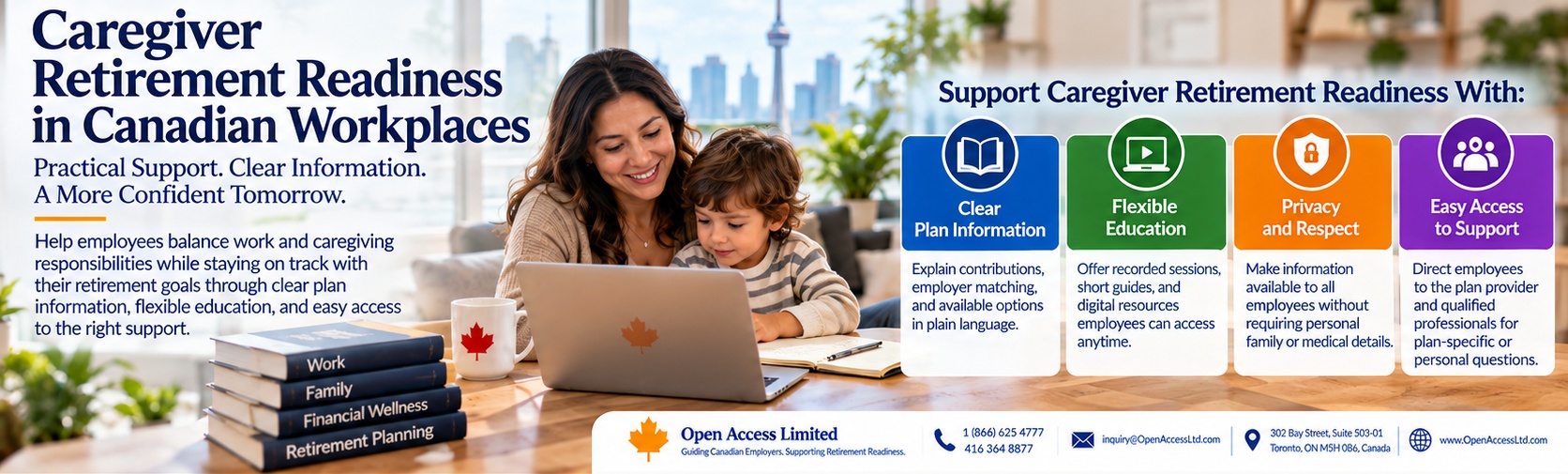
Caregiver retirement readiness can become more challenging when employees are balancing paid work with responsibility for a family member or friend.
Caregiving may affect an employee’s time, work schedule, available income, ability to attend retirement-plan education, and—in some circumstances—the contributions being made to a workplace retirement plan.
A Government of Canada employer resource states that more than 6.1 million employed Canadians, or 35% of the workforce, provide care, although the resource does not identify the year of the underlying data. OpenAccess_Q20_QA_with_Resource…
Employers cannot remove every financial or caregiving pressure, and they should not become personal financial advisers.
They can, however, make workplace retirement information easier to find, understand, and use—without requiring employees to disclose private family or medical circumstances.
The goal is not to guarantee a particular retirement outcome.
It is to make reliable retirement-plan information accessible when employees need it.
Supporting caregiver retirement readiness starts with making reliable workplace retirement information easy to find before employees need it urgently.
Quick Answer: How Can Employers Support Caregiver Retirement Readiness?
Canadian employers can support caregiver retirement readiness by providing clear retirement-plan information to all employees, protecting privacy, offering flexible education formats, explaining contribution and employer-matching rules in general terms, identifying where employees can obtain plan-specific help, and coordinating retirement communication with relevant leave, flexible-work, and accommodation policies.
Employers should not assume who is a caregiver or advise an employee whether to reduce, pause, or change retirement contributions.
On This Page
- Why Caregiving Can Affect Retirement Readiness
- 7 Smart Employer Strategies
- Contributions and Reduced Work Hours
- Flexible Education for Busy Employees
- Privacy and Caregiver Communication
- Leave and Human-Rights Considerations
- What Employers Should Avoid
- Ongoing Retirement Education
- How Open Access Limited May Support Employees
- Frequently Asked Questions
- Final Thoughts
- References
Why Caregiving Can Affect Retirement Readiness
Caregiving responsibilities are different for every employee.
Some employees may provide occasional assistance to a family member.
Others may have significant ongoing responsibilities that affect work schedules, income, leave, or available time.
Where an employee’s hours or earnings are reduced, retirement contributions that are calculated based on earnings may also change.
But employers should not assume that every caregiver:
- Has reduced income
- Needs financial assistance
- Wants to change retirement contributions
- Requires accommodation
- Has the same family circumstances
- Has the same retirement priorities
A professional approach to caregiver retirement readiness starts by making resources available to everyone rather than attempting to identify or label individual caregivers.
A consistent approach to caregiver retirement readiness can help employees understand available plan information without requiring them to disclose personal caregiving circumstances.
7 Smart Ways to Support Caregiver Retirement Readiness
1. Make Retirement Information Available Without Requiring Disclosure
Employees should not have to reveal that they are caring for a parent, child, spouse, relative, or friend simply to obtain general retirement information.
Employers can make information broadly available through:
- Employee portals
- Retirement-plan pages
- Email reminders
- Recorded education
- FAQs
- Short guides
- Financial-wellness resources
This approach avoids singling people out.
It also respects the source framework, which specifically recommends avoiding assumptions based on age, gender, family circumstances, or health. OpenAccess_Q20_QA_with_Resource…
2. Keep Retirement Communication Simple
Employees with significant caregiving responsibilities may have limited time.
Retirement communication should therefore be easy to scan and easy to revisit.
Use:
Short headings → Plain language → Clear actions → Direct links → One contact point
Avoid unnecessary technical language.
When technical terms are needed, define them immediately.
For example:
Employer Match: An employer contribution linked to an employee’s contribution, according to the applicable plan terms.
Eligibility: The conditions that determine when an employee can participate in the workplace retirement plan.
Member Portal: The online account where an employee may access applicable retirement-plan information.
Clear communication can strengthen caregiver retirement readiness without increasing the employee’s administrative burden.
Clear language is especially important for caregiver retirement readiness because employees with limited time may need to understand key plan information quickly.
3. Offer Retirement Education in Flexible Formats
A live one-hour seminar at 2:00 p.m. may not work for every employee.
A caregiver may be unable to attend because of work demands, appointments, transportation, or family responsibilities.
Employers can offer the same core information through several formats:
- Recorded webinars
- Short videos
- One-page summaries
- Downloadable guides
- FAQs
- Digital resources
- Live sessions
- Repeated sessions at different times
The original Q&A specifically recommends recorded sessions, written summaries, digital resources, and periodic repetition. OpenAccess_Q20_QA_with_Resource…
The goal is accessibility—not creating a separate retirement program only for caregivers.
Flexible learning options can strengthen caregiver retirement readiness by allowing employees to review important information when their schedules permit.
4. Explain Contribution Rules Clearly
Employees may ask what happens if their work arrangements change.
For example:
“If my hours decrease, will my contribution change?”
“What happens to employer matching?”
“Can I pause contributions?”
“Can I change my contribution amount?”
Employers can explain the applicable plan rules in general terms.
Employers can support caregiver retirement readiness by explaining contribution and matching rules accurately while leaving personal contribution decisions to the employee.
This may include:
- How employee contributions are calculated
- How employer contributions are calculated
- How employer matching works
- Whether employees can change contribution elections
- Applicable deadlines
- Where official plan rules can be found
But the employer should not say:
“You should stop contributing while you are caregiving.”
or
“You should keep contributing even if money is tight.”
Those are personal financial decisions.
5. Make Plan-Specific Help Easy to Find
Employees should not have to search through multiple HR pages to figure out whom to contact.
Communication can clearly identify:
For plan rules → Plan provider
For payroll administration → Employer/Payroll
For workplace leave → HR
For personal financial decisions → Qualified professional
This separation helps employees find the right answer while keeping the employer within an appropriate role.
The source framework specifically recommends directing plan-specific questions to the provider and personal decisions to qualified professionals. OpenAccess_Q20_QA_with_Resource…
6. Align Retirement Communication With Leave and Flexible-Work Policies
Retirement-plan communication should not operate in isolation.
Where appropriate, employers can review it alongside:
- Leave policies
- Flexible-work arrangements
- Accommodation processes
- Payroll procedures
- Employee-benefit communication
For example, if an employee takes an applicable leave, HR should know where to direct questions about retirement-plan participation and contributions.
This is also an excellent place to internally link to your article on retirement contributions during leave.
Consistency matters.
An employee should not receive one message from HR, another from payroll, and a third from the plan provider.
7. Keep Education Ongoing
Caregiver retirement readiness should not depend on information an employee received three years ago during onboarding.
Employees’ circumstances change.
The workplace retirement plan may also change.
Employers can reinforce information through:
- Annual retirement-plan communication
- Financial-wellness education
- Plan-change notices
- Contribution reminders
- Portal-support information
- Pre-retirement education
- Periodic recorded sessions
CAPSA Guideline No. 3 encourages plain-language communication and ongoing member education rather than education limited to initial enrolment. OpenAccess_Q20_QA_with_Resource…
How Can Reduced Hours Affect Retirement Contributions?
A caregiving responsibility may sometimes lead to reduced work hours, unpaid leave, or another change in an employee’s work arrangement.
If retirement contributions are based on earnings, a change in earnings can affect contribution amounts.
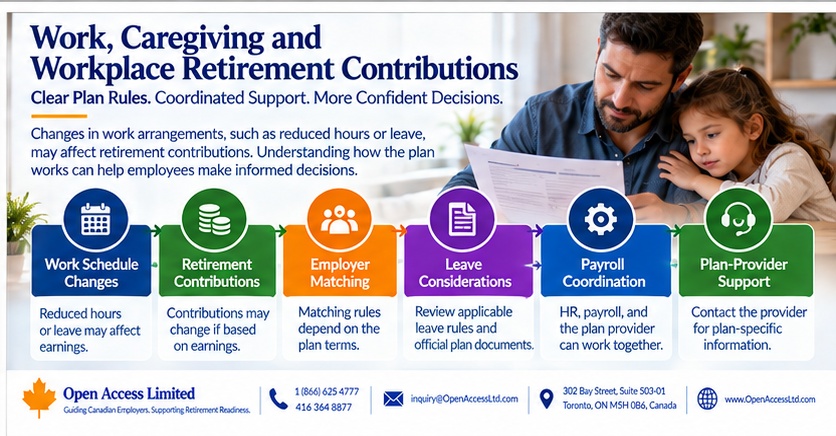
Changes in earnings or work schedules can make caregiver retirement readiness an important part of coordinated HR, payroll, and plan-provider communication
However, the result depends on:
- Plan type
- Official plan documents
- Employer contribution formula
- Matching rules
- Employment arrangement
- Applicable leave provisions
- Payroll processes
Employers should explain the applicable plan formula rather than make assumptions about the employee’s personal financial situation.
If leave is involved, the employer should also review the applicable leave rules and official plan documents.
This is why caregiver retirement readiness may require coordination between HR, payroll, and the retirement-plan provider.
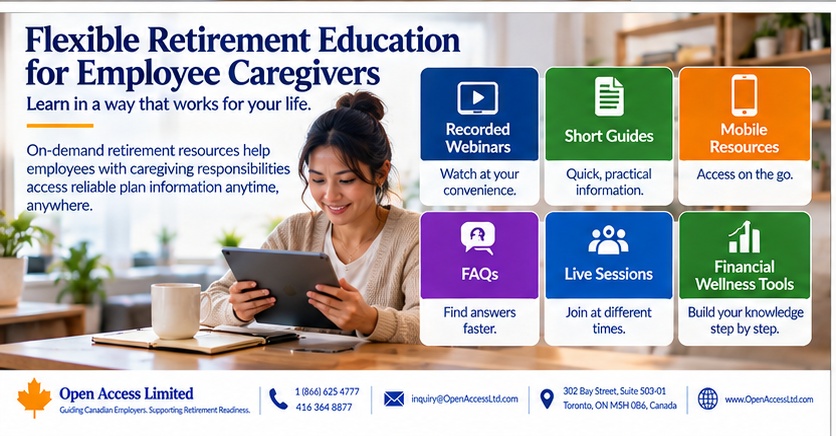
Flexible Education Can Be Especially Valuable for Caregivers
Accessibility is not only about language or disability.
It can also be about time.
An employee managing work, caregiving, appointments, and household responsibilities may benefit from information that can be accessed:
When needed.
From home.
On a phone.
In short sections.
More than once.
That makes on-demand retirement education particularly useful.
Employers can consider designing important information in layers:
60-Second Summary
What is the plan and who should the employee contact?
5-Minute Guide
Eligibility, contributions, employer match, portal access, and support.
Detailed Resource
Official plan documents and provider resources.
This structure is both employee-friendly and strong for digital communication.
Protect Employee Privacy
Caregiving may involve sensitive information about:
- Family relationships
- Health
- Disability
- Children
- Aging parents
- Personal schedules
- Financial circumstances
General retirement education should not require employees to disclose these details.
A good principle is:
Provide the resource first. Ask only for information genuinely required for the applicable HR or plan process.
Privacy-conscious communication strengthens trust without requiring employers to make assumptions about an employee’s circumstances.
Privacy-conscious communication is an important part of caregiver retirement readiness, particularly when family, health, or accommodation issues may be involved.
Leave and Human-Rights Considerations
This area requires particular care because rules can vary by jurisdiction.
Federally Regulated Employers
The Canadian Human Rights Commission’s guidance for federally regulated employers discusses caregiving responsibilities in connection with the protected ground of family status and accommodation obligations.
Federal workplace rules also provide various forms of leave, including compassionate-care and critical-illness leave.
The source notes that certain benefits may continue during most applicable federal leave periods where required employee contributions continue. OpenAccess_Q20_QA_with_Resource…
Ontario Employers
Ontario employment standards guidance identifies family caregiver, family medical, and critical illness leave among leaves relevant to benefit-plan continuation.
However, the source specifically warns that the Ontario guidance refers to pension plans and should not automatically be assumed to apply identically to a Group RRSP or DPSP. OpenAccess_Q20_QA_with_Resource…
This distinction is important.
Employers should not turn one jurisdiction-specific example into a Canada-wide policy.
What Employers Should Avoid
Employers should avoid:
- Assuming an employee is a caregiver
- Asking unnecessary family or medical questions
- Assuming caregiving automatically creates financial hardship
- Recommending that an employee reduce contributions
- Recommending that an employee maintain contributions
- Promising a particular retirement outcome
- Treating one jurisdiction’s leave rule as a Canada-wide rule
- Giving individualized tax or investment advice
- Sending conflicting HR, payroll, and provider messages
- Limiting retirement education to onboarding
The correct role is education and access to resources, not personal financial decision-making.
A Neutral Employee Message
A professional employer message could say:
Information about the workplace retirement plan, including how contributions work and whom to contact, is available to all employees. If you have questions about how a change in your work arrangements may affect your participation, please contact the plan provider. For personal financial decisions, you may wish to speak with an appropriately qualified professional.
This wording should be adapted to the employer’s actual plan documents and provider materials before use. OpenAccess_Q20_QA_with_Resource…
Why This Matters to Canadian Employers
Accessible retirement-plan information can be one part of a broader caregiver-friendly workplace.
But employers should avoid promising that these measures will automatically result in:
- Better retention
- Higher participation
- Greater employee loyalty
- Higher retirement savings
- Improved retirement outcomes
The source itself notes that outcomes may depend on plan design, workplace policies, and individual employee circumstances. OpenAccess_Q20_QA_with_Resource…
The more defensible objective is:
Clearer information + Easier access + Respectful communication + Appropriate support
Important Implementation Boundaries
Supporting employees with caregiving responsibilities can involve:
- Retirement-plan documents
- Employment standards
- Human-rights legislation
- Privacy
- Payroll
- Tax
- Leave rules
- Accommodation obligations
- Pension requirements
The requirements depend on jurisdiction and plan type.
Employers should obtain qualified legal, HR, payroll, tax, or pension advice before changing a plan or policy.
They should also avoid giving an employee individualized advice about whether to continue, pause, or change retirement contributions. OpenAccess_Q20_QA_with_Resource…
How Open Access Limited May Support Caregiver Retirement Readiness
Open Access Limited may support employers by making workplace retirement information accessible through multiple formats.
Its public resources include:
- An education hub
- Webinars
- Fact sheets
- Videos
- Presentations
- Financial-wellness resources
- Member portal access
- Contribution authorization forms
- Client Relations support
These on-demand resources may be especially useful for employees who cannot attend live retirement-plan education sessions because of work schedules or other responsibilities. OpenAccess_Q20_QA_with_Resource…
Open Access Limited should not be positioned as a human-rights, employment-law, or personal financial adviser.
Its role here is better presented as supporting:
Plan education → Member information → Digital access → Financial-wellness resources → Plan-specific support
Open Access Limited
302 Bay Street, Suite 503-01
Toronto, ON M5H 0B6, Canada
Toll-Free: 1 (866) 625 4777
General: 416 364 8877
Fax: 416 955 4878
Email: inquiry@OpenAccessLtd.com
Website: www.OpenAccessLtd.com
Frequently Asked Questions About Caregiver Retirement Readiness
Can Caregiving Affect Workplace Retirement Contributions?
It can, particularly if caregiving leads to reduced working hours, reduced earnings, or leave and the plan calculates contributions using earnings. The actual effect depends on the applicable plan terms and work arrangement.
Should Employers Ask Employees if They Are Caregivers?
Employers should not require employees to identify themselves as caregivers merely to access general retirement education.
Should an Employer Tell a Caregiver to Pause Retirement Contributions?
No. Employers can explain the applicable plan rules, but the decision should remain with the employee.
Can Employer Matching Change if an Employee Reduces Work Hours?
Possibly. It depends on the plan’s employer-contribution or matching formula and the employee’s applicable earnings and participation.
How Can Employers Make Retirement Education Easier for Caregivers?
Recorded webinars, short guides, FAQs, videos, digital resources, and repeated education can provide employees with more flexibility.
Do Caregivers Have Special Leave Rights Across Canada?
Leave and accommodation rules differ by jurisdiction. Employers should confirm the requirements that apply to their workforce rather than assuming one Canada-wide rule.
How Can Open Access Limited Help?
Where the workplace retirement arrangement is provided through Open Access Limited, employees may use applicable education resources, member tools, plan materials, and Client Relations support for plan-specific information.
For Canadian employers, caregiver retirement readiness works best when clear plan information, flexible education, privacy, and access to qualified support are available together.
Final Thoughts
Caregiver retirement readiness is not about identifying caregivers and giving them a different retirement strategy.
It is about creating an environment where reliable retirement information remains accessible even when employees have limited time, changing work arrangements, or competing responsibilities.
For employers, the strongest framework is:
Avoid Assumptions → Protect Privacy → Communicate Clearly → Offer Flexible Education → Explain Plan Rules → Provide the Right Support → Coordinate Related Policies → Keep Education Ongoing
That approach supports employees without overstepping into personal financial advice and gives Open Access Limited a credible, useful role in ongoing workplace retirement education.
References
- Government of Canada — Helping Employees Balance Work and Caregiving Responsibilities.
- Canadian Human Rights Commission — Creating a Caregiver-Friendly Workplace: A Guide for Federally Regulated Employers.
- Government of Canada — Types of Leaves for Employees Working in Federally Regulated Industries and Workplaces.
- Government of Ontario — Benefit Plans: Your Guide to the Employment Standards Act.
- Canadian Association of Pension Supervisory Authorities — Guideline No. 3: Guideline for Capital Accumulation Plans.
- Open Access Limited — Group Retirement Plans in Canada; Financial Wellness Resources; Member Forms; Member Resources.