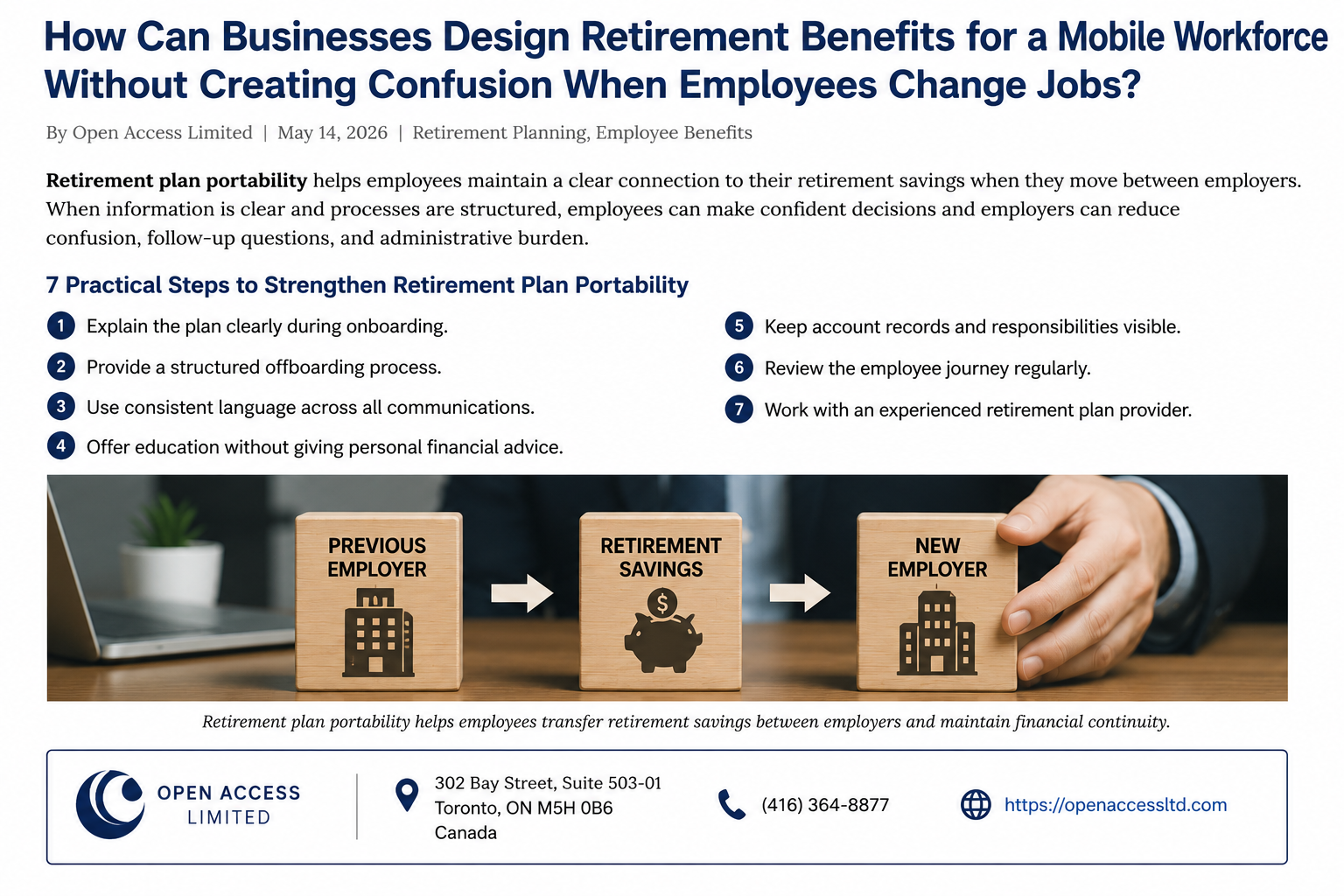
Retirement plan portability is becoming increasingly important as employees change employers, locations, and employment arrangements more frequently throughout their careers.
Modern employees may move between permanent, contract, part-time, and hybrid roles. They may also work for several organizations before retirement. While workplace retirement benefits can provide meaningful long-term value, employees may become confused about what happens to their retirement savings when they leave an employer.
A mobility-aware retirement strategy does not mean that every benefit can automatically move from one plan to another. Plan rules, transfer rights, tax treatment, deadlines, and available options can vary.
Instead, businesses should focus on making retirement plan portability easier to understand. Clear communication, structured onboarding and offboarding, visible responsibilities, and access to qualified guidance can help employees protect their retirement savings while reducing administrative pressure on HR teams.
Why Does Retirement Plan Portability Matter?
When employees change jobs, they may leave retirement accounts behind, miss important deadlines, lose track of plan administrators, or misunderstand their available choices.
Some employees may have retirement savings connected to several former employers. Others may not realize that certain registered retirement amounts may be eligible for direct transfer, depending on the type of plan, governing rules, and individual circumstances.
Confusion can reduce employee confidence and increase the risk that retirement savings become fragmented or forgotten.
For employers, retirement plan portability supports a more organized employee experience. It can reduce repetitive questions, strengthen communication, improve HR efficiency, and demonstrate that the organization supports employees throughout their employment journey—including when they leave.
7 Proven Steps to Improve Retirement Plan Portability
1. Explain the Retirement Plan During Onboarding
Retirement plan portability begins when an employee first joins the organization.
Onboarding materials should clearly explain employee and employer contributions, investment options, fees, vesting or locking-in rules where applicable, and the responsibilities of both the employee and the plan provider.
Employees should also understand what may happen to their account if their employment ends.
Providing this information at the beginning of employment helps employees view retirement benefits as part of a long-term financial strategy rather than an isolated workplace program.
2. Build a Structured Employee Offboarding Process
Departing employees should receive timely and understandable information before access to internal systems ends.
A clear offboarding package may explain available options, important deadlines, required forms, plan-provider contact information, account access, and the possible consequences of each decision.
The information should be written in plain language rather than relying only on technical pension or investment terminology.
A consistent offboarding process can reduce uncertainty and help employees remain connected to their retirement savings after leaving the organization.
- Use Consistent Language Across HR and Plan Communications
Retirement terminology can be complicated.
Confusion may increase when HR documents, payroll materials, retirement-plan statements, and provider communications use different terms for the same process.
Businesses should coordinate retirement communications with their plan provider so employees receive one clear and consistent explanation.
Using standardized language across onboarding, annual education, employee portals, and termination materials can strengthen retirement plan portability and reduce avoidable follow-up questions.
4. Support Informed Decisions Without Directing Personal Choices
Employers can provide education, general information, and access to qualified professionals. However, they should avoid telling employees which transfer, preservation, withdrawal, or investment decision is best for them.
An employee’s most appropriate option may depend on personal finances, age, plan type, tax circumstances, retirement goals, and the rules of the receiving arrangement.
The employer’s role is to make information accessible and understandable—not to replace personalized legal, tax, or financial advice.
This balanced approach supports employee confidence while protecting appropriate professional boundaries.
5. Keep Account Records and Responsibilities Visible
Employees should know who holds their retirement account, where statements are delivered, how to update contact information, and whom to contact after leaving the organization.
This is especially important when an employee’s corporate email account is closed.
Businesses can encourage employees to provide an appropriate personal mailing or email address to the plan administrator, where permitted.
Clear responsibility for record updates can prevent employees from losing contact with their retirement savings and support stronger retirement plan portability over time.
6. Review the Employee Journey Regularly
Employers should evaluate the complete retirement-benefit journey from enrollment through departure.
Recurring employee questions can reveal where communication is unclear.
For example, frequent questions about contribution rules may indicate weaknesses in onboarding. Repeated confusion about account access, deadlines, or transfer options may show that offboarding materials need improvement.
Businesses can review employee feedback, HR inquiries, plan-provider reports, and communication outcomes to identify recurring issues.
Regular review helps organizations improve processes before confusion affects a larger number of employees
7. Work With an Experienced Retirement Plan Provider
An experienced retirement-plan provider can help employers coordinate employee education, plan communications, governance processes, and transition support.
The provider can also help ensure that information reflects the specific plan structure rather than relying on general assumptions.
This support is important because retirement plan portability is not identical across every retirement arrangement.
Transfer rights, locking-in requirements, deadlines, tax treatment, and permitted destinations may differ by plan type and jurisdiction.
How Does Portability Support the Business?
A mobility-aware retirement-benefit strategy can create value beyond the individual employee.
Improved Employee Experience
Clear onboarding and offboarding information reduces uncertainty during career transitions.
Employees are more likely to appreciate retirement benefits when they understand both the immediate and long-term value of the plan.
Stronger Employer Brand
Supporting employees during departure demonstrates that the organization values people beyond a single stage of employment.
This can contribute to a more positive professional relationship and workplace reputation.
Greater HR Efficiency
Repeatable communication and offboarding processes can reduce avoidable follow-up questions.
HR teams can spend less time responding to the same concerns and more time supporting strategic workforce priorities.
Better Risk Management
Timely, consistent, and plan-specific communication can help reduce misunderstandings.
It also encourages employers to review materials with the plan provider and appropriate professional advisers.
Stronger Long-Term Plan Value
When employees remain connected to their retirement accounts after changing jobs, they may be more likely to continue thinking about long-term retirement planning.
Retirement plan portability therefore supports continuity even when employment changes.
Important Implementation Considerations
Employers should not describe portability as a universal or automatic process.
Different retirement arrangements may have different transfer rules, locked-in requirements, deadlines, tax consequences, and receiving options.
An option available under one plan may not be available under another.
Before creating detailed employee instructions, businesses should work with their retirement-plan provider and obtain appropriate legal, tax, pension, or financial guidance.
Communications should clearly distinguish between general education and personalized advice.
This approach helps employers provide useful information without creating unrealistic expectations or directing personal financial decisions.
How Open Access Limited Supports Retirement Plan Portability
Open Access Limited helps Canadian employers create a clearer retirement-benefit journey from enrollment through departure.
Its services include group retirement-plan support, employee education, coordinated communications, plan-governance guidance, and employee-focused retirement solutions.
Open Access Limited can help employers explain plan responsibilities, improve onboarding and offboarding communication, and create practical processes that help employees understand what happens to their retirement savings when employment changes.
A coordinated strategy may reduce confusion, support informed employee decisions, and strengthen the long-term value of workplace retirement benefits.
Open Access Limited
302 Bay Street, Suite 503-01
Toronto, ON M5H 0B6
Canada
Phone: (416) 364-8877
Email: inquiry@openaccessltd.com
Website: https://openaccessltd.com
Final Thoughts
Retirement plan portability is an important operational and employee-experience consideration for businesses with a mobile workforce.
Employers cannot guarantee that every retirement benefit will transfer seamlessly between plans. However, they can make plan rules, responsibilities, deadlines, and transition options easier to understand.
By improving onboarding, creating structured offboarding, using consistent communication, maintaining clear records, reviewing the employee journey, and working with an experienced plan provider, businesses can reduce confusion when employees change jobs.
A strong retirement plan portability strategy helps employees remain connected to their retirement savings while supporting HR efficiency, employee confidence, and long-term benefit continuity.
References
Financial Consumer Agency of Canada
Employer Pension Plans
https://www.canada.ca/en/financial-consumer-agency.html
Canada Revenue Agency
Registered Pension Plan Lump-Sum Payments
https://www.canada.ca/en/revenue-agency.html
Canada Revenue Agency
Transferring Between Registered Plans
https://www.canada.ca/en/revenue-agency.html
Office of the Superintendent of Financial Institutions
Directives and Pension Plan Guidance
https://www.osfi-bsif.gc.ca
Statistics Canada
Working Lives and Workforce Mobility Research
https://www.statcan.gc.ca
Open Access Limited
Group Retirement Plan Solutions
https://openaccessltd.com