Remote workforce retirement benefits require a clear and consistent strategy as more employees work outside a traditional central office.
Some employees may work entirely remotely, while others follow hybrid schedules or move between different offices, cities, or provinces while remaining with the same organization. These arrangements can create practical challenges for employers that want their retirement program to remain understandable, fairly administered, and accessible to every eligible employee.
The goal is generally not to create a separate retirement plan for each working arrangement. Instead, employers should develop one coordinated retirement-benefits strategy that can function clearly across a distributed workforce.
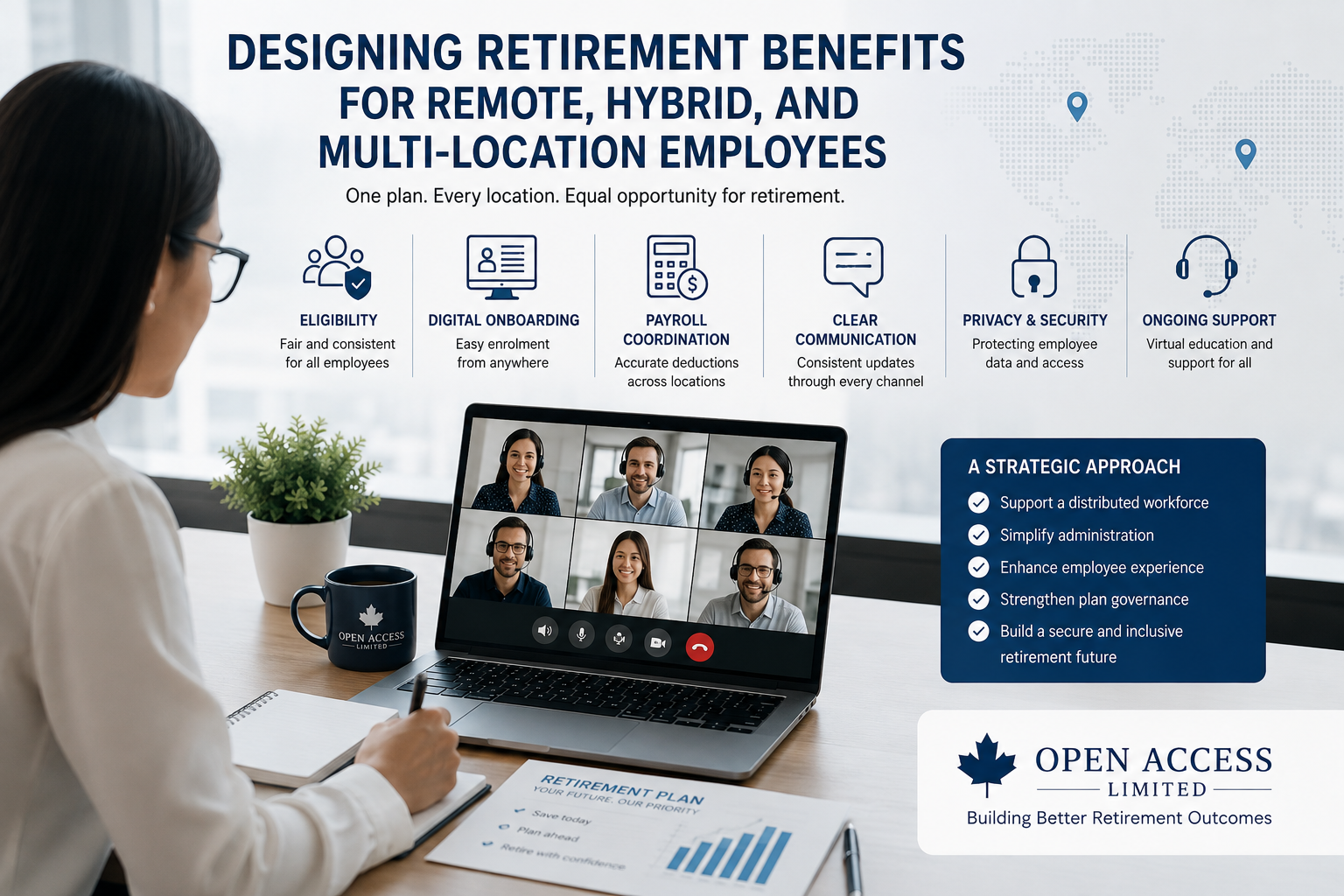
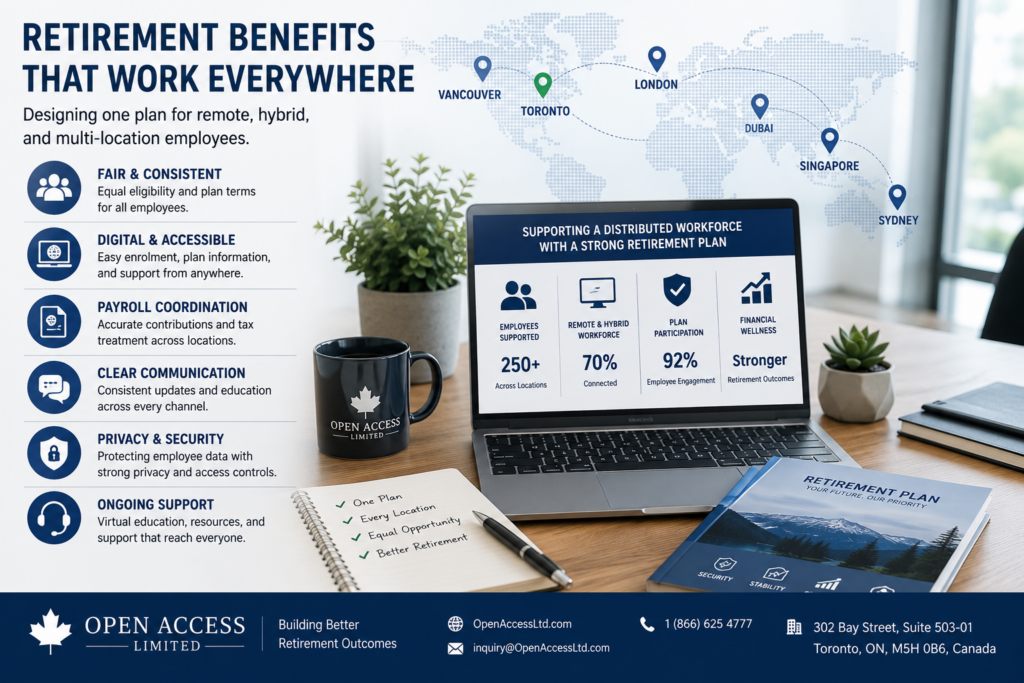
A practical framework should address employee eligibility, payroll coordination, digital onboarding, communication, privacy, access, ongoing education, and retirement-plan governance.
When these areas are managed consistently, businesses can support employee understanding while reducing avoidable pressure on HR and payroll teams.
Why Do Remote Workforce Retirement Benefits Require a Clear Strategy
Remote and hybrid work may make benefit communication more difficult.
Employees who do not regularly attend a physical workplace may miss in-person meetings, informal HR reminders, printed notices, or office-based education sessions. Without an effective digital process, employees may not fully understand:
Whether they are eligible for the retirement plan
How contributions are deducted
What options are available
When enrolment deadlines apply
Where plan documents can be found
How to update personal information
Whom to contact for support
Employees working in different locations may also be connected to different payroll, employment, tax, privacy, or administrative requirements.
A well-designed remote workforce retirement benefits strategy creates a consistent employee experience while allowing the employer to address legitimate location-specific considerations.
7 Proven Steps for Remote Workforce Retirement Benefits
1. Define Eligibility Clearly and Consistently
Employers should confirm which employees are eligible to participate in the retirement plan.
The eligibility review should consider whether remote, hybrid, part-time, permanent, contract, or multi-location employees are treated consistently with the plan’s official terms.
Employees should receive a clear explanation of:
When eligibility begins
Whether a waiting period applies
Which employment classifications qualify
How employer and employee contributions work
What happens when an employee changes work arrangements
Whether moving to another province affects administration
Eligibility decisions should be based on documented plan terms rather than informal assumptions about where an employee works.
Clear eligibility rules can reduce confusion, support consistent administration, and help HR teams respond to employee questions more efficiently.
2. Coordinate Payroll and Employee Location Information
Payroll coordination is an important part of managing remote workforce retirement benefits.
When employees work from different locations, employers may need to review province-of-employment information, payroll deductions, contribution calculations, tax-related processes, and reporting responsibilities.
The employer should establish a reliable process for updating employee location information whenever a remote or hybrid employee moves.
A practical process may include:
Confirming the employee’s current work location
Updating payroll and HR records
Reviewing contribution deductions
Checking applicable province-of-employment information
Coordinating with payroll and retirement-plan providers
Documenting responsibility for location changes
Accurate payroll and location records may help reduce contribution errors, inconsistent deductions, and administrative delays.
Employers should obtain qualified payroll, tax, or legal advice where location changes create additional obligations.
3. Provide Digital Retirement-Plan Onboarding
Employees should be able to enrol in and understand the plan without attending an in-person meeting.
A remote-friendly onboarding process may include:
Digital enrolment instructions
Electronic plan summaries
Recorded education sessions
Live virtual orientation meetings
Secure online forms
Employee portal access
Contact information for questions
Clear contribution examples
Digital beneficiary reminders
Digital onboarding should be simple enough for employees to complete without unnecessary assistance, while still providing access to support when questions arise.
Employers should also confirm that onboarding materials are accessible, updated, and consistent with information provided by the plan administrator.
Effective digital onboarding can improve employee understanding and participation across multiple locations.
4. Use Consistent Multi-Channel Communication
A distributed workforce may require more than one communication channel.
Employers can use email, employee portals, virtual meetings, recorded videos, newsletters, calendar reminders, and digital benefit guides to communicate retirement-plan information.
However, using several channels should not create several different messages.
Communication should remain consistent across:
HR announcements
Payroll notices
Provider materials
Employee portals
Virtual education sessions
Annual enrolment reminders
Plan-change communications
Employees should receive the same explanation of eligibility, contributions, fees, deadlines, account access, and support regardless of where they work.
Consistent communication strengthens remote workforce retirement benefits by helping employees remain informed even when they do not have regular contact with an office-based HR team.
5. Protect Employee Privacy and Digital Access
Remote retirement-plan administration may involve electronic records, employee portals, virtual meetings, online forms, provider platforms, and digital document delivery.
Employers should confirm that sensitive employee information is handled securely.
A privacy and access review may examine:
Who can access employee retirement data
Whether multi-factor authentication is available
How access is removed when responsibilities change
How documents are transmitted
Whether employee portals are secure
Which providers process employee information
How privacy concerns are reported
How cyber incidents are managed
Employers should also remind remote employees not to share passwords, use unsecured networks for sensitive transactions, or send personal retirement documents through inappropriate channels.
This work should connect with the organization’s broader retirement plan data security and privacy procedures.
6. Offer Ongoing Virtual Education and Support
Retirement education should not end after digital enrolment.
Employees may need additional support as their careers, financial priorities, family responsibilities, or work locations change.
Employers may provide:
Virtual retirement-education workshops
Scheduled online question sessions
Recorded learning resources
Digital FAQs
Contribution reminders
Annual plan reviews
Access to qualified professional guidance
Dedicated provider contact information
Support should be accessible to employees in different locations and time zones wherever reasonably possible.
Remote employees should not be placed at a disadvantage simply because they cannot attend an office meeting.
Ongoing support can improve employee confidence and create a more consistent retirement-benefit experience across the organization.
7. Review the Distributed Employee Journey
Employers should periodically review how the retirement plan works for employees from enrolment through ongoing participation.
A review may consider:
Eligibility questions
Enrolment completion
Payroll or contribution errors
Employee participation
Portal-access problems
Communication engagement
Support requests
Privacy concerns
Provider responsiveness
Differences between locations
Recurring questions may reveal that a process or communication needs improvement.
For example, repeated questions about eligibility may indicate that onboarding materials are unclear. Frequent portal-access problems may show that digital instructions or provider support require attention.
Regular reviews help keep remote workforce retirement benefits aligned with workforce changes, technology, plan terms, and employee needs.
How Can Employers Maintain Fairness Across Locations
Fair treatment does not always mean that every administrative detail must be identical.
Different employee locations may create legitimate payroll, tax, employment, privacy, or regulatory considerations. However, the overall employee experience should remain clear and consistently managed.
Employers can support fairness by:
Using documented eligibility rules
Providing equal access to retirement education
Maintaining consistent plan communication
Reviewing location changes promptly
Coordinating HR, payroll, and provider responsibilities
Documenting any necessary administrative differences
Giving employees accessible support regardless of location
The objective is to prevent remote or hybrid employees from receiving less information or support than office-based employees.
Why Does a Distributed Retirement Strategy Matter to Business Owners
A consistent retirement-benefits framework may reduce administrative pressure on HR and payroll teams.
It can help business owners:
Explain plan rules more clearly
Reduce inconsistent employee treatment
Minimize payroll and contribution errors
Improve digital enrolment
Strengthen employee understanding
Support data security
Improve provider coordination
Maintain a consistent employee experience
A well-organized process may also strengthen employee confidence in the organization’s retirement program.
Employees are more likely to recognize the value of workplace retirement benefits when information and support remain accessible regardless of their location.
mportant Implementation Boundaries
Remote and multi-location work may create payroll, tax, employment-law, privacy, and retirement-plan administration considerations.
The appropriate process may depend on:
The employee’s physical work location
Province of employment
Plan terms
Payroll structure
Employment classification
Organizational structure
Provider arrangements
Privacy requirements
Employers should not assume that the same administrative approach automatically applies in every situation.
Qualified payroll, legal, tax, privacy, employment, and retirement-plan professionals should review policies or communications when employees work across different jurisdictions.
This article provides general educational information and does not replace professional advice.
How Open Access Limited May Support Remote Workforce Retirement Benefits
Open Access Limited may help employers create clearer retirement-benefit communication and administration processes for remote, hybrid, and multi-location teams.
Support may include:
Digital enrolment communication
Employee retirement education
Provider coordination
Governance reviews
Plan communication
Administrative process reviews
Virtual employee support
Employee-focused retirement solutions
These approaches may help employers maintain consistent communication, improve employee understanding, and align retirement-plan administration with a distributed workforce model
Open Access Limited 302 Bay Street, Suite 503-01 Toronto, ON M5H 0B6 Canada
A successful remote workforce retirement benefitsstrategy should make one retirement program work clearly across different work arrangements and locations.
Employers can improve the employee experience by defining eligibility, coordinating payroll, providing digital onboarding, using consistent communication, protecting employee data, offering virtual education, and reviewing the employee journey regularly.
The goal is not to create unnecessary complexity or separate plans for every type of employee.
It is to build a clear, secure, and consistently administered retirement-benefits framework that supports employees wherever they work.
References
Statistics Canada — Research to Insights: Working from Home in Canada
Canada Revenue Agency — Determine the Province of Employment
Canada Revenue Agency — RRSPs and Other Registered Plans for Retirement
CAPSA — Guidelines for Industry
CAPSA — Guideline No. 3: Guideline for Capital Accumulation Plans