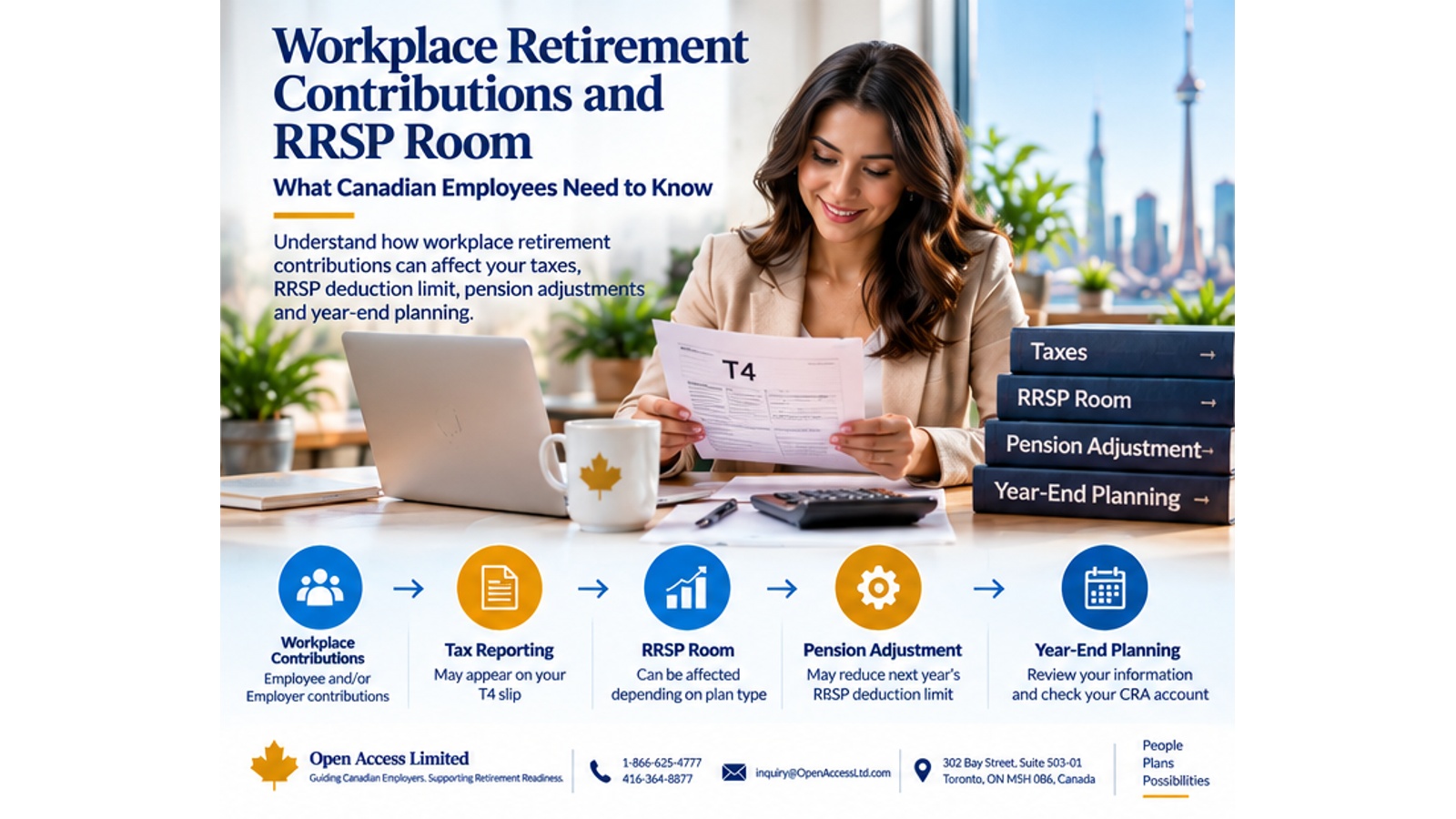
Workplace retirement contributions can affect more than an employee’s retirement account balance. Depending on the type of plan and who makes the contribution, they may also affect tax reporting, RRSP deduction room, pension adjustments, payroll information, and year-end financial planning.
This can become especially confusing during tax season, when employees begin reviewing T4 slips, contribution receipts, plan statements, and their CRA account.
A Group RRSP, Deferred Profit Sharing Plan (DPSP), Registered Pension Plan (RPP), and Pooled Registered Pension Plan (PRPP) do not all receive the same tax treatment.
For employers, the objective should be to explain the general rules of the workplace plan clearly, show employees where relevant information appears, and direct personal tax or investment questions to the Canada Revenue Agency or appropriately qualified professionals.
The employer should not calculate an individual employee’s RRSP deduction limit or predict their personal tax result. OpenAccess_Q53_QA_with_Resource…
Quick Answer: How Do Workplace Retirement Contributions Affect Taxes and RRSP Room?
Canadian employers can help employees understand workplace retirement contributions by explaining the type of retirement plan, distinguishing employee and employer contributions, describing pension adjustments in general terms, showing where amounts may appear on pay statements and tax slips, and directing employees to CRA resources for their personal RRSP deduction limit.
The tax effect depends on the plan type and the employee’s individual circumstances, so general workplace education should remain separate from personal tax advice.
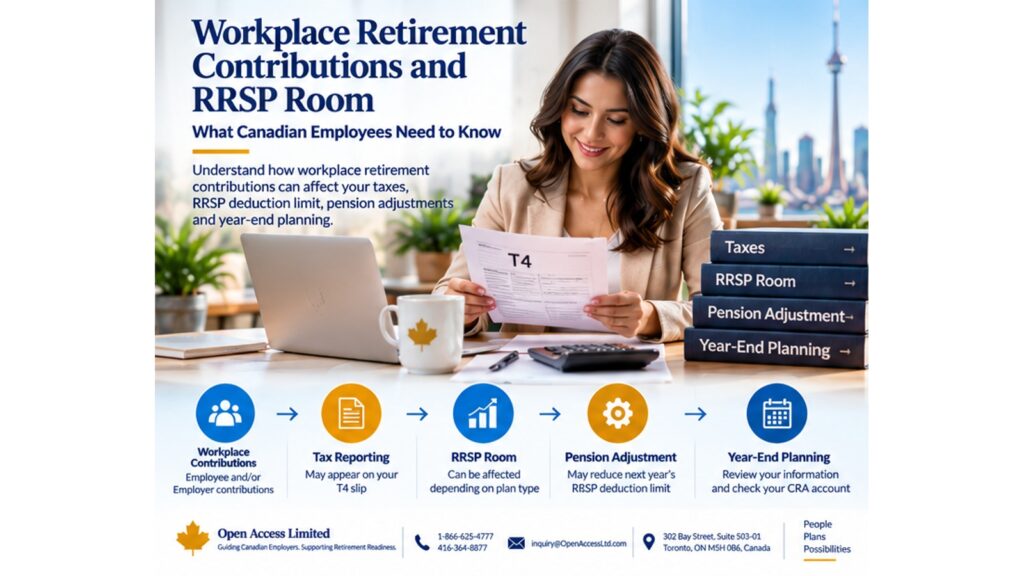
On This Page
- Why Workplace Contributions Can Affect Tax Planning
- 7 Smart Employer Education Steps
- Group RRSP Tax Treatment
- DPSP and Pension Adjustments
- Registered Pension Plans
- PRPP Contributions
- How RRSP Room Is Determined
- Year-End and Tax-Season Planning
- What Employers Should Avoid
- Ongoing Employee Education
- How Open Access Limited May Support Employers
- FAQs
- Final Thoughts
- References
Why Workplace Retirement Contributions Can Affect Tax Planning
The phrase workplace retirement contributions can describe several different arrangements.
An employee may participate in:
- A Group RRSP
- A DPSP
- A Registered Pension Plan
- A Defined Contribution pension plan
- A PRPP
The effect on income, deductions, RRSP room, and tax reporting can differ substantially.
That is why employers should begin by answering one basic question:
“Which retirement arrangement does this employee actually participate in?”
Only after the plan type is clear should the employer explain its general tax and reporting features.
7 Smart Ways to Explain Workplace Retirement Contributions
1. Start by Explaining the Type of Retirement Plan
Employees should first understand which retirement arrangement applies to them.
For example:
Group RRSP
Employees may contribute through payroll and the employer may also contribute.
DPSP
Only the employer contributes.
RPP or Defined Contribution Pension Plan
Both employee and employer contribution rules may apply, depending on plan terms.
PRPP
Contribution and tax rules differ again.
Explaining the plan type first can prevent employees from applying information about another type of retirement plan to their own situation.
This is one of the most important foundations for explaining workplace retirement contributions accurately.
2. Clearly Separate Employee Contributions From Employer Contributions
Employees may see several contribution amounts without knowing who funded them or how they are reported.
Employers should explain:
- What the employee contributes
- What the employer contributes
- Whether employer matching applies
- When contributions are made
- Where contributions appear on pay statements
- Where they appear on plan statements
- Which tax documents may contain relevant information
This is especially important where employer matching contributions form part of the plan.
A simple communication model is:
Employee Contribution → Employer Contribution → Plan Record → Tax Information
The employer should explain the process without predicting the employee’s personal tax result.
3. Explain RRSP Room in General Terms
Employees often ask:
“How much can I still put into my personal RRSP?”
The employer should not calculate this amount.
CRA calculates each individual’s RRSP deduction limit.
In general terms, the calculation can involve unused deduction room carried forward plus a percentage of previous-year earned income up to the applicable annual limit, with adjustments that can include a Pension Adjustment.
Employees can find their own RRSP deduction limit through their CRA Notice of Assessment or Reassessment or their CRA account. OpenAccess_Q53_QA_with_Resource…
A useful employer message is:
“Before making an additional personal RRSP contribution, check your current RRSP deduction limit directly with the CRA.”
4. Explain the Pension Adjustment Without Making It Complicated
The Pension Adjustment (PA) is one of the most confusing areas for employees.
A clear general explanation is:
A pension adjustment reflects the value of certain retirement benefits earned through an employer-sponsored pension arrangement during the year.
Where applicable, it is generally reported in Box 52 of the T4 slip.
It is not itself employment income and it is not an RRSP deduction.
Instead, it can reduce the employee’s RRSP deduction limit for the following year.
This is particularly relevant for DPSPs and Registered Pension Plans. OpenAccess_Q53_QA_with_Resource…
Employees should still use CRA information to determine their actual available room.
5. Show Employees Where to Find Their Information
Employees should not have to guess which document contains which information.
A year-end guide can show them where to look:
Pay Statement
Employee payroll deductions and applicable employer contributions.
Retirement Plan Statement or Portal
Contributions recorded in the workplace retirement account.
T4 Slip
Certain pension contributions, taxable benefits, and pension adjustments where applicable.
CRA Notice of Assessment
The employee’s personal RRSP deduction limit.
This practical explanation makes workplace retirement contributions easier to understand than simply describing tax rules in abstract terms.
6. Prepare Employees Before Year-End
Tax questions often arise between year-end and the tax-filing period.
Employees may be:
- Reviewing their T4
- Checking contribution receipts
- Looking at plan statements
- Reviewing their CRA account
- Considering an additional personal RRSP contribution
Employers can reduce confusion by providing general education before employees make additional personal contributions.
The message should not say:
“You should contribute another $X.”
Instead:
“Check your current CRA RRSP deduction limit before deciding whether to make an additional personal contribution.”
This keeps education useful without becoming personal tax advice.
7. Coordinate HR, Payroll, and the Plan Provider
Employee confusion increases when HR, payroll, and the provider explain the same issue differently.
Before year-end communication is released, employers should align:
- Plan terminology
- Contribution descriptions
- Tax-slip explanations
- Pension-adjustment language
- RRSP-room guidance
- Support contacts
The source specifically recommends coordination between HR, payroll, and the provider to reduce inconsistent answers. OpenAccess_Q53_QA_with_Resource…
For growing businesses, this also connects naturally with controls designed to reduce retirement plan payroll errors.

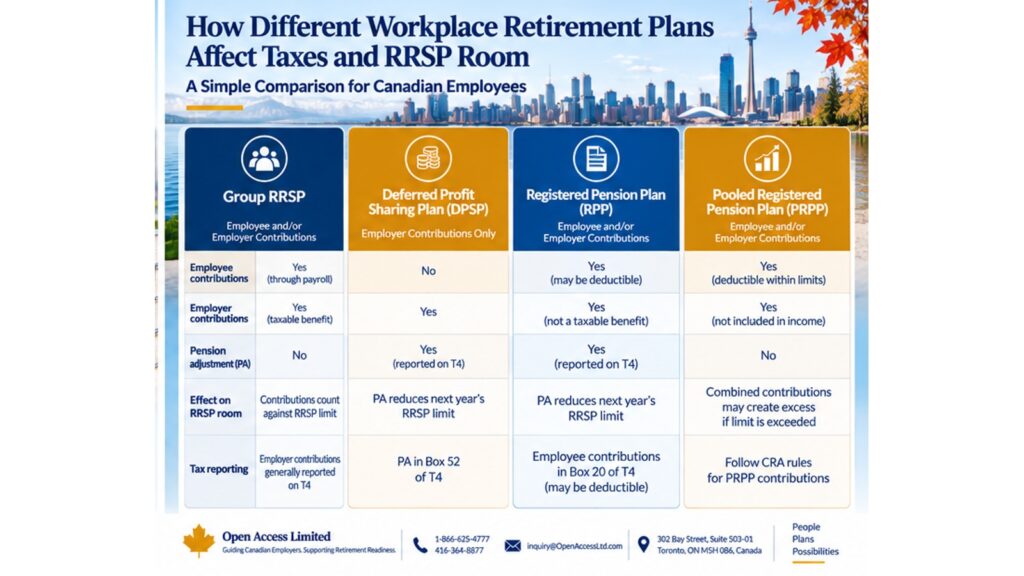
How Group RRSP Contributions Affect Taxes and RRSP Room
A Group RRSP is an employer-sponsored retirement savings arrangement.
Employees commonly make contributions through payroll deductions, and an employer may also contribute.
CRA guidance states that employer contributions to an employee’s RRSP are generally treated as a taxable benefit and reported on the employee’s T4.
Contributions to the employee’s RRSP count against that individual’s RRSP deduction limit. OpenAccess_Q53_QA_with_Resource…
This means employees should not assume that an employer contribution exists outside their personal RRSP-room considerations.
They should review their actual CRA limit before making additional personal RRSP contributions.
How DPSP Contributions Affect RRSP Room
A Deferred Profit Sharing Plan works differently.
Employees do not contribute to a DPSP.
Only the employer contributes.
Employer DPSP contributions generate a Pension Adjustment, which is reported on the employee’s T4 and generally reduces the employee’s RRSP deduction limit for the following year. OpenAccess_Q53_QA_with_Resource…
This is a useful distinction for employees who participate in a Group RRSP plus DPSP arrangement.
They may see contributions going into two retirement accounts, but the tax and RRSP-room treatment of those arrangements is not identical.
How Registered Pension Plan Contributions Are Treated
Registered Pension Plans, including defined contribution pension plans, follow another set of rules.
According to the source:
- Employer contributions to an RPP are generally not a taxable benefit to the employee.
- Eligible employee RPP contributions reported in Box 20 of the T4 may be deductible on line 20700.
- A Pension Adjustment may be reported and can reduce the following year’s RRSP deduction limit. OpenAccess_Q53_QA_with_Resource…
This is why employees should not assume that the tax treatment of an RPP is identical to a Group RRSP.
What About PRPP Contributions?
A Pooled Registered Pension Plan follows different contribution and deduction rules again.
The source notes that a member’s own PRPP contributions may be deductible within applicable limits.
Employer PRPP contributions are not included in the member’s income and are not deductible by the member.
However, employer PRPP contributions combined with the employee’s own PRPP and RRSP contributions may create an excess-contribution issue if the applicable RRSP deduction limit is exceeded. OpenAccess_Q53_QA_with_Resource…
Employees should therefore confirm their personal limit before making additional registered contributions.
Why RRSP Overcontributions Matter
The source notes that CRA generally imposes a tax of 1% per month on RRSP contributions exceeding an individual’s deduction limit by more than the applicable $2,000 threshold. OpenAccess_Q53_QA_with_Resource…
This is an important reason employers should avoid estimating an employee’s RRSP room.
The safest general message is:
“Confirm your personal RRSP deduction limit with the CRA before making additional personal contributions.”
Why Year-End Communication Matters
Year-end creates a natural opportunity to explain workplace retirement contributions.
Employees are already reviewing:
- Payroll records
- Retirement statements
- Contribution receipts
- Tax slips
- CRA information
Employers can prepare a short year-end FAQ addressing common questions.
For example:
Where Can I Find My RRSP Deduction Limit?
Use your latest CRA Notice of Assessment, Reassessment, or CRA account.
What Is the Pension Adjustment on My T4?
It generally reflects certain employer-sponsored retirement benefits earned during the year and can reduce next year’s RRSP deduction limit.
Does My Employer Contribution Affect My Taxes?
It depends on the type of retirement arrangement.
Can I Still Contribute to My Personal RRSP?
Possibly, but employees should confirm their available deduction room with the CRA first.
Who Should I Ask About My Personal Tax Situation?
CRA or an appropriately qualified tax or financial professional.
What Employers Should Avoid
Employers should avoid:
- Telling an employee exactly how much to contribute
- Calculating an employee’s RRSP deduction limit
- Promising a tax refund
- Predicting tax savings
- Predicting an individual RRSP-room outcome
- Assuming every employee has the same circumstances
- Giving personal investment recommendations
- Giving personal tax advice
- Sending conflicting HR, payroll, and provider messages
The source specifically identifies these as important boundaries. OpenAccess_Q53_QA_with_Resource…
A workplace education program should explain how the plan works, not determine what a specific employee should do.
Keep Workplace Education Separate From Personal Tax Advice
This distinction is central to the entire article.
Employers can explain:
- Plan type
- General contribution rules
- Employer matching
- Where contribution information appears
- What a pension adjustment means generally
- Where employees can find CRA information
Employers should not determine:
- The employee’s personal RRSP room
- Whether the employee should make a contribution
- The employee’s tax refund
- The employee’s personal tax strategy
- Which investment is best for that employee
The employee’s individual circumstances may include income, unused RRSP room, other registered plans, previous contributions, and personal tax circumstances that the employer does not know.
Ongoing Education Is Better Than a One-Time Tax-Season Message
Tax questions recur every year.
That means education about workplace retirement contributions should not happen only at onboarding or only once during tax season.
CAPSA’s Guideline No. 3 emphasizes ongoing member communication and education rather than limiting education to initial enrolment. OpenAccess_Q53_QA_with_Resource…
Employers can reinforce information:
- Before year-end
- When tax slips become available
- During benefit education
- When contribution formulas change
- When employees change contribution elections
- Through financial-wellness education
This also supports broader retirement income education.
How Can Employers Keep Tax-Time Communication Accurate?
A strong process can include:
- Current plan documents
- Current CRA guidance
- Plan-provider confirmation
- Consistent HR and payroll explanations
- Annual FAQ review
- Updated contribution limits
- Clear disclaimer language
- Direct links to CRA resources
- Qualified-professional referrals
Dollar limits and CRA guidance can change from year to year.
That means employee-facing materials should be reviewed before being reused.
Important Implementation Boundaries
This article describes general federal income-tax treatment.
It does not determine individual tax outcomes.
It does not address every provincial or territorial tax issue, locked-in arrangement, Group TFSA, or personal circumstance.
The treatment of workplace retirement contributions depends on:
- Plan type
- Official plan documents
- Payroll arrangements
- Employee circumstances
- Current CRA guidance
Before sending tax-related communication or changing a payroll or contribution practice, employers should confirm the information with the plan provider and obtain qualified tax or payroll advice where appropriate. OpenAccess_Q53_QA_with_Resource…
Need Help Make Workplace Retirement Contributions Easier to Understand?
Open Access Limited may support employers with workplace retirement-plan education and year-end contribution communication.
Open Access materials include group retirement-plan information, financial-wellness resources, RRSP and TFSA education, calculators, contribution forms, member portal access, statements and transaction information, and member support. OpenAccess_Q53_QA_with_Resource…
Depending on the applicable plan, Open Access Limited may help employers and members understand:
- The type of workplace retirement plan
- Contribution provisions
- Employer matching
- Recorded contributions
- Available plan statements
- Member portal information
- Financial-wellness resources
- Available member support
Employers should confirm with Open Access Limited which receipts, statements, or tax slips apply to their particular plan and when they are issued.
Open Access Limited should not be positioned as providing personal tax advice or determining an individual employee’s RRSP deduction limit.
Open Access Limited
302 Bay Street, Suite 503-01
Toronto, ON M5H 0B6, Canada
Toll-Free: 1 (866) 625 4777
General: 416 364 8877
Fax: 416 955 4878
Email: inquiry@OpenAccessLtd.com
Website: www.OpenAccessLtd.com
Frequently Asked Questions
Do Workplace Retirement Contributions Reduce Taxable Income?
It depends on the plan type, who makes the contribution, and applicable tax rules. Employees should use current plan information and CRA resources.
Do Employer Contributions Reduce My RRSP Room?
They may affect RRSP room differently depending on the plan structure. For example, DPSP and RPP benefits can create a Pension Adjustment that reduces the following year’s RRSP deduction limit.
Where Can Employees Find Their RRSP Deduction Limit?
Employees can review their CRA Notice of Assessment or Reassessment or their CRA account.
What Is a Pension Adjustment?
A Pension Adjustment generally reflects the value of certain retirement benefits earned through an employer-sponsored pension or DPSP arrangement. It is not income or a deduction but may reduce next year’s RRSP deduction limit.
Are Group RRSP and RPP Contributions Taxed the Same Way?
No. Group RRSPs and Registered Pension Plans can have different tax, reporting, and RRSP-room treatment.
Can an Employer Calculate an Employee’s RRSP Room?
Employers should not calculate an individual employee’s RRSP deduction limit. Employees should confirm their current limit directly with the CRA.
Should Employees Check RRSP Room Before Making an Extra Year-End Contribution?
Yes. Employees considering additional personal contributions should review their own current CRA limit before making a decision.
Final Thoughts
Workplace retirement contributions can affect tax reporting and RRSP room in different ways depending on the retirement-plan structure.
For Canadian employers, the strongest educational approach is:
Explain the Plan Type → Separate Employee and Employer Contributions → Explain Pension Adjustments → Show Employees Where to Find Information → Prepare for Year-End → Coordinate HR, Payroll and Provider → Refer Personal Tax Questions Appropriately
The objective is not to turn employers into tax advisers.
It is to give employees clearer information about their workplace retirement plan so they know what to look for, what questions to ask, and where to obtain authoritative information before making personal year-end financial decisions.
References
- Canada Revenue Agency — How Contributions Affect Your RRSP Deduction Limit.
- Canada Revenue Agency — Where Can You Find Your RRSP Deduction Limit.
- Financial Consumer Agency of Canada — Employer Pension Plans.
- Canada Revenue Agency — Contributions to Savings and Pension Plans.
- Canada Revenue Agency — Contributing to a Deferred Profit Sharing Plan.
- Canada Revenue Agency — Reporting a Pension Adjustment.
- Canada Revenue Agency — Line 20600 — Pension Adjustment.
- Canada Revenue Agency — Line 20700 — Registered Pension Plan (RPP) Deduction.
- Canada Revenue Agency — Contributions to a PRPP.
- Canadian Association of Pension Supervisory Authorities — Guideline No. 3: Guideline for Capital Accumulation Plans.
- Open Access Limited — Group Retirement Plans in Canada; Financial Wellness Resources; Member Forms; Member Resources.