Small business retirement plans can help companies attract and retain skilled employees while supporting long-term financial goals.
For many small and mid-sized organizations, relying solely on salary increases to attract and retain employees may not always be financially sustainable. Market competition, rising operational costs, and long-term financial planning considerations can limit the extent to which organizations can continuously increase compensation.
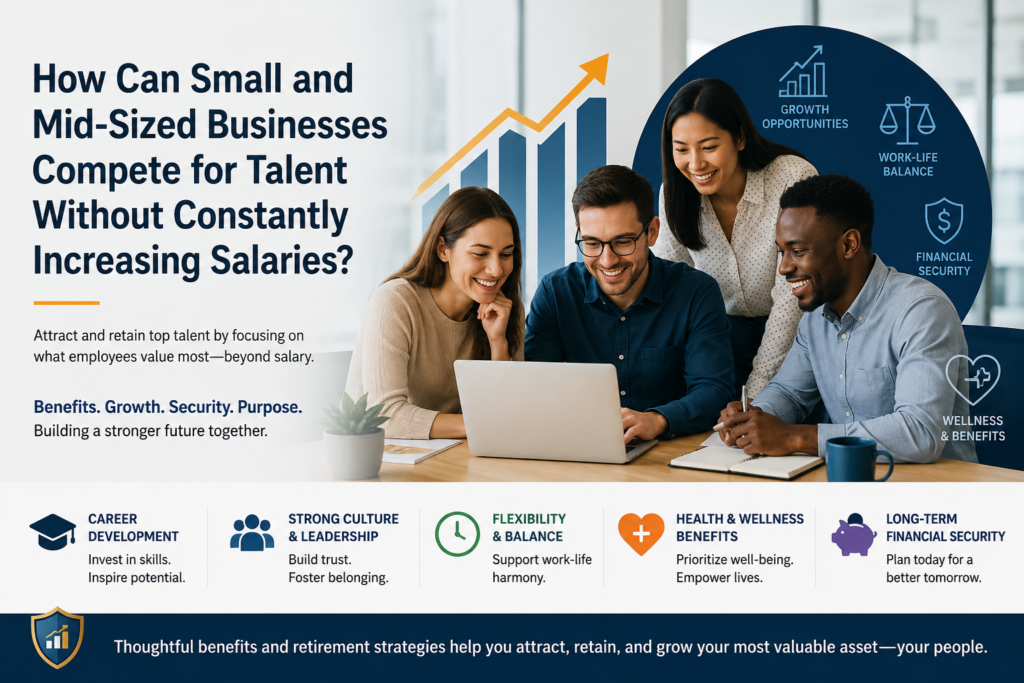
As a result, many employers are placing greater emphasis on strengthening their overall employee value proposition — the broader set of factors that influence why employees choose to join and remain with an organization.
While competitive salaries remain an important component, research suggests that employees evaluate employers based on several additional factors, including:
- Career development opportunities
- Workplace culture and leadership
- Work-life balance and flexibility
- Health and wellness benefits
- Long-term financial security
Industry research indicates that benefits — particularly those tied to long-term financial well-being — are an increasingly important consideration in employee decision-making (SHRM, 2023; Gallup, 2023).
Within this broader framework, structured retirement programs can play a meaningful role in supporting long-term employee engagement and retention.
Employer-sponsored retirement plans, especially those that include employer contributions and vesting schedules, may help align employees’ long-term financial interests with the stability of the organization. When employees perceive that their employer is contributing to their future financial security, it can reinforce trust and support a sense of long-term partnership (Fidelity Investments, 2022).
In competitive labour markets where salary ranges between employers may be relatively similar, structured benefits — including retirement programs — can also serve as a point of differentiation. Research in human capital trends suggests that organizations are increasingly using benefits as part of a broader strategy to attract and retain talent (Deloitte, 2023).
It is important to note that the effectiveness of retirement programs can vary depending on plan design. Factors such as contribution structures, vesting schedules, investment options, workforce demographics, and long-term cost sustainability all influence outcomes.
Small Business Retirement Plans for Employee Growth
Small business retirement plans help employers improve retention, employee benefits, and long-term workforce planning strategies.
For this reason, many organizations choose to work with advisory firms experienced in designing customized group retirement strategies aligned with workforce needs and business objectives.
For example, firms such as Open Access Limited, based in Ontario, work with employers to develop retirement program structures that aim to support employee financial well-being while aligning with long-term organizational goals.
Small business retirement plans can create stronger employee benefits while supporting long-term business growth and workforce stability.
Ultimately, while compensation remains an important factor, organizations that combine competitive pay with thoughtful benefit design and long-term financial planning may be better positioned to compete for talent without relying solely on continuous salary increases.
Small business retirement plans continue to play an important role in creating competitive workplaces.
References
Society for Human Resource Management (2023).
Employee Benefits Survey.
https://www.shrm.org
Fidelity Investments (2022).
Workplace Savings Research.
https://www.fidelity.com
Gallup (2023).
State of the Global Workplace Report.
https://www.gallup.com
Deloitte (2023).
Global Human Capital Trends Report.
https://www2.deloitte.com
Open Access Limited.
Group Retirement Strategy Advisory.
https://www.openaccessltd.com