Retirement plan default options can play an important role in helping employees participate in workplace retirement programs.
Many employees want to save for retirement but may feel uncertain about selecting contribution levels, investment funds, rebalancing preferences, or long-term savings approaches. When several decisions are required at the beginning, some employees may delay enrolment, avoid making selections, or disengage from the process.
A default option is the setting that applies when an employee does not make an active choice. Depending on the plan, defaults may relate to enrolment, contribution rates, investment options, automatic rebalancing, communication preferences, or other plan features.
For employers, retirement plan default options are not simply administrative settings. They can affect employee participation, plan governance, communication, provider oversight, costs, investment outcomes, and employee understanding.
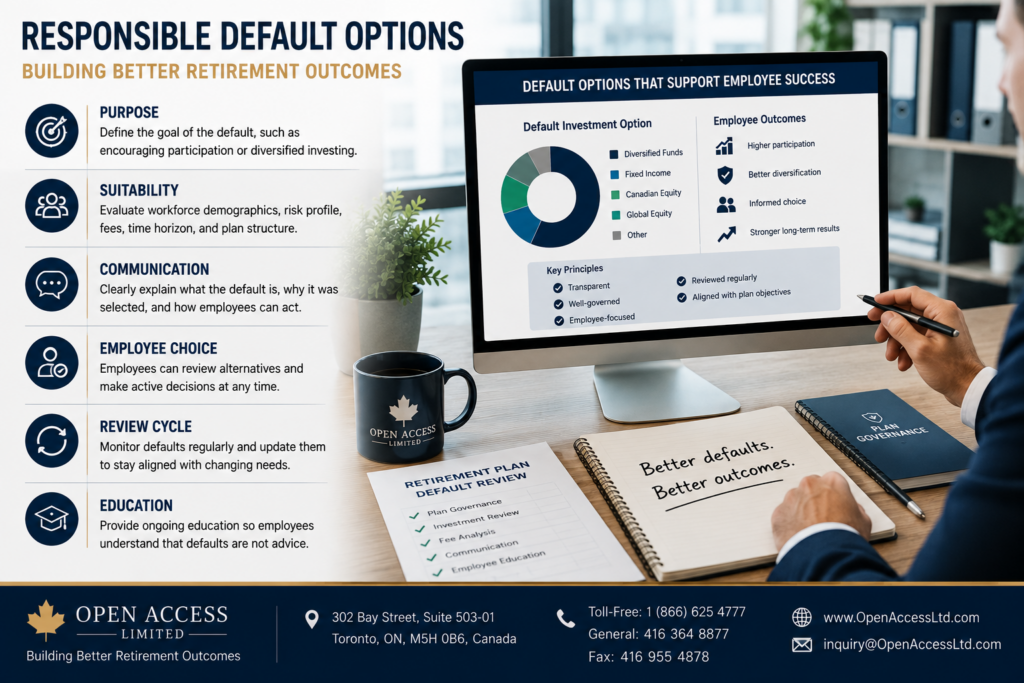
A responsible approach should define the purpose of each default, evaluate its suitability, communicate it clearly, preserve employee choice, review it regularly, and provide appropriate education.
Why Do Retirement Plan Default Options Matter
Workplace retirement plans often require employees to make several decisions at once.
Employees may need to choose:
- Whether to enrol
- How much to contribute
- Which investment option to select
- Whether to rebalance investments
- How to receive plan communication
- Whether to change an existing selection
- When to review their retirement strategy
Too many decisions can create uncertainty, especially for employees who do not have investment knowledge or retirement-planning experience.
Responsible retirement plan default options can make the initial employee experience easier to navigate. They may reduce decision complexity and provide a starting point until the employee is ready to make an active choice.
However, employers should not assume that one default will be suitable for every employee. A default should be presented as a plan setting—not as individualized investment, legal, tax, or financial advice.
7 Proven Steps for Responsible Retirement Plan Default Options
1. Define the Purpose of Each Default
Employers should first identify what the default option is intended to accomplish.
A default may be designed to:
- Support plan participation
- Simplify enrolment
- Encourage regular contributions
- Provide diversified investment exposure
- Reduce uninvested account balances
- Support automatic rebalancing
- Improve communication delivery
- Create a consistent administrative process
The purpose should be clear and documented.
For example, an investment default may be intended to provide diversified exposure for employees who have not selected a fund. An enrolment default may be intended to reduce delays in participation, where permitted under the plan and applicable rules.
Defining the objective helps ensure that retirement plan default options remain connected to the broader purpose of the workplace retirement program.
2. Evaluate Workforce and Plan Suitability
A responsible default-selection process should consider the characteristics of the workforce and the structure of the plan.
Relevant considerations may include:
- Employee age ranges
- Expected investment time horizons
- Workforce turnover
- Contribution patterns
- Financial-literacy levels
- Available investment options
- Fees
- Diversification
- Risk characteristics
- Plan design
- Provider capabilities
- Communication needs
A default should not be selected only because it is convenient or commonly used.
Employers and plan professionals should document the information considered and explain why the chosen default reasonably supports the plan’s objectives.
This creates a more deliberate and accountable selection process.
3. Communicate How the Default Works
Employees should understand what the default option is, when it applies, why it was selected, and how they can choose an alternative.
Communication should clearly explain:
- The name of the default
- The circumstances in which it applies
- The contribution or investment setting involved
- Any applicable fees
- The employee’s responsibilities
- How to review alternatives
- How to make an active selection
- Where to obtain additional information
- Whether the default may change
Clear communication supports transparency and reduces the risk that employees misunderstand a default as a personalized recommendation.
Information should be available through onboarding materials, plan summaries, employee portals, educational sessions, and provider communication.
4. Preserve Employee Choice
Employees should be informed that they can review available alternatives and make an active choice when they are ready.
A default should normally function as a starting point rather than a permanent decision made on behalf of the employee.
Employers can support employee choice by providing:
- Easy access to available options
- Clear instructions for changing selections
- Digital account access
- Investment and retirement education
- Plan-provider contact information
- Periodic reminders to review choices
- Access to qualified professional guidance
Preserving choice helps employees understand that retirement plan default options are not fixed personal recommendations.
It also encourages employees to become more engaged with their retirement strategy over time.
5. Establish a Regular Review Cycle
Default options should not remain unchanged indefinitely without review.
Employers should include default-option monitoring within the broader retirement-plan governance process.
A review may examine:
- Investment performance
- Fees
- Diversification
- Risk characteristics
- Employee participation
- Contribution patterns
- Workforce demographics
- Market changes
- Provider reporting
- Employee questions
- Regulatory or plan changes
- Communication effectiveness
The review frequency should reflect the plan’s size, structure, and complexity.
A smaller employer may review defaults annually as part of a governance meeting. A larger organization may require more frequent monitoring and formal committee oversight.
A documented review cycle helps keep retirement plan default options aligned with changing employee needs, plan features, costs, and market conditions.
6. Educate Employees About the Limits of Defaults
Employees should understand that a default option is not individualized financial advice.
Different employees may have different:
- Retirement timelines
- Financial goals
- Income needs
- Risk tolerance
- Personal savings
- Family responsibilities
- Tax circumstances
- Investment experience
- Other pension or retirement assets
Employers can provide general education about how the plan works, what the default does, and which alternatives are available.
However, they should avoid telling an employee that a particular default or investment is personally suitable for that individual.
Where personalized guidance is needed, employees should be directed to appropriately qualified professionals.
7.Document Decisions and Responsibilities
Employers should maintain a clear record of how retirement plan default options were selected, approved, communicated, and reviewed.
A governance record may include:
- The purpose of the default
- Information considered
- Workforce factors reviewed
- Provider recommendations
- Fees and investment characteristics
- Approval authority
- Communication materials
- Review dates
- Follow-up actions
- Outstanding questions
- Changes made over time
Responsibilities should also be clearly assigned.
The employer should know who monitors the default, who reviews provider reports, who approves changes, who communicates with employees, and who maintains records.
Documentation supports continuity, accountability, and more consistent retirement-plan governance.
Common Types of Retirement Plan Default Options
Defaults may apply to several areas of a workplace retirement program.
Enrolment Defaults
An enrolment default may apply when an eligible employee does not complete an active enrolment decision, where permitted under the plan and applicable requirements.
Employers should clearly explain eligibility, contribution rules, opt-out or change procedures, and employee responsibilities.
Contribution Defaults
A contribution default may establish an initial employee contribution rate.
Employers should explain how the rate works, whether employer matching applies, and how employees can increase or reduce contributions where permitted.
nvestment Defaults
An investment default may receive contributions when an employee has not selected an investment option.
The selection process should consider diversification, fees, risk, investment time horizon, plan structure, and workforce characteristics.
Rebalancing Defaults
Automatic rebalancing may help maintain a selected investment allocation over time.
Employees should understand how often rebalancing occurs and how they can review or change the setting.
Communication Defaults
Communication defaults may determine whether employees receive electronic or paper statements, reminders, notices, and educational materials.
Employers should ensure that important information remains accessible and that employee contact details are current.
Why Do Responsible Defaults Matter to Business Owners
Responsible retirement plan default options may help employers create a clearer and more consistent employee experience.
Potential benefits may include:
- Reduced enrolment delays
- Less decision complexity
- More consistent administration
- Improved participation
- Better documentation
- Stronger governance
- Clearer employee communication
- Easier provider oversight
- Reduced administrative follow-up
- Greater employee understanding
Defaults may also help employers demonstrate that plan settings are selected and monitored through a structured process rather than informal assumptions.
However, one default will not necessarily be appropriate for every employee.
The strongest approach combines responsible defaults with employee education, active choice, professional guidance, regular review, and transparent communication.
Important Implementation Boundaries
Retirement plan default options can involve investment, legal, tax, governance, regulatory, communication, and fiduciary considerations.
The appropriate structure may depend on:
- Plan type
- Applicable legislation
- Workforce demographics
- Investment options
- Provider arrangements
- Contribution structure
- Fees
- Employer responsibilities
- Employee communication
- Governance requirements
Employers should obtain qualified retirement-plan, legal, investment, tax, governance, or fiduciary advice before introducing or changing a default option.
A default should not be presented as individualized financial advice or as the best choice for every employee.
This article provides general educational information and does not replace professional advice.
How Open Access Limited May Support Employers
Open Access Limited may help employers review default-option structures and align plan settings with workforce demographics, plan objectives, and employee financial profiles.
Support may include:
- Default-option reviews
- Plan-design discussions
- Workforce analysis
- Provider coordination
- Governance support
- Employee communication
- Retirement education materials
- Investment-option explanations
- Review-cycle planning
- Documentation processes
These services may help employers improve employee understanding, maintain more consistent governance, and align retirement plan default options with the broader objectives of the workplace retirement program.
Open Access Limited
302 Bay Street, Suite 503-01
Toronto, ON M5H 0B6
Canada
Toll-Free: 1-866-625-4777
General: 416-364-8877
Fax: 416-955-4878
Email: inquiry@OpenAccessLtd.com
Website: www.OpenAccessLtd.com
Final Thoughts
Responsible retirement plan default options can help employees begin participating without requiring them to make every decision immediately.
However, defaults should be designed carefully.
Employers should define their purpose, evaluate suitability, communicate clearly, preserve employee choice, review settings regularly, educate employees, and document governance decisions.
A default is most effective when it serves as a transparent starting point rather than a permanent personal recommendation.
By combining responsible defaults with education, active employee choice, governance, and professional oversight, businesses can create a retirement program that is easier to navigate and more consistent over time.

References
CAPSA — Guideline No. 3: Guideline for Capital Accumulation Plans
CAPSA — Guidelines for Industry
FSRA — Recommendations for Strengthening CAP Guidelines
Government of Canada — Increasing Retirement Savings in Workplace Pension Plans
Ontario Securities Commission — Final Guidelines for Capital Accumulation Plans