Tag: cyber security

  • How Can Businesses Protect Employee Retirement Plan Data from Cyber and Privacy Risks

    How Can Businesses Protect Employee Retirement Plan Data from Cyber and Privacy Risks

    Retirement plan data security is becoming a critical part of workplace retirement-plan management.

    Retirement plans contain highly sensitive employee information, including identity details, employment records, contribution history, beneficiary information, account values, contact details, and financial decision data.

    As retirement-plan administration becomes more digital, employers increasingly rely on payroll systems, recordkeepers, advisers, administrators, investment providers, and technology platforms. Each connection may create additional data-handling responsibilities and operational risk.

    For business owners, cyber and privacy risk is not only an IT concern. It is also a governance, employee trust, vendor oversight, business continuity, and reputational issue.

    A practical retirement plan data security strategy should focus on preventing avoidable problems, preparing for incidents, assigning clear responsibilities, and communicating responsibly when employee information is involved.

    Why Does Retirement Plan Data Security Matter

    Employees trust their employers and retirement-plan partners with highly personal financial information.

    If this information is lost, misused, exposed, or accessed without authorization, the consequences may include:

    • Loss of employee trust
    • Operational disruption
    • Regulatory concern
    • Reputational harm
    • Additional administrative cost
    • Financial loss
    • Identity-related risks
    • Delays in retirement-plan administration

    Strong retirement plan data security also supports better plan governance.

    It helps employers ask more informed questions of service providers, document responsibilities, control access, prepare for incidents, and demonstrate that retirement-plan information is being managed with care.

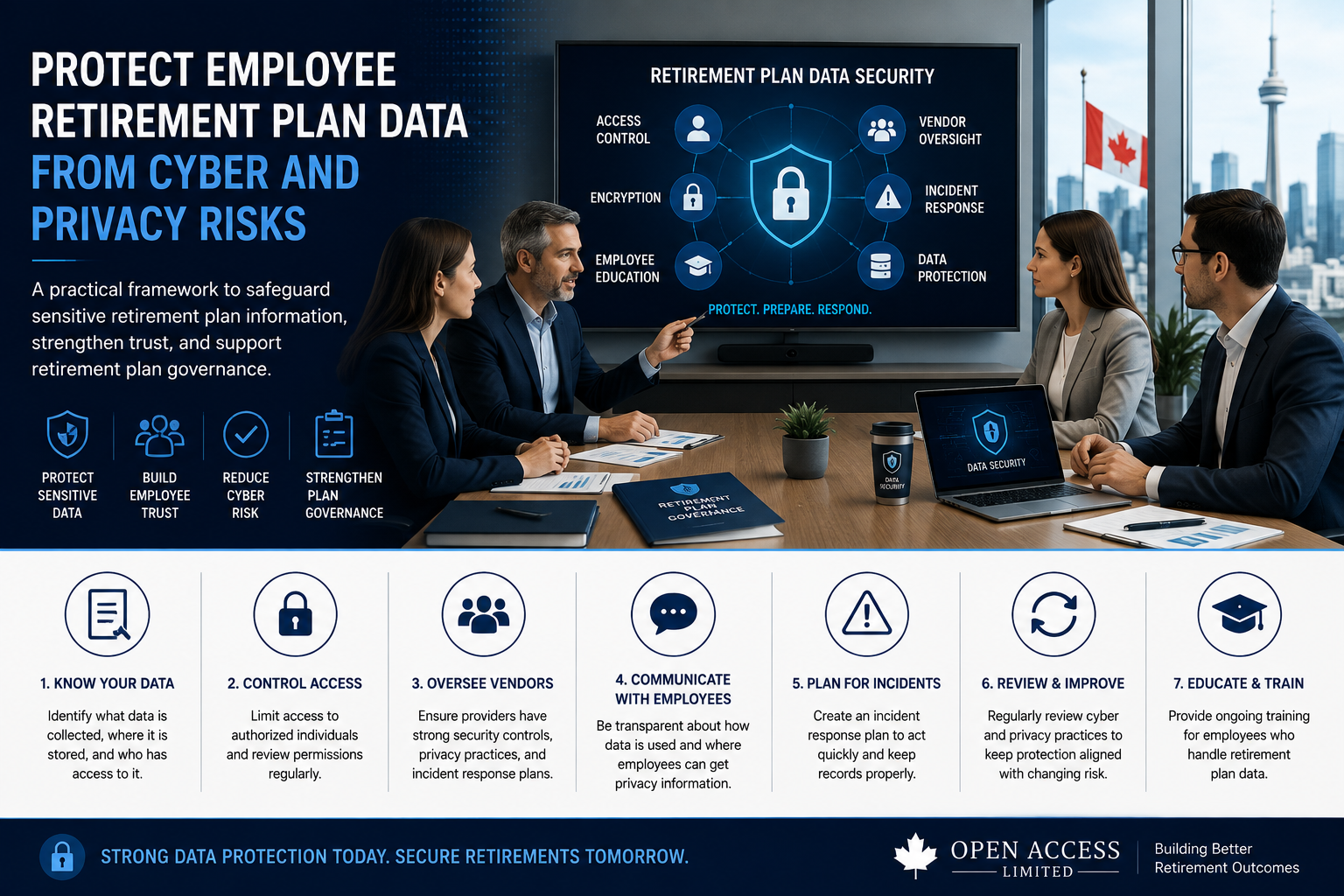
    7 Proven Steps to Strengthen Retirement Plan Data Security

    1.Create a Complete Retirement Data Inventory

    Employers should begin by identifying what retirement-plan information is collected, where it is stored, who can access it, and which external providers process it.

    The inventory may include:

    • Employee identification information
    • Payroll records
    • Contribution history
    • Beneficiary details
    • Account balances
    • Contact information
    • Investment selections
    • Plan-enrolment records
    • Retirement-related forms
    • Employee communication history

    A clear data inventory creates visibility and reduces blind spots.

    Without this information, employers may not know where sensitive records are stored or which parties are responsible for protecting them.

    2. Limit Access to Authorized Individuals

    Access to retirement-plan data should be limited to employees and providers who require it for legitimate business purposes.

    Employers should review access permissions regularly, especially when employees change roles, leave the organization, or no longer require access.

    Practical access controls may include:

    • Unique user accounts
    • Strong passwords
    • Multi-factor authentication
    • Role-based permissions
    • Regular access reviews
    • Prompt removal of inactive accounts
    • Secure remote-access procedures
    • Documented approval for elevated access

    Limiting access reduces unauthorized use, internal errors, and unnecessary exposure of employee information.

    3. Strengthen Retirement-Plan Vendor Oversight

    Retirement plans may involve several outside organizations, including recordkeepers, payroll providers, advisers, investment platforms, administrators, and technology companies.

    Employers should ask providers about:

    • Security controls
    • Privacy policies
    • Data-storage locations
    • Incident-response procedures
    • Subcontractors
    • Data-retention practices
    • Service standards
    • Business-continuity plans
    • Employee access controls
    • Breach-notification procedures

    Vendor oversight is a core part of retirement plan data security because outside providers may process or store sensitive employee information.

    Employers should also understand who is responsible for responding when a provider experiences a security incident.

    4. Communicate Clearly With Employees

    Employees should understand how their retirement-plan information is collected, why it is needed, how it is used, and where they can ask privacy-related questions.

    Clear communication can explain:

    • What information is collected
    • Why the information is required
    • Which providers may process it
    • How employees can update their information
    • How privacy questions are handled
    • What employees should do if they notice suspicious activity
    • Where plan statements and notices are delivered

    Transparent communication builds trust and helps employees understand their own role in protecting retirement-plan information.

    Employees should also be reminded not to share passwords, respond to suspicious messages, or send sensitive documents through unsecured channels.

    5. Create a Cyber and Privacy Incident Plan

    Employers should prepare for a potential privacy or cyber incident before one occurs.

    A practical incident plan should identify:

    • Who must be notified internally
    • Which provider contacts should be involved
    • Who will assess the incident
    • How affected systems will be protected
    • What records must be preserved
    • How employees will be informed
    • When legal or privacy professionals should be contacted
    • How follow-up actions will be documented
    • Who will approve public or employee communication

    Incident planning improves response speed and consistency.

    It also reduces the risk that employees receive conflicting or incomplete information during a stressful event.

    6. eview Data-Protection Practices Regularly

    Technology, cyber threats, employee roles, providers, and retirement-plan systems change over time.

    For this reason, retirement plan data security should be reviewed as part of the regular retirement-plan governance cycle.

    A review may include:

    • User-access permissions
    • Provider security reports
    • Privacy procedures
    • Employee training
    • Incident-response contacts
    • Data-retention practices
    • Backup systems
    • Business-continuity procedures
    • Unresolved security issues
    • Changes in technology platforms

    Ongoing review helps ensure that protection remains aligned with changing risks and business operations.

    7. Train Employees Who Handle Retirement Data

    Human error is a common source of cyber and privacy risk.

    Employees in HR, payroll, finance, benefits administration, and management should receive practical training on how to handle retirement-plan information securely.

    Training may cover:

    • Recognizing phishing emails
    • Secure password practices
    • Multi-factor authentication
    • Safe document sharing
    • Secure remote work
    • Reporting suspicious activity
    • Protecting printed records
    • Verifying requests for employee information
    • Escalating potential privacy incidents

    Regular education helps build a stronger security culture and reduces the risk that sensitive information is exposed through avoidable mistakes

    Common Sources of Cyber and Privacy Risk

    Employers should be aware of several common risk areas.

    These may include:

    • Phishing and social-engineering attacks
    • Weak passwords
    • Shared user accounts
    • Excessive system access
    • Unsecured laptops or mobile devices
    • Remote-work vulnerabilities
    • Outdated software
    • Vendor-system weaknesses
    • Incorrect employee data
    • Lost documents
    • Improper file sharing
    • Data retained longer than necessary
    • Inadequate employee training

    A strong retirement plan data security process does not rely on one control. It combines technology, policies, training, oversight, and clear accountability

    How Does Data Protection Support Retirement Plan Governance

    Cyber and privacy protection should be integrated with broader retirement plan governance.

    Employers can include data-protection questions in provider reviews, annual governance meetings, service-level discussions, and risk-management checklists.

    This approach helps ensure that security is not treated as a separate technical issue.

    It also creates a documented process for reviewing responsibilities, monitoring providers, and following up on unresolved concerns.

    Businesses can connect this work with their broader retirement plan governance framework to create more consistent oversight.

    Important Implementation Boundaries

    Cybersecurity and privacy obligations may vary based on:

    • Jurisdiction
    • Type of organization
    • Plan structure
    • Contract terms
    • Nature of the information
    • Service-provider arrangements
    • Applicable privacy laws
    • Regulatory requirements
    • The seriousness of an incident

    Employers should work with qualified legal, privacy, cyber-security, and retirement-plan professionals before finalizing policies or incident procedures.

    The employer’s role is to establish responsible processes and oversight—not to make legal conclusions without appropriate advice.

    How Open Access Limited Can Help

    Open Access Limited can help employers create a clearer and more coordinated retirement-plan administration process.

    Support may include:

    • Employee communication
    • Provider coordination
    • Plan-governance reviews
    • Documentation support
    • Operational-risk discussions
    • Data-handling process reviews
    • Retirement-plan education
    • Service-provider oversight

    A coordinated approach can help businesses improve retirement plan data security, strengthen employee confidence, and prepare for unexpected incidents.

    Open Access Limited
    302 Bay Street, Suite 503-01
    Toronto, ON M5H 0B6
    Canada

    Phone: (416) 364-8877
    Toll-Free: 1-866-625-4777
    Email: inquiry@openaccessltd.com
    Website: OpenAccessLtd.com
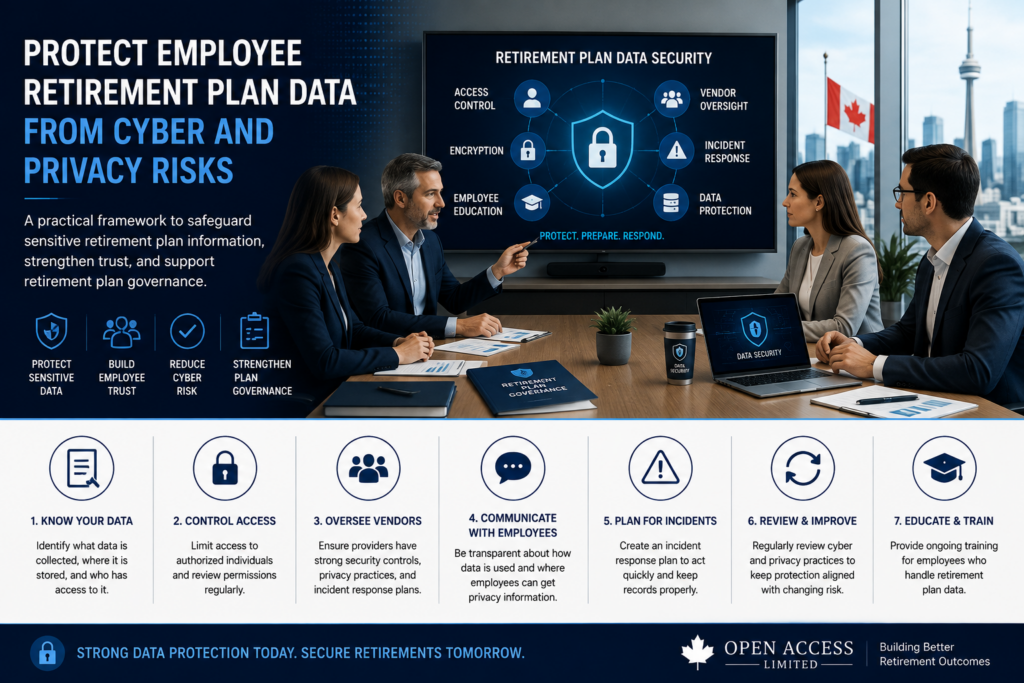
    Canadian business leaders reviewing retirement plan data security, cyber risk, employee privacy, vendor oversight, access controls, incident response, and retirement plan governance.

    Final Thoughts

    Protecting employee retirement-plan information requires more than installing security software.

    Employers need a practical framework that includes data inventories, controlled access, vendor oversight, transparent employee communication, incident planning, regular reviews, and employee training.

    Strong retirement plan data security can protect sensitive information, strengthen retirement-plan governance, reduce operational risk, and improve employee trust.

    The most effective approach is clear, documented, regularly reviewed, and proportionate to the organization’s size, plan structure, and risk profile.
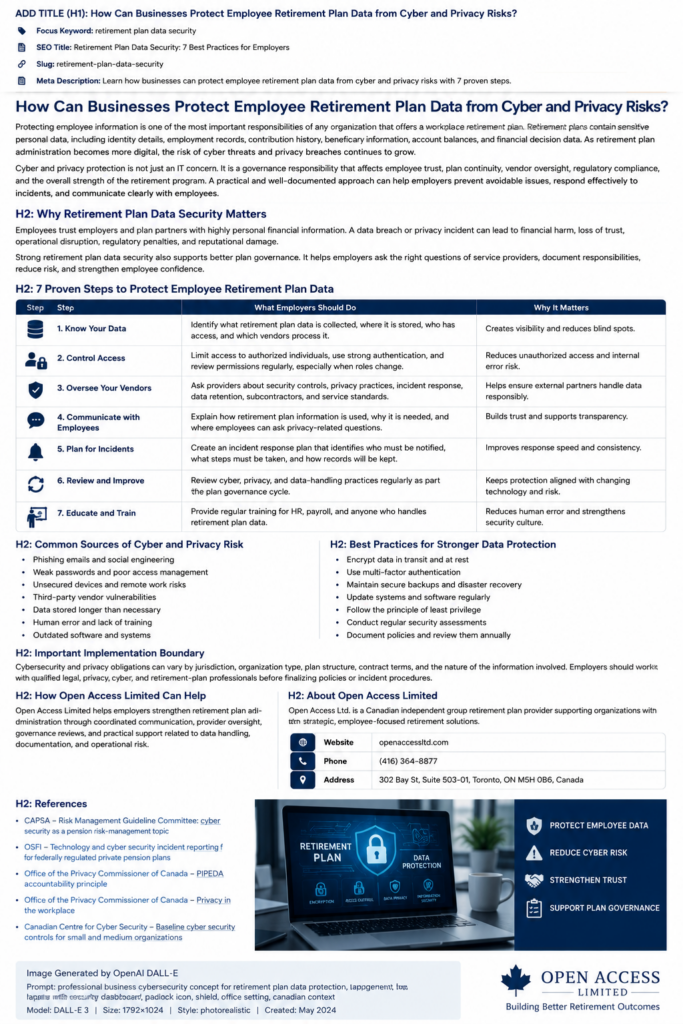
    Canadian employers reviewing retirement plan data security, cyber risk, employee privacy, vendor oversight, access controls, incident planning, and retirement plan governance.

    References

    CAPSA — Cyber Security as a Pension Risk-Management Topic

    OSFI — Technology and Cyber Security Incident Reporting for Federally Regulated Private Pension Plans

    Office of the Privacy Commissioner of Canada — PIPEDA Accountability Principle

    Office of the Privacy Commissioner of Canada — Privacy in the Workplace

    Canadian Centre for Cyber Security — Baseline Cyber Security Controls for Small and Medium Organizations
  • How Can Business Owners Strengthen Retirement Plan Governance Without Creating Unnecessary Administrative Complexity?

    How Can Business Owners Strengthen Retirement Plan Governance Without Creating Unnecessary Administrative Complexity?

    Retirement plan governance is often the most challenging part of maintaining a workplace retirement program. Selecting and implementing a plan is only the beginning. Business owners must also oversee service providers, employee communication, documentation, costs, privacy, cyber security, investment options, and regulatory expectations.

    For smaller organizations, these responsibilities can feel difficult because there may be no dedicated pension department or internal governance specialist. However, effective oversight does not require a large administrative team.

    Strong retirement plan governance requires a clear decision-making framework, defined responsibilities, reliable documentation, and a practical review schedule. The objective is to make responsible oversight repeatable instead of depending on one person’s memory, availability, or informal knowledge.

    Canadian pension guidance increasingly emphasizes documented accountability, risk management, member communication, and ongoing monitoring. CAPSA’s updated capital accumulation and risk-management guidelines reinforce the importance of clearly assigned responsibilities and governance practices that reflect the plan’s size and complexity. OSFI also encourages plan administrators to follow established governance principles and provide timely, accurate, and understandable information to members.

    Why Is Retirement Plan Governance Important?

    A retirement plan affects employees’ long-term financial security and may involve several internal and external parties.

    Business owners, HR teams, payroll staff, plan administrators, investment providers, advisers, and recordkeepers may all have responsibilities. Without a documented structure, important tasks can be duplicated, delayed, or overlooked.

    Effective retirement plan governance helps an organization answer several important questions:

    Who approves plan changes?

    Who monitors fees and service quality?

    Who responds to employee questions?

    Who reviews communication materials?

    Who maintains governance records?

    Who follows up when an operational or cyber-security issue occurs?

    Clear answers reduce uncertainty and help demonstrate that the retirement program is being managed carefully and consistently.

    7 Proven Retirement Plan Governance Steps for Business Owners

    1. Define Roles and Accountability

    The first step is to document who is responsible for each important governance activity.

    This may include approving plan amendments, reviewing providers, monitoring fees, coordinating employee communication, checking contribution processes, maintaining records, and escalating unresolved issues.

    A concise responsibility chart can be enough for a smaller business. It should identify the task, responsible person, approval authority, review frequency, and backup contact.

    Defined accountability reduces gaps, duplication, and unclear ownership. It also supports continuity when an employee changes roles or leaves the organization.

    2.Create a Practical Review Calendar

    Retirement oversight should not occur only when a problem appears.

    A review calendar can turn retirement plan governance into a predictable process. Depending on the size and complexity of the plan, employers may schedule quarterly, semi-annual, or annual reviews.

    A practical review may cover:

    • Employee participation and contribution trends
    • Fees and investment options
    • Provider service levels
    • Employee questions and communication
    • Data accuracy and privacy
    • Cyber-security practices
    • Outstanding decisions and follow-up items
    • Changes in the business or workforce

    A smaller employer may use one annual governance meeting supported by a written checklist. A larger organization may require more frequent meetings and formal committee reporting.

    3. Monitor Retirement Plan Service Providers

    Using an external provider does not remove the employer’s responsibility to maintain appropriate oversight.

    Business owners should establish clear expectations for reporting, communication, response times, issue resolution, data protection, employee support, and service quality.

    Provider reviews may consider whether reports are accurate and delivered on time, employee questions are handled appropriately, service concerns are resolved, and plan information remains understandable.

    Regular monitoring helps confirm that external partners continue to provide value and fulfil their agreed responsibilities.

    4. Maintain a Clear Decision Record

    Major plan decisions should be recorded consistently.

    A governance record may include:

    • The issue or decision considered
    • Information reviewed
    • Individuals involved
    • Advice received
    • Approval provided
    • Follow-up actions
    • Completion deadlines
    • Unresolved questions

    The record does not need to be complicated. A structured meeting note or decision log may be sufficient for a smaller organization.

    Documenting decisions supports accountability, protects institutional knowledge, and helps future reviewers understand why a particular action was taken.

    5. Strengthen Member Communication

    Employee communication is an essential part of retirement plan governance.

    Employees should receive clear and timely information about contributions, investment choices, fees, employer support, plan changes, digital access, and their own responsibilities.

    Communication should use consistent terminology across HR, payroll, onboarding materials, provider documents, and employee education sessions.

    Clear information can improve employee confidence, support informed decision-making, and reduce avoidable questions. OSFI’s guidance emphasizes that member disclosure should be timely, accurate, and understandable

    6. Address Operational and Cyber Risks

    Retirement plans depend on accurate data, secure systems, reliable providers, and timely administration.

    Employers should review privacy, cyber security, contribution accuracy, access controls, business continuity, incident reporting, and escalation procedures with their service providers.

    A practical review may ask:

    How is employee information protected?

    Who has access to plan data?

    How are errors identified and corrected?

    How would the provider respond to a cyber incident?

    How will services continue during a system disruption?

    Who must be contacted when a material issue occurs?

    CAPSA Guideline No. 10 includes risk-management principles relating to cyber security, third-party providers, investment governance, and other material risks.

    7.Keep Governance Proportional to the Plan

    The most effective retirement plan governance model reflects the organization’s size, resources, workforce, and plan complexity.

    A smaller business may need:

    • One designated plan contact
    • A concise responsibility document
    • An annual review meeting
    • A provider performance summary
    • A decision log
    • A governance checklist

    A larger organization may require a formal committee, written governance policies, scheduled reporting, specialized advisers, and more frequent risk reviews.

    The purpose is not to create unnecessary paperwork. The purpose is to establish enough structure to ensure that responsibilities are understood and important tasks are completed consistently.

    How Can Employers Reduce Administrative Complexity?

    Administrative complexity often develops when processes are informal or responsibilities are unclear.

    Employers can simplify retirement plan governance by using standard templates, assigning one accountable owner for each task, consolidating reviews into a regular calendar, and requesting consistent reports from providers.

    A single governance file can contain meeting notes, provider reports, communication materials, plan decisions, outstanding actions, and annual review checklists.

    Business owners should also distinguish between decisions that can be handled internally and matters that require specialized legal, regulatory, tax, investment, or cyber-security advice.

    Employers should not make individualized financial decisions for employees. Their role is to provide plan information, education, and access to appropriate professional guidance.

    How Open Access Limited Supports Retirement Plan Governance

    Open Access Limited can support employers in creating a practical and consistent governance process around their group retirement plan.

    Support may include clarifying roles, coordinating employee communication, reviewing plan activity, organizing provider oversight, supporting employee education, and helping employers establish a repeatable long-term review process.

    A structured approach to Retirement plan portability can help business owners improve accountability, reduce avoidable risk, support better decisions, and demonstrate that the retirement plan is being managed with care.

    Open Access Limited
    302 Bay Street, Suite 503-01
    Toronto, ON M5H 0B6
    Canada

    Phone: (416) 364-8877
    Toll-Free: 1-866-625-4777
    Email: inquiry@openaccessltd.com
    Website: https://openaccessltd.com

    Final Thoughts

    Strong retirement plan governance does not require unnecessary bureaucracy or a large internal pension department.

    Business owners can create effective oversight by defining responsibilities, scheduling regular reviews, monitoring providers, recording decisions, strengthening employee communication, managing operational risks, and choosing a governance structure that reflects the plan’s actual complexity.

    The most successful governance processes are clear, proportionate, documented, and repeatable.

    By following these principles, employers can improve employee confidence, reduce avoidable risk, support consistent decision-making, and maintain a retirement program that continues to deliver long-term value.

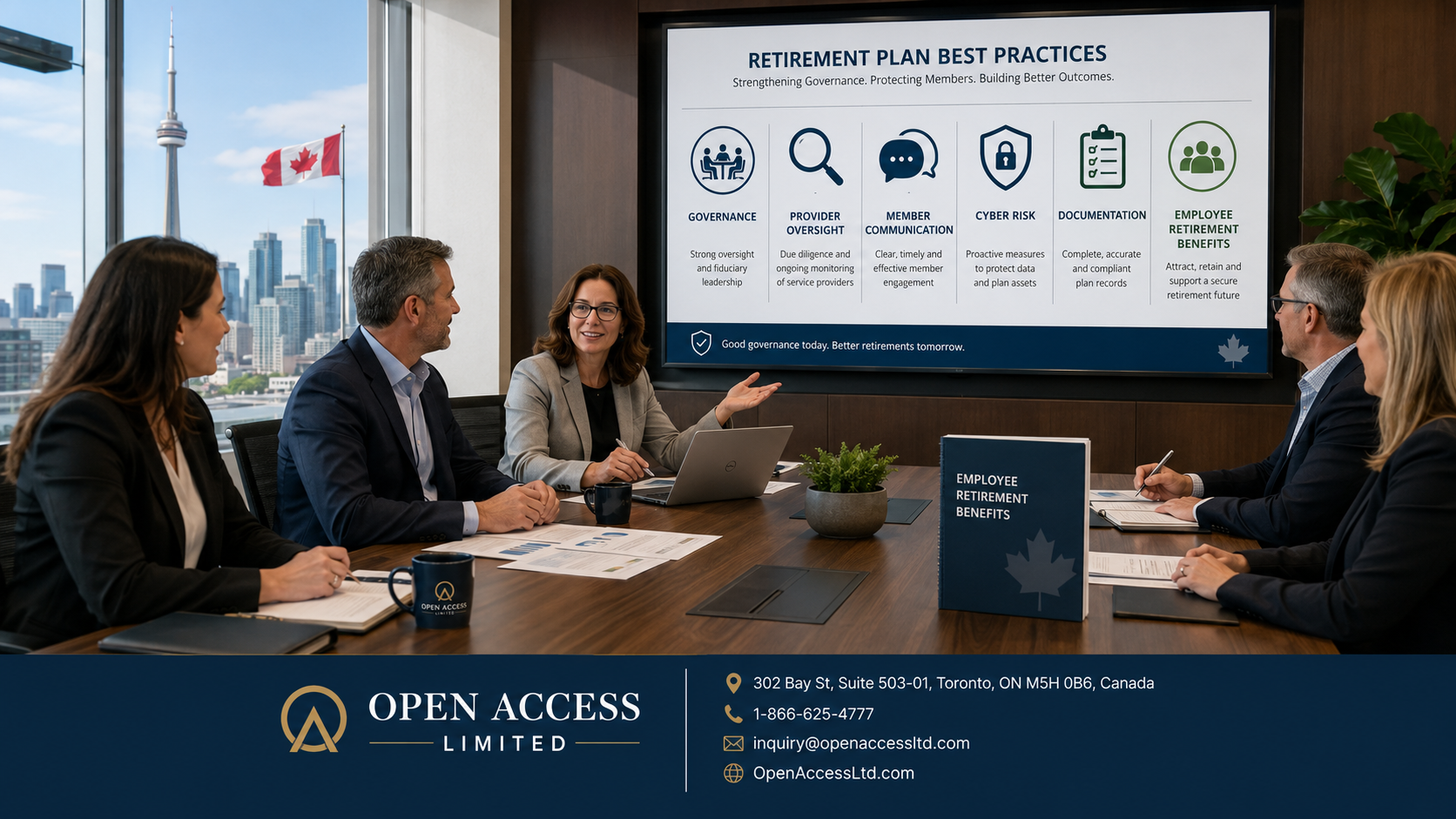
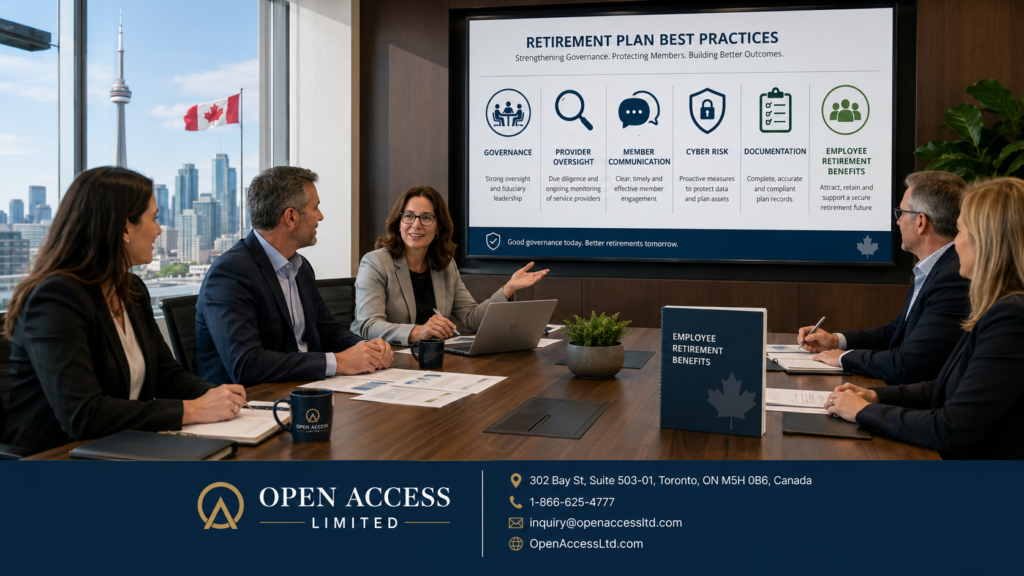
    Canadian business owners reviewing retirement plan governance, provider oversight, member communication, cyber risk, documentation, and employee retirement benefits.

    References

    CAPSA — Guideline No. 3: Guideline for Capital Accumulation Plans (2024)
    https://www.capsa-acor.org/Documents/View/2099

    CAPSA — Guideline No. 10: Guideline for Risk Management for Plan Administrators (2024)
    https://www.capsa-acor.org/Documents/View/2101

    CAPSA — Guidelines for Industry
    https://www.capsa-acor.org/GuidelinesforIndustry

    OSFI — Pension Plan Governance Guidelines
    https://www.osfi-bsif.gc.ca/en/supervision/pensions/administering-pension-plans/guidance-topic/pension-plan-governance-guidelines

    OSFI — Disclosure Requirements for Defined Contribution Pension Plans
    https://www.osfi-bsif.gc.ca/en/supervision/pensions/administering-pension-plans/guidance-topic/disclosure-requirements-defined-contribution-pension-plans