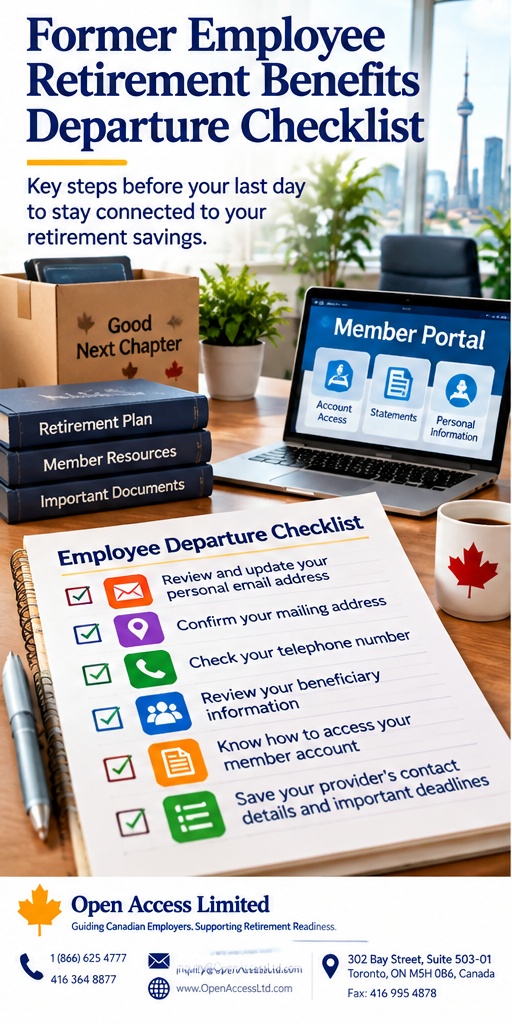
Former employee retirement benefits can remain relevant long after an employee’s final day at work.
When employment ends, retirement savings do not necessarily disappear or immediately leave the workplace plan. Depending on the plan structure and official plan terms, a former employee may continue to hold assets with the retirement-plan provider for some time.
The challenge is that life moves on.
Former employees may change their home address, email, telephone number, or other contact information. They may forget which provider holds the account, overlook statements or tax slips, or fail to complete an action required under the plan.
A strong employer departure process cannot guarantee that a former member will never become difficult to locate.
It can, however, make former employee retirement benefits easier to understand and keep important information current before the employment relationship ends.
CAPSA guidance recognizes that an individual may remain a member after employment ends and that the sponsor can retain responsibilities while the former member still has assets in the plan. OpenAccess_Q21_QA_with_Resource…
Quick Answer: How Can Employers Protect Former Employee Retirement Benefits?
Canadian employers can support former employee retirement benefits by confirming contact information before departure, explaining what happens to the account after employment ends, providing a clear departure checklist, coordinating HR, payroll and provider information, keeping appropriate records, reminding employees to update beneficiary information, and directing individual transfer or investment decisions to the provider or qualified professionals.
The strongest process begins before the employee’s last day.
On This Page
- Why Former Employee Retirement Benefits Can Be Lost
- 7 Smart Employer Steps
- What Employees Need Before Their Last Day
- What Happens to the Retirement Account After Leaving
- CAPSA Guidance for Departing Members
- Missing Members and Contact Information
- Questions Departing Employees Commonly Ask
- What Employers Should Avoid
- Privacy and Recordkeeping
- Ongoing Education Before Departure
- How Open Access Limited May Support Departing Employees
- Frequently Asked Questions
- Final Thoughts
- References
Why Former Employee Retirement Benefits Can Become Difficult to Track
The risk is usually not that the account simply disappears.
The larger issue is disconnection between the former employee and the account.
That can happen when:
- A personal address changes
- An employee stops using a work email address
- A telephone number changes
- Provider information is forgotten
- Statements go to an old address
- Required forms are not completed
- Deadlines are misunderstood
- Beneficiary information remains outdated
- The former employee does not know whom to contact later
This is why former employee retirement benefits should be included in offboarding rather than treated as an afterthought.
A clear offboarding process can help keep former employee retirement benefits connected to current contact information, provider resources, and important plan documents.
A useful employer principle is:
Before Departure → Confirm Information → Explain the Plan → Provide Contacts → Document the Process
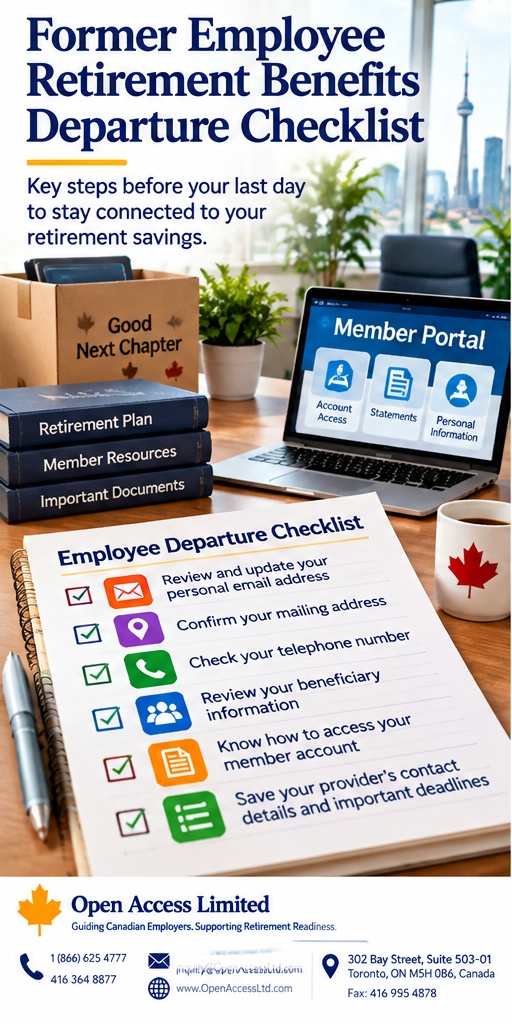
7 Smart Steps to Protect Former Employee Retirement Benefits
1. Confirm Personal Contact Information Before the Last Day
Do not wait until the employee has already left.
Before departure, remind employees to review the personal information held by the retirement-plan provider.
This may include:
- Personal email address
- Mailing address
- Telephone number
- Other applicable contact information
Employees can also be reminded to review their beneficiary information.
The objective is not for HR to collect unnecessary personal information.
It is to ensure the employee knows where their current contact details should be maintained.
Accurate information can reduce the likelihood that former employee retirement benefits later become difficult to reconnect with their owner.
2. Explain What Happens After Employment Ends
Employees often know what happens to payroll on their last day but may not understand what happens to their retirement account.
Before departure, provide a plain-language explanation based on the official plan documents.
Depending on the arrangement, explain:
- What happens to employee contributions
- What happens to employer contributions
- When final contributions are processed
- Whether account access continues
- How statements are received
- Where applicable tax documents will be sent
- Whether the employee can remain in the plan
- Which actions or deadlines may apply
CAPSA guidance identifies information sponsors should provide when active participation ends, including whether the member may remain in the plan, transfer options, applicable fees, actions and deadlines, default options, and tax consequences. OpenAccess_Q21_QA_with_Resource…
Clear explanations make former employee retirement benefits easier to manage after the employee leaves.
3. Give Every Departing Employee a Retirement Plan Departure Checklist
A checklist is one of the strongest practical improvements for this article and for employers.
The checklist can include:
Before You Leave
- Confirm personal email
- Confirm mailing address
- Confirm telephone number
- Review beneficiary information
- Save provider contact information
- Confirm member portal access
After Employment Ends
- Review official provider communication
- Watch for final contributions
- Review statements
- Note applicable deadlines
- Keep tax documents
- Update contact information after future moves
Need Help?
- Contact the retirement-plan provider for plan-specific information
- Contact a qualified professional for personal transfer, tax, investment, or legal advice
This is useful, actionable content—the type Business Owners are more likely to save or share.
4. Keep Information Separate From Personal Advice
A departure package should explain the process, not tell an employee what financial decision to make.
Employers should not say:
“Transfer your account immediately.”
“Leave the money where it is.”
“Cash it out.”
“Move everything into this investment.”
Instead:
“These are the options available under the plan. Please review the official provider materials and obtain qualified advice if you need help deciding which option is appropriate for you.”
This distinction helps keep former employee retirement benefits education useful without converting offboarding communication into personal financial advice.
5. Coordinate HR, Payroll and the Retirement-Plan Provider
The employee should not receive contradictory information.
Before the employment relationship ends, HR, payroll and the provider should be aligned on relevant operational information such as:
- Termination date
- Final payroll
- Final employee contributions
- Final employer contributions
- Required notices
- Applicable forms
- Account-status information
- Provider contact details
The source recommends consistent information between HR, payroll and the provider because coordination may reduce administrative errors. OpenAccess_Q21_QA_with_Resource…
This is especially important when former employee retirement benefits remain with the provider after the employee leaves.
6. Maintain Appropriate Records and Protect Privacy
Employers should keep appropriate records of departure communications and administrative steps.
This may include:
- What information was provided
- When it was provided
- Relevant notices
- Provider coordination
- Attempts to contact a former member where appropriate
- Applicable follow-up
But retirement-plan and personal information should also be handled consistently with applicable privacy requirements.
More data is not always better.
Employers should retain what is necessary for the applicable process and avoid unnecessary sharing of personal information.
This is where the organization’s broader retirement plan data security practices become relevant.
7. Review the Departure Process Regularly
Offboarding processes can become outdated.
The organization may introduce:
- A new provider
- A new payroll platform
- Remote work
- Multiple offices
- New retirement-plan options
- New portal access
- Updated forms
- Different communication channels
Review the retirement portion of the departure process periodically.
Pay particular attention to employees who work remotely or in different locations.
A modern former employee retirement benefits process should work equally well for an employee working at head office and someone leaving remotely.
What Should Departing Employees Know Before Their Last Day?
An effective departure conversation should answer a few basic questions.
What Happens to My Retirement Account?
Explain the plan-specific process using official documents.
Will My Employer Keep Contributing?
Typically, employer contributions connected to active employment will be governed by plan terms and the ending of employment. Employers should explain the applicable plan process rather than make assumptions.
Can I Still Access My Account?
Tell the employee how portal or account access works after departure.
Where Will My Statements and Tax Documents Go?
This is why confirming personal contact information matters.
Do I Need to Do Anything Immediately?
Explain applicable forms, actions and deadlines.
Who Do I Contact Later?
Make this exceptionally clear.
A departing employee should leave knowing the provider name, account-access method and support contact.
Employers can make former employee retirement benefits easier to manage by giving departing employees clear information before workplace access and company email accounts are closed.
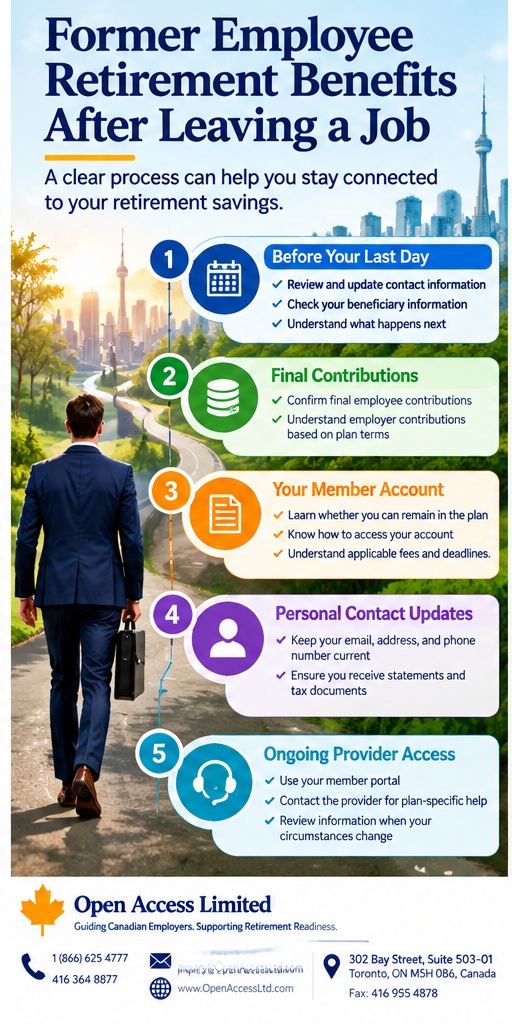
What Regulatory Guidance Says About Former Members
For capital accumulation plans, CAPSA guidance specifically addresses situations where active participation ends.
It describes information that may need to be provided concerning:
- Remaining in the plan
- Transfers
- Fees
- Actions
- Deadlines
- Default options
- Tax consequences
It also emphasizes maintaining accurate member records and having a process to locate missing members. OpenAccess_Q21_QA_with_Resource…
That makes contact-information accuracy more than a simple HR convenience.
It is an important part of ongoing plan administration.
Ontario Pension Plans and Missing Members
Ontario provides an additional pension-plan example.
FSRA guidance discusses practices such as:
- Maintaining accurate records
- Paying particular attention to termination
- Reminding members to update contact information
- Beginning searches promptly when contact is lost
FSRA consumer information cited in the source also says a member of an Ontario pension plan must receive a written statement from the administrator within 30 days after employment ends. OpenAccess_Q21_QA_with_Resource…
This Ontario example applies to registered pension plans and should not automatically be applied to a Group RRSP or DPSP.
For those arrangements, the actual plan terms and provider process remain important.
Why Beneficiary Information Should Be Reviewed Before Departure
Contact details are not the only information that can become stale.
Employees should also periodically review beneficiary information.
A departure reminder creates another opportunity to say:
“Please check that the beneficiary information recorded with your workplace retirement plan is current.”
Do not recommend whom the employee should name.
The purpose is simply to remind the employee that information may need review.
This connects naturally with your Q55 article on beneficiary designations.
What Employers Should Avoid
Employers should avoid:
- Telling an employee which transfer option to choose
- Recommending a withdrawal
- Providing investment recommendations
- Predicting tax outcomes
- Promising that the employee can remain in the plan
- Using outdated provider information
- Sending retirement information only to a work email that will soon close
- Assuming all plan types have the same termination rules
- Ignoring beneficiary or contact-information reminders
- Waiting until after termination to explain the process
The goal is clarity without personal advice.
Why Ongoing Education Should Start Before Offboarding
The best departure process actually begins much earlier.
Employees can receive periodic reminders throughout employment to:
- Maintain current contact information
- Review beneficiary information
- Know the provider name
- Know where their account is located
- Understand basic plan features
- Keep personal access credentials current
The source specifically notes that contact and beneficiary reminders are better repeated throughout employment rather than raised only when someone leaves. OpenAccess_Q21_QA_with_Resource…
That can make former employee retirement benefits easier to manage because information is already current before departure.
Important Implementation Boundaries
What happens after employment ends depends on factors such as:
- Plan type
- Official plan documents
- Jurisdiction
- Locked-in status
- Tax rules
- Privacy requirements
Employers should not promise a particular outcome or provide individualized:
- Transfer advice
- Withdrawal advice
- Investment advice
- Legal advice
- Tax advice
The source specifically recommends confirming the employer’s departure process with the plan administrator or provider and obtaining qualified advice appropriate to the plan and jurisdiction. OpenAccess_Q21_QA_with_Resource…
How Open Access Limited May Support Departing Employees
Where a workplace retirement plan is provided through Open Access Limited, employers may direct departing employees to current Open Access resources.
Open Access Limited’s materials include:
- Information-change forms
- Contact-detail updates
- Beneficiary updates
- Transfer authorization forms
- Member portal access
- Account balances
- Statements
- Transaction history
- Client Relations support
These resources can help keep former employee retirement benefits connected to current member information and appropriate plan contacts. OpenAccess_Q21_QA_with_Resource…
The employer should still confirm with Open Access Limited what happens to the account under the specific plan when employment ends.
Ongoing access to accurate provider information is an important part of helping employees manage former employee retirement benefits after the employment relationship ends.
Open Access Limited should not be presented as providing legal or individual tax advice.
Open Access Limited
302 Bay Street, Suite 503-01
Toronto, ON M5H 0B6, Canada
Toll-Free: 1 (866) 625 4777
General: 416 364 8877
Fax: 416 955 4878
Email: inquiry@OpenAccessLtd.com
Website: www.OpenAccessLtd.com
Frequently Asked Questions About Former Employee Retirement Benefits
What Happens to Workplace Retirement Savings When an Employee Leaves?
The answer depends on the retirement-plan type, official plan terms and provider process. Employees should receive current plan-specific information before departure.
Can a Former Employee Leave Retirement Savings With the Existing Provider?
Possibly. CAPSA guidance recognizes that in some capital accumulation plans a former member may remain in the plan after employment ends. The specific answer depends on the applicable plan. OpenAccess_Q21_QA_with_Resource…
Does a Former Employee Have to Transfer the Account?
Not necessarily. Available options and requirements depend on the plan. Employers should explain the options without recommending which one the employee should choose.
Where Will Statements and Tax Slips Be Sent?
That is one reason employees should ensure their current personal contact information is recorded with the appropriate provider.
What Happens if a Former Employee Moves?
The former employee should update the provider with current contact details using the applicable process.
Should Employees Review Their Beneficiary Before Leaving?
It is a useful opportunity to remind employees to review their beneficiary information, without advising them whom to designate.
What if a Former Employee Cannot Access the Account Later?
The employee should contact the applicable plan provider using current official contact information.
Can Open Access Limited Help After an Employee Leaves?
Where the plan is administered through Open Access Limited, former employees may be directed to the applicable member forms, portal and Client Relations team for plan-specific information.
Final Thoughts
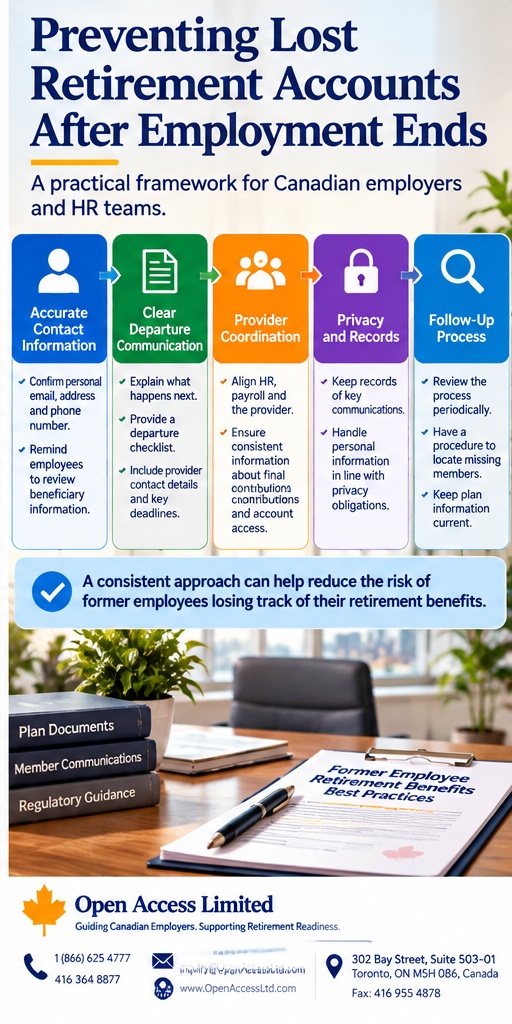
Protecting former employee retirement benefits does not require an overly complicated process.
The strongest approach is simple:
Confirm Contact Information → Explain What Happens Next → Provide a Departure Checklist → Coordinate HR, Payroll and Provider → Protect Records → Avoid Personal Advice → Review the Process
For Business Owners, this is good governance.
For HR teams, it creates a more consistent offboarding process.
For employees, it means leaving the company with clearer information about where their retirement savings are, how to stay connected to them, and whom to contact later.
And for Open Access Limited, it creates a natural and useful role around plan information, member forms, portal access, transfer documentation and Client Relations support—without overpromising outcomes.
References
- Canadian Association of Pension Supervisory Authorities (CAPSA) — Guideline No. 3: Guideline for Capital Accumulation Plans.
- Financial Services Regulatory Authority of Ontario (FSRA) — Missing Members: Principles and Practices.
- Financial Services Regulatory Authority of Ontario — Events That May Affect Your Pension.
- Open Access Limited — Member Forms; Member Resources.