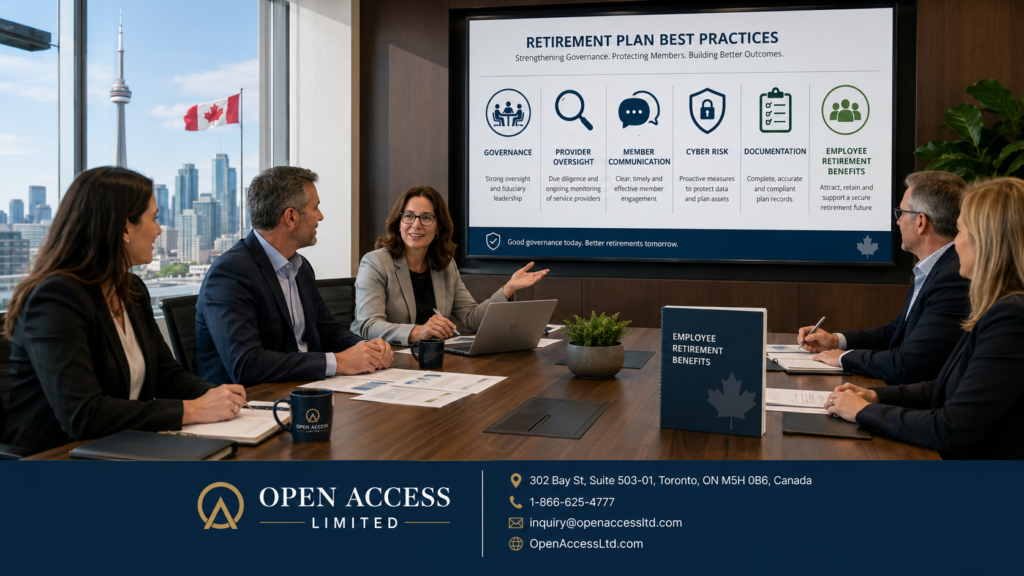
Short Answer: Canadian businesses should periodically review their retirement provider to ensure the plan still aligns with workforce needs, fees, services, investment options, technology, education, and governance expectations. A review does not automatically mean the provider needs to be changed.
Why Should Employers Review Their Retirement Provider?
Workplace retirement plans can remain in place for many years, while a business and its workforce continue to evolve.
Employee demographics, technology, fees, investment options, available services, and organizational objectives can all change over time. For this reason, employers should generally view their retirement provider relationship as something that requires periodic review rather than a one-time decision.
The Canadian Association of Pension Supervisory Authorities (CAPSA) recommends that sponsors of capital accumulation plans periodically review the performance of their service providers.
Importantly, reviewing a retirement provider does not automatically mean that changing providers is necessary. A review may instead identify opportunities to improve communication, clarify responsibilities, review fees, update investment options, strengthen employee education, or improve governance processes.
When Should You Review Your Retirement Provider?
Several developments may indicate that it is time for a more detailed review.
Your Business Has Changed
Significant growth, restructuring, new locations, or changes in workforce demographics may mean that the existing retirement arrangement should be reassessed.
Employees Have Recurring Questions
Repeated employee questions about how the retirement plan works may indicate gaps in education, communication, or member support.
Fees and Services Have Not Been Reviewed
Employers may want to periodically assess whether fees remain reasonable and competitive in relation to the services, investment options, education, administration, and support being provided.
Service Issues Keep Occurring
Recurring administrative delays, reporting issues, unresolved service concerns, or inconsistent support may warrant closer examination.
Technology Needs Have Changed
Employers should consider whether portals, digital tools, communication channels, reporting capabilities, and accessibility features continue to meet the needs of the organization and its workforce.
How to Review Your Retirement Provider in Canada?
A structured retirement provider review can consider several areas rather than focusing on a single issue.
Plan Purpose and Responsibilities
Does the current arrangement still reflect the documented purpose and objectives of the workplace retirement plan?
Employers should also understand which responsibilities belong to the provider and which remain with the plan sponsor.
Service Quality
Consider responsiveness, reporting, issue resolution, employee support, and whether agreed services are being delivered consistently.
Fees and Services
Fees should generally be considered together with the services employees and employers receive.
A lower fee alone does not necessarily establish that another provider would be more appropriate.
Investment Options
Investment options and default options should be periodically reviewed using appropriate criteria.
CAPSA recommends periodically reviewing investment options and funds and states that this review should occur at least annually.
Employee Education
Employee education should extend beyond initial enrolment.
Employers may consider whether employees continue to receive clear information about contributions, fees, investments, available tools, plan changes, and where to obtain assistance.
Administration, Technology and Security
Employers may also review recordkeeping, contribution processes, reporting, technology, privacy, cybersecurity, business continuity, and controls protecting member information.
Should Fees Be the Main Reason to Change Retirement Providers?
Not necessarily.
Price is important, but a retirement provider should generally not be evaluated on fees alone.
Employers may consider the overall arrangement, including:
total fees and expenses;
investment-management arrangements;
administration and recordkeeping;
employee education and support;
digital tools;
reporting;
governance support; and
additional or optional charges.
This provides a broader picture of the value and services associated with the retirement plan.
When Might Changing a Retirement Provider Make Sense?
A provider change may be considered when a documented review identifies material gaps that cannot be satisfactorily resolved within the existing arrangement.
Examples could include recurring unresolved service problems, unavailable required services, inadequate technology or administration, reporting or governance requirements that cannot be supported, or changes in plan objectives that the current arrangement cannot reasonably accommodate.
However, these circumstances do not automatically require a provider change.
Employers should consider their own plan circumstances and compare available alternatives using documented criteria.
What Should Employers Avoid?
Changing a retirement provider based on one isolated factor may not provide a complete picture.
For example, a decision generally should not be based solely on one employee complaint, one service incident, one period of investment performance, one lower-fee proposal, a promotional claim, or a new technology feature.
A more comprehensive review can help employers evaluate multiple factors before making a decision.
What Should You Consider Before Changing Providers?
Depending on the retirement arrangement, employers may need to consider existing contracts, termination provisions, plan documents, account or asset transfers, investment changes, payroll processes, employee records, privacy, cybersecurity, fees, communication, and applicable legal or regulatory requirements.
Communicate Changes Clearly
Employees should generally receive clear information about material changes affecting their retirement plan.
Communication may need to explain:
what is changing and what is staying the same;
when the change takes effect;
whether investment options or fees will change;
whether employees need to take action;
how existing balances will be handled; and
where employees can obtain assistance.
How Can Open Access Limited Support Employers?
For Canadian employers considering their workplace retirement options, Open Access Limited provides customizable group retirement plans and plan-specific resources.
Where an employer is considering Open Access Limited as a potential new provider, Open Access may support areas within its services, including:
discussing group retirement objectives;
developing an appropriate plan structure;
explaining available plan features and investment options;
providing applicable fee information;
establishing enrolment materials;
coordinating employee education and communication; and
supporting implementation of the Open Access arrangement.
Employers remain responsible for evaluating existing obligations, comparing available alternatives, documenting their decisions, and obtaining appropriate professional advice where required.
The Bottom Line
A retirement provider review does not necessarily mean it is time to switch providers.
Instead, periodic review can help Canadian employers determine whether their workplace retirement arrangement continues to align with plan objectives, workforce needs, fees, services, technology, education, investment options, and governance expectations.
A structured review can also help employers identify areas that may be improved within the existing arrangement before deciding whether a provider change should be considered.
References
Canadian Association of Pension Supervisory Authorities (CAPSA) (2024). Guideline No. 3: Guideline for Capital Accumulation Plans.
Canadian Association of Pension Supervisory Authorities (CAPSA) (2024). Guideline No. 10: Guideline for Risk Management for Plan Administrators.
Open Access Limited. Group Retirement Plans in Canada.
Open Access Limited. Current Group Retirement Plan Enrolment and Member Resources.
Employer matching contributions can be a valuable part of a workplace retirement plan, but the strongest contribution strategy is not necessarily the one with the highest percentage.
Canadian employers may use a percentage of employee pay, a contribution tied to employee savings, a fixed-dollar formula, or another structure permitted under the applicable retirement plan.
The more important question is whether the contribution formula is clear to employees, aligned with the purpose of the plan, financially sustainable, and administratively workable.
A well-designed approach to employer matching contributions should therefore balance employee participation with budget capacity, payroll administration, plan structure, eligibility rules, communication, and ongoing governance.
Quick Answer: How Should Employers Structure Matching Contributions?
Canadian businesses can structure employer matching contributions by first defining the purpose of the retirement plan, modelling employer costs under different participation scenarios, choosing an appropriate plan structure, keeping the formula easy to understand, coordinating payroll and administration, communicating requirements clearly, and reviewing the arrangement periodically.
The goal should be a clear and sustainable contribution structure—not simply the highest possible employer match.
Employer contributions represent a real compensation and plan cost.
Before introducing or changing a formula, employers may need to consider:
The purpose of the retirement plan
Budget and cash-flow capacity
Workforce characteristics
Eligibility rules
Payroll requirements
Contribution timing
Applicable tax rules
Plan type
Employee participation
Contribution caps
Administrative complexity
Future workforce growth
The source file specifically recommends considering different participation scenarios because an arrangement that appears affordable at today’s participation level may cost substantially more if more employees begin contributing or payroll grows.
There is no single formula that works for every Canadian employer.
8 Smart Ways to Structure Employer Matching Contributions
1. Define the Purpose of the Employer Contribution
Start by deciding what the contribution structure is intended to support.
The objective may include:
Encouraging retirement saving
Supporting employee participation
Strengthening total compensation
Supporting a profit-sharing philosophy
Providing a structured workplace savings benefit
Supporting another clearly documented plan objective
This matters because employer matching contributions should be designed around the purpose of the plan—not added simply because another employer offers a particular percentage.
A documented purpose also helps future governance reviews.
2. Build a Sustainable Employer Budget
Before finalizing a formula, model the potential cost using actual payroll information.
Consider several scenarios:
Current participation
Higher employee participation
Workforce growth
Higher average compensation
Changes in eligibility
Different contribution caps
Different matching formulas
For example, a formula that is manageable when 40% of eligible employees participate may produce a very different employer cost if participation rises to 75%.
The objective is not to predict employee behaviour.
It is to understand the range of possible costs before committing to employer matching contributions.
3. Choose the Right Retirement Plan Structure
Employer contributions can work differently depending on the type of retirement arrangement.
For example, a Group RRSP and a DPSP are not interchangeable.
The source file notes that employer-made Group RRSP contributions may have specific payroll and tax treatment, while a DPSP has its own rules and only participating employers contribute to it.
Depending on the organization, a structure might involve:
Group RRSP
DPSP
Registered pension plan
PRPP
Another permitted group retirement arrangement
The appropriate structure depends on plan objectives, payroll, tax treatment, legal requirements, and administration.
4. Keep the Matching Formula Easy to Understand
Employees should be able to understand the employer contribution without needing to decode a complicated formula.
Communication should explain:
What percentage or dollar amount applies
Whether an employee contribution is required
The maximum employer contribution
Eligibility requirements
Waiting periods
Contribution timing
Any applicable limits
A simple employer matching contributions formula can be easier for employees to understand and easier for HR and payroll teams to administer.
Complexity should only be added when there is a clear plan reason for it.
5. Explain Exactly What Employees Need to Do
Employees should know what actions are required to receive the employer contribution.
A clear explanation might answer:
Do I need to contribute first?
What percentage do I need to contribute?
What is the maximum employer contribution?
When does matching begin?
When are contributions deposited?
Is there a waiting period?
Can the formula change?
Where are the official plan terms?
Clear communication reduces uncertainty around employer matching contributions and prevents employees from relying on assumptions.
6. Coordinate Payroll and Administration Before Launch
Contribution design and payroll administration need to match.
Employers should confirm:
Payroll coding
Contribution calculations
Eligibility dates
Provider requirements
Contribution timing
Reporting
Reconciliation
Employee records
Plan administration responsibilities
Even a strong matching formula can create problems if payroll and provider processes are not aligned.
This is why contribution design should connect with broader retirement plan governance rather than being treated only as an HR benefit decision.
For example, when an employee becomes eligible, there should be a clear process showing:
When eligibility begins
When payroll deductions start
How the employer match is calculated
When funds are transmitted
How errors are identified and corrected
Clear administration helps ensure employer matching contributions operate as described to employees.
7. Review the Contribution Structure Regularly
A contribution formula should not automatically remain unchanged forever.
The employer should periodically consider whether the arrangement still fits:
Plan objectives
Financial capacity
Workforce size
Payroll levels
Employee participation
Compensation strategy
Plan structure
Administrative requirements
A formula that worked for a business with 25 employees may need a different review when that organization grows to 100 employees.
Similarly, changing salaries or eligibility rules may alter employer costs even when the matching percentage stays the same.
Regular review helps keep employer matching contributions aligned with both the retirement plan and the organization’s financial capacity.
How Can Employers Balance Participation and Cost?
This is where the strategy becomes particularly important.
An employer may want employees to understand and use the benefit while also avoiding an unpredictable long-term cost commitment.
The answer is not necessarily to reduce the benefit.
Instead, employers can improve the quality of the design through:
Clearly defined contribution limits
Sustainable caps
Eligibility rules
Accurate cost modelling
Clear employee communication
Payroll controls
Periodic review
The employer can model several participation levels before implementation.
Can the organization continue funding the contribution formula if more eligible employees actually use the benefit?
That is a healthier question than designing the plan around today’s lowest-cost scenario.
Cost Modelling Should Include More Than Today’s Payroll
A common planning mistake is to calculate employer cost using current payroll and current participation only.
That provides only one snapshot.
A stronger analysis should consider how employer matching contributions may change when:
Employee Participation Increases
More eligible employees may decide to participate after improved education or communication.
Compensation Increases
If the employer contribution is tied to salary, cost may increase as compensation increases.
The Workforce Expands
Hiring can increase the number of eligible plan members.
Eligibility Changes
Expanding eligibility may affect the number of employees receiving employer contributions.
Contribution Caps Change
A higher maximum employer contribution can materially affect future cost.
Scenario modelling helps management understand the range of potential commitments before changing the plan.
How Should Employer Matching Be Explained to Employees?
Employee communication should answer practical questions quickly.
How Much Does the Employer Contribute?
Explain the formula clearly using the plan’s actual terms.
What Must the Employee Do?
If the employee must contribute to receive the match, say so clearly.
Is There a Maximum?
Employees should understand applicable contribution caps.
When Do Contributions Begin?
Clearly explain eligibility dates and waiting periods.
Can the Formula Change?
Where appropriate, explain that the contribution structure is governed by plan documents and may be subject to permitted amendments.
Where Can Employees Get Help?
Provide a clear member-support contact and access to official plan documents.
Clear communication makes the employer contribution easier to value.
Why Education Should Continue After Enrolment
Employees may first hear about the retirement plan during onboarding—when they are also processing payroll information, workplace policies, training, benefits, technology, and job expectations.
This creates accountability and makes future plan reviews easier.
It also reduces reliance on institutional memory when HR, finance, management, or provider contacts change.
Employer Matching and Inclusive Retirement Benefits
Employers should also consider how employees across different career stages and income levels understand the matching formula.
This does not mean recommending different personal contribution amounts.
Instead, an inclusive retirement benefits approach can ensure employees receive:
Clear eligibility information
Plain-language matching explanations
Accessible education
Multiple learning formats
Ongoing support
Employees should be able to understand how the benefit works even if they make different personal contribution decisions.
Employer Matching and Retirement Income Education
The employer contribution can also be explained within the employee’s broader retirement income education.
For example, employees can learn that retirement income may come from several sources, including:
Government programs
Workplace retirement benefits
Personal savings
Investments
The employer matching contribution is one component within that broader picture.
Employers should explain the workplace plan clearly without estimating an employee’s future retirement income or promising a particular outcome.
What Employers Should Avoid
When designing or communicating employer matching contributions, employers should avoid:
Selecting a formula without modelling future cost
Making the formula unnecessarily complicated
Treating different retirement structures as interchangeable
Promising that the match will never change when plan terms permit changes
Guaranteeing increased participation
Guaranteeing improved retention
Recommending a personal contribution level
Allowing payroll and plan documents to conflict
Relying only on onboarding for employee education
The strongest approach is clear, documented, administratively workable, and financially sustainable.
Why This Matters to Business Owners
Employer contributions are both a retirement-plan feature and a compensation cost.
That means decisions about employer matching contributions should be considered alongside:
Cash flow
Compensation strategy
Workforce growth
Payroll
Employee communication
Plan administration
Long-term business planning
The objective should not be to maximize the percentage simply because a higher number appears more attractive.
A more useful objective is:
Create a contribution arrangement employees can understand and the business can sustain.
That is a stronger foundation for long-term plan management.
Important Implementation Boundaries
Employer contribution arrangements can involve:
Tax
Payroll
Pension
Employment requirements
Plan documents
Contribution limits
Governance
Communication
Treatment can differ materially depending on whether the arrangement involves a:
Group RRSP
DPSP
Registered pension plan
Pooled registered pension plan
Other retirement-savings structure
Employers should obtain appropriately qualified retirement-plan, legal, tax, payroll, pension, and compliance advice before introducing or materially changing employer matching contributions.
This includes changes to eligibility, contribution caps, payroll treatment, plan combinations, or material employee communication.
Employees who require individualized financial or tax advice should be directed to qualified professionals.
Need Help Structuring Employer Contributions More Clearly?
A well-designed employer contribution arrangement should align the workplace retirement plan with the organization’s objectives, administration, employee communication, and financial capacity.
Open Access Limited may support employers with the retirement-plan component of this process, including:
Reviewing available group retirement structures
Establishing plan-specific eligibility and contribution provisions
Documenting employer matching rules
Coordinating plan administration
Preparing enrolment and member materials
Supporting ongoing employee education
Providing member support
Open Access Limited materials also describe employer contributions that may be structured as a percentage of salary or a fixed-dollar amount, depending on plan design.
Employers remain responsible for determining the financial commitment appropriate for their organization and obtaining tax, payroll, legal, and other professional advice where required.
Open Access Limited 302 Bay Street, Suite 503-01 Toronto, ON M5H 0B6, Canada
Frequently Asked Questions About Employer Matching Contributions
Are Employer Matching Contributions Required to Be the Same for Every Business?
No. There is no single contribution formula that is appropriate for every organization. Plan type, workforce characteristics, compensation, financial resources, and organizational objectives may all affect the design.
Should Employers Offer the Highest Match They Can Afford Today?
Not necessarily. Employers should also consider how the cost could change with increased participation, higher salaries, workforce growth, or changes in eligibility.
Can an Employer Matching Formula Change?
That depends on the governing plan terms and applicable requirements. Employers should avoid describing a reviewable or amendable contribution as permanently guaranteed.
Can Employers Recommend How Much Employees Should Contribute?
Employers can explain the plan and matching formula, but personalized contribution recommendations should be handled by appropriately qualified professionals.
Are Group RRSPs and DPSPs the Same?
No. They operate differently and may have different contribution, tax, payroll, eligibility, and administrative requirements.
How Often Should Employer Contributions Be Reviewed?
Employers should periodically reassess the contribution arrangement as payroll, participation, workforce composition, plan objectives, and financial circumstances change.
Final Thoughts
Employer matching contributions can add meaningful value to a workplace retirement plan when they are designed with both employees and the business in mind.
The strongest contribution strategy is not necessarily the largest.
It is one that is:
Clear to employees. Sustainable for the employer. Accurate in payroll. Consistent with the plan. Reviewed over time.
By defining the purpose, modelling long-term costs, selecting an appropriate plan structure, communicating clearly, coordinating administration, and reviewing the arrangement regularly, Canadian businesses can create a more durable employer contribution strategy without making promises about employee behaviour or business outcomes.
REFERENCES
Canadian Association of Pension Supervisory Authorities — Guideline No. 3: Guideline for Capital Accumulation Plans
Canada Revenue Agency — Contributions to Savings and Pension Plans
Canada Revenue Agency — Register a Deferred Profit Sharing Plan
Canada Revenue Agency — RRSPs and Other Registered Plans for Retirement
Open Access Limited — Group Retirement Plans in Canada
Open Access Limited — Setting Up a Group Retirement Plan for Your Business in Canada
ESG investment options are becoming an increasingly visible part of workplace retirement-plan discussions as some employees look for investments that consider environmental, social, and governance factors.
For employers, however, the real question is not simply whether an ESG-labelled fund should be added to the plan.
The more important questions are:
How was the option selected? How does it fit within the broader investment menu? What does the fund actually consider? How are its risks, fees, and investment objectives communicated? Who is responsible for monitoring it over time?
A responsible approach treats ESG investment options with the same disciplined due-diligence standards applied to other investment choices.
That means reviewing the investment objective, strategy, risk-return profile, fees, diversification, investment-manager process, available disclosure, and continued fit within the overall retirement-plan lineup.The goal is not to market an ESG label.
The goal is to create a documented, understandable, and consistently governed investment-choice process.
What Are ESG Investment Options in an Employee Retirement Plan?
ESG stands for environmental, social, and governance.
An ESG-labelled or responsible-investment fund may take certain ESG factors into account as part of its investment process.
However, the label alone does not explain:
How ESG factors are used
How important those factors are to investment decisions
Whether exclusions are applied
How companies are evaluated
How the investment manager engages with companies
What financial risks remain
Whether the fund will outperform
Whether the fund reflects every employee’s personal values
For employers, ESG investment options should therefore be evaluated as investments first.
The ESG designation is one characteristic of the investment—not a guarantee of performance, lower risk, positive environmental impact, or suitability for every employee.
Adding an ESG-labelled fund can appear simple from an employee-choice perspective.
From a governance perspective, however, it raises several important questions.
Employers should understand:
Who selects the option
Who approves it
Who monitors it
Who reviews provider materials
Who communicates it to employees
What criteria were used
How those decisions are documented
When the option will be reviewed again
CAPSA guidance indicates that investment options in capital accumulation plans should be considered using factors such as risk-return characteristics, fees, diversification, investment strategy, member characteristics, and the sponsor’s ability to assess and review the option over time.That means ESG investment options should not bypass the normal investment-review process simply because they carry an ESG or responsible-investment label.
7 Smart Safeguards for ESG Investment Options
1. Apply the Same Due-Diligence Standards as Other Investments
Employers should review an ESG option using the same disciplined framework applied to the rest of the plan’s investment menu.
The review may include:
Investment objective
Investment strategy
Risk-return profile
Fees
Diversification
Historical performance
Expected characteristics
Investment-manager process
Fund disclosure
Role within the broader investment menu
This helps prevent an ESG option from being selected primarily because of marketing language or employee interest.
A well-governed process starts with investment fundamentals.
ESG investment options should be able to explain their place within the overall menu based on documented criteria.
2. Define Who Is Responsible for What
Clear accountability is essential.
Employers should confirm who is responsible for:
Reviewing proposed investment options
Approving additions or removals
Monitoring existing funds
Reviewing provider disclosures
Preparing employee communication
Documenting decisions
Escalating concerns
A common governance risk is assuming that another provider or adviser is responsible for a task when responsibility has never been clearly assigned.
Role clarity supports stronger retirement plan governance and creates a more reliable decision-making process.
3. Document Why the ESG Option Was Selected
Documentation is one of the strongest protections against inconsistent decision-making.
Employers should record:
Why the option was considered
What information was reviewed
What selection criteria were applied
Which alternatives were considered
What professional advice was obtained
How the fund fits within the overall investment lineup
Who approved the decision
When the option should be reviewed again
This record can support future governance reviews and provide continuity when committee members, advisers, providers, or internal decision-makers change.
Good documentation also helps demonstrate that ESG investment options were selected through a structured process rather than simply added because ESG was popular at the time.
4. Use Official Fund Materials in Employee Communication
When explaining an ESG option, employers should rely on current provider and investment-fund materials.
Employee communication may explain:
The fund’s investment objective
ESG factors considered
Investment strategy
Material risks
Fees
Diversification
Available alternatives
Where employees can find current fund information
Employers should avoid expanding ESG claims beyond what the official disclosure supports.
For example, phrases such as “better for the environment” or “lower investment risk” can be misleading if the fund’s official materials do not support those statements.
Accurate communication helps employees understand ESG investment options without turning education into promotion.
5. Avoid Greenwashing and Unsupported ESG Claims
Greenwashing risk can arise when environmental or sustainability claims become broader or stronger than the underlying investment disclosure supports.
Employers should be cautious about statements that imply:
Guaranteed environmental benefits
Guaranteed social outcomes
Lower investment risk
Higher expected returns
Universal sustainability
Superior suitability for employees
An ESG-labelled fund remains an investment.
It may lose value. It may not outperform other funds. It may not reflect every employee’s personal priorities.
The Canadian Securities Administrators have emphasized the importance of clear and consistent ESG-related fund disclosure and identified greenwashing as a concern in investment-fund communication.
For employers, this reinforces a practical rule:
Do not say more about an ESG fund than the current official disclosure supports.
6. Preserve Employee Choice and Avoid Personalized Recommendations
Providing ESG investment options can expand the investment menu, but employers should avoid presenting an ESG fund as the correct choice for every employee.
Employees may differ in:
Financial circumstances
Investment horizon
Risk tolerance
Retirement timeline
Personal values
Investment objectives
Existing savings
Employer communication should explain available choices rather than recommend a particular fund to an individual employee.
Where employees require individualized investment advice, they should be directed to appropriately qualified professionals.
This distinction helps preserve employee choice and reduces the risk that general plan education is interpreted as personal investment advice.
7. Review ESG Investment Options Regularly
Investment oversight does not end when a fund is added.
Employers should periodically review ESG investment options against the criteria originally used to select them.
The review may consider:
Investment performance
Fees
Risk characteristics
Diversification
Manager changes
Investment-strategy changes
ESG disclosures
Continued fit within the overall investment menu
Employee communication materials
Regulatory developments
CAPSA’s 2024 Guideline No. 3 states that investment options should be reviewed periodically and at least annually.
A documented review cycle can help employers identify when an option, provider, disclosure, or communication requires attention.
What Is Greenwashing in Retirement-Plan Communication?
In practical terms, greenwashing risk can arise when the way an ESG investment is described gives employees a stronger impression of environmental or social benefits than the official fund information supports.
The problem may not always be an intentionally false statement.
Sometimes it comes from oversimplification.
For example, turning a detailed statement about ESG integration into a headline such as:
“A greener investment for your retirement.”
could create a broader impression than the fund disclosure actually supports.
Employers should therefore avoid simplifying ESG terminology in ways that change its meaning.
The safer approach is to use current official fund descriptions and explain them in balanced language.
ESG Labels Do Not Remove Investment Risk
Employees should understand that ESG investment options are still investments.
An ESG-labelled fund:
Can decline in value
May underperform other options
May charge different fees
May have different risk characteristics
May use ESG factors differently from another ESG fund
May not reflect every employee’s personal values
ESG considerations also do not replace the need to review:
Investment objective
Diversification
Fees
Risk profile
Manager strategy
Performance characteristics
The ESG label should add information—not replace traditional investment analysis.
How Should Employers Communicate ESG Investment Options?
Communication should be factual, balanced, and easy to verify.
A strong employee explanation should answer:
H3: What Does the Fund Invest In?
Use official fund materials to explain the investment objective and strategy.
H3: How Does the Fund Use ESG Factors?
Describe only the ESG process supported by current provider disclosure.
H3: What Risks Apply?
Employees should understand that ESG does not eliminate normal investment risk.
H3: What Fees Apply?
Fees should be communicated alongside other investment characteristics.
H3: What Other Options Are Available?
Employees should understand that ESG funds are part of a broader investment menu rather than the default choice for every employee.
Where Can Employees Find Current Information?
Provide access to official fund documents and qualified support.
This type of communication supports informed employee decision-making without turning ESG investment options into marketing claims.
Common ESG Communication Mistakes Employers Should Avoid
Employers should be especially careful with short promotional language.
Common mistakes may include:
Calling a fund “sustainable” without context
Saying it is automatically better for the environment
Suggesting ESG investing reduces investment risk
Suggesting ESG funds will outperform
Assuming all ESG funds use the same methodology
Presenting ESG as appropriate for every employee
Relying on outdated fund descriptions
Rewriting provider claims too aggressively
Ignoring fees or traditional investment risks
The strongest communication is often less promotional and more precise.
Why Ongoing Employee Education Matters
Employee investment education should not end during enrolment.
Investment funds change.
Providers update disclosures.
Managers may change.
Fees may change.
Investment strategies may evolve.
Employees’ own financial circumstances may also change.
Employers should reinforce education periodically and tell employees where current investment information can be found.
This approach is particularly important for ESG investment options, where terminology and investment approaches can differ significantly from one fund to another.
Ongoing education helps employees review their choices using current information rather than relying on what they remember from onboarding.
How ESG Fits Into Retirement Plan Governance
ESG should not be treated as a separate marketing project.
Where ESG-related funds are offered, they should fit within the employer’s broader governance process.
That process may include:
Selection criteria
Approval responsibilities
Documentation
Provider oversight
Employee communication
Investment monitoring
Annual reviews
Escalation procedures
Connecting ESG oversight with retirement plan governance helps avoid creating a parallel process that is less rigorous than the framework used for other investment options.
Questions Employers Should Ask Before Adding an ESG Fund
Before adding an ESG option, employers may consider asking:
What Is the Investment Objective?
Does the fund’s objective clearly explain its financial and ESG approach?
How Are ESG Factors Incorporated?
Are ESG factors integrated, screened, excluded, prioritized, or used in another way?
What Are the Fees?
How do fees compare with other available options?
What Are the Risk Characteristics?
How does the fund fit into the plan’s overall investment lineup?
What Disclosure Is Available?
Can employees access current and understandable official information?
Who Will Monitor the Fund?
Is responsibility clearly assigned?
How Often Will It Be Reviewed?
Is there a documented review cycle?
These questions support a more structured approach to ESG investment options.
Why This Matters to Business Owners
Offering an ESG or responsible-investment option may give employees an additional choice.
However, employers should not promise that adding an ESG option will automatically improve:
Continues to meet the criteria used in its selection
That is the foundation of responsible ESG governance.
Important Implementation Boundaries
Selecting, changing, or communicating investment options may involve:
Investment considerations
Securities requirements
Pension requirements
Governance responsibilities
Fiduciary considerations
Legal requirements
Regulatory obligations
Employers should avoid recommending an ESG option to an individual employee or representing it as suitable for that employee’s personal circumstances.
Before adding, removing, or materially changing ESG investment options, employers should review:
Plan documents
Service-provider responsibilities
Official investment-fund disclosure
Applicable legal requirements
Relevant regulatory guidance
Appropriately qualified retirement, investment, legal, and compliance professionals should be involved where needed.
How Open Access Limited May Support Employers
Where ESG or responsible-investment choices are available within an Open Access retirement plan, Open Access Limited may support employers by providing:
Current investment-option information
Official fund materials
Member education
Provider communication
Investment objective information
Risk-return information
Fee information
Diversification information
Responsible-investment characteristics
Updated education when investment information changes
These resources may help employers communicate ESG investment options more consistently while avoiding the suggestion that an ESG designation guarantees performance, suitability, or sustainability outcomes.
Open Access Limited 302 Bay Street, Suite 503-01 Toronto, ON M5H 0B6 Canada
No. An ESG designation does not guarantee higher investment returns or lower investment risk.
Does ESG Mean an Investment Is Environmentally Sustainable?
Not necessarily. ESG approaches vary between funds. Employers should use official fund disclosure when explaining how ESG factors are incorporated.
Can Employers Recommend an ESG Fund to Employees?
Employers should avoid presenting a particular ESG option as appropriate for an individual employee. Personalized investment advice should come from appropriately qualified professionals.
How Often Should ESG Funds Be Reviewed?
Investment options should be reviewed periodically. CAPSA’s 2024 guidance states that investment options should be reviewed at least annually.
What Is the Best Way to Reduce Greenwashing Risk?
Use current official provider and fund materials, avoid unsupported sustainability claims, document the communication process, and review language before distribution.
Final Thoughts
ESG investment options can add meaningful choice to a workplace retirement plan, but the ESG label should never replace disciplined investment governance.
Employers should evaluate ESG funds using the same rigorous standards applied to other investment options.
That means reviewing investment objectives, risks, fees, diversification, manager processes, disclosure, employee communication, and ongoing performance.
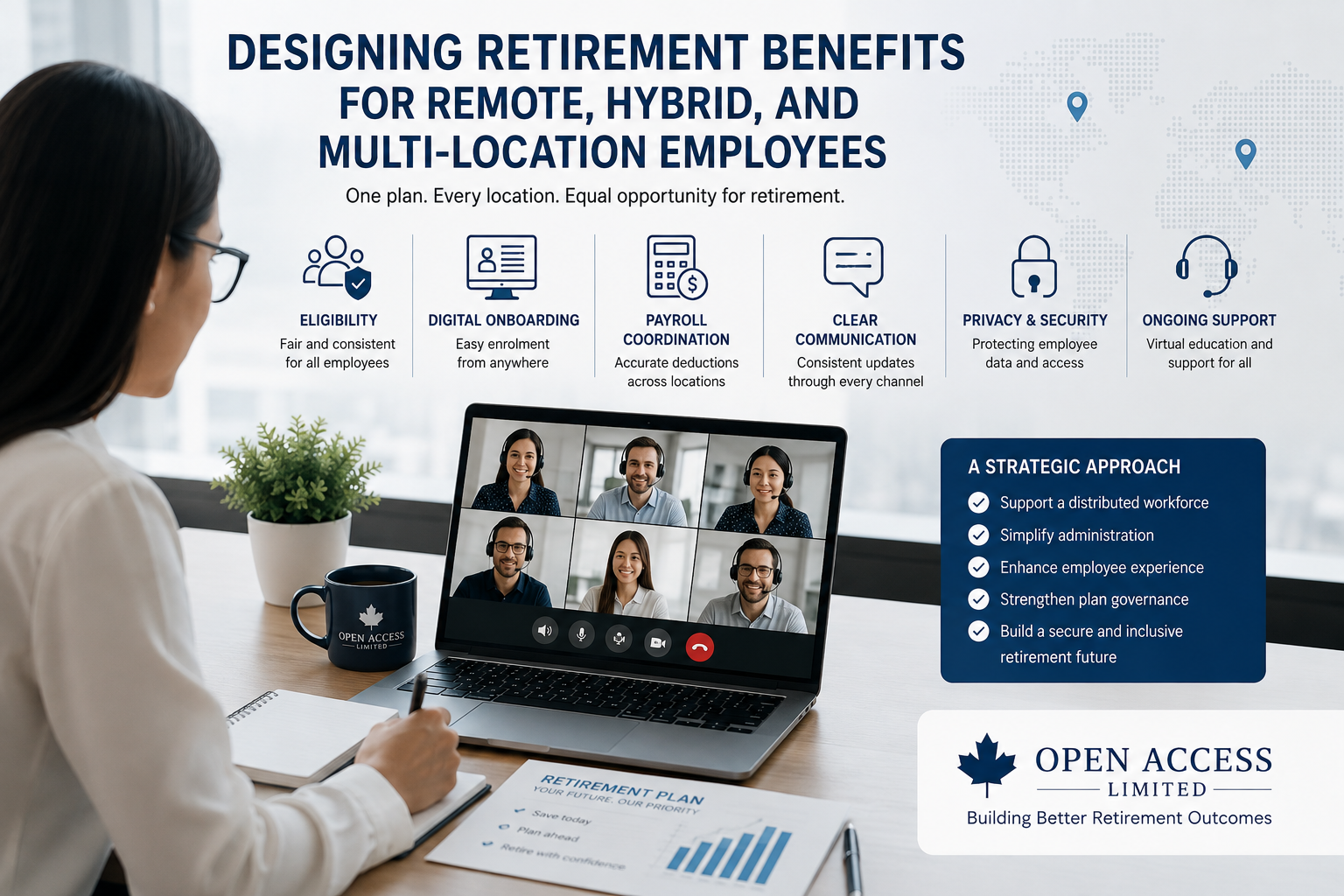
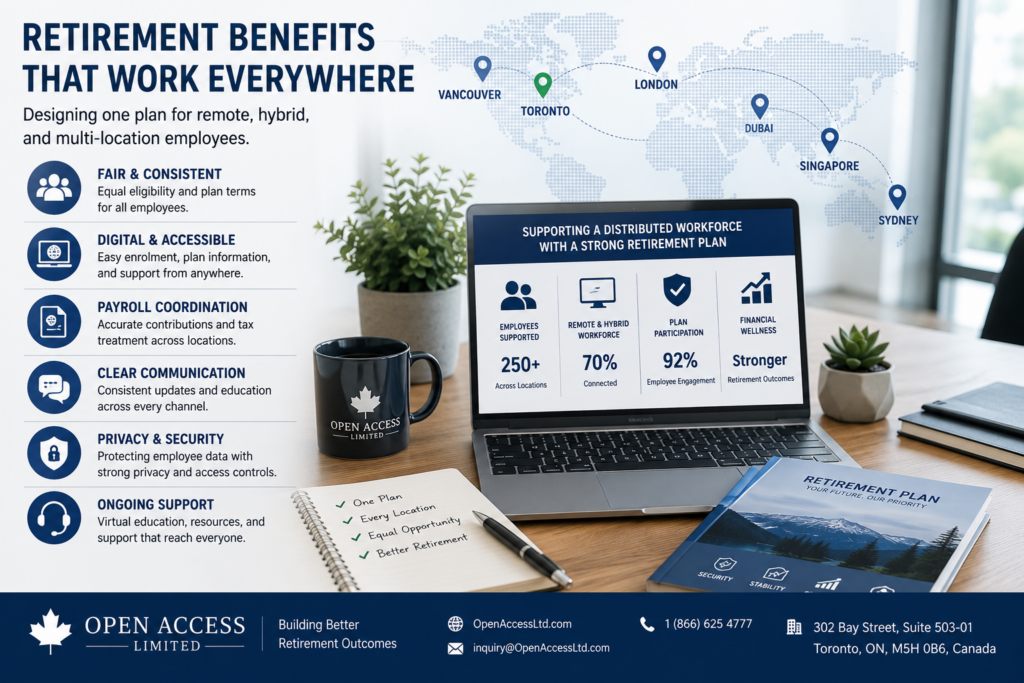
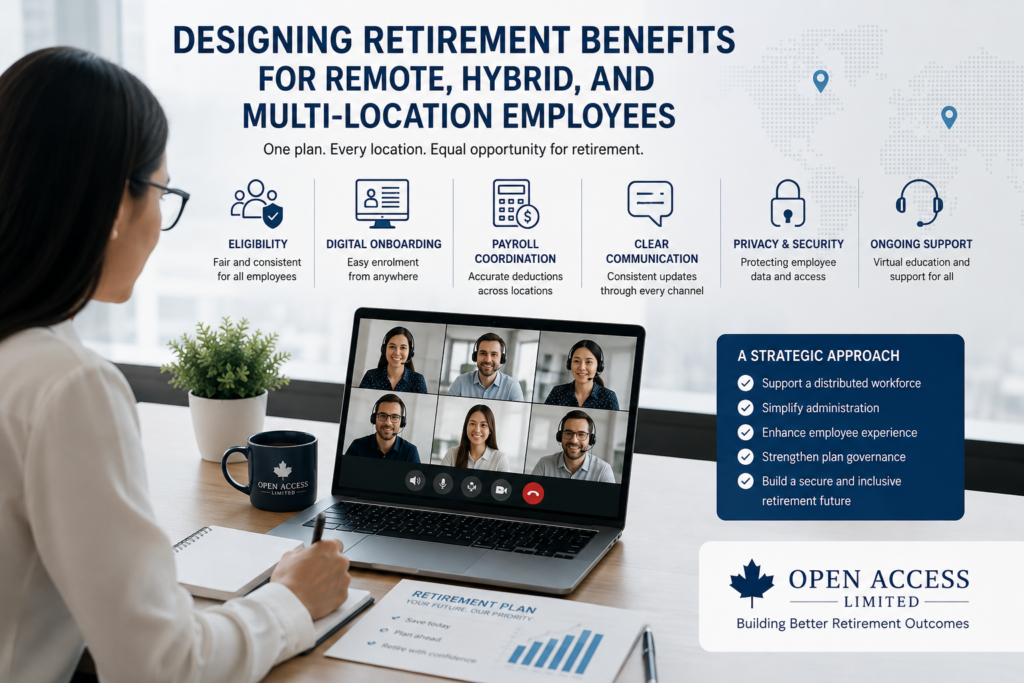
Remote workforce retirement benefits require a clear and consistent strategy as more employees work outside a traditional central office.
Some employees may work entirely remotely, while others follow hybrid schedules or move between different offices, cities, or provinces while remaining with the same organization. These arrangements can create practical challenges for employers that want their retirement program to remain understandable, fairly administered, and accessible to every eligible employee.
The goal is generally not to create a separate retirement plan for each working arrangement. Instead, employers should develop one coordinated retirement-benefits strategy that can function clearly across a distributed workforce.
A practical framework should address employee eligibility, payroll coordination, digital onboarding, communication, privacy, access, ongoing education, and retirement-plan governance.
When these areas are managed consistently, businesses can support employee understanding while reducing avoidable pressure on HR and payroll teams.
Why Do Remote Workforce Retirement Benefits Require a Clear Strategy
Remote and hybrid work may make benefit communication more difficult.
Employees who do not regularly attend a physical workplace may miss in-person meetings, informal HR reminders, printed notices, or office-based education sessions. Without an effective digital process, employees may not fully understand:
Whether they are eligible for the retirement plan
How contributions are deducted
What options are available
When enrolment deadlines apply
Where plan documents can be found
How to update personal information
Whom to contact for support
Employees working in different locations may also be connected to different payroll, employment, tax, privacy, or administrative requirements.
A well-designed remote workforce retirement benefits strategy creates a consistent employee experience while allowing the employer to address legitimate location-specific considerations.
7 Proven Steps for Remote Workforce Retirement Benefits
1. Define Eligibility Clearly and Consistently
Employers should confirm which employees are eligible to participate in the retirement plan.
The eligibility review should consider whether remote, hybrid, part-time, permanent, contract, or multi-location employees are treated consistently with the plan’s official terms.
Employees should receive a clear explanation of:
When eligibility begins
Whether a waiting period applies
Which employment classifications qualify
How employer and employee contributions work
What happens when an employee changes work arrangements
Whether moving to another province affects administration
Eligibility decisions should be based on documented plan terms rather than informal assumptions about where an employee works.
Clear eligibility rules can reduce confusion, support consistent administration, and help HR teams respond to employee questions more efficiently.
2. Coordinate Payroll and Employee Location Information
Payroll coordination is an important part of managing remote workforce retirement benefits.
When employees work from different locations, employers may need to review province-of-employment information, payroll deductions, contribution calculations, tax-related processes, and reporting responsibilities.
The employer should establish a reliable process for updating employee location information whenever a remote or hybrid employee moves.
A practical process may include:
Confirming the employee’s current work location
Updating payroll and HR records
Reviewing contribution deductions
Checking applicable province-of-employment information
Coordinating with payroll and retirement-plan providers
Documenting responsibility for location changes
Accurate payroll and location records may help reduce contribution errors, inconsistent deductions, and administrative delays.
Employers should obtain qualified payroll, tax, or legal advice where location changes create additional obligations.
3. Provide Digital Retirement-Plan Onboarding
Employees should be able to enrol in and understand the plan without attending an in-person meeting.
A remote-friendly onboarding process may include:
Digital enrolment instructions
Electronic plan summaries
Recorded education sessions
Live virtual orientation meetings
Secure online forms
Employee portal access
Contact information for questions
Clear contribution examples
Digital beneficiary reminders
Digital onboarding should be simple enough for employees to complete without unnecessary assistance, while still providing access to support when questions arise.
Employers should also confirm that onboarding materials are accessible, updated, and consistent with information provided by the plan administrator.
Effective digital onboarding can improve employee understanding and participation across multiple locations.
4. Use Consistent Multi-Channel Communication
A distributed workforce may require more than one communication channel.
Employers can use email, employee portals, virtual meetings, recorded videos, newsletters, calendar reminders, and digital benefit guides to communicate retirement-plan information.
However, using several channels should not create several different messages.
Communication should remain consistent across:
HR announcements
Payroll notices
Provider materials
Employee portals
Virtual education sessions
Annual enrolment reminders
Plan-change communications
Employees should receive the same explanation of eligibility, contributions, fees, deadlines, account access, and support regardless of where they work.
Consistent communication strengthens remote workforce retirement benefits by helping employees remain informed even when they do not have regular contact with an office-based HR team.
5. Protect Employee Privacy and Digital Access
Remote retirement-plan administration may involve electronic records, employee portals, virtual meetings, online forms, provider platforms, and digital document delivery.
Employers should confirm that sensitive employee information is handled securely.
A privacy and access review may examine:
Who can access employee retirement data
Whether multi-factor authentication is available
How access is removed when responsibilities change
How documents are transmitted
Whether employee portals are secure
Which providers process employee information
How privacy concerns are reported
How cyber incidents are managed
Employers should also remind remote employees not to share passwords, use unsecured networks for sensitive transactions, or send personal retirement documents through inappropriate channels.
This work should connect with the organization’s broader retirement plan data security and privacy procedures.
6. Offer Ongoing Virtual Education and Support
Retirement education should not end after digital enrolment.
Employees may need additional support as their careers, financial priorities, family responsibilities, or work locations change.
Employers may provide:
Virtual retirement-education workshops
Scheduled online question sessions
Recorded learning resources
Digital FAQs
Contribution reminders
Annual plan reviews
Access to qualified professional guidance
Dedicated provider contact information
Support should be accessible to employees in different locations and time zones wherever reasonably possible.
Remote employees should not be placed at a disadvantage simply because they cannot attend an office meeting.
Ongoing support can improve employee confidence and create a more consistent retirement-benefit experience across the organization.
7. Review the Distributed Employee Journey
Employers should periodically review how the retirement plan works for employees from enrolment through ongoing participation.
A review may consider:
Eligibility questions
Enrolment completion
Payroll or contribution errors
Employee participation
Portal-access problems
Communication engagement
Support requests
Privacy concerns
Provider responsiveness
Differences between locations
Recurring questions may reveal that a process or communication needs improvement.
For example, repeated questions about eligibility may indicate that onboarding materials are unclear. Frequent portal-access problems may show that digital instructions or provider support require attention.
Regular reviews help keep remote workforce retirement benefits aligned with workforce changes, technology, plan terms, and employee needs.
How Can Employers Maintain Fairness Across Locations
Fair treatment does not always mean that every administrative detail must be identical.
Different employee locations may create legitimate payroll, tax, employment, privacy, or regulatory considerations. However, the overall employee experience should remain clear and consistently managed.
Employers can support fairness by:
Using documented eligibility rules
Providing equal access to retirement education
Maintaining consistent plan communication
Reviewing location changes promptly
Coordinating HR, payroll, and provider responsibilities
Documenting any necessary administrative differences
Giving employees accessible support regardless of location
The objective is to prevent remote or hybrid employees from receiving less information or support than office-based employees.
Why Does a Distributed Retirement Strategy Matter to Business Owners
A consistent retirement-benefits framework may reduce administrative pressure on HR and payroll teams.
It can help business owners:
Explain plan rules more clearly
Reduce inconsistent employee treatment
Minimize payroll and contribution errors
Improve digital enrolment
Strengthen employee understanding
Support data security
Improve provider coordination
Maintain a consistent employee experience
A well-organized process may also strengthen employee confidence in the organization’s retirement program.
Employees are more likely to recognize the value of workplace retirement benefits when information and support remain accessible regardless of their location.
mportant Implementation Boundaries
Remote and multi-location work may create payroll, tax, employment-law, privacy, and retirement-plan administration considerations.
The appropriate process may depend on:
The employee’s physical work location
Province of employment
Plan terms
Payroll structure
Employment classification
Organizational structure
Provider arrangements
Privacy requirements
Employers should not assume that the same administrative approach automatically applies in every situation.
Qualified payroll, legal, tax, privacy, employment, and retirement-plan professionals should review policies or communications when employees work across different jurisdictions.
This article provides general educational information and does not replace professional advice.
How Open Access Limited May Support Remote Workforce Retirement Benefits
Open Access Limited may help employers create clearer retirement-benefit communication and administration processes for remote, hybrid, and multi-location teams.
Support may include:
Digital enrolment communication
Employee retirement education
Provider coordination
Governance reviews
Plan communication
Administrative process reviews
Virtual employee support
Employee-focused retirement solutions
These approaches may help employers maintain consistent communication, improve employee understanding, and align retirement-plan administration with a distributed workforce model
Open Access Limited 302 Bay Street, Suite 503-01 Toronto, ON M5H 0B6 Canada
A successful remote workforce retirement benefitsstrategy should make one retirement program work clearly across different work arrangements and locations.
Employers can improve the employee experience by defining eligibility, coordinating payroll, providing digital onboarding, using consistent communication, protecting employee data, offering virtual education, and reviewing the employee journey regularly.
The goal is not to create unnecessary complexity or separate plans for every type of employee.
It is to build a clear, secure, and consistently administered retirement-benefits framework that supports employees wherever they work.
References
Statistics Canada — Research to Insights: Working from Home in Canada
Canada Revenue Agency — Determine the Province of Employment
Canada Revenue Agency — RRSPs and Other Registered Plans for Retirement
CAPSA — Guidelines for Industry
CAPSA — Guideline No. 3: Guideline for Capital Accumulation Plans
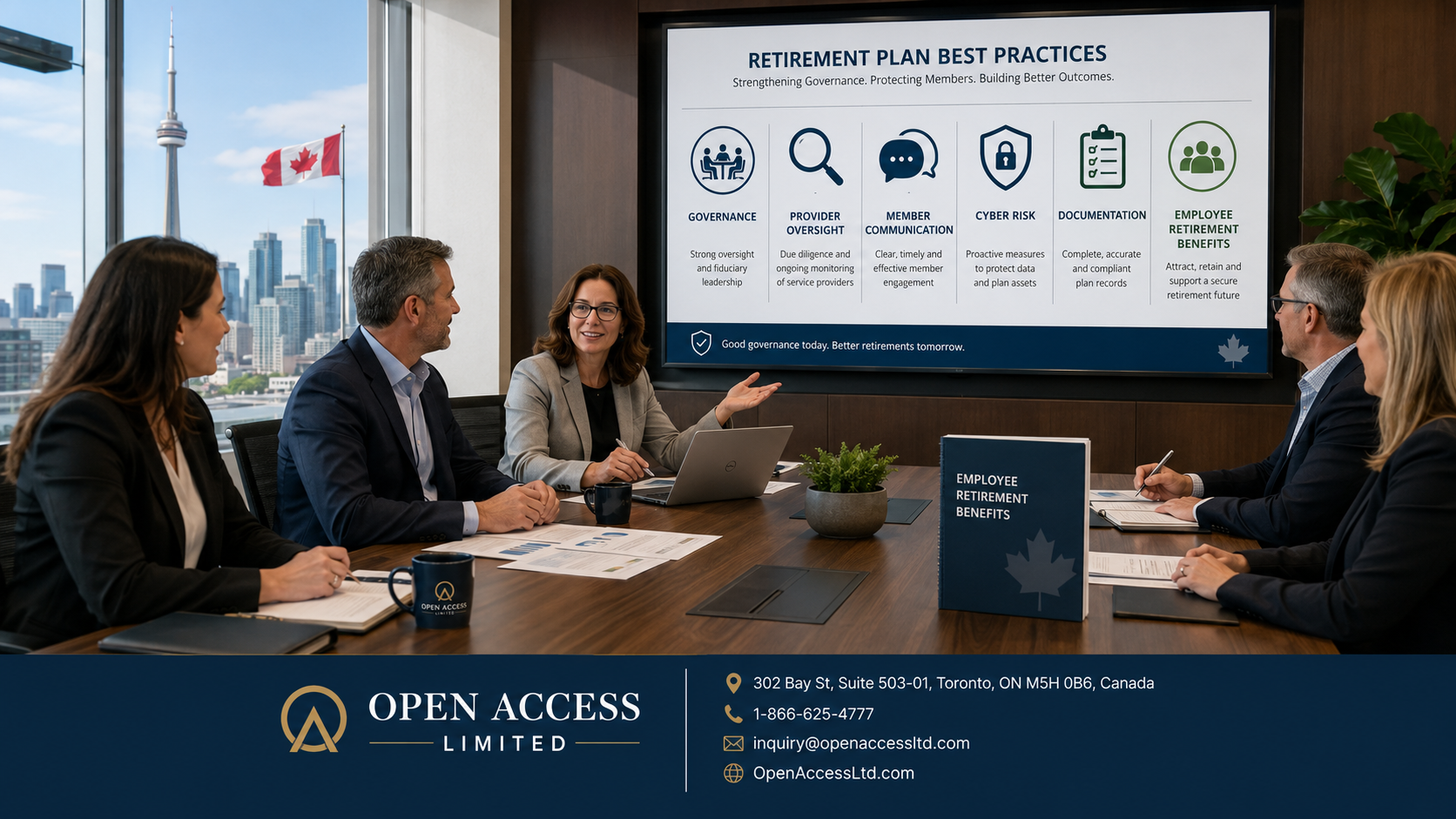
Retirement plan governance is often the most challenging part of maintaining a workplace retirement program. Selecting and implementing a plan is only the beginning. Business owners must also oversee service providers, employee communication, documentation, costs, privacy, cyber security, investment options, and regulatory expectations.
For smaller organizations, these responsibilities can feel difficult because there may be no dedicated pension department or internal governance specialist. However, effective oversight does not require a large administrative team.
Strong retirement plan governance requires a clear decision-making framework, defined responsibilities, reliable documentation, and a practical review schedule. The objective is to make responsible oversight repeatable instead of depending on one person’s memory, availability, or informal knowledge.
Canadian pension guidance increasingly emphasizes documented accountability, risk management, member communication, and ongoing monitoring. CAPSA’s updated capital accumulation and risk-management guidelines reinforce the importance of clearly assigned responsibilities and governance practices that reflect the plan’s size and complexity. OSFI also encourages plan administrators to follow established governance principles and provide timely, accurate, and understandable information to members.
Why Is Retirement Plan Governance Important?
A retirement plan affects employees’ long-term financial security and may involve several internal and external parties.
Business owners, HR teams, payroll staff, plan administrators, investment providers, advisers, and recordkeepers may all have responsibilities. Without a documented structure, important tasks can be duplicated, delayed, or overlooked.
Effective retirement plan governance helps an organization answer several important questions:
Who approves plan changes?
Who monitors fees and service quality?
Who responds to employee questions?
Who reviews communication materials?
Who maintains governance records?
Who follows up when an operational or cyber-security issue occurs?
Clear answers reduce uncertainty and help demonstrate that the retirement program is being managed carefully and consistently.
7 Proven Retirement Plan Governance Steps for Business Owners
1. Define Roles and Accountability
The first step is to document who is responsible for each important governance activity.
This may include approving plan amendments, reviewing providers, monitoring fees, coordinating employee communication, checking contribution processes, maintaining records, and escalating unresolved issues.
A concise responsibility chart can be enough for a smaller business. It should identify the task, responsible person, approval authority, review frequency, and backup contact.
Defined accountability reduces gaps, duplication, and unclear ownership. It also supports continuity when an employee changes roles or leaves the organization.
2.Create a Practical Review Calendar
Retirement oversight should not occur only when a problem appears.
A review calendar can turn retirement plan governance into a predictable process. Depending on the size and complexity of the plan, employers may schedule quarterly, semi-annual, or annual reviews.
A practical review may cover:
Employee participation and contribution trends
Fees and investment options
Provider service levels
Employee questions and communication
Data accuracy and privacy
Cyber-security practices
Outstanding decisions and follow-up items
Changes in the business or workforce
A smaller employer may use one annual governance meeting supported by a written checklist. A larger organization may require more frequent meetings and formal committee reporting.
3. Monitor Retirement Plan Service Providers
Using an external provider does not remove the employer’s responsibility to maintain appropriate oversight.
Business owners should establish clear expectations for reporting, communication, response times, issue resolution, data protection, employee support, and service quality.
Provider reviews may consider whether reports are accurate and delivered on time, employee questions are handled appropriately, service concerns are resolved, and plan information remains understandable.
Regular monitoring helps confirm that external partners continue to provide value and fulfil their agreed responsibilities.
4. Maintain a Clear Decision Record
Major plan decisions should be recorded consistently.
A governance record may include:
The issue or decision considered
Information reviewed
Individuals involved
Advice received
Approval provided
Follow-up actions
Completion deadlines
Unresolved questions
The record does not need to be complicated. A structured meeting note or decision log may be sufficient for a smaller organization.
Documenting decisions supports accountability, protects institutional knowledge, and helps future reviewers understand why a particular action was taken.
5. Strengthen Member Communication
Employee communication is an essential part of retirement plan governance.
Employees should receive clear and timely information about contributions, investment choices, fees, employer support, plan changes, digital access, and their own responsibilities.
Communication should use consistent terminology across HR, payroll, onboarding materials, provider documents, and employee education sessions.
Clear information can improve employee confidence, support informed decision-making, and reduce avoidable questions. OSFI’s guidance emphasizes that member disclosure should be timely, accurate, and understandable
6. Address Operational and Cyber Risks
Retirement plans depend on accurate data, secure systems, reliable providers, and timely administration.
Employers should review privacy, cyber security, contribution accuracy, access controls, business continuity, incident reporting, and escalation procedures with their service providers.
A practical review may ask:
How is employee information protected?
Who has access to plan data?
How are errors identified and corrected?
How would the provider respond to a cyber incident?
How will services continue during a system disruption?
Who must be contacted when a material issue occurs?
CAPSA Guideline No. 10 includes risk-management principles relating to cyber security, third-party providers, investment governance, and other material risks.
7.Keep Governance Proportional to the Plan
The most effective retirement plan governance model reflects the organization’s size, resources, workforce, and plan complexity.
A smaller business may need:
One designated plan contact
A concise responsibility document
An annual review meeting
A provider performance summary
A decision log
A governance checklist
A larger organization may require a formal committee, written governance policies, scheduled reporting, specialized advisers, and more frequent risk reviews.
The purpose is not to create unnecessary paperwork. The purpose is to establish enough structure to ensure that responsibilities are understood and important tasks are completed consistently.
How Can Employers Reduce Administrative Complexity?
Administrative complexity often develops when processes are informal or responsibilities are unclear.
Employers can simplify retirement plan governance by using standard templates, assigning one accountable owner for each task, consolidating reviews into a regular calendar, and requesting consistent reports from providers.
A single governance file can contain meeting notes, provider reports, communication materials, plan decisions, outstanding actions, and annual review checklists.
Business owners should also distinguish between decisions that can be handled internally and matters that require specialized legal, regulatory, tax, investment, or cyber-security advice.
Employers should not make individualized financial decisions for employees. Their role is to provide plan information, education, and access to appropriate professional guidance.
How Open Access Limited Supports Retirement Plan Governance
Open Access Limited can support employers in creating a practical and consistent governance process around their group retirement plan.
Support may include clarifying roles, coordinating employee communication, reviewing plan activity, organizing provider oversight, supporting employee education, and helping employers establish a repeatable long-term review process.
A structured approach to Retirement plan portabilitycan help business owners improve accountability, reduce avoidable risk, support better decisions, and demonstrate that the retirement plan is being managed with care.
Open Access Limited 302 Bay Street, Suite 503-01 Toronto, ON M5H 0B6 Canada
Strong retirement plan governance does not require unnecessary bureaucracy or a large internal pension department.
Business owners can create effective oversight by defining responsibilities, scheduling regular reviews, monitoring providers, recording decisions, strengthening employee communication, managing operational risks, and choosing a governance structure that reflects the plan’s actual complexity.
The most successful governance processes are clear, proportionate, documented, and repeatable.
By following these principles, employers can improve employee confidence, reduce avoidable risk, support consistent decision-making, and maintain a retirement program that continues to deliver long-term value.
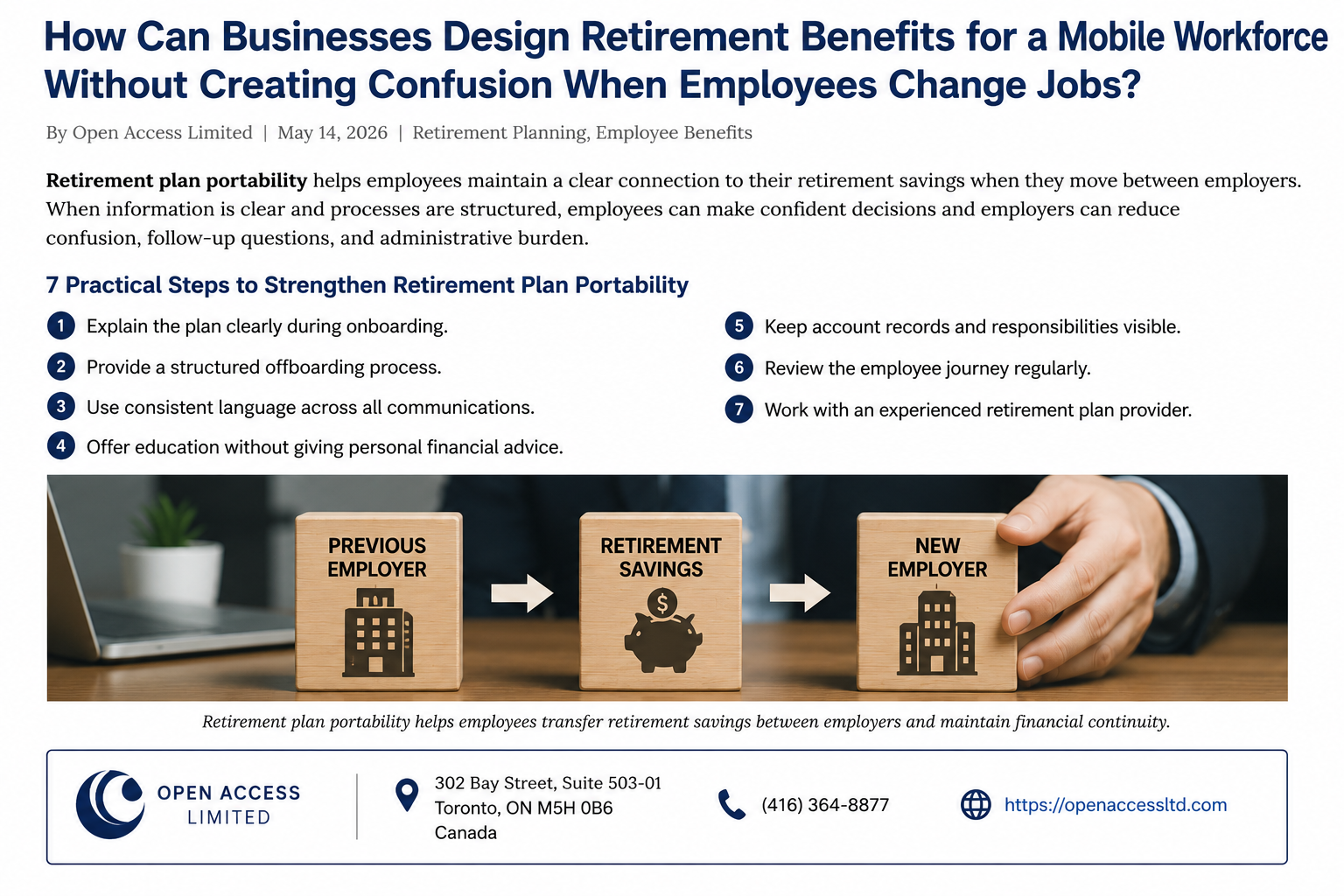
Retirement plan portability is becoming increasingly important as employees change employers, locations, and employment arrangements more frequently throughout their careers.
Modern employees may move between permanent, contract, part-time, and hybrid roles. They may also work for several organizations before retirement. While workplace retirement benefits can provide meaningful long-term value, employees may become confused about what happens to their retirement savings when they leave an employer.
A mobility-aware retirement strategy does not mean that every benefit can automatically move from one plan to another. Plan rules, transfer rights, tax treatment, deadlines, and available options can vary.
Instead, businesses should focus on making retirement plan portability easier to understand. Clear communication, structured onboarding and offboarding, visible responsibilities, and access to qualified guidance can help employees protect their retirement savings while reducing administrative pressure on HR teams.
Why Does Retirement Plan Portability Matter?
When employees change jobs, they may leave retirement accounts behind, miss important deadlines, lose track of plan administrators, or misunderstand their available choices.
Some employees may have retirement savings connected to several former employers. Others may not realize that certain registered retirement amounts may be eligible for direct transfer, depending on the type of plan, governing rules, and individual circumstances.
Confusion can reduce employee confidence and increase the risk that retirement savings become fragmented or forgotten.
For employers, retirement plan portability supports a more organized employee experience. It can reduce repetitive questions, strengthen communication, improve HR efficiency, and demonstrate that the organization supports employees throughout their employment journey—including when they leave.
7 Proven Steps to Improve Retirement Plan Portability
1. Explain the Retirement Plan During Onboarding
Retirement plan portability begins when an employee first joins the organization.
Onboarding materials should clearly explain employee and employer contributions, investment options, fees, vesting or locking-in rules where applicable, and the responsibilities of both the employee and the plan provider.
Employees should also understand what may happen to their account if their employment ends.
Providing this information at the beginning of employment helps employees view retirement benefits as part of a long-term financial strategy rather than an isolated workplace program.
2. Build a Structured Employee Offboarding Process
Departing employees should receive timely and understandable information before access to internal systems ends.
A clear offboarding package may explain available options, important deadlines, required forms, plan-provider contact information, account access, and the possible consequences of each decision.
The information should be written in plain language rather than relying only on technical pension or investment terminology.
A consistent offboarding process can reduce uncertainty and help employees remain connected to their retirement savings after leaving the organization.
Use Consistent Language Across HR and Plan Communications
Retirement terminology can be complicated.
Confusion may increase when HR documents, payroll materials, retirement-plan statements, and provider communications use different terms for the same process.
Businesses should coordinate retirement communications with their plan provider so employees receive one clear and consistent explanation.
Using standardized language across onboarding, annual education, employee portals, and termination materials can strengthen retirement plan portability and reduce avoidable follow-up questions.
4. Support Informed Decisions Without Directing Personal Choices
Employers can provide education, general information, and access to qualified professionals. However, they should avoid telling employees which transfer, preservation, withdrawal, or investment decision is best for them.
An employee’s most appropriate option may depend on personal finances, age, plan type, tax circumstances, retirement goals, and the rules of the receiving arrangement.
The employer’s role is to make information accessible and understandable—not to replace personalized legal, tax, or financial advice.
This balanced approach supports employee confidence while protecting appropriate professional boundaries.
5. Keep Account Records and Responsibilities Visible
Employees should know who holds their retirement account, where statements are delivered, how to update contact information, and whom to contact after leaving the organization.
This is especially important when an employee’s corporate email account is closed.
Businesses can encourage employees to provide an appropriate personal mailing or email address to the plan administrator, where permitted.
Clear responsibility for record updates can prevent employees from losing contact with their retirement savings and support stronger retirement plan portability over time.
6. Review the Employee Journey Regularly
Employers should evaluate the complete retirement-benefit journey from enrollment through departure.
Recurring employee questions can reveal where communication is unclear.
For example, frequent questions about contribution rules may indicate weaknesses in onboarding. Repeated confusion about account access, deadlines, or transfer options may show that offboarding materials need improvement.
Businesses can review employee feedback, HR inquiries, plan-provider reports, and communication outcomes to identify recurring issues.
Regular review helps organizations improve processes before confusion affects a larger number of employees
7. Work With an Experienced Retirement Plan Provider
An experienced retirement-plan provider can help employers coordinate employee education, plan communications, governance processes, and transition support.
The provider can also help ensure that information reflects the specific plan structure rather than relying on general assumptions.
This support is important because retirement plan portability is not identical across every retirement arrangement.
Transfer rights, locking-in requirements, deadlines, tax treatment, and permitted destinations may differ by plan type and jurisdiction.
How Does Portability Support the Business?
A mobility-aware retirement-benefit strategy can create value beyond the individual employee.
Improved Employee Experience
Clear onboarding and offboarding information reduces uncertainty during career transitions.
Employees are more likely to appreciate retirement benefits when they understand both the immediate and long-term value of the plan.
Stronger Employer Brand
Supporting employees during departure demonstrates that the organization values people beyond a single stage of employment.
This can contribute to a more positive professional relationship and workplace reputation.
Greater HR Efficiency
Repeatable communication and offboarding processes can reduce avoidable follow-up questions.
HR teams can spend less time responding to the same concerns and more time supporting strategic workforce priorities.
Better Risk Management
Timely, consistent, and plan-specific communication can help reduce misunderstandings.
It also encourages employers to review materials with the plan provider and appropriate professional advisers.
Stronger Long-Term Plan Value
When employees remain connected to their retirement accounts after changing jobs, they may be more likely to continue thinking about long-term retirement planning.
Retirement plan portability therefore supports continuity even when employment changes.
Important Implementation Considerations
Employers should not describe portability as a universal or automatic process.
Different retirement arrangements may have different transfer rules, locked-in requirements, deadlines, tax consequences, and receiving options.
An option available under one plan may not be available under another.
Before creating detailed employee instructions, businesses should work with their retirement-plan provider and obtain appropriate legal, tax, pension, or financial guidance.
Communications should clearly distinguish between general education and personalized advice.
This approach helps employers provide useful information without creating unrealistic expectations or directing personal financial decisions.
How Open Access Limited Supports Retirement Plan Portability
Open Access Limited helps Canadian employers create a clearer retirement-benefit journey from enrollment through departure.
Its services include group retirement-plan support, employee education, coordinated communications, plan-governance guidance, and employee-focused retirement solutions.
Open Access Limited can help employers explain plan responsibilities, improve onboarding and offboarding communication, and create practical processes that help employees understand what happens to their retirement savings when employment changes.
A coordinated strategy may reduce confusion, support informed employee decisions, and strengthen the long-term value of workplace retirement benefits.
Open Access Limited 302 Bay Street, Suite 503-01 Toronto, ON M5H 0B6 Canada
Retirement plan portability is an important operational and employee-experience consideration for businesses with a mobile workforce.
Employers cannot guarantee that every retirement benefit will transfer seamlessly between plans. However, they can make plan rules, responsibilities, deadlines, and transition options easier to understand.
By improving onboarding, creating structured offboarding, using consistent communication, maintaining clear records, reviewing the employee journey, and working with an experienced plan provider, businesses can reduce confusion when employees change jobs.
A strong retirement plan portability strategy helps employees remain connected to their retirement savings while supporting HR efficiency, employee confidence, and long-term benefit continuity.
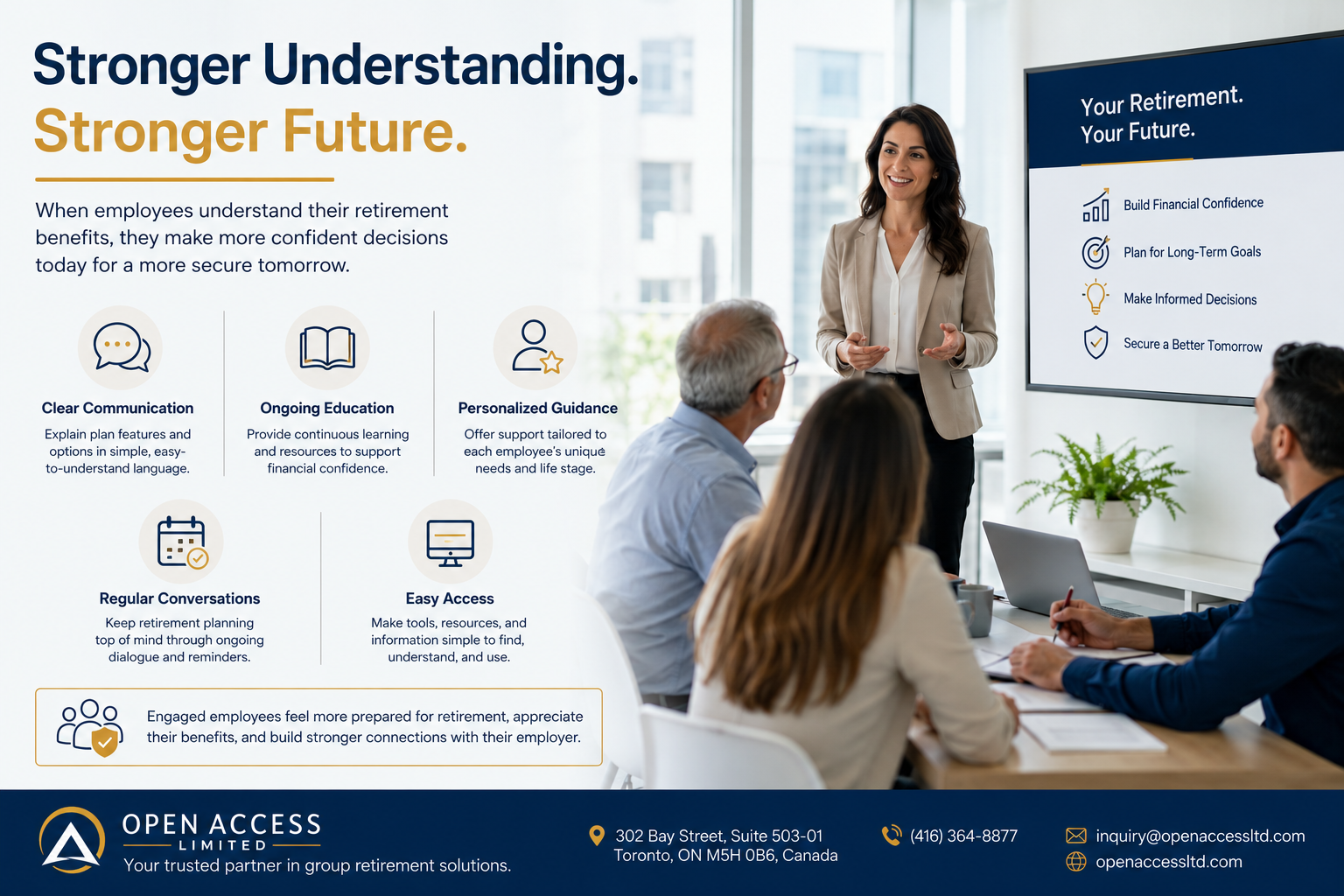
Employee retirement benefits engagement has become one of the most important priorities for organizations that want to maximize the value of their workplace retirement programs. While many employers invest significantly in retirement plans, employees do not always understand how these benefits support their long-term financial wellbeing.
Without clear communication and ongoing education, retirement programs may be underutilized, participation rates may remain lower than expected, and employees may miss valuable opportunities to prepare for retirement. Businesses that actively invest in education, communication, and employee support often create stronger engagement while helping employees make more informed financial decisions.
Rather than viewing retirement plans as a one-time employee benefit, organizations are increasingly treating them as an ongoing financial wellness initiative that evolves throughout an employee’s career.
Why Is Employee Retirement Benefits Engagement Important?
Offering employees retirement benefits engagement is only the first step.
Employees receive the greatest value when they understand how retirement programs work, why participation matters, and how their contributions support long-term financial security.
A lack of understanding can reduce employee confidence and participation while limiting the overall effectiveness of the retirement plan.
Organizations that focus on communication and financial education often create greater trust, improve employee confidence, and encourage long-term participation in workplace retirement programs.
Retirement education also helps employees connect today’s financial decisions with tomorrow’s retirement goals.
5 Smart Ways to Improve Employee Retirement Benefits Engagement
1. Communicate Retirement Benefits Clearly
Retirement plans often contain terminology that employees may not fully understand.
Organizations should communicate plan features using simple language that explains contribution options, employer matching opportunities, investment choices, and long-term retirement objectives.
Clear communication helps employees understand both the immediate and future value of participating in the plan.
2. Provide Ongoing Financial Education
Financial education should continue throughout an employee’s career instead of ending after onboarding.
Educational workshops, webinars, newsletters, retirement planning sessions, and digital learning resources help employees build financial confidence while improving retirement readiness.
Continuous learning encourages greater engagement because employees receive information when it becomes relevant to their current financial situation.
3. Personalize Employee Guidance
Employees have different financial priorities depending on age, income level, career stage, and family responsibilities.
Providing personalized education and communication allows employees to better understand retirement options that fit their own circumstances rather than receiving the same information as everyone else.
This individualized approach can improve understanding while increasing confidence in retirement planning decisions.
4. Encourage Regular Retirement Conversations
Many employees think about retirement only occasionally.
Organizations can improve engagement by encouraging regular discussions during benefit reviews, annual enrollment periods, financial wellness events, and employee education programs.
Frequent communication keeps retirement planning relevant and helps employees adjust their financial strategies as personal circumstances change.
5. Make Retirement Resources Easy to Access
Employees are more likely to engage when retirement information is easy to find and simple to understand.
Businesses can provide online portals, educational videos, retirement calculators, FAQs, and digital planning tools that employees can access whenever needed.
Accessible resources encourage ongoing learning while helping employees make informed financial decisions throughout their careers.
Building Long-Term Employee Financial Confidence
Improving employee retirement benefits engagement is not simply about increasing participation rates.
It is about helping employees develop greater confidence in their financial future.
Organizations that combine education, communication, and personalized support create stronger workplace relationships while demonstrating their long-term commitment to employee wellbeing.
Retirement programs supported by continuous communication often become an important part of a broader employee financial wellness strategy that benefits both employees and employers.
How Open Access Limited Helps Improve Employee Retirement Benefits Engagement
Many organizations choose to work with experienced retirement specialists to strengthen employee understanding and long-term engagement with workplace retirement programs.
Open Access Limited is an independent Canadian group retirement plan provider Employee Retirement Benefits Engagement that works closely with employers to develop retirement solutions focused on education, communication, and employee success.
Rather than simply implementing retirement plans, Open Access Limited supports organizations by helping employees understand the value of their workplace benefits through ongoing financial education, structured onboarding, personalized communication, and continuous engagement initiatives.
These services may help organizations improve employee participation, increase financial confidence, and strengthen retirement readiness while supporting long-term workforce wellbeing.
Open Access Limited
302 Bay Street, Suite 503-01 Toronto, ON M5H 0B6 Canada
Organizations that invest in clear communication, continuous financial education, personalized employee support, and accessible retirement resources often create stronger engagement with workplace retirement programs.
When employees understand how retirement benefits contribute to their long-term financial wellbeing, they are more likely to appreciate the value of their benefits, participate confidently, and remain engaged throughout their careers.
An effective employee retirement benefits engagement strategy can strengthen workplace trust, improve financial confidence, and help businesses maximize the long-term value of their retirement programs.
References
Financial Literacy and Education Commission – Workplace Financial Education Research
Retirement Planning Investment: 5 Powerful Ways to Build Workforce Success
Retirement planning investment is becoming an important part of how organizations evaluate long-term workforce success, employee engagement, and sustainable business growth.
For many businesses, retirement programs have traditionally been viewed as employee benefit expenses. However, modern organizations are increasingly considering how these programs can support broader workforce objectives.
A strategic approach to retirement planning may help companies strengthen employee confidence, improve benefits understanding, and create a stronger connection between workplace programs and organizational goals.
Why Should Businesses View Retirement Planning as an Investment?
A retirement planning investment goes beyond providing a standard workplace benefit.
When designed effectively, retirement programs can support workforce stability, employee value proposition, and long-term planning needs.
Employees often evaluate workplace benefits as part of their overall employment experience. A well-structured retirement strategy may contribute to stronger engagement by helping employees understand the value of their total rewards package.
Organizations that evaluate retirement planning strategically can better understand how benefits influence workforce expectations and future planning.
Retirement programs can support workforce stability by creating benefits structures that encourage long-term participation.
When employees understand available retirement resources, they may feel more prepared when making financial decisions.
Clear retirement planning strategies can help organizations build a more informed and engaged workforce.
2.Improving Employee Financial Education
Employee financial education is a key part of successful retirement planning investment.
Providing resources, guidance, and communication can help employees better understand retirement options and available workplace benefits.
Education helps transform retirement programs from simple benefits into meaningful workforce support tools.
3. Supporting Employee Value Proposition
A strong employee value proposition includes more than salary.
Benefits, workplace culture, professional development, and financial wellness programs all influence how employees view their organization.
Retirement planning can become part of a complete benefits strategy that supports attraction, engagement, and long-term workforce goals.
4. Connecting Benefits With Business Objectives
Organizations can evaluate retirement plans by considering how they align with company priorities.
This may include workforce planning goals, employee participation, communication effectiveness, and long-term organizational needs.
A thoughtful retirement planning investment helps connect employee support with broader business strategies.
5. Creating Sustainable Workforce Planning
Workforce needs continue to change as employee expectations, demographics, and economic conditions evolve.
Retirement strategies that include regular review and improvement can help businesses maintain benefits that remain relevant over time.
A sustainable approach allows organizations to adapt while supporting employees through different career stages.
How Can Organizations Measure Retirement Planning Value?
Businesses may review retirement programs alongside workforce indicators such as employee feedback, participation levels, engagement trends, and retention considerations.
The impact of retirement planning can vary depending on plan design, workforce characteristics, and business objectives.
For this reason, organizations often benefit from a structured approach that combines analysis, communication, and ongoing improvement.
How Open Access Limited Supports Workforce Investment Strategies
Open Access Limited, based in Ontario, works with employers to align retirement plan structures with organizational goals, employee education strategies, and long-term workforce planning needs.
Through customized communication, contribution framework design, and benefits strategy support, Open Access Limited helps organizations evaluate retirement programs as part of a broader workforce investment approach.
Open Access Limited 302 Bay Street, Suite 503-01 Toronto, ON M5H 0B6 Phone: 1-866-625-4777 Email: inquiry@openaccessltd.com Website: OpenAccessLtd.com
Final Thoughts
Retirement planning investment can help businesses create stronger connections between employee benefits and organizational success.
By focusing on education, workforce stability, employee engagement, and sustainable planning, companies can build retirement strategies that support both employees and future business goals.
Viewing retirement planning as a long-term workforce strategy allows organizations to create benefits programs with greater purpose and value.
References
Boston Consulting Group (BCG) – Future of Work and Workforce Strategy Research https://www.bcg.com
In today’s competitive labour market, businesses are increasingly taking a broader approach to compensation by considering not only salary, but also long-term financial wellness programs such as employee retirement plans.
For many organizations, retirement planning has become an important component of the overall employee value proposition (EVP). When integrated thoughtfully into a compensation strategy, retirement programs may help strengthen employee engagement, support workforce retention, and contribute to long-term organizational planning.
Rather than functioning as standalone benefits, retirement plans are often viewed as part of a more comprehensive approach to employee well-being and workforce strategy.
What Is an Employee Value Proposition (EVP)?
An employee value proposition (EVP) refers to the overall value employees receive in exchange for their contributions to an organization.
An EVP often includes:
Salary and compensation
Employee benefits
Career development opportunities
Workplace culture
Financial wellness support
Retirement planning programs
A strong EVP may help organizations attract skilled talent, improve retention, and strengthen employer branding in competitive industries.
Why Retirement Planning Matters in Compensation Strategies
As employees place greater emphasis on financial wellness and long-term security, retirement planning is becoming an increasingly important part of workplace compensation strategies.
Employer-sponsored retirement programs may help employees:
Build long-term financial confidence
Prepare for retirement readiness
Feel supported beyond immediate compensation
View workplace benefits more holistically
For employers, integrating retirement planning into compensation strategies may strengthen the overall perceived value of employment offerings.
1. Strengthening Employee Financial Wellness
Retirement programs can contribute to broader financial wellness initiatives within organizations.
Employer contributions and long-term savings opportunities may support employees’ financial planning goals while helping create a greater sense of long-term financial stability.
Financial wellness support may also positively influence:
Employee confidence
Workplace engagement
Organizational loyalty
Long-term employee satisfaction
2. Supporting Employee Retention and Engagement
Retirement planning may also support employee retention strategies.
Employees who perceive strong long-term financial support from their employer may be more likely to remain engaged and committed to the organization over time.
In many industries, retaining experienced employees is an important workforce objective, particularly in competitive labour markets where talent acquisition costs continue to rise.
Businesses Often Evaluate:
Employee retention rates
Employee satisfaction surveys
Participation in retirement programs
Workforce engagement trends
3. Enhancing Employer Branding and Talent Attraction
Organizations that offer structured retirement programs may strengthen their employer brand by demonstrating a commitment to employee financial well-being.
In situations where salary offerings are relatively similar between employers, retirement benefits and long-term financial programs can become important differentiators.
A strong compensation and retirement strategy may help businesses:
Attract skilled talent
Improve recruitment competitiveness
Enhance employee perception of workplace value
Strengthen overall employer reputation
4. Aligning Retirement Planning With Workforce Objectives
Some organizations integrate retirement planning into broader workforce planning and organizational strategies.
Retirement programs may support:
Long-term workforce participation
Succession planning
Organizational continuity
Workforce stability
Employee retirement readiness
By aligning retirement planning with business objectives, organizations may create a more cohesive and sustainable workforce strategy.
5. Taking a Customized and Data-Informed Approach
Because every workforce is different, many businesses take a customized approach when integrating retirement planning into compensation frameworks.
Factors often considered include:
Workforce demographics
Employee financial priorities
Organizational goals
Compensation structures
Industry competitiveness
As a result, organizations may work with experienced retirement advisory firms to help design retirement strategies aligned with both employee needs and long-term business objectives.
Supporting Long-Term Workforce Planning Through Retirement Strategies
For example, Open Access Limited works with employers across Ontario and Canada to help integrate retirement planning into compensation strategies in ways that support employee financial well-being and long-term organizational planning.
To build a stronger workforce strategy, explore how employee retirement solutions can support long-term engagement and financial wellness.
Supporting Long-Term Workforce Planning Through Retirement Strategies
Employee retirement plans are often viewed as an important part of a company’s compensation strategy. However, many organizations today also recognize these programs as long-term workforce investments that may influence employee retention, engagement, financial wellness, and overall organizational stability.
As businesses continue to compete for skilled talent in evolving labour markets, understanding the return on investment (ROI) of employee retirement plans has become increasingly important.
Rather than relying on a single financial metric, organizations typically evaluate retirement plan ROI through a combination of workforce performance indicators, employee feedback, and long-term business outcomes.Effective employee retirement plans help businesses improve retention, measure long-term value, and create stronger financial wellness strategies.
Why Measuring Retirement Plan ROI Matters
Businesses invest significant resources into employee benefits programs. Measuring the effectiveness of retirement plans may help organizations better understand how these programs contribute to:
Employee retention
Recruitment competitiveness
Workforce engagement
Financial wellness initiatives
Long-term workforce planning
Organizational stability
For many employers, retirement plans are not only employee benefits — they may also support broader business objectives and workforce strategies.
1. Employee Retention and Reduced Turnover Costs
One of the most commonly evaluated indicators of retirement plan ROI is employee retention.
Research suggests that benefits tied to long-term financial well-being may influence employees’ decisions to remain with an organization. Strong retirement offerings can contribute to reduced turnover, helping businesses lower recruitment, onboarding, and training costs.
Retaining experienced employees may also help preserve institutional knowledge and support operational continuity.
Businesses Often Measure:
Employee turnover rates
Average employee tenure
Recruitment and training costs
Retention trends over time
2. Employee Engagement and Workplace Productivity
Organizations may also assess how retirement plans influence employee engagement and productivity.
Employees who feel supported in their financial future may experience lower financial stress, which can positively impact workplace morale, focus, and participation.
Financial wellness initiatives are increasingly being integrated into broader employee engagement strategies across many organizations.
Common Indicators Include:
Absenteeism rates
Employee satisfaction surveys
Workplace engagement scores
Participation in financial wellness programs
Productivity trends
3. Talent Attraction and Employer Competitiveness
In competitive labour markets, retirement benefits may play a role in attracting skilled employees.
Candidates often compare workplace benefits when evaluating job opportunities. A structured retirement program can become part of an employer’s overall value proposition and help strengthen employer branding.
Organizations May Evaluate:
Offer acceptance rates
Time-to-fill positions
Candidate feedback
Recruitment performance metrics
Employer brand perception
4. Workforce Stability and Long-Term Planning
Some organizations also evaluate empoyee retirement plans as part of broader workforce planning and risk management strategies.
Structured retirement programs may support:
Long-term workforce participation
Leadership succession planning
Organizational continuity
Employee retirement preparedness
Businesses may monitor participation rates and retirement readiness to better understand long-term workforce trends.
5. Combining Quantitative and Qualitative Metrics
Measuring the ROI of employee retirement plans often requires a balanced approach using both quantitative and qualitative indicators.
Quantitative Metrics
Businesses may review:
Retention rates
Participation levels
Contribution rates
Recruitment costs
Workforce turnover data
Qualitative Indicators
Organizations may also consider:
Employee feedback
Workplace satisfaction
Financial wellness perceptions
Employee confidence in retirement readiness
Because every organization is different, outcomes may vary depending on workforce demographics, plan structure, and overall business strategy.
Supporting Long-Term Business Goals Through Retirement Planning
Many businesses work with experienced retirement advisory firms to help design retirement strategies aligned with workforce and organizational objectives.
For example, Open Access Limitedworks with employers across Ontario and Canada to help develop retirement program structures focused on employee financial well-being and long-term organizational planning.
Final Thoughts
Employee retirement plans are often viewed as more than standard workplace benefits. For many organizations, they represent long-term investments in workforce stability, employee well-being, and business continuity.
By evaluating factors such as retention, engagement, talent attraction, and workforce planning, businesses can gain a broader understanding of the value retirement programs may provide over time.
References
Benefits Canada (2025) — Employee Benefits and Retention Insights
Gallup (2024) — State of the Global Workplace Report
Mercer (2024) — Global Talent Trends Report
OECD (2023) — Pensions and Workforce Participation Analysis
Willis Towers Watson (WTW) (2023) — Global Benefits Attitudes Surve