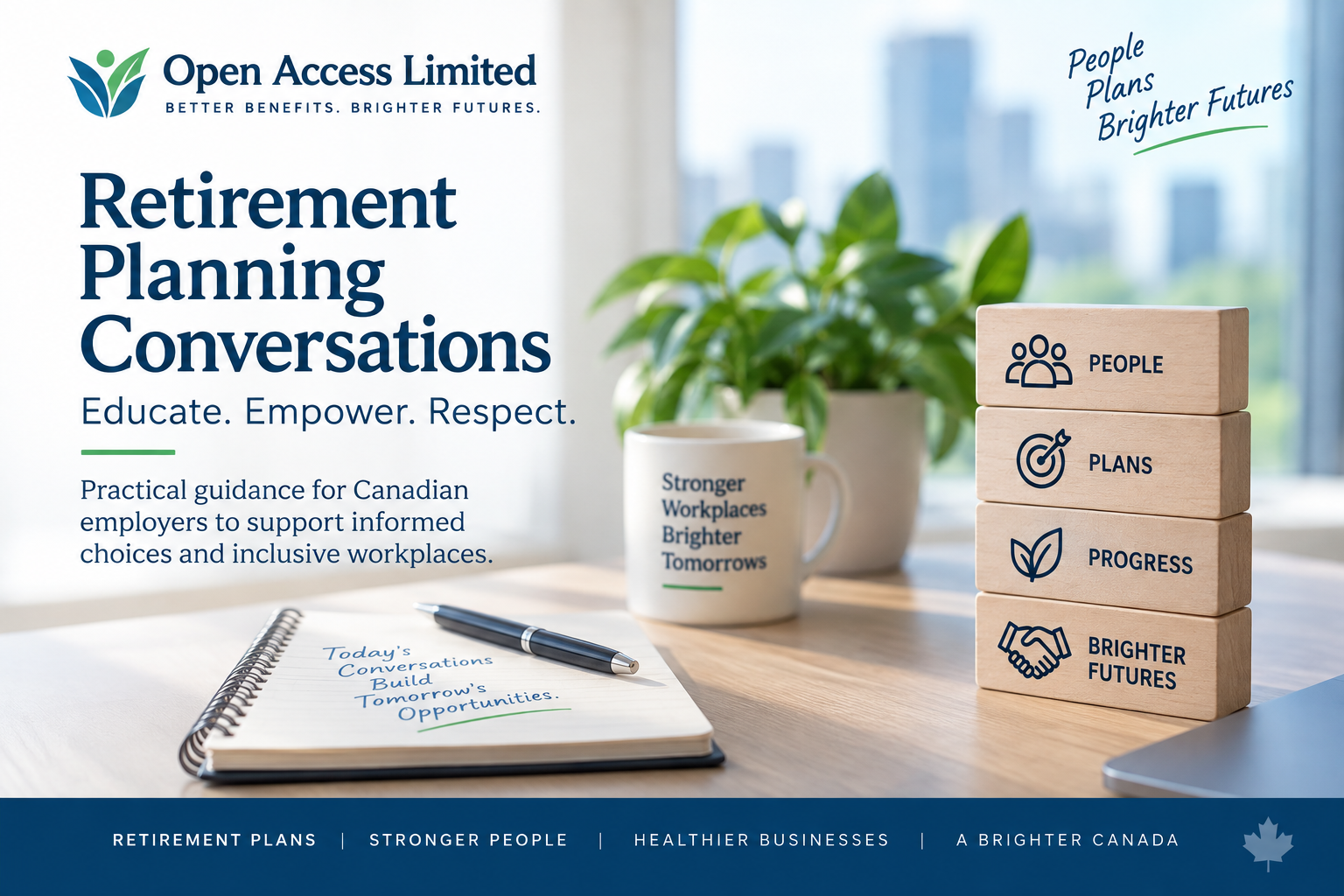
Canadian businesses can approach retirement planning conversations by keeping communication age-neutral, making retirement education broadly available, offering additional resources voluntarily, and separating retirement education from individual employment decisions..
In these situations, retirement planning conversations should remain voluntary and focused on the employee’s individual choices and available options.
Employers should avoid making assumptions about an employee’s retirement timing based on age, pension eligibility, health, or how long the employee is expected to continue working.
A practical approach is to focus on helping employees understand their workplace retirement plan and available resources rather than encouraging a particular employee to retire.
Why Retirement Planning Conversations Require Care
Clear retirement planning conversations can help employees better understand available resources while keeping individual retirement decisions personal
Well-structured retirement planning conversations can help employers provide useful information while respecting employee choice and avoiding assumptions about individual retirement timing.
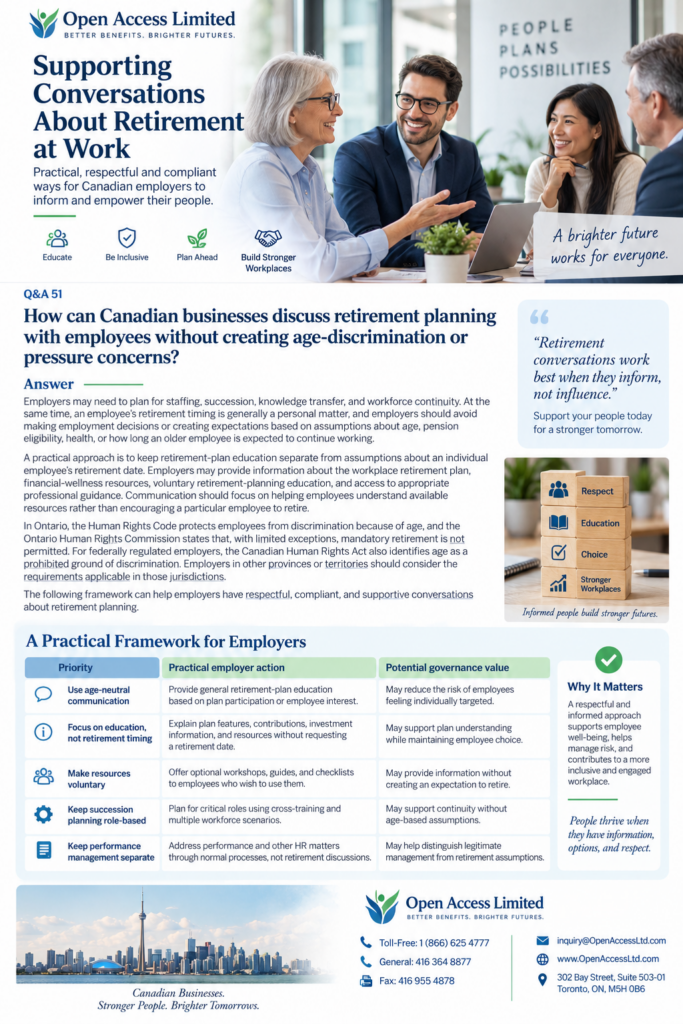
Employers may need to plan for staffing, succession, knowledge transfer, and workforce continuity. At the same time, an employee’s retirement timing is generally a personal matter.
Retirement-plan education should therefore be kept separate from assumptions about when a particular employee may leave the workforce.
Canadian businesses can manage retirement planning conversations by using age-neutral communication, providing retirement education broadly, keeping additional resources voluntary, and separating retirement discussions from performance or employment decisions. Employers should avoid assumptions about retirement timing based on age, pension eligibility, health, or expected tenure, and refer sensitive individual matters to HR or qualified legal professionals.
Employers may provide:
- workplace retirement-plan information;
- financial-wellness resources;
- voluntary retirement-planning education; and
- access to appropriate professional guidance.
Communication should focus on helping employees understand available resources rather than suggesting that a particular employee should retire.
In Ontario, the Human Rights Code protects employees from discrimination in employment because of age. The Ontario Human Rights Commission also states that, with limited exceptions, mandatory retirement is not permitted.
For federally regulated employers, the Canadian Human Rights Act also identifies age as a prohibited ground of discrimination.
Employers in other provinces and territories should consider the human-rights and employment requirements that apply in their jurisdiction.
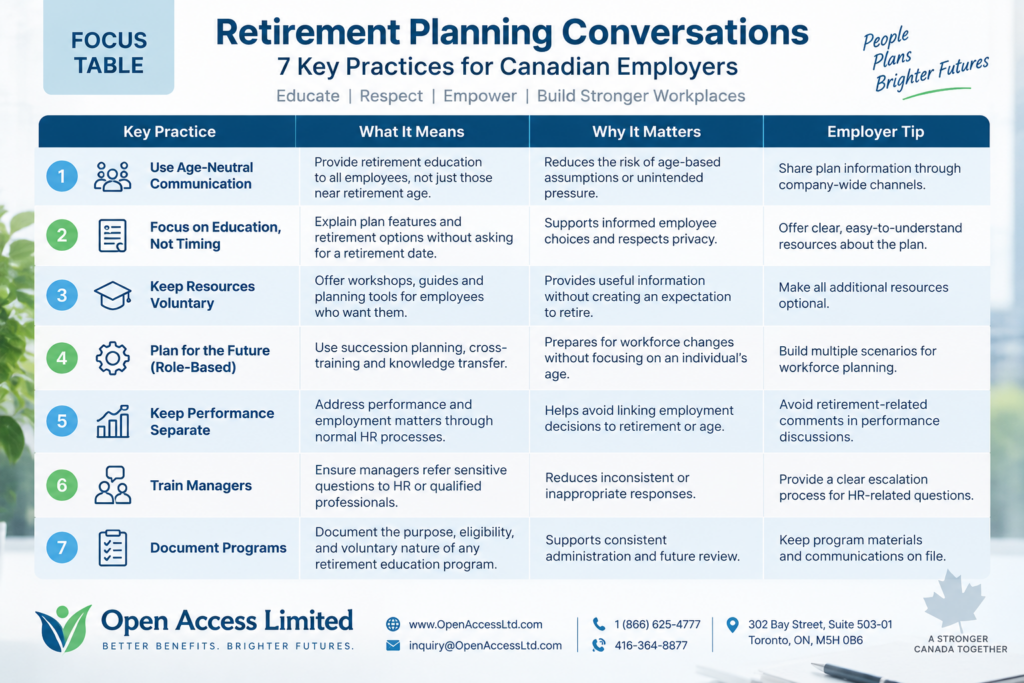
7 Smart Retirement Planning Practices for Canadian Employers
1. Use Age-Neutral Communication
Retirement-plan education should be made available based on plan participation, employee interest, or broadly scheduled education.
It should not be offered based on an assumption that employees of a certain age are preparing to leave the workforce.
Age-neutral communication may help reduce the risk of employees feeling individually targeted because of age.
2. Focus on Education, Not Retirement Timing
Employers can explain:
- plan features;
- employee contributions;
- employer contributions or matching, where applicable;
- investment information;
- retirement-income concepts;
- fees;
- available member tools; and
- where employees may obtain qualified assistance.
The purpose of retirement education should be to help employees understand their options, not to request that they commit to a retirement date.
3. Make Additional Retirement Resources Voluntary
Employers may offer optional:
- workshops;
- guides;
- checklists;
- retirement-readiness resources; and
- access to qualified support.
These resources should be available to employees who wish to use them.
Keeping additional resources voluntary may provide useful information without creating an expectation that retirement is required.
4. Keep Succession Planning Role-Based
Succession planning is a legitimate business consideration, but employers do not necessarily need to know exactly when a particular employee plans to retire.
Instead, businesses can prepare around roles and workforce scenarios through:
- cross-training;
- documentation of key processes;
- leadership development;
- knowledge-transfer procedures;
- interim coverage;
- planning for earlier-than-anticipated departures;
- planning for longer-than-anticipated tenure; and
- voluntary phased transitions where legally and operationally appropriate.
This allows the organization to prepare for workforce changes without making assumptions about an individual employee based on age.
5. Keep Performance Management Separate
Performance, attendance, restructuring, role changes, and conduct should be addressed through the employer’s normal HR processes.
They should not be reframed as retirement discussions.
Employers should be cautious about statements such as:
- “Have you thought about retiring?”
- “Isn’t it time to slow down?”
- “Wouldn’t retirement make sense now?”
- “We need younger people for the next phase.”
Statements of this nature may create age-discrimination concerns, particularly when connected to decisions about continued employment, promotion, training, assignments, or termination.
6. Train Managers to Escalate Sensitive Questions
Managers should have a clear process for referring retirement, pension, accommodation, and employment-law questions to HR or appropriately qualified professionals.
Managers should generally avoid answering sensitive retirement or employment questions informally when those questions involve legal or employment issues.
A clear escalation process may help reduce inconsistent or inappropriate responses.
7. Document Formal Retirement Planning Programs
If an employer provides a formal pre-retirement education or transition program, the business should document:
- the purpose of the program;
- eligibility criteria;
- how the program is communicated; and
- the voluntary nature of participation.
Clear documentation may support consistent administration and future review.
What Retirement Planning Education Can Employers Provide?
A business does not necessarily need to avoid retirement education because age discrimination is a concern.
Effective retirement planning conversations can help employees better understand their workplace plan, available resources, and individual options.
The more important distinction is between:
- general or voluntary education available to employees; and
- individual pressure or employment decisions based on age or presumed retirement intentions.
Employers may provide ongoing education about:
- plan contributions;
- employer contributions or matching, where applicable;
- investment options and risk profiles;
- fees;
- retirement-income concepts;
- available member tools;
- government retirement resources;
- plan portability;
- beneficiary information; and
- where employees may obtain qualified assistance.
Retirement education should also not be limited to onboarding.
The Canadian Association of Pension Supervisory Authorities recommends that member education and communication for capital accumulation plans be considered on an ongoing basis rather than only at initial enrolment.
Making information available periodically to a broader group of employees may also reduce the need for managers to initiate individualized retirement conversations based on perceived age.
Regular retirement planning conversations can also help employees understand their workplace plan and available educational resources throughout their careers.
What Should Employers Avoid in Retirement Conversations?
Retirement discussions can become sensitive when they begin to suggest that continued employment is connected to an employee’s age.
Employers should be particularly cautious about:
- repeatedly asking an employee when they intend to retire when they have not volunteered such plans;
- assuming an employee wants fewer responsibilities because of age;
- linking pension eligibility to an expectation that an employee should leave;
- making assumptions about health, energy, adaptability, productivity, or career ambition based on age;
- using retirement discussions as a substitute for performance management;
- excluding older employees from training, promotion, development, or new assignments because retirement is assumed to be approaching;
- targeting only older employees with communications that imply they are expected to leave; or
- presenting an optional retirement arrangement in a way that could reasonably be perceived as coercive.
These examples do not mean that every retirement-related conversation automatically constitutes discrimination.
The context, jurisdiction, purpose, wording, frequency, and surrounding employment decisions may all matter.
Employers should obtain qualified HR or legal advice where a conversation involves a particular employee’s employment status or potential retirement date.
Employers should approach individual retirement planning conversations carefully when age, performance, pension eligibility, or continued employment may become part of the discussion.
Can Employers Offer Voluntary Phased Retirement?
Some employees may independently express an interest in gradually reducing their work commitments before retirement.
Where an employer wishes to offer:
- phased work;
- reduced hours;
- consulting arrangements;
- mentoring roles; or
- another transition option,
participation should generally be voluntary and the arrangement should be reviewed carefully.
Depending on the circumstances, the arrangement may involve:
- employment law;
- human rights;
- pension and benefit eligibility;
- payroll;
- tax;
- compensation;
- accommodation obligations;
- employment-status questions; and
- plan rules.
The existence of pension eligibility or a particular age should not automatically determine whether an employee is expected to participate.
Why This Matters to Canadian Business Owners
The objective is not to prevent retirement-planning conversations altogether.
Clear retirement planning conversations can also support a more consistent approach to employee education across the workplace.
A more appropriate process is one in which:
- employees have access to retirement-plan education;
- additional planning resources are voluntary;
- managers know where to refer sensitive questions;
- workforce planning is based on roles and scenarios rather than age assumptions;
- employment decisions remain separate from retirement-plan education; and
- individualized employment or legal issues are escalated appropriately.
This type of process may help create clearer boundaries between retirement education and employment decision-making.
It should not be presented as guaranteeing employee trust, preventing discrimination complaints, improving retention, or ensuring legally compliant outcomes in every situation.
How Can Open Access Limited Support Retirement Planning Education?
Open Access Limited may support employers with the retirement-plan education and member-support elements that can help inform retirement planning conversations.
Structured retirement planning conversations can also help employers provide consistent plan education and access to appropriate member resources.
Depending on the applicable plan, Open Access Limited may support employers through:
- plan-specific employee education;
- enrolment and plan materials;
- explanations of plan features;
- retirement-planning resources;
- financial-wellness education;
- member-support channels; and
- communication relating to applicable group retirement-plan provisions.
These resources may allow employers to provide retirement information through a structured plan-education process rather than relying on individual managers to explain retirement-plan details informally.
Open Access Limited should not be positioned as determining whether an employer’s retirement conversation complies with human-rights or employment law, training managers on employment-law obligations, deciding when an employee should retire, or advising an employer on termination or performance management unless those services are specifically within the scope of an applicable engagement.
Those matters should be addressed through the employer’s HR function and appropriately qualified legal professionals.
Open Access Limited
Website: www.OpenAccessLtd.com
Email: inquiry@OpenAccessLtd.com
Address: 302 Bay Street, Suite 503-01, Toronto, ON, M5H 0B6
Toll-Free: 1 (866) 625-4777
General: 416-364-8877
Fax: 416-955-4878
The Bottom Line
Effective retirement planning conversations should focus on education, access to information, and employee choice rather than assumptions about when a particular employee should retire.
Well-designed retirement planning conversations can support employee education while helping employers maintain clear boundaries between retirement information and employment decisions
Canadian employers can create clearer boundaries by using age-neutral communication, making additional resources voluntary, keeping succession planning role-based, separating employment decisions from retirement education, and referring sensitive matters to appropriate HR or legal professionals.
Effective retirement planning conversations can give employees clearer access to information while helping employers maintain appropriate boundaries around individual retirement decisions.
Frequently Asked Questions
Can an employer ask an employee when they plan to retire?
Context matters. Repeatedly asking an employee about retirement when they have not volunteered such plans may create concerns, particularly where the conversation is connected to age or employment decisions.
Should retirement education only be offered to older employees?
Employers should generally use age-neutral communication and broadly available retirement education rather than targeting employees because they are assumed to be approaching retirement.
Can Canadian employers offer phased retirement?
Potentially. Participation should generally be voluntary, and the arrangement may require consideration of employment law, human rights, pension and benefit eligibility, payroll, tax, compensation, accommodation obligations, and plan rules.
Can Open Access Limited support retirement planning education?
Depending on the applicable plan, Open Access Limited may provide plan-specific employee education, retirement-planning resources, financial-wellness education, enrolment materials, plan information, and member-support channels.
References
- Ontario Human Rights Commission. Age Discrimination. Guidance on protection from age discrimination in employment.
- Ontario Human Rights Commission. The End of Mandatory Retirement. Guidance explaining Ontario’s protection against age-based mandatory retirement, subject to limited exceptions.
- Government of Ontario. Human Rights Code, R.S.O. 1990, c. H.19. Current Ontario legislation governing equal treatment in employment, including discrimination based on age.
- Government of Canada, Justice Laws. Canadian Human Rights Act. Federal legislation identifying age as a prohibited ground of discrimination in areas under federal jurisdiction.
- Government of Canada. Rights in the Workplace. Overview of the Canadian Human Rights Act’s application to federally regulated employers.
- Canadian Association of Pension Supervisory Authorities (CAPSA) (2024). Guideline No. 3: Guideline for Capital Accumulation Plans. Guidance concerning plan communication, education, governance, and member responsibilities.
- Open Access Limited. Employee/Member Retirement Planning Resources. Current retirement-planning resources and member-support information.
Editorial Note
This Q&A is general educational content for employers and is not legal, human-rights, employment, pension, tax, payroll, HR, or regulatory advice.
Retirement discussions and age-discrimination obligations are fact-specific and may differ by jurisdiction and employment context. Employers should obtain appropriately qualified employment-law, human-rights, HR, and retirement-plan advice before implementing policies, programs, or individual employment decisions involving retirement.