Tag: retirement plan governance

  • How Can Canadian Businesses Prevent Former Employees From Losing Track of Workplace Retirement Benefits After They Leave?

    How Can Canadian Businesses Prevent Former Employees From Losing Track of Workplace Retirement Benefits After They Leave?


    Former employee retirement benefits can remain relevant long after an employee’s final day at work.

    When employment ends, retirement savings do not necessarily disappear or immediately leave the workplace plan. Depending on the plan structure and official plan terms, a former employee may continue to hold assets with the retirement-plan provider for some time.

    The challenge is that life moves on.

    Former employees may change their home address, email, telephone number, or other contact information. They may forget which provider holds the account, overlook statements or tax slips, or fail to complete an action required under the plan.

    A strong employer departure process cannot guarantee that a former member will never become difficult to locate.

    It can, however, make former employee retirement benefits easier to understand and keep important information current before the employment relationship ends.

    CAPSA guidance recognizes that an individual may remain a member after employment ends and that the sponsor can retain responsibilities while the former member still has assets in the plan. OpenAccess_Q21_QA_with_Resource…

    Quick Answer: How Can Employers Protect Former Employee Retirement Benefits?

    Canadian employers can support former employee retirement benefits by confirming contact information before departure, explaining what happens to the account after employment ends, providing a clear departure checklist, coordinating HR, payroll and provider information, keeping appropriate records, reminding employees to update beneficiary information, and directing individual transfer or investment decisions to the provider or qualified professionals.

    The strongest process begins before the employee’s last day.

    On This Page

    1. Why Former Employee Retirement Benefits Can Be Lost
    2. 7 Smart Employer Steps
    3. What Employees Need Before Their Last Day
    4. What Happens to the Retirement Account After Leaving
    5. CAPSA Guidance for Departing Members
    6. Missing Members and Contact Information
    7. Questions Departing Employees Commonly Ask
    8. What Employers Should Avoid
    9. Privacy and Recordkeeping
    10. Ongoing Education Before Departure
    11. How Open Access Limited May Support Departing Employees
    12. Frequently Asked Questions
    13. Final Thoughts
    14. References

    Why Former Employee Retirement Benefits Can Become Difficult to Track

    The risk is usually not that the account simply disappears.

    The larger issue is disconnection between the former employee and the account.

    That can happen when:

    • A personal address changes
    • An employee stops using a work email address
    • A telephone number changes
    • Provider information is forgotten
    • Statements go to an old address
    • Required forms are not completed
    • Deadlines are misunderstood
    • Beneficiary information remains outdated
    • The former employee does not know whom to contact later

    This is why former employee retirement benefits should be included in offboarding rather than treated as an afterthought.

    A clear offboarding process can help keep former employee retirement benefits connected to current contact information, provider resources, and important plan documents.

    A useful employer principle is:

    Before Departure → Confirm Information → Explain the Plan → Provide Contacts → Document the Process
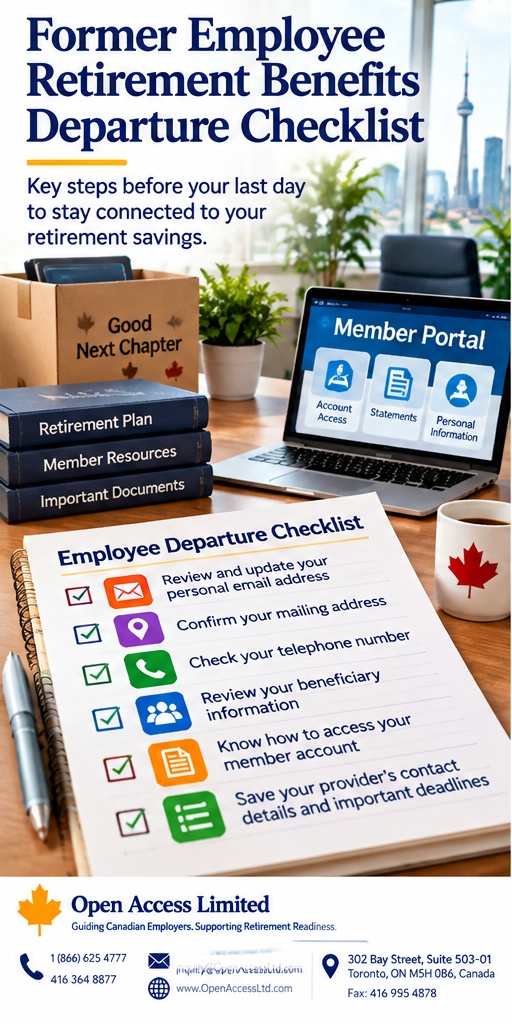
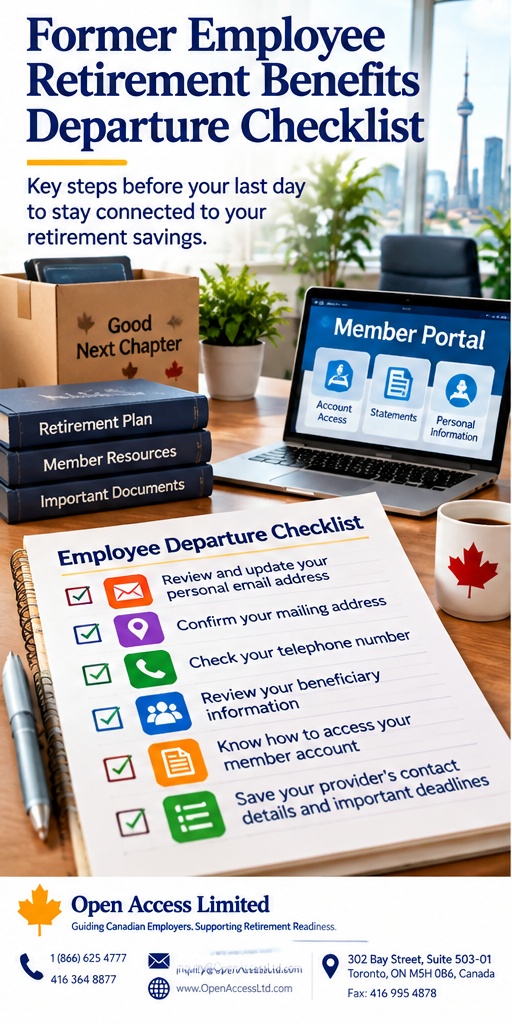
    Former employee retirement benefits departure checklist with updated contact information, beneficiary review, member portal access, provider details, and final plan communication.

    7 Smart Steps to Protect Former Employee Retirement Benefits

    1. Confirm Personal Contact Information Before the Last Day

    Do not wait until the employee has already left.

    Before departure, remind employees to review the personal information held by the retirement-plan provider.

    This may include:

    • Personal email address
    • Mailing address
    • Telephone number
    • Other applicable contact information

    Employees can also be reminded to review their beneficiary information.

    The objective is not for HR to collect unnecessary personal information.

    It is to ensure the employee knows where their current contact details should be maintained.

    Accurate information can reduce the likelihood that former employee retirement benefits later become difficult to reconnect with their owner.

    2. Explain What Happens After Employment Ends

    Employees often know what happens to payroll on their last day but may not understand what happens to their retirement account.

    Before departure, provide a plain-language explanation based on the official plan documents.

    Depending on the arrangement, explain:

    • What happens to employee contributions
    • What happens to employer contributions
    • When final contributions are processed
    • Whether account access continues
    • How statements are received
    • Where applicable tax documents will be sent
    • Whether the employee can remain in the plan
    • Which actions or deadlines may apply

    CAPSA guidance identifies information sponsors should provide when active participation ends, including whether the member may remain in the plan, transfer options, applicable fees, actions and deadlines, default options, and tax consequences. OpenAccess_Q21_QA_with_Resource…

    Clear explanations make former employee retirement benefits easier to manage after the employee leaves.

    3. Give Every Departing Employee a Retirement Plan Departure Checklist

    A checklist is one of the strongest practical improvements for this article and for employers.

    The checklist can include:

    Before You Leave

    • Confirm personal email
    • Confirm mailing address
    • Confirm telephone number
    • Review beneficiary information
    • Save provider contact information
    • Confirm member portal access

    After Employment Ends

    • Review official provider communication
    • Watch for final contributions
    • Review statements
    • Note applicable deadlines
    • Keep tax documents
    • Update contact information after future moves

    Need Help?

    • Contact the retirement-plan provider for plan-specific information
    • Contact a qualified professional for personal transfer, tax, investment, or legal advice

    This is useful, actionable content—the type Business Owners are more likely to save or share.

    4. Keep Information Separate From Personal Advice

    A departure package should explain the process, not tell an employee what financial decision to make.

    Employers should not say:

    “Transfer your account immediately.”

    “Leave the money where it is.”

    “Cash it out.”

    “Move everything into this investment.”

    Instead:

    “These are the options available under the plan. Please review the official provider materials and obtain qualified advice if you need help deciding which option is appropriate for you.”

    This distinction helps keep former employee retirement benefits education useful without converting offboarding communication into personal financial advice.

    5. Coordinate HR, Payroll and the Retirement-Plan Provider

    The employee should not receive contradictory information.

    Before the employment relationship ends, HR, payroll and the provider should be aligned on relevant operational information such as:

    • Termination date
    • Final payroll
    • Final employee contributions
    • Final employer contributions
    • Required notices
    • Applicable forms
    • Account-status information
    • Provider contact details

    The source recommends consistent information between HR, payroll and the provider because coordination may reduce administrative errors. OpenAccess_Q21_QA_with_Resource…

    This is especially important when former employee retirement benefits remain with the provider after the employee leaves.

    6. Maintain Appropriate Records and Protect Privacy

    Employers should keep appropriate records of departure communications and administrative steps.

    This may include:

    • What information was provided
    • When it was provided
    • Relevant notices
    • Provider coordination
    • Attempts to contact a former member where appropriate
    • Applicable follow-up

    But retirement-plan and personal information should also be handled consistently with applicable privacy requirements.

    More data is not always better.

    Employers should retain what is necessary for the applicable process and avoid unnecessary sharing of personal information.

    This is where the organization’s broader retirement plan data security practices become relevant.

    7. Review the Departure Process Regularly

    Offboarding processes can become outdated.

    The organization may introduce:

    • A new provider
    • A new payroll platform
    • Remote work
    • Multiple offices
    • New retirement-plan options
    • New portal access
    • Updated forms
    • Different communication channels

    Review the retirement portion of the departure process periodically.

    Pay particular attention to employees who work remotely or in different locations.

    A modern former employee retirement benefits process should work equally well for an employee working at head office and someone leaving remotely.

    What Should Departing Employees Know Before Their Last Day?

    An effective departure conversation should answer a few basic questions.

    What Happens to My Retirement Account?

    Explain the plan-specific process using official documents.

    Will My Employer Keep Contributing?

    Typically, employer contributions connected to active employment will be governed by plan terms and the ending of employment. Employers should explain the applicable plan process rather than make assumptions.

    Can I Still Access My Account?

    Tell the employee how portal or account access works after departure.

    Where Will My Statements and Tax Documents Go?

    This is why confirming personal contact information matters.

    Do I Need to Do Anything Immediately?

    Explain applicable forms, actions and deadlines.

    Who Do I Contact Later?

    Make this exceptionally clear.

    A departing employee should leave knowing the provider name, account-access method and support contact.

    Employers can make former employee retirement benefits easier to manage by giving departing employees clear information before workplace access and company email accounts are closed.
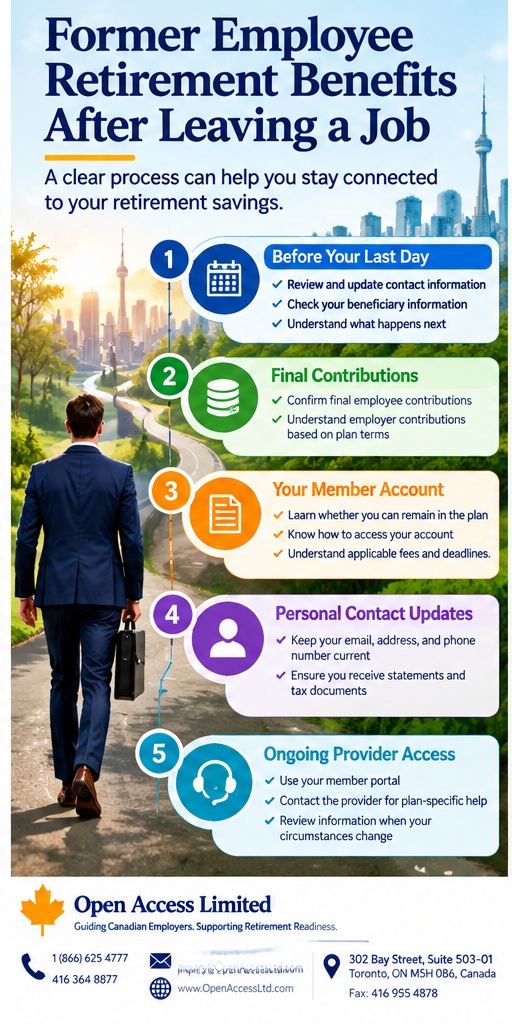
    Former employee retirement benefits timeline showing final contributions, account access, provider communication, contact updates, statements, and ongoing member support.

    What Regulatory Guidance Says About Former Members

    For capital accumulation plans, CAPSA guidance specifically addresses situations where active participation ends.

    It describes information that may need to be provided concerning:

    • Remaining in the plan
    • Transfers
    • Fees
    • Actions
    • Deadlines
    • Default options
    • Tax consequences

    It also emphasizes maintaining accurate member records and having a process to locate missing members. OpenAccess_Q21_QA_with_Resource…

    That makes contact-information accuracy more than a simple HR convenience.

    It is an important part of ongoing plan administration.

    Ontario Pension Plans and Missing Members

    Ontario provides an additional pension-plan example.

    FSRA guidance discusses practices such as:

    • Maintaining accurate records
    • Paying particular attention to termination
    • Reminding members to update contact information
    • Beginning searches promptly when contact is lost

    FSRA consumer information cited in the source also says a member of an Ontario pension plan must receive a written statement from the administrator within 30 days after employment ends. OpenAccess_Q21_QA_with_Resource…

    This Ontario example applies to registered pension plans and should not automatically be applied to a Group RRSP or DPSP.

    For those arrangements, the actual plan terms and provider process remain important.
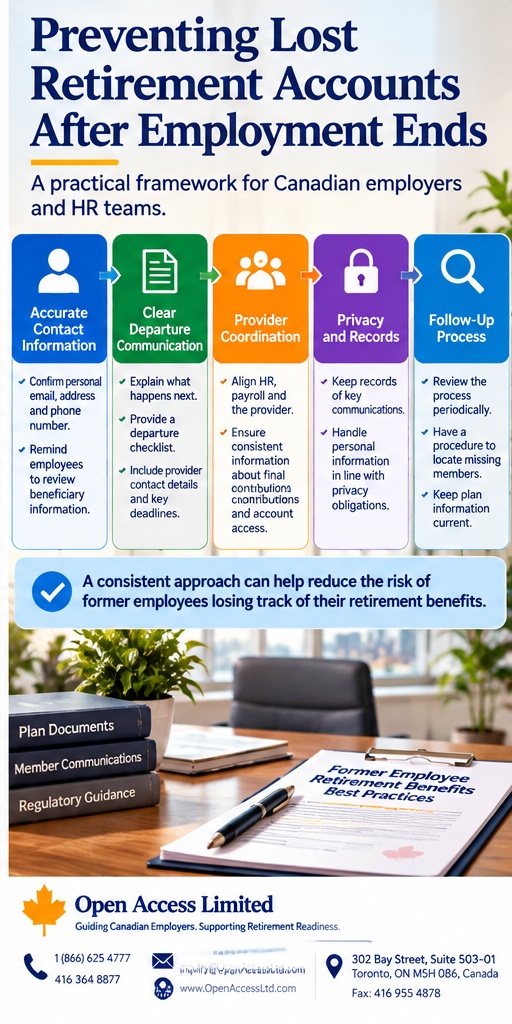
    Former employee retirement benefits framework for preventing lost accounts through accurate contact information, provider coordination, privacy, records, and follow-up.

    Why Beneficiary Information Should Be Reviewed Before Departure

    Contact details are not the only information that can become stale.

    Employees should also periodically review beneficiary information.

    A departure reminder creates another opportunity to say:

    “Please check that the beneficiary information recorded with your workplace retirement plan is current.”

    Do not recommend whom the employee should name.

    The purpose is simply to remind the employee that information may need review.

    This connects naturally with your Q55 article on beneficiary designations.

    What Employers Should Avoid

    Employers should avoid:

    • Telling an employee which transfer option to choose
    • Recommending a withdrawal
    • Providing investment recommendations
    • Predicting tax outcomes
    • Promising that the employee can remain in the plan
    • Using outdated provider information
    • Sending retirement information only to a work email that will soon close
    • Assuming all plan types have the same termination rules
    • Ignoring beneficiary or contact-information reminders
    • Waiting until after termination to explain the process

    The goal is clarity without personal advice.

    Why Ongoing Education Should Start Before Offboarding

    The best departure process actually begins much earlier.

    Employees can receive periodic reminders throughout employment to:

    • Maintain current contact information
    • Review beneficiary information
    • Know the provider name
    • Know where their account is located
    • Understand basic plan features
    • Keep personal access credentials current

    The source specifically notes that contact and beneficiary reminders are better repeated throughout employment rather than raised only when someone leaves. OpenAccess_Q21_QA_with_Resource…

    That can make former employee retirement benefits easier to manage because information is already current before departure.

    Important Implementation Boundaries

    What happens after employment ends depends on factors such as:

    • Plan type
    • Official plan documents
    • Jurisdiction
    • Locked-in status
    • Tax rules
    • Privacy requirements

    Employers should not promise a particular outcome or provide individualized:

    • Transfer advice
    • Withdrawal advice
    • Investment advice
    • Legal advice
    • Tax advice

    The source specifically recommends confirming the employer’s departure process with the plan administrator or provider and obtaining qualified advice appropriate to the plan and jurisdiction. OpenAccess_Q21_QA_with_Resource…

    How Open Access Limited May Support Departing Employees

    Where a workplace retirement plan is provided through Open Access Limited, employers may direct departing employees to current Open Access resources.

    Open Access Limited’s materials include:

    • Information-change forms
    • Contact-detail updates
    • Beneficiary updates
    • Transfer authorization forms
    • Member portal access
    • Account balances
    • Statements
    • Transaction history
    • Client Relations support

    These resources can help keep former employee retirement benefits connected to current member information and appropriate plan contacts. OpenAccess_Q21_QA_with_Resource…

    The employer should still confirm with Open Access Limited what happens to the account under the specific plan when employment ends.

    Ongoing access to accurate provider information is an important part of helping employees manage former employee retirement benefits after the employment relationship ends.

    Open Access Limited should not be presented as providing legal or individual tax advice.

    Open Access Limited
    302 Bay Street, Suite 503-01
    Toronto, ON M5H 0B6, Canada

    Toll-Free: 1 (866) 625 4777
    General: 416 364 8877
    Fax: 416 955 4878
    Email: inquiry@OpenAccessLtd.com
    Website: www.OpenAccessLtd.com

    Frequently Asked Questions About Former Employee Retirement Benefits

    What Happens to Workplace Retirement Savings When an Employee Leaves?

    The answer depends on the retirement-plan type, official plan terms and provider process. Employees should receive current plan-specific information before departure.

    Can a Former Employee Leave Retirement Savings With the Existing Provider?

    Possibly. CAPSA guidance recognizes that in some capital accumulation plans a former member may remain in the plan after employment ends. The specific answer depends on the applicable plan. OpenAccess_Q21_QA_with_Resource…

    Does a Former Employee Have to Transfer the Account?

    Not necessarily. Available options and requirements depend on the plan. Employers should explain the options without recommending which one the employee should choose.

    Where Will Statements and Tax Slips Be Sent?

    That is one reason employees should ensure their current personal contact information is recorded with the appropriate provider.

    What Happens if a Former Employee Moves?

    The former employee should update the provider with current contact details using the applicable process.

    Should Employees Review Their Beneficiary Before Leaving?

    It is a useful opportunity to remind employees to review their beneficiary information, without advising them whom to designate.

    What if a Former Employee Cannot Access the Account Later?

    The employee should contact the applicable plan provider using current official contact information.

    Can Open Access Limited Help After an Employee Leaves?

    Where the plan is administered through Open Access Limited, former employees may be directed to the applicable member forms, portal and Client Relations team for plan-specific information.

    Final Thoughts

    Protecting former employee retirement benefits does not require an overly complicated process.

    The strongest approach is simple:

    Confirm Contact Information → Explain What Happens Next → Provide a Departure Checklist → Coordinate HR, Payroll and Provider → Protect Records → Avoid Personal Advice → Review the Process

    For Business Owners, this is good governance.

    For HR teams, it creates a more consistent offboarding process.

    For employees, it means leaving the company with clearer information about where their retirement savings are, how to stay connected to them, and whom to contact later.

    And for Open Access Limited, it creates a natural and useful role around plan information, member forms, portal access, transfer documentation and Client Relations support—without overpromising outcomes.

    References

    1. Canadian Association of Pension Supervisory Authorities (CAPSA) — Guideline No. 3: Guideline for Capital Accumulation Plans.
    2. Financial Services Regulatory Authority of Ontario (FSRA) — Missing Members: Principles and Practices.
    3. Financial Services Regulatory Authority of Ontario — Events That May Affect Your Pension.
    4. Open Access Limited — Member Forms; Member Resources.

  • How Can Canadian Businesses Help Employees Understand Beneficiary Designations and Family Protection in Workplace Retirement Plans?

    How Can Canadian Businesses Help Employees Understand Beneficiary Designations and Family Protection in Workplace Retirement Plans?

    Beneficiary designations are an important but sometimes overlooked part of a workplace retirement plan.

    An employee may participate in a plan for many years without reviewing who is currently named to receive plan proceeds after their death.

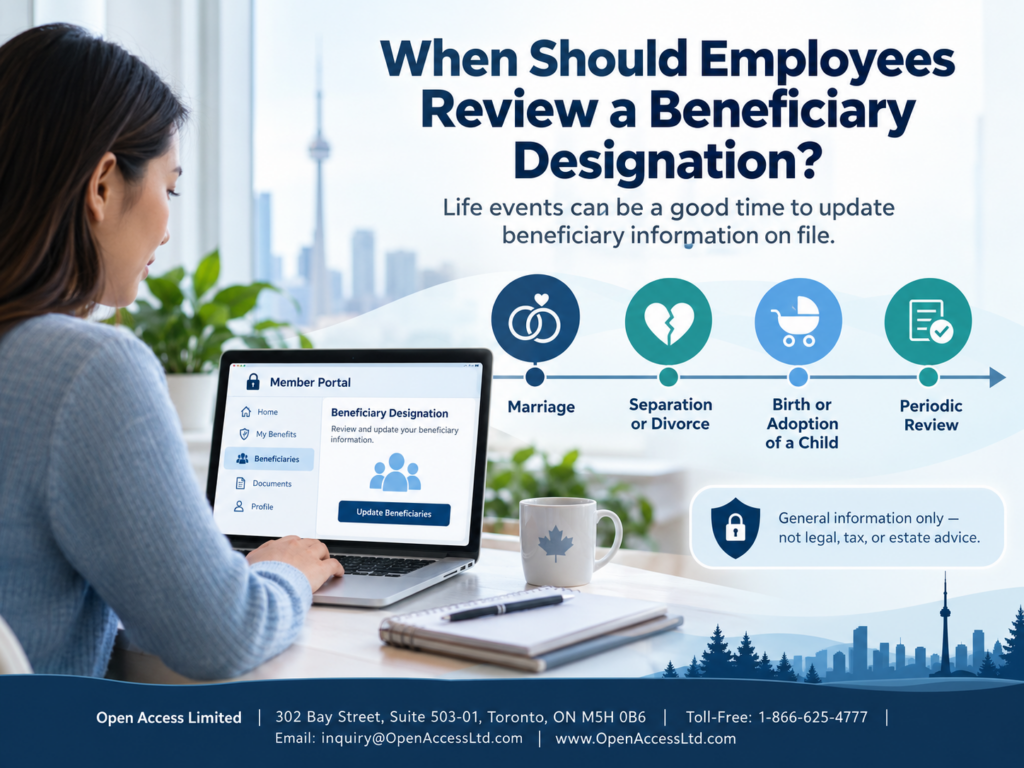
    Marriage, separation, divorce, the birth or adoption of a child, changes in family circumstances, or simply the passage of time can make it appropriate for an employee to review the information on file.

    For Canadian employers, the objective is not to tell employees whom to name.

    A better approach is to explain where beneficiary designations are recorded, how employees can review or update them, where official forms and plan documents are available, and when legal, tax, estate, or financial questions should be referred to qualified professionals.

    Importantly, a beneficiary designation does not necessarily determine the outcome by itself. The plan type, applicable legislation, official plan documents, and individual circumstances may also matter. OpenAccess_Q55_QA_with_Resource…

    Quick Answer: What Should Employers Explain About Beneficiary Designations?

    Canadian employers can help employees understand beneficiary designations by explaining what a designation is, where the information is recorded, how employees can review and update it, why major life events may be a useful reminder to review it, and where official plan forms and provider support are available.

    Employers should provide general education rather than personal legal, tax, estate, or financial advice and should avoid telling employees whom to name or guaranteeing who will ultimately receive plan proceeds.

    On This Page

    1. Why Beneficiary Designations Matter
    2. 7 Smart Employer Steps
    3. When Employees May Want to Review a Designation
    4. How Rules Can Differ by Plan Type
    5. Group RRSP Beneficiary Considerations
    6. Ontario Pension Plan Example
    7. Family Protection: What Employers Should and Should Not Say
    8. Privacy and Beneficiary Information
    9. What Happens After a Member’s Death
    10. Ongoing Employee Education
    11. How Open Access Limited May Support Employers
    12. Frequently Asked Questions
    13. Final Thoughts
    14. References

    Why Beneficiary Designations Matter

    A beneficiary designation is generally an instruction on file with a plan identifying who is intended to receive plan proceeds after a member’s death.

    That sounds simple, but beneficiary designations can interact with several other factors.

    These may include:

    • The type of workplace retirement plan
    • Official plan documents
    • Provincial or territorial law
    • Pension legislation
    • Family law
    • Succession and estate law
    • Tax rules
    • The employee’s individual circumstances

    For that reason, employers should avoid telling employees:

    “If you name this person, they will definitely receive the money.”

    The employer’s role is better framed as:

    Explain the process → Provide official resources → Encourage review → Refer personal questions appropriately

    Beneficiary designations in workplace retirement plans explained for Canadian employees with plan forms, periodic review, member records, and qualified support.

    7 Smart Steps for Employers to Explain Beneficiary Designations

    1. Explain What a Beneficiary Designation Is

    Start with plain language.

    Employees should understand that beneficiary designations identify the person or persons intended to receive applicable plan proceeds after the member’s death, subject to the plan terms and applicable law.

    Employers do not need to interpret succession law or determine entitlement.

    A simple explanation can be:

    “Your workplace retirement plan may have beneficiary information on file. You can review the designation and the applicable plan forms through the plan provider.”

    This gives employees useful information without making legal conclusions.

    2. Encourage Periodic Review Without Making Assumptions

    An employer can periodically remind all employees that beneficiary information may need to be reviewed.

    Possible review points may include:

    • Marriage
    • Separation
    • Divorce
    • Birth of a child
    • Adoption
    • Changes in personal circumstances
    • Pre-retirement planning
    • Periodic benefit reviews

    The employer should not assume or ask employees about private family circumstances.

    The source specifically recommends general life-event reminders rather than making assumptions about an individual employee’s family situation. OpenAccess_Q55_QA_with_Resource…

    A respectful message might simply say:

    “Please consider reviewing the beneficiary information currently on file for your workplace retirement plan.”

    3. Show Employees Where Official Forms and Instructions Are Located

    A reminder is only useful if employees know what to do next.

    Employers should explain where employees can find:

    • Beneficiary forms
    • Information-change forms
    • Plan documents
    • Member portal access
    • Provider contact information
    • Account details
    • Submission instructions

    This makes beneficiary designations easier to review and reduces the likelihood that employees rely on outdated or unofficial instructions.

    Where possible, link directly to the current provider form rather than copying an old form into an internal HR folder.

    4. Explain That Rules Differ by Plan Type and Jurisdiction

    This is essential.

    A Group RRSP, Registered Pension Plan, DPSP, PRPP, locked-in account, or another workplace arrangement may not follow identical rules.

    The effect of beneficiary designations may also depend on provincial or territorial law.

    An Ontario pension-plan example should not automatically be applied to a Group RRSP or to an employee in another province.

    The source specifically notes that succession law is provincial and territorial and that pension legislation can create rights that do not depend solely on a beneficiary designation. OpenAccess_Q55_QA_with_Resource…

    Employers should therefore use plan-specific wording.

    5. Keep Education Separate From Personal Advice

    Employees may ask:

    “Should I name my spouse?”

    “Should I name my children?”

    “Should I name my estate?”

    “Does my will override this form?”

    “Which option gives my family the lowest tax?”

    These are personal questions.

    Employers can explain:

    • Where the designation is held
    • How to access the form
    • How to submit an update
    • Where plan documents are located
    • Who the provider contact is

    Employers should not advise:

    • Whom to name
    • What creates the best tax result
    • How an estate should be structured
    • Whether a will overrides a designation
    • Who is legally entitled in a particular case

    This boundary is particularly important because beneficiary questions can involve family, succession, pension, tax, and estate law.

    6. Coordinate Instructions With the Plan Provider

    HR and the provider should not give employees conflicting directions.

    Employers should confirm with the provider:

    • How a designation is made
    • How it is changed
    • What form is required
    • Whether electronic updates are available
    • How instructions are recorded
    • Where employees can confirm information on file
    • Who handles plan-specific questions

    Clear provider coordination strengthens retirement plan governance and can reduce inconsistent instructions.

    The employer should use current plan materials rather than relying on memory or an outdated internal process.

    7. Have a Respectful Process After a Member’s Death

    A member’s death is a sensitive event.

    Employers should have a documented and respectful process for directing family members, an estate representative, or another authorized person to the appropriate provider contact.

    The employer should avoid making statements about who is entitled to the proceeds.

    For example, HR should not say:

    “You are the beneficiary, so the money will be paid to you.”

    Instead:

    “We can connect you with the retirement-plan provider, who can explain the required process and documentation.”

    The source recommends a documented process and cautions employers against making statements about entitlement. OpenAccess_Q55_QA_with_Resource…

    When Should Employees Review a Beneficiary Designation?

    There is no single life event that automatically means a designation must be changed.

    However, employers can remind employees that certain changes may be good times to review the information currently on file.

    Marriage or a New Partnership

    Employees may wish to confirm whether their existing designation still reflects their intentions and applicable plan requirements.

    Separation or Divorce

    Employees may wish to review plan information and obtain qualified legal advice where needed.

    Birth or Adoption of a Child

    A family change may prompt an employee to review existing information.

    Changes in Personal Circumstances

    An employee’s preferences or circumstances may change even without a major formal life event.

    Periodic Review

    Even when nothing significant has changed, periodically reviewing beneficiary designations can help employees confirm that the information recorded by the plan remains current.

    The employer should provide the reminder—not determine whether a change is necessary.

    <!-- wp:image {"id":352,"sizeSlug":"large","linkDestination":"none"} -->
<figure class="wp-block-image size-large"><img src="https://employerretirementguide.com/wp-content/uploads/2026/10/ChatGPT-Image-Oct-13-2026-07_40_35-PM-2-1024x768.png" alt="Beneficiary designations review timeline showing marriage, separation or divorce, birth or adoption, and periodic workplace retirement plan review." class="wp-image-352"/></figure>
<!-- /wp:image -->

    How Group RRSP Beneficiary Rules Can Differ

    For RRSPs, including Group RRSPs, CRA guidance states that a beneficiary may be designated in the RRSP contract or in the annuitant’s will.

    Where a designation is valid under applicable succession law, the amount may be paid to the beneficiary.

    Where there is no beneficiary or the designation is not valid, the amount may instead be paid to the estate. OpenAccess_Q55_QA_with_Resource…

    However, succession law differs by province and territory.

    This is why employers should avoid presenting a general Group RRSP explanation as individualized legal advice.

    What About Tax After the Death of an RRSP Annuitant?

    CRA guidance generally provides that the fair market value of RRSP property at death is included in the deceased annuitant’s income for the year of death.

    Different treatment may be available in certain situations involving qualifying survivors, such as a spouse or common-law partner or certain financially dependent children or grandchildren.

    How those rules apply depends on individual circumstances. OpenAccess_Q55_QA_with_Resource…

    Employers should therefore avoid promising a particular tax outcome.

    Tax questions should be directed to CRA information or qualified tax and estate professionals.

    Registered Pension Plans Can Follow Different Rules

    Pension plans introduce another important distinction.

    For example, FSRA publishes an Ontario form allowing certain spouses of pension-plan members or former members to waive entitlement to a pre-retirement death benefit.

    That illustrates that in an Ontario-registered pension plan, a spouse may have rights that do not depend solely on whether that spouse is named as beneficiary. OpenAccess_Q55_QA_with_Resource…

    This is an Ontario example—not a Canada-wide rule.

    Other jurisdictions and plan types can operate differently.

    Why “Family Protection” Needs Careful Wording

    The phrase family protection may sound reassuring, but employers should use it carefully.

    A beneficiary designation does not guarantee:

    • Who ultimately receives plan proceeds
    • A particular tax result
    • A particular estate outcome
    • That a spouse has or does not have separate rights
    • That a designation overrides other applicable legal requirements

    A better employer message is:

    “Reviewing beneficiary information is an important part of keeping your workplace retirement-plan records current.”

    This is accurate without promising an outcome.

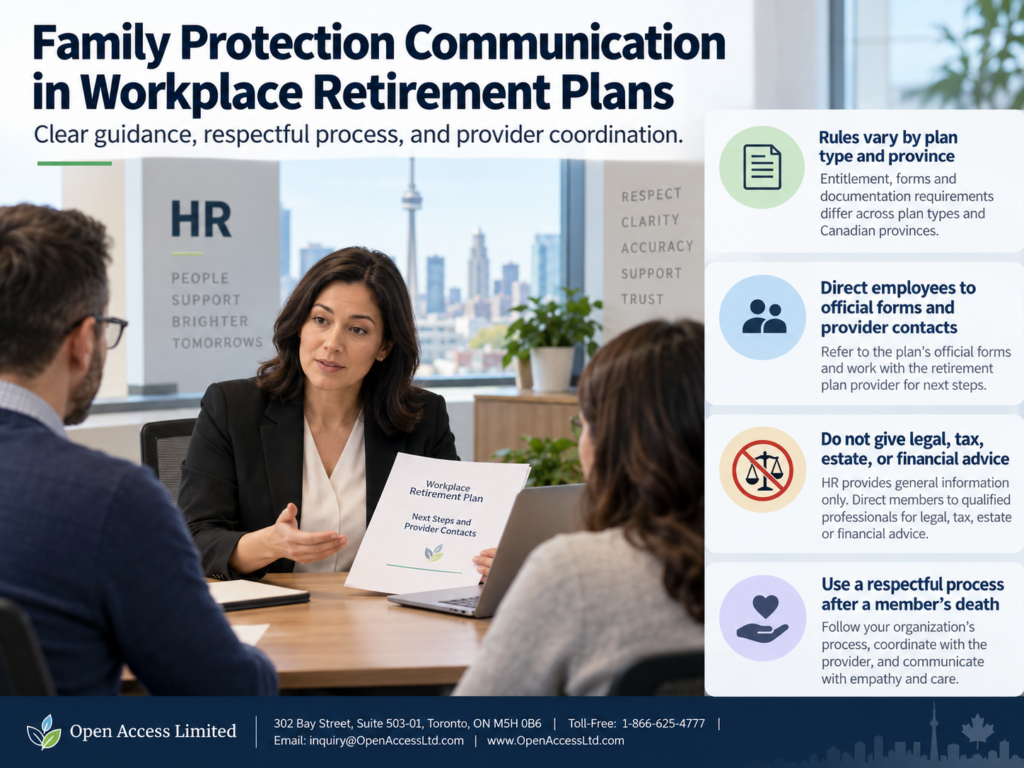
    Beneficiary designations and family protection communication for Canadian employers using official forms, provider coordination, privacy safeguards, and qualified advice.

    Protect Beneficiary Information as Personal Information

    Beneficiary information can reveal sensitive information about an employee’s personal relationships and preferences.

    Employers should avoid unnecessary access or casual discussion of beneficiary designations.

    Information should be handled according to the employer’s applicable privacy and plan-administration processes.

    Employees should also be directed to secure official channels when updating information.

    This connects naturally with broader retirement plan data security practices.

    A Neutral Beneficiary Reminder Employers Can Use

    A professional employee reminder could say:

    Please review the beneficiary information on file for your workplace retirement plan from time to time, including after a change in your personal circumstances. Forms and instructions are available from the plan provider. This reminder is general information only. If you have personal legal, tax, estate, or financial questions, you may wish to speak with an appropriately qualified professional.

    This wording should be adapted to the employer’s actual plan and checked against current provider materials before use.

    Beneficiary Education Should Continue Beyond Onboarding

    Employees may complete beneficiary information when they first enrol in a retirement plan and then not look at it for many years.

    That is why beneficiary designations should not be treated as a one-time onboarding topic.

    Employers can reinforce the reminder through:

    • Annual benefits communication
    • Periodic retirement-plan reviews
    • Pre-retirement education
    • Life-event reminder campaigns
    • Member portal reminders
    • Financial-wellness education

    CAPSA’s Guideline No. 3 identifies ongoing accuracy of personal/contact information and beneficiary designations as part of member responsibilities within capital accumulation plans. OpenAccess_Q55_QA_with_Resource…

    The employer’s role is to make review easier—not to decide what the employee should choose.

    What Employers Should Avoid

    Employers should avoid:

    • Telling an employee whom to name
    • Interpreting a beneficiary designation
    • Promising who will receive the proceeds
    • Giving personal estate-planning advice
    • Giving personal tax advice
    • Assuming an employee’s family situation
    • Asking unnecessary personal questions
    • Treating all Canadian jurisdictions the same
    • Assuming a Group RRSP and pension plan follow identical rules
    • Using outdated beneficiary forms
    • Making entitlement statements after an employee’s death

    These boundaries protect both the employee and the employer.

    Important Implementation Boundaries

    Beneficiary designations can involve:

    • Succession law
    • Estate law
    • Family law
    • Pension legislation
    • Tax law
    • Insurance law
    • Privacy obligations

    Rules can differ significantly by plan type, province, and territory, and Quebec may have rules that differ from other Canadian jurisdictions.

    Employers should not interpret a designation, advise an employee whom to name, or state who is legally entitled to proceeds. OpenAccess_Q55_QA_with_Resource…

    Before implementing a beneficiary-reminder program or a process for dealing with a member’s death, employers should confirm the approach with the plan administrator or provider and obtain qualified legal advice where appropriate.

    Need Help Make Beneficiary Information Easier for Employees to Review?

    Where a workplace retirement plan is provided through Open Access Limited, employers may direct employees to official Open Access forms and member-support resources.

    Open Access Limited’s public resources include member forms for information changes, including beneficiary updates, as well as member resources, a portal, and Client Relations support. OpenAccess_Q55_QA_with_Resource…

    Depending on the applicable plan, Open Access Limited may support employees with:

    • Finding the appropriate beneficiary or information-change form
    • Understanding how to submit plan-related information
    • Accessing member resources
    • Navigating the member portal
    • Locating plan-specific information
    • Contacting Client Relations with plan-administration questions

    Open Access Limited should not be positioned as providing individualized legal, tax, estate, or financial advice.

    Questions about the legal or tax effect of beneficiary designations should be referred to appropriately qualified professionals.

    Open Access Limited
    302 Bay Street, Suite 503-01
    Toronto, ON M5H 0B6, Canada

    Toll-Free: 1 (866) 625 4777
    General: 416 364 8877
    Fax: 416 955 4878
    Email: inquiry@OpenAccessLtd.com
    Website: www.OpenAccessLtd.com

    Frequently Asked Questions About Beneficiary Designations

    What Is a Beneficiary Designation?

    A beneficiary designation is information recorded with a plan identifying who is intended to receive applicable plan proceeds after a member’s death, subject to plan terms and applicable law.

    Should Employees Review Their Beneficiary After Marriage or Divorce?

    A major change in personal circumstances can be an appropriate reminder to review the information on file. Whether a change should actually be made depends on the employee’s circumstances and applicable requirements.

    What Happens if No Beneficiary Is Named?

    The result depends on the type of plan and applicable law. For certain RRSP situations, proceeds may be paid to the estate when there is no valid beneficiary designation.

    Does a Beneficiary Designation Override a Will?

    Employers should not provide a general legal answer to this question. The interaction between a designation, will, plan documents, and applicable succession law can depend on the jurisdiction and circumstances.

    Does a Spouse Automatically Receive Pension Benefits?

    Not necessarily in every plan or jurisdiction. Pension legislation may provide specific spousal rights, and employers should rely on the applicable plan documents and legislation.

    Can an Employer Tell an Employee Whom to Name?

    No. Employers can explain the process and provide official forms but should not recommend whom an employee should designate.

    How Often Should Beneficiary Designations Be Reviewed?

    There is no universal schedule, but employees may benefit from reviewing information periodically and after significant changes in personal circumstances.

    Final Thoughts

    Beneficiary designations are an important part of workplace retirement-plan administration, but they should not be presented as a simple guarantee of who will ultimately receive plan proceeds.

    For Canadian employers, a stronger communication model is:

    Explain the Designation → Encourage Periodic Review → Provide Official Forms → Respect Privacy → Coordinate With the Provider → Keep Education Separate From Advice → Refer Personal Questions Appropriately

    The goal is not for HR to make estate or family decisions for employees.

    It is to help employees keep plan information current, understand where to find reliable resources, and know when their personal circumstances require qualified professional advice.

    References

    1. Canada Revenue Agency — Who Is the Beneficiary and How Is the Beneficiary Designated?
    2. Canada Revenue Agency — Death of an RRSP Annuitant (RC4177).
    3. Financial Services Regulatory Authority of Ontario — Form 4: Waiver of Pre-Retirement Death Benefit.
    4. Canadian Association of Pension Supervisory Authorities — Guideline No. 3: Guideline for Capital Accumulation Plans.
    5. Financial Consumer Agency of Canada — Choosing a Financial Advisor.
    6. Open Access Limited — Member Forms; Member Resources.

  • How Should Canadian Businesses Communicate With Employees During Market Volatility in Workplace Retirement Plans?

    How Should Canadian Businesses Communicate With Employees During Market Volatility in Workplace Retirement Plans?

    Retirement plan market volatility can create understandable questions for employees.

    When investment values rise and fall, employees may wonder why their workplace retirement account has changed, whether they should alter contributions, whether their investment options are still appropriate, or what they should do next.

    For Canadian employers, the objective is not to predict where markets are heading or tell employees what investment decision to make.

    A more appropriate role is to provide clear general education, direct employees to official workplace-plan information, explain basic concepts such as risk and diversification in plain language, and ensure employees know where to obtain qualified individual support.

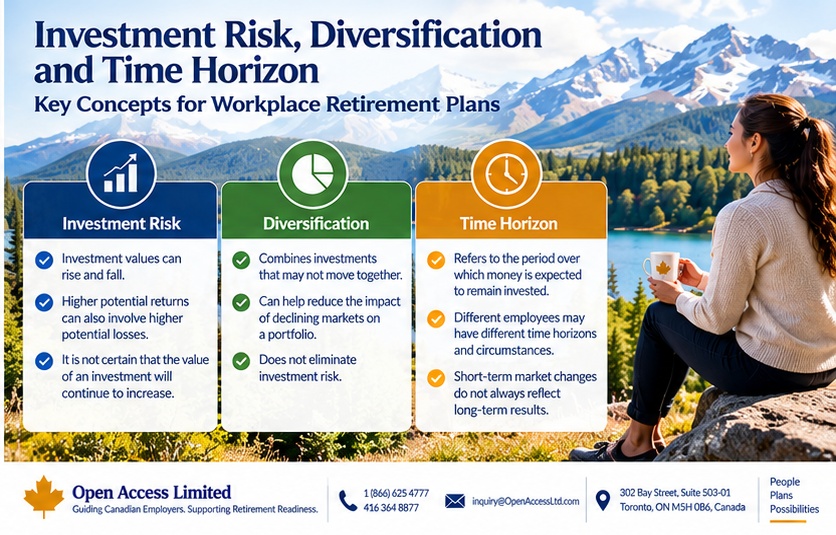
    The Canadian Investment Regulatory Organization notes that investment risk and potential return are related: higher risk can involve both greater potential return and greater potential loss. Diversification may help reduce the effect of declines in one area of a portfolio, but neither concept predicts what markets will do next. OpenAccess_Q54_QA_with_Resource…

    Quick Answer: How Should Employers Communicate During Retirement Plan Market Volatility?

    During retirement plan market volatility, Canadian employers should acknowledge employee questions, reinforce the stated purpose of the workplace plan, use official provider and plan resources, explain general concepts such as risk, diversification, and time horizon, avoid individual investment recommendations or market predictions, provide access to qualified support, and review employee communication after the period of volatility.

    The goal is clear information—not investment advice.

    On This Page

    1. Why Market Volatility Communication Matters
    2. 7 Best Employer Communication Steps
    3. How to Explain Risk and Diversification
    4. What Employers Should Avoid
    5. Neutral Communication Example
    6. What a Market-Volatility Communication Plan Should Include
    7. Why Education Should Begin Before Volatility
    8. Important Employer Boundaries
    9. How Open Access Limited May Support Employers
    10. Frequently Asked Questions
    11. Final Thoughts
    12. References

    Why Retirement Plan Market Volatility Communication Matters

    Employees may naturally pay more attention to their retirement accounts when markets become volatile.

    A falling account value can lead to questions about:

    • What caused the change
    • Whether the workplace plan is still working as intended
    • Whether contributions should continue
    • Whether an investment option should be changed
    • How investment risk works
    • Whether losses are temporary or permanent
    • Who can provide personal guidance

    Employers should take these questions seriously without assuming how an employee feels or what their financial circumstances are.

    Good retirement plan market volatility communication acknowledges the question without turning the employer into a market forecaster or personal investment adviser.

    A useful principle is:

    Acknowledge → Educate → Provide Resources → Refer Personal Decisions

    Effective retirement plan market volatility communication can help employees find reliable information without encouraging emotional or short-term investment decisions.

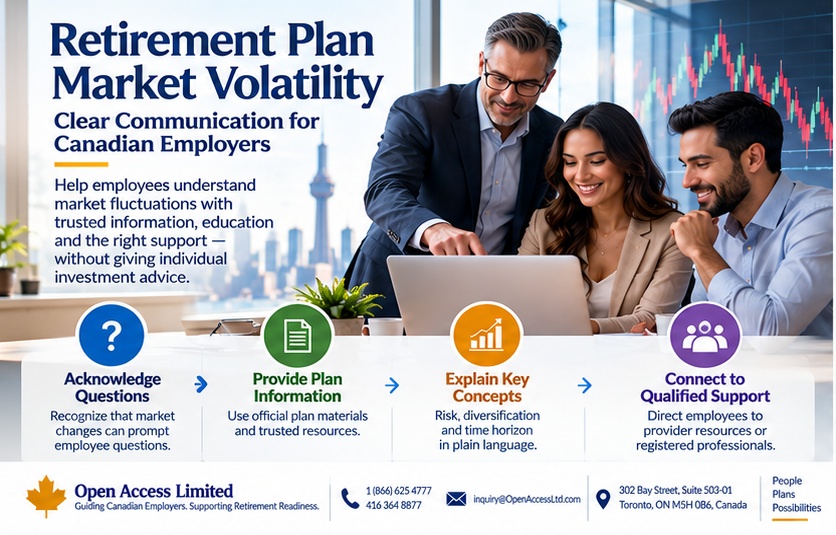
    Retirement plan market volatility communication for Canadian employees with clear education, official plan information, investment risk guidance, and qualified support.

    7 Best Employer Steps During Retirement Plan Market Volatility

    1. Acknowledge Employee Questions Without Creating Fear

    The first step is simple.

    Recognize that changes in account values may cause employees to have questions.

    An employer can say that investment values fluctuate over time and that plan information and support are available.

    Avoid language that assumes:

    • Employees are panicking
    • Employees are financially distressed
    • Everyone has the same concerns
    • The current decline will continue
    • The current decline will quickly reverse

    The purpose is to make communication relevant and respectful.

    During retirement plan market volatility, neutral language is usually stronger than dramatic reassurance.

    2. Reinforce the Stated Purpose of the Workplace Plan

    Employees may benefit from being reminded why the workplace retirement plan exists and how it is designed.

    Use the official plan materials to explain:

    • The purpose of the plan
    • Available investment options
    • Member responsibilities
    • Contribution provisions
    • Employer contributions or matching, where applicable
    • Available education
    • Member support

    Do not add predictions about future returns.

    Do not tell employees that the plan will “recover” or that a particular investment will perform better.

    A plan’s long-term purpose can provide context without making claims about short-term markets.

    This is also a natural place to link to broader retirement income education.

    During retirement plan market volatility, reinforcing the plan’s documented purpose can provide useful context without making assumptions about future market performance.

    3. Keep General Education Separate From Individual Investment Advice

    This is one of the most important boundaries.

    Employers should not tell an individual employee:

    • Which fund to choose
    • Which investment option to sell
    • Which investment option to buy
    • When to switch investments
    • Whether to stop contributing
    • Whether to increase contributions
    • Whether the market has reached a bottom
    • Whether a particular investment will recover

    The source specifically recommends keeping employer communication separate from individualized investment advice. OpenAccess_Q54_QA_with_Resource…

    If an employee needs advice about their own financial circumstances, investment choices, risk tolerance, or retirement strategy, the employee should be directed to appropriately qualified support.

    4. Provide Official Plan Resources

    During retirement plan market volatility, employees should know where reliable information is located.

    Depending on the plan, useful resources may include:

    • Official plan documents
    • Member portal
    • Investment-option information
    • Fund factsheets
    • Account statements
    • Provider education
    • Investor-profile tools
    • Financial-wellness resources
    • Market commentary prepared by the appropriate provider
    • Member-support contact information

    Using official resources helps reduce the risk of conflicting messages between the employer and the plan provider.

    Where reliable provider materials already exist, employers generally do not need to create their own market commentary.

    A consistent retirement plan market volatility process should direct employees to current plan documents, provider resources, account tools, and approved investment information.

    5. Explain Risk, Diversification, and Time Horizon in Plain Language

    Employees do not need an investment textbook.

    They need clear explanations.

    What Is Investment Risk?

    Investment risk means the value of an investment can change and that investment outcomes are uncertain.

    Higher potential returns may also involve greater potential losses.

    What Is Diversification?

    Diversification means holding investments that may respond differently to market conditions.

    It can reduce dependence on one investment, company, sector, or asset category.

    Diversification does not eliminate investment risk.

    What Is Time Horizon?

    Time horizon refers to the period over which money is expected to remain invested.

    Different employees may have different time horizons and personal circumstances.

    The employer can explain these concepts generally but should not decide what level of risk or investment strategy is appropriate for an individual employee.

    6. Direct Employees to Qualified Support

    Employees may have questions that go beyond general education.

    For example:

    “Should I change my portfolio?”

    “Is my risk level too high?”

    “Should I stop contributing until markets improve?”

    “Should I move everything into a safer investment?”

    Those are individual decisions.

    During retirement plan market volatility, employers should clearly explain where employees can obtain qualified assistance.

    Depending on the question, this may include the workplace retirement-plan provider or an appropriately qualified and registered financial professional.

    The source also notes the importance of registration for securities professionals and references resources for checking registration. OpenAccess_Q54_QA_with_Resource…

    7. Review Communication After the Volatility Period

    Communication should not end when the immediate market headlines disappear.

    Afterward, employers can review:

    • Which questions employees asked most often
    • Which resources employees used
    • Whether plan information was easy to find
    • Whether HR and provider messages were consistent
    • Whether employees knew where to obtain support
    • Whether FAQs need updating
    • Whether additional education would help

    This allows the employer to improve future retirement plan market volatility communication rather than rebuilding the process from scratch each time markets become unsettled.

    How Should Employers Explain Investment Risk Without Giving Advice?

    This distinction matters.

    Employers can explain what risk means.

    They should not decide how much risk is appropriate for a particular employee.

    For example:

    Appropriate general education:
    “Investment values can rise and fall, and different investment options have different levels of expected risk and return.”

    Not appropriate as general employer communication:
    “You should move into a lower-risk portfolio.”

    Likewise:

    Appropriate:
    “Diversification may reduce the impact of declines in one area of a portfolio.”

    Not appropriate:
    “This portfolio is safe during a market downturn.”

    This approach keeps employee education useful without turning general communication into personal investment advice.

    Clear retirement plan market volatility education should explain investment concepts objectively while leaving personal portfolio decisions to the employee and appropriately qualified professionals

    What Employers Should Avoid During Market Volatility

    Avoid statements such as:

    “The market will recover soon.”

    “Do not change anything.”

    “You should move into this fund.”

    “Your retirement money is safe.”

    “Now is the best time to buy.”

    “This downturn is a buying opportunity.”

    “Keep contributing because markets always come back.”

    The source specifically cautions against forecasts, personal investment instructions, guarantees or implied guarantees, inconsistent communication, and using market volatility as a sales or promotional message. OpenAccess_Q54_QA_with_Resource…

    That final point is especially important.

    Retirement plan market volatility should not be turned into a sales campaign.

    Communication should remain educational and member-focused.

    Retirement plan market volatility explained with investment risk, diversification, time horizon, workplace retirement options, and employee education.

    A Neutral Communication Example

    A professional employer message could say:

    Investment values can rise and fall over time. Information about your workplace retirement plan and available investment options can be found in the official plan materials and through the plan provider. This communication is general educational information and is not individual investment advice. Employees with questions about their own circumstances can contact the plan provider or an appropriately qualified professional.

    The wording should always be checked against the employer’s actual plan documents and provider materials before use.

    What Should a Market-Volatility Communication Plan Include?

    A practical communication plan may include:

    A Short FAQ

    Address recurring questions without predicting future markets.

    The Plan’s Purpose

    Use language from official plan documents.

    Official Education Resources

    Link directly to appropriate provider information.

    Account and Investment Access

    Remind employees where they can review their account and available investment information.

    Clear Advice Boundaries

    State that employer communication is general education rather than individualized investment advice.

    A Referral Process

    Make it clear where individual or technical questions should go.

    Follow-Up Education

    Provide additional education after the immediate volatility period.

    These elements come directly from the communication approach described in the source Q&A. OpenAccess_Q54_QA_with_Resource…

    Why Investment Education Should Begin Before Volatility

    One of the strongest improvements employers can make is not waiting for a market decline.

    Concepts such as:

    • Investment risk
    • Diversification
    • Time horizon
    • Investment-option differences
    • Investor profiles
    • Member support

    are easier to understand when employees are not reacting to dramatic financial headlines.

    CAPSA’s Guideline No. 3 supports ongoing member education and access to investment information and decision-making tools, rather than limiting education to initial enrolment. OpenAccess_Q54_QA_with_Resource…

    That means good retirement plan market volatility communication actually begins during calmer markets.

    Preparing employees before retirement plan market volatility occurs can make concepts such as risk, diversification, and time horizon easier to understand when markets become unsettled.

    Why This Matters to Employers

    Employees may look to their employer when account values change.

    Timely and accurate communication can help employees find trustworthy information.

    But employers should not promise that communication will:

    • Remove investment risk
    • Prevent concern
    • Stop employees from making changes
    • Improve investment performance
    • Increase participation
    • Improve retention
    • Guarantee better retirement outcomes

    The effect of communication depends on the quality of information, plan design, employee circumstances, and access to qualified support.

    The goal is better information—not guaranteed behaviour.

    Important Implementation Boundaries

    Workplace investment communication can involve:

    • Securities requirements
    • Pension responsibilities
    • Employment considerations
    • Contractual obligations
    • Plan documents
    • Provider agreements
    • Fiduciary responsibilities in some pension arrangements

    Plan design also matters.

    Some plans allow employees to select individual investment options.

    Others may use managed portfolios or default arrangements.

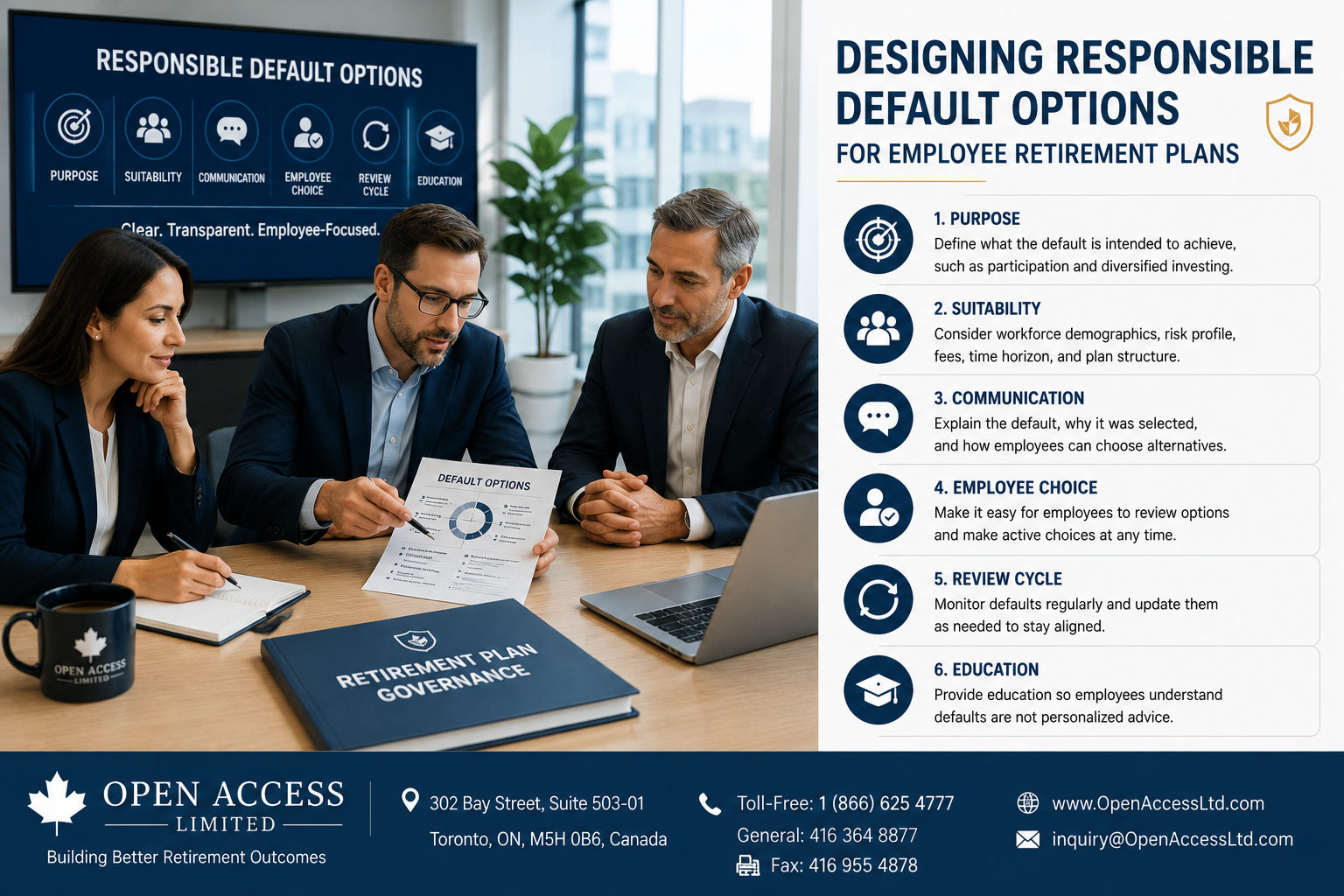
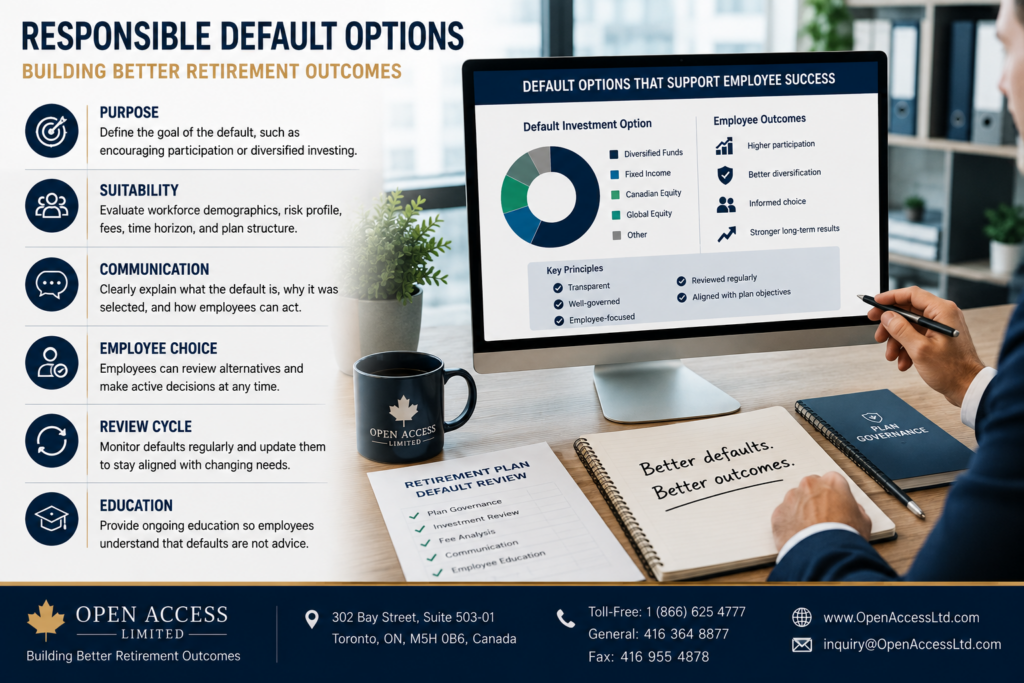
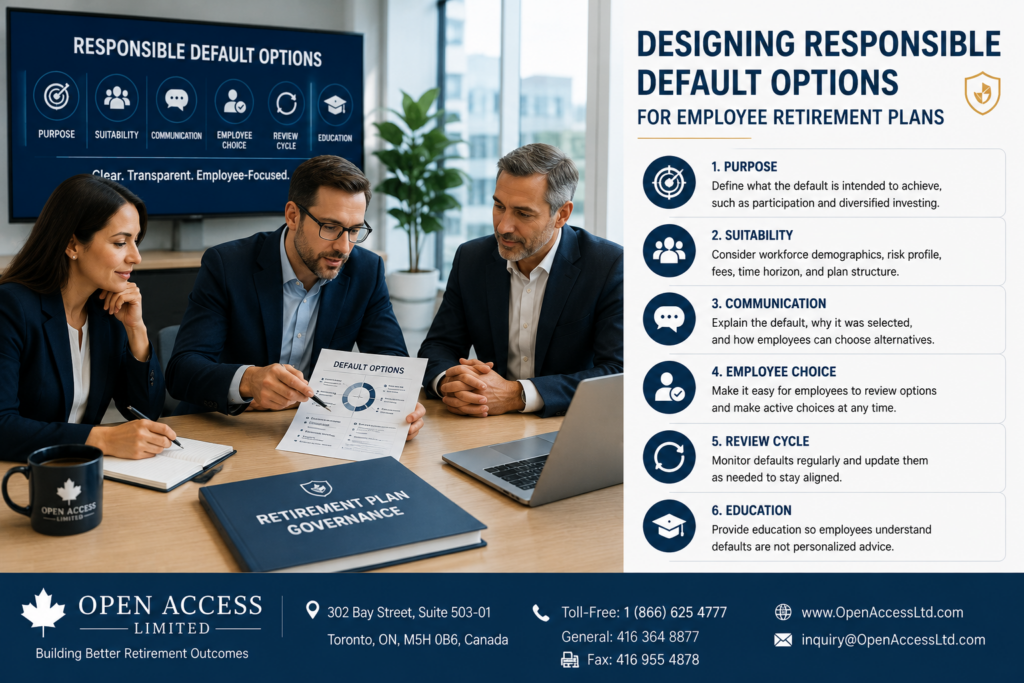
    That makes the employer’s retirement plan default options governance relevant as well.

    Employers should confirm employee-facing communication against current plan documents and provider materials, avoid forecasts, and obtain qualified legal or other professional advice where appropriate.

    Individual investment advice should remain with properly qualified or registered persons. OpenAccess_Q54_QA_with_Resource…

    A documented retirement plan market volatility communication framework can also help HR teams, employers, and plan providers deliver more consistent information when employee questions increase.

    Need Help Communicate More Clearly During Market Volatility?

    Where a workplace retirement plan is provided through Open Access Limited, employers may direct members to official Open Access plan and investment resources rather than creating their own market predictions or investment commentary.

    Open Access Limited’s materials include:

    • CAP Portfolios
    • Investor profile resources
    • Investor profile update forms
    • CAP Portfolio factsheets
    • Periodic market commentary
    • Financial-wellness resources
    • Member portal access
    • Client Relations support

    Members with personal questions about their investor profile or portfolio can contact Open Access Limited directly. OpenAccess_Q54_QA_with_Resource…

    Open Access Limited should not be positioned as guaranteeing any investment outcome, and its resources do not replace official plan documents or individualized advice from an appropriately qualified professional.

    Open Access Limited
    302 Bay Street, Suite 503-01
    Toronto, ON M5H 0B6, Canada

    Toll-Free: 1 (866) 625 4777
    General: 416 364 8877
    Fax: 416 955 4878
    Email: inquiry@OpenAccessLtd.com
    Website: www.OpenAccessLtd.com

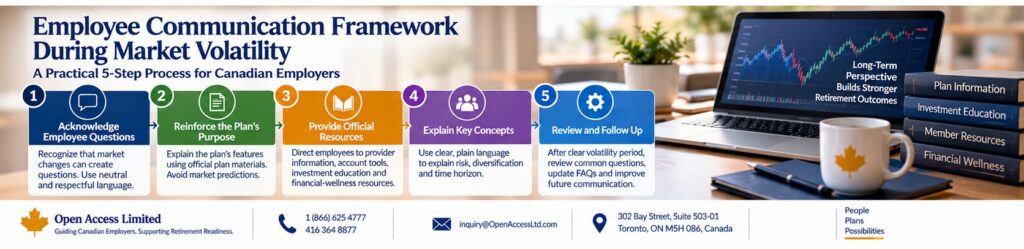
    Retirement plan market volatility communication framework showing acknowledge, educate, provide resources, qualified support, and follow-up education.

    Frequently Asked Questions About Retirement Plan Market Volatility

    Should Employers Tell Employees Not to Change Investments During Market Volatility?

    No. Employers should provide general plan education and avoid telling individual employees whether to buy, sell, switch, or hold a particular investment.

    Can Employers Tell Employees That the Market Will Recover?

    Employers should avoid market forecasts or statements implying that a particular outcome is certain.

    Should Employees Stop Retirement Contributions During Market Volatility?

    That is an individual decision. Employers can explain contribution rules but should not advise a particular employee whether to stop or continue contributing.

    What Is Diversification?

    Diversification involves combining investments that may respond differently to market conditions. It may reduce concentration risk but does not eliminate the possibility of loss.

    Where Should Employees Find Information About Their Investment Options?

    Employees should use official workplace-plan documents, provider resources, account tools, investment information, and available member-support channels.

    When Should an Employee Speak With a Financial Professional?

    Employees with personal questions about their risk profile, investment choices, portfolio, financial circumstances, or strategy may wish to speak with an appropriately qualified or registered professional.

    Should Employers Communicate Only When Markets Fall?

    No. Ongoing investment education during normal market conditions can help employees better understand risk, diversification, investment options, and available support before periods of volatility occur.

    Final Thoughts

    Retirement plan market volatility does not require employers to predict the future.

    It requires a disciplined communication process:

    Acknowledge Questions → Reinforce the Plan Purpose → Avoid Personal Advice → Provide Official Resources → Explain Key Concepts → Connect Employees With Qualified Support → Review the Communication

    The strongest employer message is not:

    “Here is what the market will do.”

    It is:

    “Here is where you can find reliable information about your plan, understand the relevant concepts, and obtain qualified help for decisions that depend on your individual circumstances.”

    That approach supports clearer employee communication while maintaining appropriate boundaries between workplace retirement education and personal investment advice.

    References

    1. Canadian Investment Regulatory Organization — Understanding Risk.
    2. Canadian Investment Regulatory Organization — Why Diversify Your Portfolio?
    3. Canadian Securities Administrators — Are They Registered?
    4. Financial Consumer Agency of Canada — Choosing a Financial Advisor.
    5. Canadian Association of Pension Supervisory Authorities — Guideline No. 3: Guideline for Capital Accumulation Plans.
    6. Open Access Limited — Investments; CAP Portfolio Factsheets; Member Forms; Financial Wellness Resources; Member Resources.

  • How Can Canadian Businesses Reduce Payroll and Contribution Errors in Workplace Retirement Plans as They Grow?

    How Can Canadian Businesses Reduce Payroll and Contribution Errors in Workplace Retirement Plans as They Grow?

    Retirement plan payroll errors can become more likely as a business grows and its workplace retirement plan becomes more complex.

    More employees, additional locations, different payroll schedules, bonuses, commissions, part-time arrangements, eligibility rules, employer contribution formulas, and new service providers can all create additional administrative touchpoints.

    The risk is not simply a payroll calculation being wrong. Problems can arise when the official plan terms, payroll configuration, employee records, provider records, and employee communication no longer match.

    Examples may include an eligible employee being enrolled late, an incorrect contribution percentage being entered, employer matching being calculated differently from the plan terms, or bonuses and commissions being treated inconsistently.

    For Canadian employers, the objective should not be to promise an error-free system.

    A stronger approach is to establish controls that reduce the likelihood of errors, identify discrepancies earlier, document corrections, and make responsibilities clear across HR, payroll, the employer, and the retirement-plan provider.


    As organizations expand, retirement plan payroll errors can become harder to detect when HR, payroll, provider records, and official plan terms are not reviewed together.

    
Retirement plan payroll errors prevention workflow connecting HR, payroll, plan records, provider records, and employee contribution information.

    Quick Answer: How Can Employers Reduce Retirement Plan Payroll Errors?

    Canadian businesses can reduce retirement plan payroll errors by translating official plan terms into clear payroll instructions, defining responsibilities, reviewing employee eligibility, testing contribution formulas, reconciling payroll with provider records, controlling plan changes, communicating deductions clearly, documenting corrections, and reassessing processes as the organization grows.

    The goal is not perfection. It is earlier detection, clearer ownership, more consistent records, and stronger retirement-plan governance.


    Why Payroll and Retirement Plan Records Can Fall Out of Sync

    As a business grows, different systems may hold different pieces of employee information.

    HR may manage employment status and eligibility.

    Payroll may calculate deductions and employer contributions.

    A retirement-plan provider may maintain member and contribution records.

    Management may approve plan amendments.

    Employees may receive information through another communication channel.

    If these processes are not coordinated, retirement plan payroll errors may arise even when each team believes it is following the correct procedure.

    Common examples include:

    • Eligible employees not being enrolled when expected
    • Incorrect employee contribution percentages
    • Employer contributions calculated differently from plan terms
    • Bonuses or commissions handled inconsistently
    • Different eligibility dates across systems
    • Plan amendments implemented in one system but not another
    • Incorrect contribution-limit or reporting treatment
    • Unclear employee communication about deductions or matching

    The control objective is therefore alignment.


    9 Proven Controls to Reduce Retirement Plan Payroll Errors

    1. Translate Official Plan Terms Into Payroll Instructions

    Payroll teams should not have to interpret retirement-plan documents every time a contribution is calculated.

    Employers can document how the plan’s official terms translate into operational payroll instructions.

    This may include:

    • Eligibility
    • Waiting periods
    • Employee contributions
    • Employer contributions
    • Matching formulas
    • Contribution caps
    • Definition of eligible compensation
    • Contribution timing
    • Effective dates

    For example, if the plan uses a specific definition of compensation, payroll configuration should reflect that definition accurately.

    This becomes particularly important where salaries, bonuses, commissions, or other forms of compensation are treated differently.

    A written bridge between plan documents and payroll processes can help reduce inconsistencies.


    2. Define Who Is Responsible for What

    One of the easiest ways for an administrative task to be missed is when everyone assumes someone else owns it.

    Employers should clearly establish which responsibilities belong to:

    • HR
    • Payroll
    • Finance
    • Management
    • The plan administrator
    • The retirement-plan provider
    • External service providers

    The process should also identify:

    Who approves a change?
    Who enters it?
    Who checks it?
    Who resolves discrepancies?

    Clear ownership can help prevent both duplicated work and missed steps.

    As the organization grows, these responsibilities should be documented rather than relying only on informal knowledge.


    Clear ownership can also reduce retirement plan payroll errors by ensuring that changes, approvals, calculations, and corrections have a defined responsible party.


    3. Review Employee Eligibility Regularly

    Employee eligibility is not always static.

    An employee’s status may change because of:

    • Hours worked
    • Employment status
    • Compensation
    • Waiting periods
    • Location
    • Plan amendments
    • Changes in employment arrangements

    Employers should establish a process for identifying when employees become eligible under the official plan terms.

    This is closely connected with retirement plan eligibility governance.

    Eligibility information should also be compared across HR, payroll, and plan-provider records.

    That can help identify missed enrolments or inconsistent eligibility dates earlier.


    Regular eligibility reviews can help prevent retirement plan payroll errors caused by missed enrolment dates, changing work status, or inconsistent employee records.


    4. Test Contribution Calculations Before Going Live

    A contribution formula should be tested before it affects the entire workforce.

    Testing is especially valuable:

    • When launching a plan
    • When changing employer matching
    • When changing eligibility
    • When changing payroll systems
    • When adding new compensation types
    • When implementing a material plan amendment

    Employers can create representative payroll scenarios that include:

    Regular salary → bonus → commission → different eligibility dates → employee contribution → employer match

    The purpose is to see whether payroll produces the result required by the plan terms.

    This type of testing may identify retirement plan payroll errors before they affect multiple employees.


    5. Reconcile Payroll and Provider Records

    Reconciliation is one of the strongest controls in the entire process.

    Payroll processing and retirement-plan administration may take place in different systems.

    Employers can periodically compare four things:

    1. What payroll says was deducted or contributed
    2. What was transmitted to the provider
    3. What appears in member records
    4. What the official plan formula requires

    These figures should logically align.

    When they do not, the difference should be investigated using an established escalation process.

    Examples may include:

    • Missing contributions
    • Duplicate transactions
    • Delayed transactions
    • Incorrect amounts
    • Incorrect employee records
    • Contribution timing differences

    CAPSA’s guidance emphasizes accurate member records and periodic review of identified errors, controls, processes, and systems.

    A Simple Reconciliation Question

    Payroll → Provider → Member Account → Plan Document

    Do all four tell the same story?

    If not, investigate.


    6. Use Controlled Procedures for Plan Changes

    Plan changes create a particularly important period of administrative risk.

    When eligibility, matching formulas, compensation definitions, or contribution rules change, employers should document:

    • What is changing
    • Effective date
    • Who approved it
    • Which systems need updating
    • Who updates each system
    • Employee communication
    • Provider communication
    • Testing
    • Final confirmation

    Without a controlled process, one system may start using new information while another continues using the previous rules.

    For example:

    Plan document updated ✓
    Payroll updated ✓
    Provider updated ✓
    Employee communication updated ✓

    All four matter.

    Controlled implementation can significantly reduce avoidable retirement plan payroll errors.


    7. Communicate Contributions and Deductions Clearly

    Employees can also act as an additional source of early detection when they understand what should appear on their pay and retirement-plan records.

    Employers should clearly explain:

    • Employee contribution options
    • Employer matching or contributions
    • Eligibility
    • Applicable limits
    • Contribution timing
    • Changes employees can make
    • Important deadlines
    • Where account information can be reviewed
    • Who to contact with questions

    This is particularly important for employer matching contributions, because employees should understand both their contribution and the employer-funded portion of the arrangement.

    Communication should continue after onboarding.

    Employees receive large amounts of information when starting a new position, so retirement-plan education should be reinforced throughout employment.


    8. Document Errors and Corrections

    Errors can still occur even when good controls exist.

    The important question becomes:

    What happens next?

    When a discrepancy is identified, employers should document:

    • What happened
    • When it occurred
    • Who was affected
    • How it was identified
    • What corrective action was taken
    • Who approved the correction
    • Whether employee communication was required
    • Whether a process change was implemented

    This creates an audit trail and can help prevent the same issue from happening again.

    Employers should not automatically assume that simply adjusting the next payroll is the appropriate correction.

    The required approach may depend on the plan type, nature of the error, period affected, tax treatment, plan documents, and applicable regulatory requirements.

    Material errors should be reviewed with appropriately qualified professionals.


    9. Review the Process as the Business Grows

    A process designed for 20 employees may not remain appropriate for 200 employees.

    Administrative controls should be reassessed when there are material changes involving:

    • Workforce size
    • Locations
    • Payroll systems
    • Compensation structures
    • Eligibility
    • Providers
    • Plan design
    • Employer contribution formulas
    • Internal responsibilities

    Growth should trigger a review of the process—not simply more transactions through the same workflow.

    Strong retirement plan governance includes asking whether existing controls remain appropriate for the organization’s current operating environment.


    Why Reconciliation Is One of the Most Important Controls

    Reconciliation deserves additional attention because payroll and retirement-plan records may exist in different systems.

    A practical reconciliation process can compare:

    Payroll Record

    What amount was deducted from the employee or calculated as the employer contribution?

    Amount Transmitted

    What amount was actually sent to the applicable provider or retirement plan?

    Provider Record

    What amount appears in the member account?

    Official Plan Formula

    What amount should have been calculated under the plan terms?

    When these amounts do not align, the organization should investigate the difference promptly.

    This process can help identify missing, duplicated, delayed, or inconsistent transactions before they remain unresolved for an extended period.

    
Retirement plan payroll errors reconciliation comparing payroll deductions, transmitted contributions, provider records, and official plan formulas

    Plan Type Matters

    Not every retirement arrangement follows the same tax, reporting, contribution, or administrative rules.

    Examples include:

    • Registered Pension Plan — RPP
    • Deferred Profit Sharing Plan — DPSP
    • Group Registered Retirement Savings Plan — Group RRSP
    • Pooled Registered Pension Plan — PRPP

    Employers should not automatically apply the requirements of one arrangement to another.

    Pension Adjustments Are One Example

    CRA guidance distinguishes between plan structures when determining whether a pension adjustment may be required.

    Employers participating in certain RPPs or DPSPs may need to calculate and report a pension adjustment.

    The original source also notes that a pension adjustment is not reported for an individual or Group RRSP or for a PRPP.

    This demonstrates why payroll administration should begin with the specific plan structure rather than a generic retirement-plan assumption.


    Compensation Type Can Affect Payroll Configuration

    Payroll treatment can also vary depending on the type of payment.

    Examples include:

    • Regular salary
    • Bonuses
    • Commissions
    • Retroactive pay
    • Other remuneration

    However, an important distinction must be maintained.

    How payroll treats compensation does not automatically determine whether that compensation should be included when calculating retirement-plan contributions.

    The applicable plan terms should determine the contribution calculation.

    For example, if the employer contribution formula uses a defined category of eligible compensation, payroll should be configured according to that definition.


    Additional Considerations for Registered Pension Plans

    Registered pension plans may involve additional statutory administration and contribution requirements depending on jurisdiction.

    For Ontario-registered pension plans, FSRA identifies contribution oversight as one of the administrator’s responsibilities and uses Form 7 contribution reporting within the applicable Ontario framework.

    These requirements should not automatically be applied to Group RRSPs, DPSPs, PRPPs, or arrangements governed under another jurisdiction.

    This is why employers should identify:

    Plan Type + Jurisdiction + Plan Terms + Payroll Treatment

    before establishing an administrative process.


    Why Retirement Plan Education Should Continue After Onboarding

    Contribution information should not disappear after an employee’s first week.

    Employers may reinforce:

    • Employee contribution choices
    • Employer matching
    • Eligibility
    • Changes employees can make
    • Deadlines
    • Plan amendments
    • Account access
    • Member support

    Ongoing communication can also complement broader retirement income education by helping employees understand how workplace contributions fit within their retirement planning.

    The purpose is not to recommend how much an individual should contribute.

    It is to make the workplace plan easier to understand.


    How Can Employers Keep Payroll and Plan Information Accurate?

    A strong process should be built around authoritative information.

    Employers can:

    • Use current official plan documents
    • Keep payroll instructions documented
    • Verify provider information
    • Maintain clear approval processes
    • Test material changes
    • Reconcile records
    • Record corrections
    • Update employee communication
    • Review controls periodically

    This is the accuracy and authenticity layer of the article.

    Do not call the heading “Authenticity Layer” in WordPress.
    The reader-facing heading above — How Can Employers Keep Payroll and Plan Information Accurate? — is much more natural.


    Why This Matters to Growing Businesses

    Administrative discrepancies create more than an accounting inconvenience.

    They may require additional work from:

    • HR
    • Payroll
    • Finance
    • Management
    • The retirement-plan provider
    • External advisers

    A structured administration process may help businesses:

    • Identify discrepancies earlier
    • Clarify responsibilities
    • Maintain consistent records
    • Coordinate system changes
    • Document corrective actions
    • Improve employee communication

    However, these controls should not be presented as guaranteeing:

    • Error-free administration
    • Higher participation
    • Better retention
    • Increased employee trust
    • Better investment outcomes

    Their appropriate purpose is supporting consistent administration, stronger governance, and clearer communication.

    
Retirement plan payroll errors controls for a growing Canadian business with multiple employees, locations, payroll schedules, eligibility rules, and contribution processes.

    Important Implementation Boundaries

    Payroll and retirement-plan administration can involve:

    • Tax
    • Payroll
    • Pension requirements
    • Employment requirements
    • Privacy
    • Recordkeeping
    • Plan documents
    • Service-provider contracts
    • Regulatory obligations

    The applicable approach can depend on:

    • Plan type
    • Jurisdiction
    • Contribution formula
    • Compensation definition
    • Employee classification
    • Payroll system
    • Provider arrangement
    • Nature of an error

    Employers should obtain appropriately qualified payroll, tax, pension, legal, HR, and retirement-plan advice before making material contribution changes or correcting significant errors.


    Need Help Coordinate Your Workplace Retirement Plan More Clearly?

    Open Access Limited may support employers with the retirement-plan side of administration, including:

    • Documenting plan-specific eligibility and contribution provisions
    • Providing contribution and enrolment materials
    • Communicating employer and employee contribution rules
    • Supporting member education
    • Coordinating retirement-plan information with the employer
    • Supporting ongoing review of the group retirement arrangement

    Open Access Limited should be positioned as supporting plan design, contribution information, enrolment, education, and retirement-plan administration coordination.

    The employer remains responsible for its payroll processes and for obtaining appropriate payroll, tax, legal, pension, and regulatory advice where required.

    Open Access Limited
    302 Bay Street, Suite 503-01
    Toronto, ON M5H 0B6, Canada

    Toll-Free: 1-866-625-4777
    General: 416-364-8877
    Fax: 416-955-4878
    Email: inquiry@OpenAccessLtd.com
    Website: www.OpenAccessLtd.com


    Frequently Asked Questions

    What Is a Common Cause of Retirement Plan Payroll Errors?

    One common cause is inconsistency between official plan terms and payroll configuration. Eligibility rules, contribution formulas, compensation definitions, and effective dates should be reflected accurately across systems.

    How Often Should Payroll and Provider Records Be Reconciled?

    The appropriate frequency depends on the arrangement and operating environment. Employers should establish a periodic reconciliation process appropriate to their plan and review it as the organization grows.

    Should Bonuses and Commissions Always Be Included in Retirement Contributions?

    Not necessarily. Whether particular compensation is included should be determined by the applicable plan terms and relevant requirements rather than assumed from payroll treatment alone.

    Are Group RRSP, DPSP, RPP, and PRPP Payroll Rules the Same?

    No. Tax, reporting, contribution, and administrative requirements can differ by plan structure.

    Can Employers Simply Correct a Contribution Error on the Next Payroll?

    Not necessarily. The appropriate correction may depend on the type of plan, nature and period of the error, tax treatment, plan documents, and regulatory requirements.

    Can Open Access Limited Guarantee Payroll Accuracy?

    No. Open Access Limited may support plan design, contribution information, enrolment, employee education, and retirement-plan coordination, while employers remain responsible for their own payroll processes.


    Final Thoughts

    As a company grows, retirement plan payroll errors can become more difficult to prevent through informal processes alone.

    A stronger approach is systematic:

    Translate the plan → Define responsibility → Test calculations → Reconcile records → Control changes → Communicate clearly → Document corrections → Review again as the business grows.

    The goal is not to claim that errors will never happen.

    The goal is to make discrepancies easier to prevent, easier to identify, and easier to address through clear processes, reliable records, and appropriate governance.


    References

    1. Canadian Association of Pension Supervisory Authorities (CAPSA) (2024). Guideline No. 3: Guideline for Capital Accumulation Plans.
    2. Canada Revenue Agency (2026). T4001 Employers’ Guide — Payroll Deductions and Remittances.
    3. Canada Revenue Agency (2026). Payroll Deductions Formulas.
    4. Canada Revenue Agency. Pension Adjustment Guide.
    5. Canada Revenue Agency (2026). Pension Adjustment — Personal Income Tax.
    6. Financial Services Regulatory Authority of Ontario (FSRA). Pension Plan Administrator Roles and Responsibilities.
    7. Financial Services Regulatory Authority of Ontario (FSRA). Form 7 — Summary of Contributions.
    8. Open Access Limited. Current Group Retirement Plan and Plan-Specific Enrolment Materials.

  • How Can Canadian Businesses Structure Employer Matching Contributions While Managing Long-Term Costs?

    How Can Canadian Businesses Structure Employer Matching Contributions While Managing Long-Term Costs?

    Employer matching contributions can be a valuable part of a workplace retirement plan, but the strongest contribution strategy is not necessarily the one with the highest percentage.

    Canadian employers may use a percentage of employee pay, a contribution tied to employee savings, a fixed-dollar formula, or another structure permitted under the applicable retirement plan.

    The more important question is whether the contribution formula is clear to employees, aligned with the purpose of the plan, financially sustainable, and administratively workable.

    A well-designed approach to employer matching contributions should therefore balance employee participation with budget capacity, payroll administration, plan structure, eligibility rules, communication, and ongoing governance.

    Quick Answer: How Should Employers Structure Matching Contributions?

    Canadian businesses can structure employer matching contributions by first defining the purpose of the retirement plan, modelling employer costs under different participation scenarios, choosing an appropriate plan structure, keeping the formula easy to understand, coordinating payroll and administration, communicating requirements clearly, and reviewing the arrangement periodically.

    The goal should be a clear and sustainable contribution structure—not simply the highest possible employer match.

    Why Employer Matching Contributions Require Careful Planning

    Employer contributions represent a real compensation and plan cost.

    Before introducing or changing a formula, employers may need to consider:

    • The purpose of the retirement plan
    • Budget and cash-flow capacity
    • Workforce characteristics
    • Eligibility rules
    • Payroll requirements
    • Contribution timing
    • Applicable tax rules
    • Plan type
    • Employee participation
    • Contribution caps
    • Administrative complexity
    • Future workforce growth

    The source file specifically recommends considering different participation scenarios because an arrangement that appears affordable at today’s participation level may cost substantially more if more employees begin contributing or payroll grows.

    There is no single formula that works for every Canadian employer.

    8 Smart Ways to Structure Employer Matching Contributions

    1. Define the Purpose of the Employer Contribution

    Start by deciding what the contribution structure is intended to support.

    The objective may include:

    • Encouraging retirement saving
    • Supporting employee participation
    • Strengthening total compensation
    • Supporting a profit-sharing philosophy
    • Providing a structured workplace savings benefit
    • Supporting another clearly documented plan objective

    This matters because employer matching contributions should be designed around the purpose of the plan—not added simply because another employer offers a particular percentage.

    A documented purpose also helps future governance reviews.

    2. Build a Sustainable Employer Budget

    Before finalizing a formula, model the potential cost using actual payroll information.

    Consider several scenarios:

    • Current participation
    • Higher employee participation
    • Workforce growth
    • Higher average compensation
    • Changes in eligibility
    • Different contribution caps
    • Different matching formulas

    For example, a formula that is manageable when 40% of eligible employees participate may produce a very different employer cost if participation rises to 75%.

    The objective is not to predict employee behaviour.

    It is to understand the range of possible costs before committing to employer matching contributions.

    3. Choose the Right Retirement Plan Structure

    Employer contributions can work differently depending on the type of retirement arrangement.

    For example, a Group RRSP and a DPSP are not interchangeable.

    The source file notes that employer-made Group RRSP contributions may have specific payroll and tax treatment, while a DPSP has its own rules and only participating employers contribute to it.

    Depending on the organization, a structure might involve:

    • Group RRSP
    • DPSP
    • Registered pension plan
    • PRPP
    • Another permitted group retirement arrangement

    The appropriate structure depends on plan objectives, payroll, tax treatment, legal requirements, and administration.

    4. Keep the Matching Formula Easy to Understand

    Employees should be able to understand the employer contribution without needing to decode a complicated formula.

    Communication should explain:

    • What percentage or dollar amount applies
    • Whether an employee contribution is required
    • The maximum employer contribution
    • Eligibility requirements
    • Waiting periods
    • Contribution timing
    • Any applicable limits

    A simple employer matching contributions formula can be easier for employees to understand and easier for HR and payroll teams to administer.

    Complexity should only be added when there is a clear plan reason for it.

    5. Explain Exactly What Employees Need to Do

    Employees should know what actions are required to receive the employer contribution.

    A clear explanation might answer:

    • Do I need to contribute first?
    • What percentage do I need to contribute?
    • What is the maximum employer contribution?
    • When does matching begin?
    • When are contributions deposited?
    • Is there a waiting period?
    • Can the formula change?
    • Where are the official plan terms?

    Clear communication reduces uncertainty around employer matching contributions and prevents employees from relying on assumptions.

    6. Coordinate Payroll and Administration Before Launch

    Contribution design and payroll administration need to match.

    Employers should confirm:

    • Payroll coding
    • Contribution calculations
    • Eligibility dates
    • Provider requirements
    • Contribution timing
    • Reporting
    • Reconciliation
    • Employee records
    • Plan administration responsibilities

    Even a strong matching formula can create problems if payroll and provider processes are not aligned.

    This is why contribution design should connect with broader retirement plan governance rather than being treated only as an HR benefit decision.

    For example, when an employee becomes eligible, there should be a clear process showing:

    1. When eligibility begins
    2. When payroll deductions start
    3. How the employer match is calculated
    4. When funds are transmitted
    5. How errors are identified and corrected

    Clear administration helps ensure employer matching contributions operate as described to employees.

    7. Review the Contribution Structure Regularly

    A contribution formula should not automatically remain unchanged forever.

    The employer should periodically consider whether the arrangement still fits:

    • Plan objectives
    • Financial capacity
    • Workforce size
    • Payroll levels
    • Employee participation
    • Compensation strategy
    • Plan structure
    • Administrative requirements

    A formula that worked for a business with 25 employees may need a different review when that organization grows to 100 employees.

    Similarly, changing salaries or eligibility rules may alter employer costs even when the matching percentage stays the same.

    Regular review helps keep employer matching contributions aligned with both the retirement plan and the organization’s financial capacity.


    How Can Employers Balance Participation and Cost?

    This is where the strategy becomes particularly important.

    An employer may want employees to understand and use the benefit while also avoiding an unpredictable long-term cost commitment.

    The answer is not necessarily to reduce the benefit.

    Instead, employers can improve the quality of the design through:

    • Clearly defined contribution limits
    • Sustainable caps
    • Eligibility rules
    • Accurate cost modelling
    • Clear employee communication
    • Payroll controls
    • Periodic review

    The employer can model several participation levels before implementation.

    For example:

    Current Participation → Higher Participation → Workforce Growth → Higher Payroll

    The key question is:

    Can the organization continue funding the contribution formula if more eligible employees actually use the benefit?

    That is a healthier question than designing the plan around today’s lowest-cost scenario.


    Cost Modelling Should Include More Than Today’s Payroll

    A common planning mistake is to calculate employer cost using current payroll and current participation only.

    That provides only one snapshot.

    A stronger analysis should consider how employer matching contributions may change when:

    Employee Participation Increases

    More eligible employees may decide to participate after improved education or communication.

    Compensation Increases

    If the employer contribution is tied to salary, cost may increase as compensation increases.

    The Workforce Expands

    Hiring can increase the number of eligible plan members.

    Eligibility Changes

    Expanding eligibility may affect the number of employees receiving employer contributions.

    Contribution Caps Change

    A higher maximum employer contribution can materially affect future cost.

    Scenario modelling helps management understand the range of potential commitments before changing the plan.


    How Should Employer Matching Be Explained to Employees?

    Employee communication should answer practical questions quickly.

    How Much Does the Employer Contribute?

    Explain the formula clearly using the plan’s actual terms.

    What Must the Employee Do?

    If the employee must contribute to receive the match, say so clearly.

    Is There a Maximum?

    Employees should understand applicable contribution caps.

    When Do Contributions Begin?

    Clearly explain eligibility dates and waiting periods.

    Can the Formula Change?

    Where appropriate, explain that the contribution structure is governed by plan documents and may be subject to permitted amendments.

    Where Can Employees Get Help?

    Provide a clear member-support contact and access to official plan documents.

    Clear communication makes the employer contribution easier to value.


    Why Education Should Continue After Enrolment

    Employees may first hear about the retirement plan during onboarding—when they are also processing payroll information, workplace policies, training, benefits, technology, and job expectations.

    That is a lot of information at once.

    Employers can reinforce employer matching contributions later through:

    • Annual benefit communication
    • Plan reminders
    • Member education sessions
    • Digital plan materials
    • Portal resources
    • Financial-wellness education
    • Communications when plan features change

    CAPSA’s guidance emphasizes ongoing member education rather than treating enrolment as the only communication event.

    Repeated education gives employees another opportunity to understand the employer-funded portion of their retirement plan.


    How Can Employers Keep Contribution Information Accurate and Reliable?

    The communication process should always be grounded in current information.

    Employers should:

    • Use current official plan documents
    • Confirm contribution formulas with the provider
    • Verify payroll treatment
    • Avoid unsupported promises
    • Update materials after plan changes
    • Document decisions
    • Review employee-facing explanations
    • Provide a clear contact point for questions

    If a plain-language summary conflicts with the official plan document, the plan document should govern.

    This authenticity layer is especially important when contribution formulas are adjusted over time.


    How Employer Matching Fits With Retirement Plan Governance

    Employer matching contributions should be part of the broader retirement plan governance process.

    Employers should document:

    • Why the contribution formula was selected
    • What cost scenarios were considered
    • Who approved the arrangement
    • How payroll implementation was reviewed
    • How employees were informed
    • When the structure will be reviewed again

    This creates accountability and makes future plan reviews easier.

    It also reduces reliance on institutional memory when HR, finance, management, or provider contacts change.


    Employer Matching and Inclusive Retirement Benefits

    Employers should also consider how employees across different career stages and income levels understand the matching formula.

    This does not mean recommending different personal contribution amounts.

    Instead, an inclusive retirement benefits approach can ensure employees receive:

    • Clear eligibility information
    • Plain-language matching explanations
    • Accessible education
    • Multiple learning formats
    • Ongoing support

    Employees should be able to understand how the benefit works even if they make different personal contribution decisions.


    Employer Matching and Retirement Income Education

    The employer contribution can also be explained within the employee’s broader retirement income education.

    For example, employees can learn that retirement income may come from several sources, including:

    • Government programs
    • Workplace retirement benefits
    • Personal savings
    • Investments

    The employer matching contribution is one component within that broader picture.

    Employers should explain the workplace plan clearly without estimating an employee’s future retirement income or promising a particular outcome.

    Employer matching contributions for Canadian businesses with clear plan design, employee participation, payroll coordination, and sustainable long-term costs.

    What Employers Should Avoid

    When designing or communicating employer matching contributions, employers should avoid:

    • Selecting a formula without modelling future cost
    • Making the formula unnecessarily complicated
    • Treating different retirement structures as interchangeable
    • Promising that the match will never change when plan terms permit changes
    • Guaranteeing increased participation
    • Guaranteeing improved retention
    • Recommending a personal contribution level
    • Allowing payroll and plan documents to conflict
    • Relying only on onboarding for employee education

    The strongest approach is clear, documented, administratively workable, and financially sustainable.


    Why This Matters to Business Owners

    Employer contributions are both a retirement-plan feature and a compensation cost.

    That means decisions about employer matching contributions should be considered alongside:

    • Cash flow
    • Compensation strategy
    • Workforce growth
    • Payroll
    • Employee communication
    • Plan administration
    • Long-term business planning

    The objective should not be to maximize the percentage simply because a higher number appears more attractive.

    A more useful objective is:

    Create a contribution arrangement employees can understand and the business can sustain.

    That is a stronger foundation for long-term plan management.


    Important Implementation Boundaries

    Employer contribution arrangements can involve:

    • Tax
    • Payroll
    • Pension
    • Employment requirements
    • Plan documents
    • Contribution limits
    • Governance
    • Communication

    Treatment can differ materially depending on whether the arrangement involves a:

    • Group RRSP
    • DPSP
    • Registered pension plan
    • Pooled registered pension plan
    • Other retirement-savings structure

    Employers should obtain appropriately qualified retirement-plan, legal, tax, payroll, pension, and compliance advice before introducing or materially changing employer matching contributions.

    This includes changes to eligibility, contribution caps, payroll treatment, plan combinations, or material employee communication.

    Employees who require individualized financial or tax advice should be directed to qualified professionals.


    Need Help Structuring Employer Contributions More Clearly?

    A well-designed employer contribution arrangement should align the workplace retirement plan with the organization’s objectives, administration, employee communication, and financial capacity.

    Open Access Limited may support employers with the retirement-plan component of this process, including:

    • Reviewing available group retirement structures
    • Establishing plan-specific eligibility and contribution provisions
    • Documenting employer matching rules
    • Coordinating plan administration
    • Preparing enrolment and member materials
    • Supporting ongoing employee education
    • Providing member support

    Open Access Limited materials also describe employer contributions that may be structured as a percentage of salary or a fixed-dollar amount, depending on plan design.

    Employers remain responsible for determining the financial commitment appropriate for their organization and obtaining tax, payroll, legal, and other professional advice where required.

    Open Access Limited
    302 Bay Street, Suite 503-01
    Toronto, ON M5H 0B6, Canada

    Toll-Free: 1-866-625-4777
    General: 416-364-8877
    Fax: 416-955-4878
    Email: inquiry@OpenAccessLtd.com
    Website: www.OpenAccessLtd.com

    Employer matching contributions cost modelling for Canadian businesses across employee participation, payroll growth, workforce expansion, eligibility changes, and contribution caps.

    Frequently Asked Questions About Employer Matching Contributions

    Are Employer Matching Contributions Required to Be the Same for Every Business?

    No. There is no single contribution formula that is appropriate for every organization. Plan type, workforce characteristics, compensation, financial resources, and organizational objectives may all affect the design.

    Should Employers Offer the Highest Match They Can Afford Today?

    Not necessarily. Employers should also consider how the cost could change with increased participation, higher salaries, workforce growth, or changes in eligibility.

    Can an Employer Matching Formula Change?

    That depends on the governing plan terms and applicable requirements. Employers should avoid describing a reviewable or amendable contribution as permanently guaranteed.

    Can Employers Recommend How Much Employees Should Contribute?

    Employers can explain the plan and matching formula, but personalized contribution recommendations should be handled by appropriately qualified professionals.

    Are Group RRSPs and DPSPs the Same?

    No. They operate differently and may have different contribution, tax, payroll, eligibility, and administrative requirements.

    How Often Should Employer Contributions Be Reviewed?

    Employers should periodically reassess the contribution arrangement as payroll, participation, workforce composition, plan objectives, and financial circumstances change.


    Final Thoughts

    Employer matching contributions can add meaningful value to a workplace retirement plan when they are designed with both employees and the business in mind.

    The strongest contribution strategy is not necessarily the largest.

    It is one that is:

    Clear to employees. Sustainable for the employer. Accurate in payroll. Consistent with the plan. Reviewed over time.

    By defining the purpose, modelling long-term costs, selecting an appropriate plan structure, communicating clearly, coordinating administration, and reviewing the arrangement regularly, Canadian businesses can create a more durable employer contribution strategy without making promises about employee behaviour or business outcomes.

    Employer matching contributions explained to Canadian employees with clear eligibility rules, contribution limits, payroll timing, enrolment information, and retirement plan support.

    REFERENCES

    1. Canadian Association of Pension Supervisory Authorities — Guideline No. 3: Guideline for Capital Accumulation Plans
    2. Canada Revenue Agency — Contributions to Savings and Pension Plans
    3. Canada Revenue Agency — Register a Deferred Profit Sharing Plan
    4. Canada Revenue Agency — RRSPs and Other Registered Plans for Retirement
    5. Open Access Limited — Group Retirement Plans in Canada
    6. Open Access Limited — Setting Up a Group Retirement Plan for Your Business in Canada

  • How Can Canadian Businesses Explain Retirement Plan Fees Clearly and Help Employees Understand What They Pay For?

    How Can Canadian Businesses Explain Retirement Plan Fees Clearly and Help Employees Understand What They Pay For?

    Retirement plan fees can be difficult for employees to understand, even when the information is already available in plan documents or account statements.

    A workplace retirement plan may involve investment-management fees, fund operating expenses, recordkeeping costs, service-provider fees, account charges, or transaction-related costs. The challenge is that employees may see these numbers without understanding what they cover, who pays them, or how they may affect long-term savings.

    For Canadian employers, the goal should not be to describe a plan simply as “low cost” or “high value.” A stronger approach is to explain retirement plan fees clearly, connect applicable costs to the services employees receive, show where current fee information can be found, and help employees understand that fees are one factor among several when evaluating retirement-plan investments.Employers can strengthen this process by incorporating fee reviews into their broader retirement plan governance framework, including provider oversight, documentation, communication, and periodic review.

    Quick Answer: What Should Employees Know About Retirement Plan Fees?

    Canadian employers can explain retirement plan fees more clearly by identifying the fees that apply, explaining who pays them, connecting costs to the services provided, showing how fees may affect savings over time, and directing employees to current plan-specific information.

    Employers should use plain language, avoid unsupported “lowest cost” or “best value” claims, and provide access to qualified support when employees have individual investment or retirement questions.

    What Types of Retirement Plan Fees May Employees See?

    Not every workplace retirement arrangement has the same fee structure.

    Depending on the plan and available investment options, employees may encounter:

    • Investment-management fees
    • Fund operating expenses
    • Account fees
    • Trustee or custody fees
    • Recordkeeping fees
    • Service-provider expenses
    • Transfer or transaction charges
    • Fees for certain optional services, tools, or advice

    Employers should therefore avoid using a generic fee list as though it applies identically to every employee.

    Current plan documents and provider materials should determine which retirement plan fees actually apply.

    This distinction matters because transparency is not simply about providing more numbers. It is about helping employees understand the numbers that are relevant to their own workplace plan.

    7 Smart Ways to Explain Retirement Plan Fees Clearly

    1. Use Plain Language Instead of Fee Jargon

    Retirement-plan terminology can become technical very quickly.

    Employees may see terms such as:

    • Investment-management fee
    • Operating expense
    • Asset-based fee
    • Service-provider fee
    • Management Expense Ratio (MER)
    • Recordkeeping cost

    Employers can make retirement plan fees easier to understand by defining terms in short, plain-language explanations.

    Instead of simply listing a technical fee, explain what the fee represents and where the employee can find the current amount.

    Formal plan documents should remain authoritative, but plain-language education can help employees navigate those documents more confidently.

    A simple rule works well:

    Name the fee. Explain what it means. Show where to verify it.

    2. Explain Who Actually Pays Each Cost

    Employees may assume that every plan-related expense comes directly from their account.

    That may not be the case.

    Depending on the arrangement, some costs may be:

    • Paid by the employer
    • Charged directly to employee accounts
    • Reflected through investment expenses
    • Shared in another way under the plan structure

    A strong explanation of retirement plan fees should therefore answer a practical employee question:

    “Am I paying this, is my employer paying it, or is it reflected somewhere else in the plan?”

    Employees should also be shown where they can review the current fee amounts.

    This provides greater clarity about how plan costs are allocated without oversimplifying the arrangement.

    3. Connect Fees to the Services They Support

    A fee is easier to understand when employees know what is associated with it.

    Depending on the workplace plan, applicable fees may support services such as:

    • Investment management
    • Plan administration
    • Recordkeeping
    • Account statements
    • Online account access
    • Employee education
    • Decision-making tools
    • Member support
    • Governance-related services
    • Other plan features

    CAPSA specifically recommends that fee information include descriptions of the services provided for applicable fees and expenses.

    This is an important distinction.

    The question should not be only:

    “How much does this cost?”

    Employees may also reasonably want to understand:

    “What am I receiving in connection with that cost?”

    Connecting retirement plan fees with services can create a more complete picture of the workplace retirement arrangement.

    4. Explain the Potential Long-Term Impact of Fees

    Fees and expenses reduce investment returns and may affect account balances over time.

    That does not mean employers should create fear around fees or suggest that the lowest-fee investment must automatically be the best choice.

    Instead, employees can be shown that fees are one consideration alongside:

    • Investment objectives
    • Risk
    • Diversification
    • Expected return
    • Investment strategy
    • Available services
    • Individual circumstances

    Where appropriate, employers may use approved illustrations or tools to demonstrate how retirement plan fees can affect long-term account balances.

    Any illustration should make clear that projected outcomes are not guaranteed.

    The purpose is education—not investment recommendation.

    5. Make Fee Information Easy to Find More Than Once

    Fee disclosure should not disappear after enrolment.

    Employees may receive information when joining the plan, but many will not remember every detail months or years later.

    Fee information can be reinforced through:

    • Plan booklets
    • Member portals
    • Annual statements
    • Benefit reviews
    • Employee education
    • Provider materials
    • Significant plan-change communication
    • Financial-wellness resources

    CAPSA’s guidance recommends providing fee and expense information when a capital accumulation plan is introduced, when material changes occur, and at least annually thereafter.

    Ongoing communication makes retirement plan fees easier to revisit when an employee actually needs the information.

    6. Avoid Unsupported “Cheapest” or “Best Value” Claims

    This is one of the most important communication safeguards.

    Employers should be cautious with statements such as:

    • “This is the cheapest plan.”
    • “Lower fees mean better investment results.”
    • “This plan gives you better value than other plans.”
    • “These fees will produce better retirement outcomes.”

    The Q&A source specifically warns against these types of statements unless they can be appropriately substantiated and accurately communicated in context.

    A safer and more useful approach is:

    Explain what employees pay, what services are associated with those costs, and where current information can be reviewed.

    Lower fees can be important, but cost alone does not necessarily determine whether a retirement arrangement provides appropriate value.

    7. Provide a Contact Point and Review Fees Regularly

    Employees should know where to go when they have questions about:

    • Fees
    • Statements
    • Investment options
    • Plan documents
    • Account information

    Employers should also review member-borne fees, provider arrangements, investment options, and associated services periodically as part of broader retirement plan governance.

    The employer review and employee communication processes should reinforce each other.

    If employees repeatedly ask the same fee question, that may indicate that communication needs improvement.

    If a provider arrangement changes, employee information may also need updating.

    Clear retirement plan fees communication should therefore be treated as an ongoing process rather than a one-time disclosure exercise.

    Why “Low Cost” Is Not the Same as “Good Value”

    Cost matters.

    But cost is not the only consideration.

    A retirement plan may also provide:

    • Investment choices
    • Administration
    • Digital tools
    • Member education
    • Account support
    • Recordkeeping
    • Financial-wellness resources
    • Other services

    CAPSA recommends that plan sponsors periodically consider whether member-borne fees are reasonable and competitive and whether they provide value to members, including factors such as net investment return and services.

    This means employees benefit from seeing cost and service together.

    A more balanced question is therefore:

    “What does the plan cost, what services are included, and how do those costs fit within the overall retirement arrangement?”

    That is more useful than reducing the conversation to “cheap” versus “expensive.”

    How Can Employers Keep Fee Information Accurate and Reliable?

    Fee communication should be grounded in current information.

    Employers can strengthen accuracy by:

    • Using current plan documents
    • Using current provider materials
    • Verifying fee terminology before publishing
    • Avoiding unsupported comparisons
    • Updating information when plan arrangements change
    • Distinguishing facts from promotional language
    • Making formal plan documents easy to locate
    • Providing a clear contact for follow-up questions

    For federally regulated defined contribution pension plans, OSFI also emphasizes that disclosure should be timely, understandable, and accurate and specifically identifies investment-management, account, and service-provider fees among information that should be disclosed to members.

    Requirements can differ by plan structure and jurisdiction, so employers should not assume that the same disclosure rules apply identically to every workplace retirement arrangement.

    What Questions Should Employees Be Able to Answer?

    After reading fee information, an employee should ideally be able to answer:

    What fees apply to my plan?

    The employee should know where the current plan-specific fee information is located.

    Which costs come from my account?

    Communication should distinguish employee-borne fees from costs paid by the employer or handled through other parts of the arrangement.

    What services are associated with the fees?

    Employees should be able to understand whether fees relate to investment management, administration, recordkeeping, member education, tools, or other services.

    Can fees affect my retirement savings?

    Yes. Fees reduce investment returns and may affect long-term balances, although fees should be considered alongside risk, diversification, investment objectives, return expectations, and available services.

    Who can answer my questions?

    Every communication should provide a clear contact point for questions about fees, investment options, statements, and plan documentation.

    Why Clear Fee Communication Matters to Employers

    Better fee communication may help employees understand how their workplace retirement plan operates and how costs interact with investments.

    It can also support stronger employer governance by creating a reason to periodically review:

    • Member-borne fees
    • Services
    • Providers
    • Investment options
    • Communication materials

    However, clearer retirement plan fees communication should not be presented as guaranteeing higher participation, better investment performance, greater employee trust, increased engagement, or improved retirement outcomes.

    Employee responses can differ based on financial circumstances, plan design, financial literacy, investment choices, and other factors.

    Transparency is valuable because it improves access to information—not because it guarantees a specific result.

    How Can Employees Compare Cost and Value More Thoughtfully?

    Employees should not necessarily make investment decisions based on one number.

    For example, a fee may need to be considered together with:

    • Fund objective
    • Risk level
    • Diversification
    • Investment management
    • Services
    • Net return
    • Available support

    The Financial Consumer Agency of Canada also notes that management fees reduce investment returns and that even relatively small fee differences can affect investment value over time.

    A workplace education program can explain these relationships without telling an individual employee which option to select.

    This keeps retirement plan fees education informative without crossing into personalized investment advice.

    Important Boundaries for Employers

    Fee-disclosure requirements may vary depending on:

    • Type of retirement arrangement
    • Province or jurisdiction
    • Federal or provincial regulation
    • Investment products
    • Provider contracts
    • Pension requirements
    • Securities requirements
    • Insurance requirements
    • Tax considerations

    Employers should rely on current plan and provider materials and obtain appropriate retirement-plan, legal, investment, tax, or compliance guidance where necessary.

    Employees who need advice about whether a particular fee structure, investment option, or retirement strategy is appropriate for them should be directed to appropriately qualified professionals.

    Need Help Making Retirement Plan Fees Easier to Understand?

    Clear retirement-plan communication can help employees understand what they pay, what services are associated with those costs, and where they can find current information.

    Open Access Limited may support employers with plan-specific fee information, enrolment resources, member materials, financial-wellness education, and support channels relating to eligible group retirement-plan members.

    Because fee structures and plan terms may differ, current plan-specific materials should always govern rather than broad statements about fees.

    Open Access Limited
    302 Bay Street, Suite 503-01
    Toronto, ON M5H 0B6, Canada

    Toll-Free: 1-866-625-4777
    General: 416-364-8877
    Fax: 416-955-4878
    Email: inquiry@OpenAccessLtd.com
    Website: www.OpenAccessLtd.com

    
Retirement plan fees explained clearly for Canadian employees, including investment fees, administration, recordkeeping, services, and long-term savings impact.

    Frequently Asked Questions About Retirement Plan Fees

    Are Retirement Plan Fees Always the Same?

    No. Fee structures can vary depending on the plan, investment options, providers, services, and applicable arrangements.

    Do Lower Retirement Plan Fees Always Mean Better Results?

    No. Lower fees do not guarantee better investment or retirement outcomes. Fees should be considered alongside investment objectives, risk, diversification, expected returns, and available services.

    How Often Should Employees Receive Fee Information?

    For capital accumulation plans, CAPSA recommends fee and expense information at plan introduction, when material changes occur, and at least annually thereafter.

    Should Employers Compare Their Plan With Competitors?

    Employers should avoid unsupported claims such as being the “cheapest” or providing “better value.” Comparisons should be appropriately supported and communicated in context.

    Where Should Employees Look for Current Fee Information?

    Employees should use current plan-specific documents, statements, member portals, and approved provider information.

    Canadian employees reviewing retirement plan costs, investment management, administration, recordkeeping, education, and member support services.

    Final Thoughts

    Retirement plan fees should not feel like unexplained numbers buried inside an account statement.

    Employers can make fee information more useful by explaining what costs apply, who pays them, what services they support, how they may affect long-term savings, and where employees can find current information.

    The strongest approach is straightforward:

    Explain clearly. Show the services. Avoid unsupported claims. Keep information current. Provide human support.

    That creates a more transparent retirement-plan experience while keeping education separate from individualized financial advice.

    : Canadian employers comparing retirement plan fees with investment options, services, net returns, education, and employee support.

    References

    1. Canadian Association of Pension Supervisory Authorities — Guideline No. 3: Guideline for Capital Accumulation Plans
    2. Office of the Superintendent of Financial Institutions — Disclosure Requirements for Defined Contribution Pension Plans
    3. Office of the Superintendent of Financial Institutions — InfoPensions, Issue 34
    4. Financial Consumer Agency of Canada — Employer Pension Plans
    5. Open Access Limited — Current Group Retirement Plan and Plan-Specific Member Materials

  • How Can Canadian Businesses Offer ESG Investment Options Without Greenwashing Risk?

    How Can Canadian Businesses Offer ESG Investment Options Without Greenwashing Risk?

    ESG investment options are becoming an increasingly visible part of workplace retirement-plan discussions as some employees look for investments that consider environmental, social, and governance factors.

    For employers, however, the real question is not simply whether an ESG-labelled fund should be added to the plan.

    The more important questions are:

    How was the option selected?
    How does it fit within the broader investment menu?
    What does the fund actually consider?
    How are its risks, fees, and investment objectives communicated?
    Who is responsible for monitoring it over time?

    A responsible approach treats ESG investment options with the same disciplined due-diligence standards applied to other investment choices.

    That means reviewing the investment objective, strategy, risk-return profile, fees, diversification, investment-manager process, available disclosure, and continued fit within the overall retirement-plan lineup.The goal is not to market an ESG label.

    The goal is to create a documented, understandable, and consistently governed investment-choice process.

    What Are ESG Investment Options in an Employee Retirement Plan?

    ESG stands for environmental, social, and governance.

    An ESG-labelled or responsible-investment fund may take certain ESG factors into account as part of its investment process.

    However, the label alone does not explain:

    • How ESG factors are used
    • How important those factors are to investment decisions
    • Whether exclusions are applied
    • How companies are evaluated
    • How the investment manager engages with companies
    • What financial risks remain
    • Whether the fund will outperform
    • Whether the fund reflects every employee’s personal values

    For employers, ESG investment options should therefore be evaluated as investments first.

    The ESG designation is one characteristic of the investment—not a guarantee of performance, lower risk, positive environmental impact, or suitability for every employee.

    Why ESG Investment Options Require Strong Governance

    Adding an ESG-labelled fund can appear simple from an employee-choice perspective.

    From a governance perspective, however, it raises several important questions.

    Employers should understand:

    • Who selects the option
    • Who approves it
    • Who monitors it
    • Who reviews provider materials
    • Who communicates it to employees
    • What criteria were used
    • How those decisions are documented
    • When the option will be reviewed again

    CAPSA guidance indicates that investment options in capital accumulation plans should be considered using factors such as risk-return characteristics, fees, diversification, investment strategy, member characteristics, and the sponsor’s ability to assess and review the option over time.That means ESG investment options should not bypass the normal investment-review process simply because they carry an ESG or responsible-investment label.

    7 Smart Safeguards for ESG Investment Options

    1. Apply the Same Due-Diligence Standards as Other Investments

    Employers should review an ESG option using the same disciplined framework applied to the rest of the plan’s investment menu.

    The review may include:

    • Investment objective
    • Investment strategy
    • Risk-return profile
    • Fees
    • Diversification
    • Historical performance
    • Expected characteristics
    • Investment-manager process
    • Fund disclosure
    • Role within the broader investment menu

    This helps prevent an ESG option from being selected primarily because of marketing language or employee interest.

    A well-governed process starts with investment fundamentals.

    ESG investment options should be able to explain their place within the overall menu based on documented criteria.

    2. Define Who Is Responsible for What

    Clear accountability is essential.

    Employers should confirm who is responsible for:

    • Reviewing proposed investment options
    • Approving additions or removals
    • Monitoring existing funds
    • Reviewing provider disclosures
    • Preparing employee communication
    • Documenting decisions
    • Escalating concerns

    A common governance risk is assuming that another provider or adviser is responsible for a task when responsibility has never been clearly assigned.

    Role clarity supports stronger retirement plan governance and creates a more reliable decision-making process.

    3. Document Why the ESG Option Was Selected

    Documentation is one of the strongest protections against inconsistent decision-making.

    Employers should record:

    • Why the option was considered
    • What information was reviewed
    • What selection criteria were applied
    • Which alternatives were considered
    • What professional advice was obtained
    • How the fund fits within the overall investment lineup
    • Who approved the decision
    • When the option should be reviewed again

    This record can support future governance reviews and provide continuity when committee members, advisers, providers, or internal decision-makers change.

    Good documentation also helps demonstrate that ESG investment options were selected through a structured process rather than simply added because ESG was popular at the time.

    4. Use Official Fund Materials in Employee Communication

    When explaining an ESG option, employers should rely on current provider and investment-fund materials.

    Employee communication may explain:

    • The fund’s investment objective
    • ESG factors considered
    • Investment strategy
    • Material risks
    • Fees
    • Diversification
    • Available alternatives
    • Where employees can find current fund information

    Employers should avoid expanding ESG claims beyond what the official disclosure supports.

    For example, phrases such as “better for the environment” or “lower investment risk” can be misleading if the fund’s official materials do not support those statements.

    Accurate communication helps employees understand ESG investment options without turning education into promotion.

    5. Avoid Greenwashing and Unsupported ESG Claims

    Greenwashing risk can arise when environmental or sustainability claims become broader or stronger than the underlying investment disclosure supports.

    Employers should be cautious about statements that imply:

    • Guaranteed environmental benefits
    • Guaranteed social outcomes
    • Lower investment risk
    • Higher expected returns
    • Universal sustainability
    • Superior suitability for employees

    An ESG-labelled fund remains an investment.

    It may lose value. It may not outperform other funds. It may not reflect every employee’s personal priorities.

    The Canadian Securities Administrators have emphasized the importance of clear and consistent ESG-related fund disclosure and identified greenwashing as a concern in investment-fund communication.

    For employers, this reinforces a practical rule:

    Do not say more about an ESG fund than the current official disclosure supports.

    6. Preserve Employee Choice and Avoid Personalized Recommendations

    Providing ESG investment options can expand the investment menu, but employers should avoid presenting an ESG fund as the correct choice for every employee.

    Employees may differ in:

    • Financial circumstances
    • Investment horizon
    • Risk tolerance
    • Retirement timeline
    • Personal values
    • Investment objectives
    • Existing savings

    Employer communication should explain available choices rather than recommend a particular fund to an individual employee.

    Where employees require individualized investment advice, they should be directed to appropriately qualified professionals.

    This distinction helps preserve employee choice and reduces the risk that general plan education is interpreted as personal investment advice.

    7. Review ESG Investment Options Regularly

    Investment oversight does not end when a fund is added.

    Employers should periodically review ESG investment options against the criteria originally used to select them.

    The review may consider:

    • Investment performance
    • Fees
    • Risk characteristics
    • Diversification
    • Manager changes
    • Investment-strategy changes
    • ESG disclosures
    • Continued fit within the overall investment menu
    • Employee communication materials
    • Regulatory developments

    CAPSA’s 2024 Guideline No. 3 states that investment options should be reviewed periodically and at least annually.

    A documented review cycle can help employers identify when an option, provider, disclosure, or communication requires attention.

    What Is Greenwashing in Retirement-Plan Communication?

    In practical terms, greenwashing risk can arise when the way an ESG investment is described gives employees a stronger impression of environmental or social benefits than the official fund information supports.

    The problem may not always be an intentionally false statement.

    Sometimes it comes from oversimplification.

    For example, turning a detailed statement about ESG integration into a headline such as:

    “A greener investment for your retirement.”

    could create a broader impression than the fund disclosure actually supports.

    Employers should therefore avoid simplifying ESG terminology in ways that change its meaning.

    The safer approach is to use current official fund descriptions and explain them in balanced language.

    ESG Labels Do Not Remove Investment Risk

    Employees should understand that ESG investment options are still investments.

    An ESG-labelled fund:

    • Can decline in value
    • May underperform other options
    • May charge different fees
    • May have different risk characteristics
    • May use ESG factors differently from another ESG fund
    • May not reflect every employee’s personal values

    ESG considerations also do not replace the need to review:

    • Investment objective
    • Diversification
    • Fees
    • Risk profile
    • Manager strategy
    • Performance characteristics

    The ESG label should add information—not replace traditional investment analysis.

    How Should Employers Communicate ESG Investment Options?

    Communication should be factual, balanced, and easy to verify.

    A strong employee explanation should answer:

    H3: What Does the Fund Invest In?

    Use official fund materials to explain the investment objective and strategy.

    H3: How Does the Fund Use ESG Factors?

    Describe only the ESG process supported by current provider disclosure.

    H3: What Risks Apply?

    Employees should understand that ESG does not eliminate normal investment risk.

    H3: What Fees Apply?

    Fees should be communicated alongside other investment characteristics.

    H3: What Other Options Are Available?

    Employees should understand that ESG funds are part of a broader investment menu rather than the default choice for every employee.

    Where Can Employees Find Current Information?

    Provide access to official fund documents and qualified support.

    This type of communication supports informed employee decision-making without turning ESG investment options into marketing claims.

    Common ESG Communication Mistakes Employers Should Avoid

    Employers should be especially careful with short promotional language.

    Common mistakes may include:

    • Calling a fund “sustainable” without context
    • Saying it is automatically better for the environment
    • Suggesting ESG investing reduces investment risk
    • Suggesting ESG funds will outperform
    • Assuming all ESG funds use the same methodology
    • Presenting ESG as appropriate for every employee
    • Relying on outdated fund descriptions
    • Rewriting provider claims too aggressively
    • Ignoring fees or traditional investment risks

    The strongest communication is often less promotional and more precise.

    Why Ongoing Employee Education Matters

    Employee investment education should not end during enrolment.

    Investment funds change.

    Providers update disclosures.

    Managers may change.

    Fees may change.

    Investment strategies may evolve.

    Employees’ own financial circumstances may also change.

    Employers should reinforce education periodically and tell employees where current investment information can be found.

    This approach is particularly important for ESG investment options, where terminology and investment approaches can differ significantly from one fund to another.

    Ongoing education helps employees review their choices using current information rather than relying on what they remember from onboarding.

    How ESG Fits Into Retirement Plan Governance

    ESG should not be treated as a separate marketing project.

    Where ESG-related funds are offered, they should fit within the employer’s broader governance process.

    That process may include:

    • Selection criteria
    • Approval responsibilities
    • Documentation
    • Provider oversight
    • Employee communication
    • Investment monitoring
    • Annual reviews
    • Escalation procedures

    Connecting ESG oversight with retirement plan governance helps avoid creating a parallel process that is less rigorous than the framework used for other investment options.

    Questions Employers Should Ask Before Adding an ESG Fund

    Before adding an ESG option, employers may consider asking:

    What Is the Investment Objective?

    Does the fund’s objective clearly explain its financial and ESG approach?

    How Are ESG Factors Incorporated?

    Are ESG factors integrated, screened, excluded, prioritized, or used in another way?

    What Are the Fees?

    How do fees compare with other available options?

    What Are the Risk Characteristics?

    How does the fund fit into the plan’s overall investment lineup?

    What Disclosure Is Available?

    Can employees access current and understandable official information?

    Who Will Monitor the Fund?

    Is responsibility clearly assigned?

    How Often Will It Be Reviewed?

    Is there a documented review cycle?

    These questions support a more structured approach to ESG investment options.

    Why This Matters to Business Owners

    Offering an ESG or responsible-investment option may give employees an additional choice.

    However, employers should not promise that adding an ESG option will automatically improve:

    • Employee engagement
    • Employee trust
    • Retention
    • Investment performance
    • Retirement outcomes

    The more relevant retirement plan governance question is whether the investment:

    • Was selected responsibly
    • Fits within the broader investment menu
    • Is communicated accurately
    • Is monitored consistently
    • Continues to meet the criteria used in its selection

    That is the foundation of responsible ESG governance.

    Important Implementation Boundaries

    Selecting, changing, or communicating investment options may involve:

    • Investment considerations
    • Securities requirements
    • Pension requirements
    • Governance responsibilities
    • Fiduciary considerations
    • Legal requirements
    • Regulatory obligations

    Employers should avoid recommending an ESG option to an individual employee or representing it as suitable for that employee’s personal circumstances.

    Before adding, removing, or materially changing ESG investment options, employers should review:

    • Plan documents
    • Service-provider responsibilities
    • Official investment-fund disclosure
    • Applicable legal requirements
    • Relevant regulatory guidance

    Appropriately qualified retirement, investment, legal, and compliance professionals should be involved where needed.

    How Open Access Limited May Support Employers

    Where ESG or responsible-investment choices are available within an Open Access retirement plan, Open Access Limited may support employers by providing:

    • Current investment-option information
    • Official fund materials
    • Member education
    • Provider communication
    • Investment objective information
    • Risk-return information
    • Fee information
    • Diversification information
    • Responsible-investment characteristics
    • Updated education when investment information changes

    These resources may help employers communicate ESG investment options more consistently while avoiding the suggestion that an ESG designation guarantees performance, suitability, or sustainability outcomes.

    Open Access Limited
    302 Bay Street, Suite 503-01
    Toronto, ON M5H 0B6
    Canada

    Toll-Free: 1-866-625-4777
    General: 416-364-8877
    Fax: 416-955-4878
    Email: inquiry@OpenAccessLtd.com
    Website: www.OpenAccessLtd.com

    Canadian employers reviewing ESG fund disclosures, greenwashing risk, investment objectives, fees, diversification, employee education, and ongoing retirement-plan monitoring.

    Frequently Asked Questions About ESG Investment Options

    Are ESG Investment Options Guaranteed to Perform Better?

    No. An ESG designation does not guarantee higher investment returns or lower investment risk.

    Does ESG Mean an Investment Is Environmentally Sustainable?

    Not necessarily. ESG approaches vary between funds. Employers should use official fund disclosure when explaining how ESG factors are incorporated.

    Can Employers Recommend an ESG Fund to Employees?

    Employers should avoid presenting a particular ESG option as appropriate for an individual employee. Personalized investment advice should come from appropriately qualified professionals.

    How Often Should ESG Funds Be Reviewed?

    Investment options should be reviewed periodically. CAPSA’s 2024 guidance states that investment options should be reviewed at least annually.

    What Is the Best Way to Reduce Greenwashing Risk?

    Use current official provider and fund materials, avoid unsupported sustainability claims, document the communication process, and review language before distribution.


    Final Thoughts

    ESG investment options can add meaningful choice to a workplace retirement plan, but the ESG label should never replace disciplined investment governance.

    Employers should evaluate ESG funds using the same rigorous standards applied to other investment options.

    That means reviewing investment objectives, risks, fees, diversification, manager processes, disclosure, employee communication, and ongoing performance.

    Select carefully. Document clearly. Communicate accurately. Monitor consistently.

    When those principles are in place, employers can offer responsible-investment choices while reducing governance confusion and greenwashing risk.

    ESG investment options in employee retirement plans with governance review, fund disclosure, risk analysis, employee communication, and greenwashing safeguards.

    TheREFERENCES

    Open Access Limited — NextPhase™ Group Plan: Responsible Investment / ESG Information strongest approach is simple:

    Canadian Association of Pension Supervisory Authorities — Guideline No. 3: Guideline for Capital Accumulation Plans

    Canadian Association of Pension Supervisory Authorities — Guideline No. 10: Guideline for Risk Management for Plan Administrators

    Canadian Securities Administrators — CSA Staff Notice 81-334: ESG-Related Investment Fund Disclosure (Revised)

    Open Access Limited — Investment Brochure: Responsible Investment and Investment Platform Information

  • How Should Businesses Manage Employee Retirement Benefits During a Merger, Acquisition, or Restructuring?

    How Should Businesses Manage Employee Retirement Benefits During a Merger, Acquisition, or Restructuring?

    Retirement benefits during mergers can become a major part of transition planning when a business is acquired, sold, amalgamated, merged, or restructured.

    Employees may want to know whether contributions will continue, whether accumulated retirement savings remain protected within the applicable plan structure, whether providers or investment options may change, and whether they need to complete new forms.

    For business owners, this is not only an HR matter.

    Retirement-benefit integration may involve payroll, legal review, compliance, provider coordination, administration, cost planning, employee communication, record protection, and the broader execution of the transaction.

    A practical approach should begin before the transaction is completed. Employers should identify all plans involved, compare their features, review contribution obligations, examine provider contracts, protect employee records, communicate clearly, and monitor the plan after integration.

    Why Do Retirement Benefits During Mergers Require Early Planning

    Retirement plans are often closely connected with payroll, employee records, contribution formulas, provider systems, plan documents, beneficiary information, and investment arrangements.

    During a merger or restructuring, changes to any of these areas may affect how retirement benefits are administered.

    A detailed plan comparison can help employers manage retirement benefits during mergers while reducing payroll errors, administrative disruption, and employee uncertainty.

    Early planning can help employers identify:

    • Different eligibility rules
    • Different employer matching formulas
    • Different contribution schedules
    • Different providers
    • Different investment menus
    • Different service standards
    • Different fees
    • Different payroll processes
    • Different governance responsibilities
    • Different employee communication needs

    Without early review, employers may discover important differences only after payroll, provider, or employee systems have already changed.

    A structured process can reduce uncertainty and support more consistent decision-making.

    7 Proven Steps for Managing Retirement Benefits During Mergers

    1. Build a Complete Retirement Plan Inventory

    The first step is to identify all retirement plans connected to the transaction.

    The inventory should include:

    • Plan names
    • Plan types
    • Providers
    • Eligibility rules
    • Contribution formulas
    • Employer matching formulas
    • Fees
    • Investment options
    • Plan documents
    • Employee communication materials
    • Payroll deduction processes
    • Beneficiary records
    • Governance responsibilities
    • Service agreements

    A complete inventory provides a clear starting point before integration decisions are made.

    It also helps the employer understand where the plans are similar and where meaningful differences exist.

    2. Conduct Retirement Plan Due Diligence

    Due diligence should review the legal, tax, payroll, pension, governance, administrative, and communication issues connected to the plans.

    Employers may need to examine:

    • Contribution obligations
    • Outstanding payroll issues
    • Plan amendments
    • Provider contracts
    • Recordkeeping processes
    • Employee participation levels
    • Service standards
    • Data-security controls
    • Fees
    • Asset-transfer requirements
    • Regulatory considerations
    • Existing employee complaints
    • Unresolved administrative matters

    Due diligence may help reduce unexpected issues and support more informed transition planning.

    Employers should work with qualified legal, tax, actuarial, payroll, investment, and retirement-plan professionals before making final decisions.

    3. Compare the Existing Retirement Plans

    A detailed comparison can help the business determine whether plans should be merged, replaced, harmonized, or maintained separately for a period of time.

    The comparison may include:

    • Eligibility requirements
    • Employee contribution rates
    • Employer matching formulas
    • Vesting rules
    • Locking-in rules
    • Investment menus
    • Fees
    • Employee service levels
    • Digital access
    • Education resources
    • Provider support
    • Plan governance
    • Payroll integration
    • Employee experience

    The goal is not simply to choose the least expensive arrangement.

    The employer should consider cost, administration, employee impact, provider capability, plan objectives, and the needs of the new or restructured organization.

    4. Decide Whether to Merge, Replace, or Temporarily Maintain Separate Plans

    Some organizations may decide to move employees into one harmonized plan.

    Others may maintain separate plans temporarily to reduce disruption while integration work continues.

    The appropriate strategy may depend on:

    • The type of transaction
    • The type of retirement plan
    • Jurisdictions involved
    • Plan documents
    • Provider contracts
    • Payroll systems
    • Employee groups
    • Cost considerations
    • Administrative capacity
    • Regulatory requirements

    Employers should document why the chosen approach supports the broader transition plan.

    Temporary arrangements should also have a clear review date, responsible decision-makers, and a defined process for future integration.

    5. Communicate Clearly With Employees

    Employee communication is one of the most important parts of managing retirement benefits during mergers.

    Employees should receive clear answers about what is changing and what is not changing.

    Communication may need to address:

    • Whether the retirement plan will continue
    • Whether contribution rates will change
    • Whether employer matching will change
    • Whether providers will cClear communication about retirement benefits during mergers helps employees understand provider changes, contribution rules, important deadlines, and required actions.hange
    • Whether investment options will change
    • Whether new forms are required
    • Whether prior service remains recognized
    • Whether contribution history will be preserved
    • Important deadlines
    • Where employees can get help
    • Who should receive employee questions

    Messages should be consistent across HR, payroll, management, providers, email notices, employee portals, and virtual or in-person meetings.

    Clear communication may reduce uncertainty during an already sensitive period of organizational change.

    6.Protect Employee Records and Retirement Data

    Employee retirement records must remain accurate and secure during provider, payroll, or administrative changes.

    Employers should protect:

    • Contribution history
    • Account records
    • Beneficiary information
    • Employee identification data
    • Payroll deduction records
    • Eligibility records
    • Plan elections
    • Service history
    • Contact information
    • Employee communication records

    Before transferring records, employers should confirm:

    • Who is responsible for the transfer
    • Which records must be retained
    • How the data will be verified
    • How errors will be corrected
    • How access will be controlled
    • How employee privacy will be protected
    • How records will be reconciled after the change

    Record protection may reduce errors and support continuity throughout the transition.

    7. Complete a Post-Integration Review

    The work does not end when the transaction closes.

    Employers should review the retirement-benefit process after integration to confirm that it is operating correctly.

    A post-integration review may examine:

    • Payroll accuracy
    • Contribution deductions
    • Employer matching
    • Plan participation
    • Employee enrolment
    • Provider performance
    • Employee questions
    • Record-transfer accuracy
    • Outstanding forms
    • Communication gaps
    • Administrative errors
    • Unresolved transition issues

    The review should identify what has been completed, what remains outstanding, and who is responsible for follow-up.

    Monitoring after the change helps employers identify confusion or administrative problems early.

    Questions Employees May Need Answered

    During a merger or restructuring, employees may ask:

    Will My Retirement Plan Continue

    Employees should be told whether the current plan will remain in place, be replaced, or transition to a new provider or structure.

    Will My Contributions or Employer Match Change

    Any changes to contribution rates, matching formulas, or payroll deductions should be communicated clearly and in advance where possible.

    Will My Provider or Investment Options Change

    Employees should receive an explanation of any provider, investment-menu, fee, or account-access changes.

    Do I Need to Complete New Forms

    The employer should explain whether new enrolment, beneficiary, investment, or payroll forms are required.

    Will My Previous Service or Contribution History Be Recognized

    Employees should understand how previous records, contributions, service history, and account information will be treated.

    Who Should I Contact During the Transition

    Employees should receive a clear contact point for questions related to payroll, plan administration, provider access, investments, or documentation.

    Common Risks During Retirement Plan Integration

    A common risk is treating retirement benefits as a secondary issue rather than part of the overall transaction plan.

    Other risks may include:

    • Incomplete plan inventories
    • Missed contribution obligations
    • Payroll deduction errors
    • Inconsistent employee communication
    • Lost or incomplete records
    • Provider transition delays
    • Unclear responsibility
    • Unresolved legal or tax issues
    • Conflicting plan documents
    • Employee confusion
    • Delayed enrolment
    • Incorrect beneficiary records
    • Inadequate post-integration monitoring

    A documented transition plan can help reduce these risks.

    How Can Employers Support a Smoother Transition

    Employers can support a smoother process by coordinating HR, payroll, finance, legal, providers, advisers, and management.

    Employers should connect the transition process to their broader retirement plan governance framework so responsibilities, decisions, provider oversight, and follow-up actions remain clearly documented.

    A practical transition process should include:

    • A named project lead
    • A written implementation timeline
    • Clear responsibility assignments
    • Provider contact lists
    • Payroll testing
    • Record-reconciliation procedures
    • Employee communication schedules
    • Review checkpoints
    • Escalation procedures
    • Post-integration reporting

    The retirement-benefit transition should be integrated with the broader merger or restructuring plan rather than managed as a separate last-minute task.

    Important Implementation Boundaries

    Retirement plan integration may involve:

    • Legal considerations
    • Tax considerations
    • Pension regulation
    • Actuarial review
    • Investment issues
    • Payroll administration
    • Employment matters
    • Data privacy
    • Asset transfers
    • Employee communication
    • Governance responsibilities

    The appropriate strategy will depend on the transaction, the plan type, the jurisdictions involved, the applicable documents, and the objectives of the new or restructured organization.

    Employers should obtain qualified professional advice before finalizing changes.

    This article is general educational content and is not legal, tax, actuarial, investment, employment, or regulatory advice.

    Regular monitoring of retirement benefits during mergers can help employers identify unresolved payroll, provider, communication, and recordkeeping issues early.

    How Open Access Limited May Support Employers

    Open Access Limited may help employers review retirement-plan structures involved in a merger, acquisition, or restructuring.

    Support may include:

    • Plan inventory reviews
    • Plan comparisons
    • Provider coordination
    • Employee communication
    • Governance documentation
    • Transition-process support
    • Administrative reviews
    • Employee education
    • Recordkeeping discussions
    • Post-integration follow-up

    These services may help improve clarity, support more consistent administration, and align retirement-benefit decisions with the broader business transition.

    Open Access Limited
    302 Bay Street, Suite 503-01
    Toronto, ON M5H 0B6
    Canada

    Toll-Free: 1-866-625-4777
    General: 416-364-8877
    Fax: 416-955-4878
    Email: inquiry@OpenAccessLtd.com
    Website: www.OpenAccessLtd.com

    Retirement benefits during mergers with plan due diligence, employee communication, record protection, and post-integration review.

    Final Thoughts

    Managing retirement benefits during mergers requires careful planning before, during, and after the transaction.

    Employers should build a complete plan inventory, conduct due diligence, compare existing plans, choose an integration strategy, communicate clearly, protect employee records, and complete a post-integration review.

    The strongest approach treats retirement benefits as part of the overall business transition—not as a secondary administrative issue.

    Clear governance, accurate records, coordinated providers, and transparent employee communication can reduce disruption and support a more consistent transition.

    Retirement benefits during mergers with plan due diligence, employee communication, record protection, and post-integration review.

    References

    OSFI — Asset Transfers Related to Defined Contribution Provisions of Pension Plans

    OSFI — Asset Transfers Related to Defined Benefit Provisions of Pension Plans

    FSRA — Asset Transfers

    Canada Revenue Agency — Registered Pension Plans Guide

    Mercer — Mergers and Acquisitions: Integration Planning and Execution

    WTW — Pensions in Mergers and Acquisitions

  • How Can Businesses Design Responsible Default Options in Employee Retirement Plans?

    How Can Businesses Design Responsible Default Options in Employee Retirement Plans?

    Retirement plan default options can play an important role in helping employees participate in workplace retirement programs.

    Many employees want to save for retirement but may feel uncertain about selecting contribution levels, investment funds, rebalancing preferences, or long-term savings approaches. When several decisions are required at the beginning, some employees may delay enrolment, avoid making selections, or disengage from the process.

    A default option is the setting that applies when an employee does not make an active choice. Depending on the plan, defaults may relate to enrolment, contribution rates, investment options, automatic rebalancing, communication preferences, or other plan features.

    For employers, retirement plan default options are not simply administrative settings. They can affect employee participation, plan governance, communication, provider oversight, costs, investment outcomes, and employee understanding.

    A responsible approach should define the purpose of each default, evaluate its suitability, communicate it clearly, preserve employee choice, review it regularly, and provide appropriate education.

    Why Do Retirement Plan Default Options Matter

    Workplace retirement plans often require employees to make several decisions at once.

    Employees may need to choose:

    • Whether to enrol
    • How much to contribute
    • Which investment option to select
    • Whether to rebalance investments
    • How to receive plan communication
    • Whether to change an existing selection
    • When to review their retirement strategy

    Too many decisions can create uncertainty, especially for employees who do not have investment knowledge or retirement-planning experience.

    Responsible retirement plan default options can make the initial employee experience easier to navigate. They may reduce decision complexity and provide a starting point until the employee is ready to make an active choice.

    However, employers should not assume that one default will be suitable for every employee. A default should be presented as a plan setting—not as individualized investment, legal, tax, or financial advice.

    7 Proven Steps for Responsible Retirement Plan Default Options

    1. Define the Purpose of Each Default

    Employers should first identify what the default option is intended to accomplish.

    A default may be designed to:

    • Support plan participation
    • Simplify enrolment
    • Encourage regular contributions
    • Provide diversified investment exposure
    • Reduce uninvested account balances
    • Support automatic rebalancing
    • Improve communication delivery
    • Create a consistent administrative process

    The purpose should be clear and documented.

    For example, an investment default may be intended to provide diversified exposure for employees who have not selected a fund. An enrolment default may be intended to reduce delays in participation, where permitted under the plan and applicable rules.

    Defining the objective helps ensure that retirement plan default options remain connected to the broader purpose of the workplace retirement program.

    2. Evaluate Workforce and Plan Suitability

    A responsible default-selection process should consider the characteristics of the workforce and the structure of the plan.

    Relevant considerations may include:

    • Employee age ranges
    • Expected investment time horizons
    • Workforce turnover
    • Contribution patterns
    • Financial-literacy levels
    • Available investment options
    • Fees
    • Diversification
    • Risk characteristics
    • Plan design
    • Provider capabilities
    • Communication needs

    A default should not be selected only because it is convenient or commonly used.

    Employers and plan professionals should document the information considered and explain why the chosen default reasonably supports the plan’s objectives.

    This creates a more deliberate and accountable selection process.

    3. Communicate How the Default Works

    Employees should understand what the default option is, when it applies, why it was selected, and how they can choose an alternative.

    Communication should clearly explain:

    • The name of the default
    • The circumstances in which it applies
    • The contribution or investment setting involved
    • Any applicable fees
    • The employee’s responsibilities
    • How to review alternatives
    • How to make an active selection
    • Where to obtain additional information
    • Whether the default may change

    Clear communication supports transparency and reduces the risk that employees misunderstand a default as a personalized recommendation.

    Information should be available through onboarding materials, plan summaries, employee portals, educational sessions, and provider communication.

    4. Preserve Employee Choice

    Employees should be informed that they can review available alternatives and make an active choice when they are ready.

    A default should normally function as a starting point rather than a permanent decision made on behalf of the employee.

    Employers can support employee choice by providing:

    • Easy access to available options
    • Clear instructions for changing selections
    • Digital account access
    • Investment and retirement education
    • Plan-provider contact information
    • Periodic reminders to review choices
    • Access to qualified professional guidance

    Preserving choice helps employees understand that retirement plan default options are not fixed personal recommendations.

    It also encourages employees to become more engaged with their retirement strategy over time.

    5. Establish a Regular Review Cycle

    Default options should not remain unchanged indefinitely without review.

    Employers should include default-option monitoring within the broader retirement-plan governance process.

    A review may examine:

    • Investment performance
    • Fees
    • Diversification
    • Risk characteristics
    • Employee participation
    • Contribution patterns
    • Workforce demographics
    • Market changes
    • Provider reporting
    • Employee questions
    • Regulatory or plan changes
    • Communication effectiveness

    The review frequency should reflect the plan’s size, structure, and complexity.

    A smaller employer may review defaults annually as part of a governance meeting. A larger organization may require more frequent monitoring and formal committee oversight.

    A documented review cycle helps keep retirement plan default options aligned with changing employee needs, plan features, costs, and market conditions.

    6. Educate Employees About the Limits of Defaults

    Employees should understand that a default option is not individualized financial advice.

    Different employees may have different:

    • Retirement timelines
    • Financial goals
    • Income needs
    • Risk tolerance
    • Personal savings
    • Family responsibilities
    • Tax circumstances
    • Investment experience
    • Other pension or retirement assets

    Employers can provide general education about how the plan works, what the default does, and which alternatives are available.

    However, they should avoid telling an employee that a particular default or investment is personally suitable for that individual.

    Where personalized guidance is needed, employees should be directed to appropriately qualified professionals.

    7.Document Decisions and Responsibilities

    Employers should maintain a clear record of how retirement plan default options were selected, approved, communicated, and reviewed.

    A governance record may include:

    • The purpose of the default
    • Information considered
    • Workforce factors reviewed
    • Provider recommendations
    • Fees and investment characteristics
    • Approval authority
    • Communication materials
    • Review dates
    • Follow-up actions
    • Outstanding questions
    • Changes made over time

    Responsibilities should also be clearly assigned.

    The employer should know who monitors the default, who reviews provider reports, who approves changes, who communicates with employees, and who maintains records.

    Documentation supports continuity, accountability, and more consistent retirement-plan governance.

    Common Types of Retirement Plan Default Options

    Defaults may apply to several areas of a workplace retirement program.

    Enrolment Defaults

    An enrolment default may apply when an eligible employee does not complete an active enrolment decision, where permitted under the plan and applicable requirements.

    Employers should clearly explain eligibility, contribution rules, opt-out or change procedures, and employee responsibilities.

    Contribution Defaults

    A contribution default may establish an initial employee contribution rate.

    Employers should explain how the rate works, whether employer matching applies, and how employees can increase or reduce contributions where permitted.

    nvestment Defaults

    An investment default may receive contributions when an employee has not selected an investment option.

    The selection process should consider diversification, fees, risk, investment time horizon, plan structure, and workforce characteristics.

    Rebalancing Defaults

    Automatic rebalancing may help maintain a selected investment allocation over time.

    Employees should understand how often rebalancing occurs and how they can review or change the setting.

    Communication Defaults

    Communication defaults may determine whether employees receive electronic or paper statements, reminders, notices, and educational materials.

    Employers should ensure that important information remains accessible and that employee contact details are current.

    Why Do Responsible Defaults Matter to Business Owners

    Responsible retirement plan default options may help employers create a clearer and more consistent employee experience.

    Potential benefits may include:

    • Reduced enrolment delays
    • Less decision complexity
    • More consistent administration
    • Improved participation
    • Better documentation
    • Stronger governance
    • Clearer employee communication
    • Easier provider oversight
    • Reduced administrative follow-up
    • Greater employee understanding

    Defaults may also help employers demonstrate that plan settings are selected and monitored through a structured process rather than informal assumptions.

    However, one default will not necessarily be appropriate for every employee.

    The strongest approach combines responsible defaults with employee education, active choice, professional guidance, regular review, and transparent communication.

    Important Implementation Boundaries

    Retirement plan default options can involve investment, legal, tax, governance, regulatory, communication, and fiduciary considerations.

    The appropriate structure may depend on:

    • Plan type
    • Applicable legislation
    • Workforce demographics
    • Investment options
    • Provider arrangements
    • Contribution structure
    • Fees
    • Employer responsibilities
    • Employee communication
    • Governance requirements

    Employers should obtain qualified retirement-plan, legal, investment, tax, governance, or fiduciary advice before introducing or changing a default option.

    A default should not be presented as individualized financial advice or as the best choice for every employee.

    This article provides general educational information and does not replace professional advice.

    How Open Access Limited May Support Employers

    Open Access Limited may help employers review default-option structures and align plan settings with workforce demographics, plan objectives, and employee financial profiles.

    Support may include:

    • Default-option reviews
    • Plan-design discussions
    • Workforce analysis
    • Provider coordination
    • Governance support
    • Employee communication
    • Retirement education materials
    • Investment-option explanations
    • Review-cycle planning
    • Documentation processes

    These services may help employers improve employee understanding, maintain more consistent governance, and align retirement plan default options with the broader objectives of the workplace retirement program.

    Open Access Limited
    302 Bay Street, Suite 503-01
    Toronto, ON M5H 0B6
    Canada

    Toll-Free: 1-866-625-4777
    General: 416-364-8877
    Fax: 416-955-4878
    Email: inquiry@OpenAccessLtd.com
    Website: www.OpenAccessLtd.com

    Canadian retirement professionals reviewing responsible retirement plan default options, diversified investments, employee choice, communication, education, fees, and plan governance.

    Final Thoughts

    Responsible retirement plan default options can help employees begin participating without requiring them to make every decision immediately.

    However, defaults should be designed carefully.

    Employers should define their purpose, evaluate suitability, communicate clearly, preserve employee choice, review settings regularly, educate employees, and document governance decisions.

    A default is most effective when it serves as a transparent starting point rather than a permanent personal recommendation.

    By combining responsible defaults with education, active employee choice, governance, and professional oversight, businesses can create a retirement program that is easier to navigate and more consistent over time.

    Canadian business owners reviewing retirement plan default options, employee choice, investment suitability, communication, education, governance, fees, and regular plan monitoring.

    References

    CAPSA — Guideline No. 3: Guideline for Capital Accumulation Plans

    CAPSA — Guidelines for Industry

    FSRA — Recommendations for Strengthening CAP Guidelines

    Government of Canada — Increasing Retirement Savings in Workplace Pension Plans

    Ontario Securities Commission — Final Guidelines for Capital Accumulation Plans

  • How Can Businesses Protect Employee Retirement Plan Data from Cyber and Privacy Risks

    How Can Businesses Protect Employee Retirement Plan Data from Cyber and Privacy Risks

    Retirement plan data security is becoming a critical part of workplace retirement-plan management.

    Retirement plans contain highly sensitive employee information, including identity details, employment records, contribution history, beneficiary information, account values, contact details, and financial decision data.

    As retirement-plan administration becomes more digital, employers increasingly rely on payroll systems, recordkeepers, advisers, administrators, investment providers, and technology platforms. Each connection may create additional data-handling responsibilities and operational risk.

    For business owners, cyber and privacy risk is not only an IT concern. It is also a governance, employee trust, vendor oversight, business continuity, and reputational issue.

    A practical retirement plan data security strategy should focus on preventing avoidable problems, preparing for incidents, assigning clear responsibilities, and communicating responsibly when employee information is involved.

    Why Does Retirement Plan Data Security Matter

    Employees trust their employers and retirement-plan partners with highly personal financial information.

    If this information is lost, misused, exposed, or accessed without authorization, the consequences may include:

    • Loss of employee trust
    • Operational disruption
    • Regulatory concern
    • Reputational harm
    • Additional administrative cost
    • Financial loss
    • Identity-related risks
    • Delays in retirement-plan administration

    Strong retirement plan data security also supports better plan governance.

    It helps employers ask more informed questions of service providers, document responsibilities, control access, prepare for incidents, and demonstrate that retirement-plan information is being managed with care.

    7 Proven Steps to Strengthen Retirement Plan Data Security

    1.Create a Complete Retirement Data Inventory

    Employers should begin by identifying what retirement-plan information is collected, where it is stored, who can access it, and which external providers process it.

    The inventory may include:

    • Employee identification information
    • Payroll records
    • Contribution history
    • Beneficiary details
    • Account balances
    • Contact information
    • Investment selections
    • Plan-enrolment records
    • Retirement-related forms
    • Employee communication history

    A clear data inventory creates visibility and reduces blind spots.

    Without this information, employers may not know where sensitive records are stored or which parties are responsible for protecting them.

    2. Limit Access to Authorized Individuals

    Access to retirement-plan data should be limited to employees and providers who require it for legitimate business purposes.

    Employers should review access permissions regularly, especially when employees change roles, leave the organization, or no longer require access.

    Practical access controls may include:

    • Unique user accounts
    • Strong passwords
    • Multi-factor authentication
    • Role-based permissions
    • Regular access reviews
    • Prompt removal of inactive accounts
    • Secure remote-access procedures
    • Documented approval for elevated access

    Limiting access reduces unauthorized use, internal errors, and unnecessary exposure of employee information.

    3. Strengthen Retirement-Plan Vendor Oversight

    Retirement plans may involve several outside organizations, including recordkeepers, payroll providers, advisers, investment platforms, administrators, and technology companies.

    Employers should ask providers about:

    • Security controls
    • Privacy policies
    • Data-storage locations
    • Incident-response procedures
    • Subcontractors
    • Data-retention practices
    • Service standards
    • Business-continuity plans
    • Employee access controls
    • Breach-notification procedures

    Vendor oversight is a core part of retirement plan data security because outside providers may process or store sensitive employee information.

    Employers should also understand who is responsible for responding when a provider experiences a security incident.

    4. Communicate Clearly With Employees

    Employees should understand how their retirement-plan information is collected, why it is needed, how it is used, and where they can ask privacy-related questions.

    Clear communication can explain:

    • What information is collected
    • Why the information is required
    • Which providers may process it
    • How employees can update their information
    • How privacy questions are handled
    • What employees should do if they notice suspicious activity
    • Where plan statements and notices are delivered

    Transparent communication builds trust and helps employees understand their own role in protecting retirement-plan information.

    Employees should also be reminded not to share passwords, respond to suspicious messages, or send sensitive documents through unsecured channels.

    5. Create a Cyber and Privacy Incident Plan

    Employers should prepare for a potential privacy or cyber incident before one occurs.

    A practical incident plan should identify:

    • Who must be notified internally
    • Which provider contacts should be involved
    • Who will assess the incident
    • How affected systems will be protected
    • What records must be preserved
    • How employees will be informed
    • When legal or privacy professionals should be contacted
    • How follow-up actions will be documented
    • Who will approve public or employee communication

    Incident planning improves response speed and consistency.

    It also reduces the risk that employees receive conflicting or incomplete information during a stressful event.

    6. eview Data-Protection Practices Regularly

    Technology, cyber threats, employee roles, providers, and retirement-plan systems change over time.

    For this reason, retirement plan data security should be reviewed as part of the regular retirement-plan governance cycle.

    A review may include:

    • User-access permissions
    • Provider security reports
    • Privacy procedures
    • Employee training
    • Incident-response contacts
    • Data-retention practices
    • Backup systems
    • Business-continuity procedures
    • Unresolved security issues
    • Changes in technology platforms

    Ongoing review helps ensure that protection remains aligned with changing risks and business operations.

    7. Train Employees Who Handle Retirement Data

    Human error is a common source of cyber and privacy risk.

    Employees in HR, payroll, finance, benefits administration, and management should receive practical training on how to handle retirement-plan information securely.

    Training may cover:

    • Recognizing phishing emails
    • Secure password practices
    • Multi-factor authentication
    • Safe document sharing
    • Secure remote work
    • Reporting suspicious activity
    • Protecting printed records
    • Verifying requests for employee information
    • Escalating potential privacy incidents

    Regular education helps build a stronger security culture and reduces the risk that sensitive information is exposed through avoidable mistakes

    Common Sources of Cyber and Privacy Risk

    Employers should be aware of several common risk areas.

    These may include:

    • Phishing and social-engineering attacks
    • Weak passwords
    • Shared user accounts
    • Excessive system access
    • Unsecured laptops or mobile devices
    • Remote-work vulnerabilities
    • Outdated software
    • Vendor-system weaknesses
    • Incorrect employee data
    • Lost documents
    • Improper file sharing
    • Data retained longer than necessary
    • Inadequate employee training

    A strong retirement plan data security process does not rely on one control. It combines technology, policies, training, oversight, and clear accountability

    How Does Data Protection Support Retirement Plan Governance

    Cyber and privacy protection should be integrated with broader retirement plan governance.

    Employers can include data-protection questions in provider reviews, annual governance meetings, service-level discussions, and risk-management checklists.

    This approach helps ensure that security is not treated as a separate technical issue.

    It also creates a documented process for reviewing responsibilities, monitoring providers, and following up on unresolved concerns.

    Businesses can connect this work with their broader retirement plan governance framework to create more consistent oversight.

    Important Implementation Boundaries

    Cybersecurity and privacy obligations may vary based on:

    • Jurisdiction
    • Type of organization
    • Plan structure
    • Contract terms
    • Nature of the information
    • Service-provider arrangements
    • Applicable privacy laws
    • Regulatory requirements
    • The seriousness of an incident

    Employers should work with qualified legal, privacy, cyber-security, and retirement-plan professionals before finalizing policies or incident procedures.

    The employer’s role is to establish responsible processes and oversight—not to make legal conclusions without appropriate advice.

    How Open Access Limited Can Help

    Open Access Limited can help employers create a clearer and more coordinated retirement-plan administration process.

    Support may include:

    • Employee communication
    • Provider coordination
    • Plan-governance reviews
    • Documentation support
    • Operational-risk discussions
    • Data-handling process reviews
    • Retirement-plan education
    • Service-provider oversight

    A coordinated approach can help businesses improve retirement plan data security, strengthen employee confidence, and prepare for unexpected incidents.

    Open Access Limited
    302 Bay Street, Suite 503-01
    Toronto, ON M5H 0B6
    Canada

    Phone: (416) 364-8877
    Toll-Free: 1-866-625-4777
    Email: inquiry@openaccessltd.com
    Website: OpenAccessLtd.com

    Canadian business leaders reviewing retirement plan data security, cyber risk, employee privacy, vendor oversight, access controls, incident response, and retirement plan governance.

    Final Thoughts

    Protecting employee retirement-plan information requires more than installing security software.

    Employers need a practical framework that includes data inventories, controlled access, vendor oversight, transparent employee communication, incident planning, regular reviews, and employee training.

    Strong retirement plan data security can protect sensitive information, strengthen retirement-plan governance, reduce operational risk, and improve employee trust.

    The most effective approach is clear, documented, regularly reviewed, and proportionate to the organization’s size, plan structure, and risk profile.

    Canadian employers reviewing retirement plan data security, cyber risk, employee privacy, vendor oversight, access controls, incident planning, and retirement plan governance.

    References

    CAPSA — Cyber Security as a Pension Risk-Management Topic

    OSFI — Technology and Cyber Security Incident Reporting for Federally Regulated Private Pension Plans

    Office of the Privacy Commissioner of Canada — PIPEDA Accountability Principle

    Office of the Privacy Commissioner of Canada — Privacy in the Workplace

    Canadian Centre for Cyber Security — Baseline Cyber Security Controls for Small and Medium Organizations