Category: Retirement Planning FAQs

  • How Can Businesses Design Retirement Benefits for a Mobile Workforce Without Creating Confusion When Employees Change Jobs?

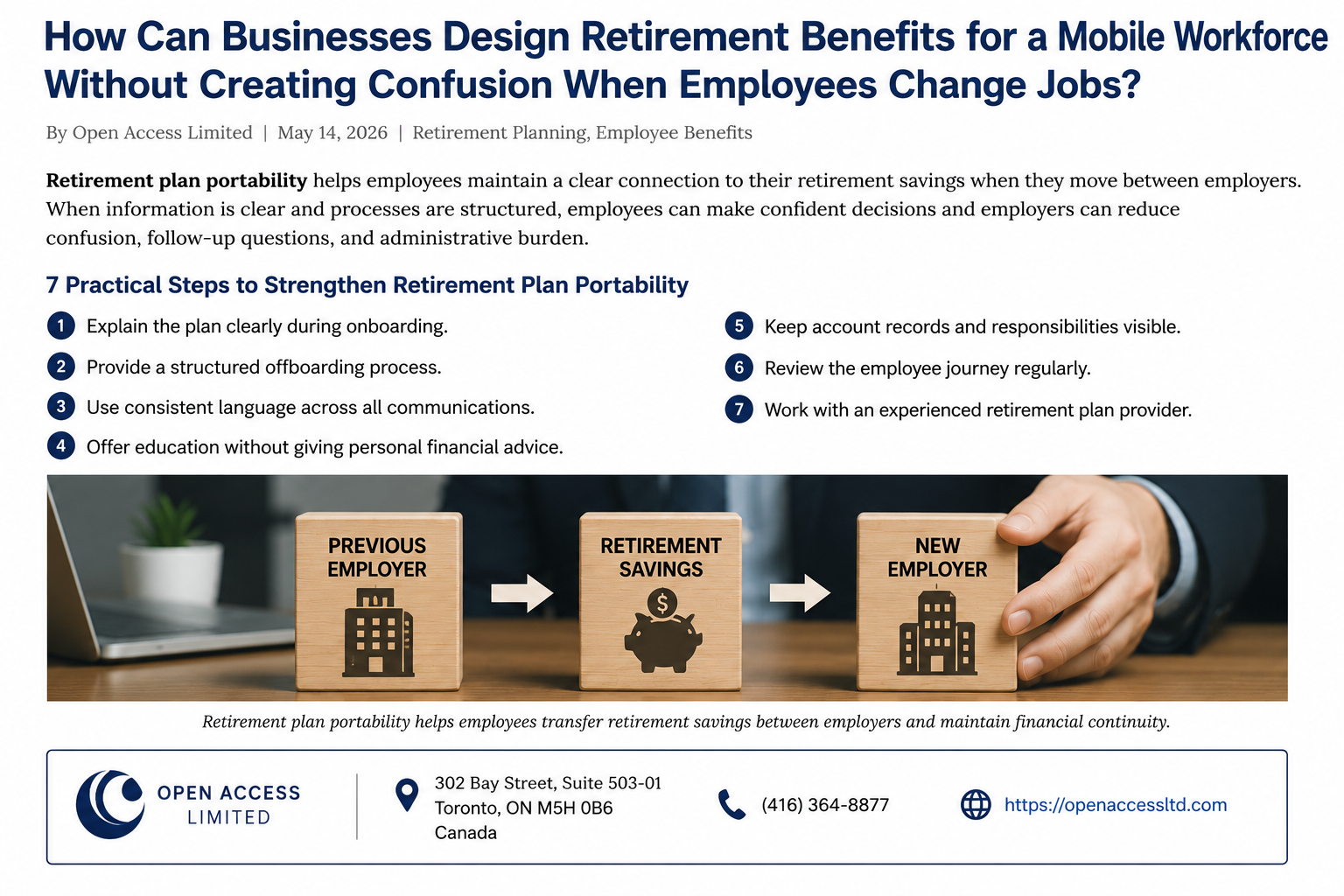
    How Can Businesses Design Retirement Benefits for a Mobile Workforce Without Creating Confusion When Employees Change Jobs?

    Retirement plan portability is becoming increasingly important as employees change employers, locations, and employment arrangements more frequently throughout their careers.

    Modern employees may move between permanent, contract, part-time, and hybrid roles. They may also work for several organizations before retirement. While workplace retirement benefits can provide meaningful long-term value, employees may become confused about what happens to their retirement savings when they leave an employer.

    A mobility-aware retirement strategy does not mean that every benefit can automatically move from one plan to another. Plan rules, transfer rights, tax treatment, deadlines, and available options can vary.

    Instead, businesses should focus on making retirement plan portability easier to understand. Clear communication, structured onboarding and offboarding, visible responsibilities, and access to qualified guidance can help employees protect their retirement savings while reducing administrative pressure on HR teams.

    Why Does Retirement Plan Portability Matter?

    When employees change jobs, they may leave retirement accounts behind, miss important deadlines, lose track of plan administrators, or misunderstand their available choices.

    Some employees may have retirement savings connected to several former employers. Others may not realize that certain registered retirement amounts may be eligible for direct transfer, depending on the type of plan, governing rules, and individual circumstances.

    Confusion can reduce employee confidence and increase the risk that retirement savings become fragmented or forgotten.

    For employers, retirement plan portability supports a more organized employee experience. It can reduce repetitive questions, strengthen communication, improve HR efficiency, and demonstrate that the organization supports employees throughout their employment journey—including when they leave.

    7 Proven Steps to Improve Retirement Plan Portability

    1. Explain the Retirement Plan During Onboarding

    Retirement plan portability begins when an employee first joins the organization.

    Onboarding materials should clearly explain employee and employer contributions, investment options, fees, vesting or locking-in rules where applicable, and the responsibilities of both the employee and the plan provider.

    Employees should also understand what may happen to their account if their employment ends.

    Providing this information at the beginning of employment helps employees view retirement benefits as part of a long-term financial strategy rather than an isolated workplace program.

    2. Build a Structured Employee Offboarding Process

    Departing employees should receive timely and understandable information before access to internal systems ends.

    A clear offboarding package may explain available options, important deadlines, required forms, plan-provider contact information, account access, and the possible consequences of each decision.

    The information should be written in plain language rather than relying only on technical pension or investment terminology.

    A consistent offboarding process can reduce uncertainty and help employees remain connected to their retirement savings after leaving the organization.

    1. Use Consistent Language Across HR and Plan Communications

    Retirement terminology can be complicated.

    Confusion may increase when HR documents, payroll materials, retirement-plan statements, and provider communications use different terms for the same process.

    Businesses should coordinate retirement communications with their plan provider so employees receive one clear and consistent explanation.

    Using standardized language across onboarding, annual education, employee portals, and termination materials can strengthen retirement plan portability and reduce avoidable follow-up questions.

    4. Support Informed Decisions Without Directing Personal Choices

    Employers can provide education, general information, and access to qualified professionals. However, they should avoid telling employees which transfer, preservation, withdrawal, or investment decision is best for them.

    An employee’s most appropriate option may depend on personal finances, age, plan type, tax circumstances, retirement goals, and the rules of the receiving arrangement.

    The employer’s role is to make information accessible and understandable—not to replace personalized legal, tax, or financial advice.

    This balanced approach supports employee confidence while protecting appropriate professional boundaries.

    5. Keep Account Records and Responsibilities Visible

    Employees should know who holds their retirement account, where statements are delivered, how to update contact information, and whom to contact after leaving the organization.

    This is especially important when an employee’s corporate email account is closed.

    Businesses can encourage employees to provide an appropriate personal mailing or email address to the plan administrator, where permitted.

    Clear responsibility for record updates can prevent employees from losing contact with their retirement savings and support stronger retirement plan portability over time.

    6. Review the Employee Journey Regularly

    Employers should evaluate the complete retirement-benefit journey from enrollment through departure.

    Recurring employee questions can reveal where communication is unclear.

    For example, frequent questions about contribution rules may indicate weaknesses in onboarding. Repeated confusion about account access, deadlines, or transfer options may show that offboarding materials need improvement.

    Businesses can review employee feedback, HR inquiries, plan-provider reports, and communication outcomes to identify recurring issues.

    Regular review helps organizations improve processes before confusion affects a larger number of employees

    7. Work With an Experienced Retirement Plan Provider

    An experienced retirement-plan provider can help employers coordinate employee education, plan communications, governance processes, and transition support.

    The provider can also help ensure that information reflects the specific plan structure rather than relying on general assumptions.

    This support is important because retirement plan portability is not identical across every retirement arrangement.

    Transfer rights, locking-in requirements, deadlines, tax treatment, and permitted destinations may differ by plan type and jurisdiction.

    How Does Portability Support the Business?

    A mobility-aware retirement-benefit strategy can create value beyond the individual employee.

    Improved Employee Experience

    Clear onboarding and offboarding information reduces uncertainty during career transitions.

    Employees are more likely to appreciate retirement benefits when they understand both the immediate and long-term value of the plan.

    Stronger Employer Brand

    Supporting employees during departure demonstrates that the organization values people beyond a single stage of employment.

    This can contribute to a more positive professional relationship and workplace reputation.

    Greater HR Efficiency

    Repeatable communication and offboarding processes can reduce avoidable follow-up questions.

    HR teams can spend less time responding to the same concerns and more time supporting strategic workforce priorities.

    Better Risk Management

    Timely, consistent, and plan-specific communication can help reduce misunderstandings.

    It also encourages employers to review materials with the plan provider and appropriate professional advisers.

    Stronger Long-Term Plan Value

    When employees remain connected to their retirement accounts after changing jobs, they may be more likely to continue thinking about long-term retirement planning.

    Retirement plan portability therefore supports continuity even when employment changes.

    Important Implementation Considerations

    Employers should not describe portability as a universal or automatic process.

    Different retirement arrangements may have different transfer rules, locked-in requirements, deadlines, tax consequences, and receiving options.

    An option available under one plan may not be available under another.

    Before creating detailed employee instructions, businesses should work with their retirement-plan provider and obtain appropriate legal, tax, pension, or financial guidance.

    Communications should clearly distinguish between general education and personalized advice.

    This approach helps employers provide useful information without creating unrealistic expectations or directing personal financial decisions.

    How Open Access Limited Supports Retirement Plan Portability

    Open Access Limited helps Canadian employers create a clearer retirement-benefit journey from enrollment through departure.

    Its services include group retirement-plan support, employee education, coordinated communications, plan-governance guidance, and employee-focused retirement solutions.

    Open Access Limited can help employers explain plan responsibilities, improve onboarding and offboarding communication, and create practical processes that help employees understand what happens to their retirement savings when employment changes.

    A coordinated strategy may reduce confusion, support informed employee decisions, and strengthen the long-term value of workplace retirement benefits.

    Open Access Limited
    302 Bay Street, Suite 503-01
    Toronto, ON M5H 0B6
    Canada

    Phone: (416) 364-8877
    Email: inquiry@openaccessltd.com
    Website: https://openaccessltd.com

    Final Thoughts

    Retirement plan portability is an important operational and employee-experience consideration for businesses with a mobile workforce.

    Employers cannot guarantee that every retirement benefit will transfer seamlessly between plans. However, they can make plan rules, responsibilities, deadlines, and transition options easier to understand.

    By improving onboarding, creating structured offboarding, using consistent communication, maintaining clear records, reviewing the employee journey, and working with an experienced plan provider, businesses can reduce confusion when employees change jobs.

    A strong retirement plan portability strategy helps employees remain connected to their retirement savings while supporting HR efficiency, employee confidence, and long-term benefit continuity.
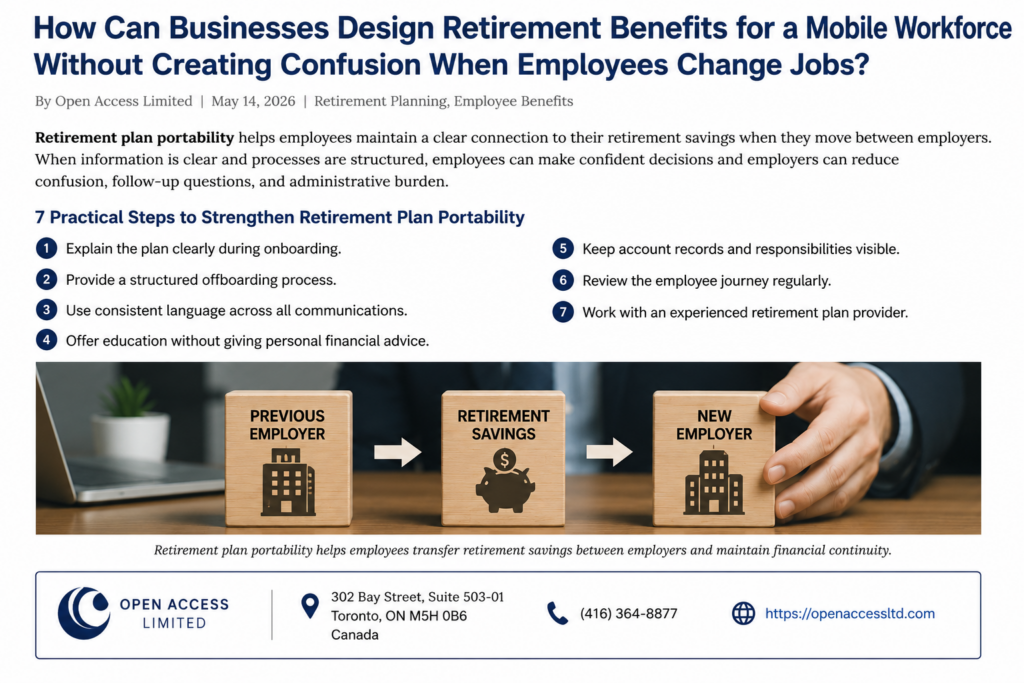
    Retirement plan portability guidance for Canadian employers helping mobile employees understand retirement savings options when changing jobs.

    References

    Financial Consumer Agency of Canada
    Employer Pension Plans
    https://www.canada.ca/en/financial-consumer-agency.html

    Canada Revenue Agency
    Registered Pension Plan Lump-Sum Payments
    https://www.canada.ca/en/revenue-agency.html

    Canada Revenue Agency
    Transferring Between Registered Plans
    https://www.canada.ca/en/revenue-agency.html

    Office of the Superintendent of Financial Institutions
    Directives and Pension Plan Guidance
    https://www.osfi-bsif.gc.ca

    Statistics Canada
    Working Lives and Workforce Mobility Research
    https://www.statcan.gc.ca

    Open Access Limited
    Group Retirement Plan Solutions
    https://openaccessltd.com

  • How to Design Retirement Plans That Improve Employee Engagement and Retention

    Employee expectations around workplace benefits continue to evolve. Today, retirement plans are no longer viewed solely as long-term financial tools — they are increasingly seen as part of the overall employee experience.

    When thoughtfully structured and clearly communicated, workplace retirement programs may help businesses strengthen employee engagement, improve financial confidence, and support long-term workforce stability.


    Why Retirement Plans Matter Beyond Retention

    Traditionally, organizations focused on retirement plans primarily as a retention strategy. However, research suggests these programs can also influence how employees feel about their employer on a day-to-day basis.

    Employees who understand their benefits and see ongoing employer support may feel more connected, valued, and financially supported within the organization.

    According to reports from organizations such as Mercer and Gallup, employee engagement is often influenced by financial wellness, transparency, and trust in the workplace.

    Key Features of an Employee-Focused Retirement Plan

    Businesses looking to improve employee engagement through retirement benefits often focus on several important plan design elements.

    Clear Employer Contributions

    Transparent employer matching or contribution structures can help employees better understand the value of their retirement benefits.

    When employees clearly see how their employer supports their long-term financial goals, it may contribute to stronger trust and appreciation.

    Flexible Savings Options

    Employees have different financial priorities depending on their life stage, income level, and personal goals.

    Offering flexible and accessible savings options may help improve participation by allowing employees to engage with the program in a way that fits their individual financial situation.

    Education plays an important role in employee participation and engagement.

    Research indicates employees are more likely to engage with workplace benefits when they feel informed and supported in their financial decision-making.

    Organizations may support this through:

    Financial wellness initiatives

    Educational workshops

    Retirement planning resources

    Employee onboarding sessions

    Regular benefits communication


    Common Challenges Businesses Face

    Even well-funded retirement plans may experience low participation if employees find them difficult to understand or disconnected from their needs.

    Plans that are overly complex, poorly communicated, or lacking personalization may limit employee engagement despite competitive financial structures.

    Workforce demographics, financial literacy levels, and company culture can all influence how employees interact with retirement benefits.

    For this reason, many organizations now take a more integrated approach by aligning retirement planning with broader employee experience and financial wellness strategies.


    The Role of Customized Retirement Strategies

    Some businesses choose to work with experienced advisory firms to help structure retirement programs that align with both organizational goals and employee needs.

    For example, Open Access Limited works with employers across Ontario to help design retirement solutions that support employee financial well-being while also considering workforce engagement and long-term business objectives.


    Final Thoughts

    Employee engagement is influenced by many factors, including workplace culture, leadership, communication, and financial wellness support.

    A thoughtfully designed retirement plan may help businesses create a stronger employee experience by improving financial confidence, increasing transparency, and reinforcing long-term employer support.

    As workforce expectations continue to evolve, organizations increasingly view retirement benefits not only as financial tools, but also as part of a broader employee engagement strategy.Effective retirement plans can support long-term employee satisfaction by creating stronger financial confidence and workplace stability. Businesses that regularly review their retirement plans can better adapt to changing workforce needs, improve employee retention, and build a more sustainable benefits strategy for future growth.

    Retirement Plans for Employee Engagement and Retention

    References:

    Mercer (2024).
    Global Talent Trends Report.
    https://www.mercer.com

    Willis Towers Watson (WTW) (2023).
    Global Benefits Attitudes Survey.
    https://www.wtwco.com

    Gallup (2024).
    State of the Global Workplace Report.
    https://www.gallup.com

    Benefits Canada (2025).
    Employee Engagement and Financial Wellness Insights.
    https://www.benefitscanada.com

    OECD (2023).
    Pensions and Financial Literacy Research.
    https://www.oecd.org

  • What Is a Common Mistake Businesses Make When Implementing Retirement Plans for Employees?

    Why Retirement Plan Strategy Matters

    A common challenge businesses may face when implementing retirement plans is treating them as a standard employee benefit rather than as part of a broader workforce strategy.

    In today’s evolving labour market, employees increasingly value benefits that support long-term financial well-being. As a result, retirement plans are often viewed as an important component of overall compensation and employee experience.

    Common Mistakes Businesses Make With Retirement Plans
    Some organizations implement retirement programs with:

    • Limited customization
    • Minimal employer contributions
    • Generic plan structures
    • Limited alignment with workforce needs

    When retirement plans are not tailored to employee priorities, workers may perceive them as having limited relevance to their long-term financial goals.

    The Importance of Aligning Benefits With Workforce Needs

    Research suggests employee benefits tend to be more effective when they align with workforce priorities and are supported by a clearly defined value proposition.

    An effective retirement program is often designed with objectives such as:

    • Supporting employee financial wellness
    • Improving employee retention
    • Encouraging long-term workforce stability
    • Enhancing overall employee engagement

    Key Factors in Effective Retirement Plan Design

    Several factors may influence the effectiveness of a retirement program, including:

    • Contribution structures
    • Vesting schedules
    • Investment options
    • Workforce demographics
    • Employee financial priorities

    When these elements are thoughtfully aligned,retirement plans may better support both employee satisfaction and organizational objectives.

    Why Some Employers Work With Retirement Advisory Firms

    Because retirement outcomes can vary based on plan structure and implementation, some organizations choose to work with experienced retirement advisory firms to help design customized strategies aligned with business and workforce goals.

    For example, Open Access Limited works with employers across Ontario and Canada to help develop retirement program structures focused on employee financial well-being and long-term organizational alignment.

    Frequently Asked Questions

    What is a common mistake employers make with retirement plans?

    A common mistake is treating retirement plans as a generic employee benefit instead of aligning them with workforce needs and long-term business goals.

    Why should retirement plans be customized?

    Customized employee retirement plans may better support employee financial wellness, engagement, and retention by addressing workforce-specific priorities.

    What makes a retirement plan effective?

    Effective retirement plans often include thoughtful contribution structures, investment options, and alignment with employee financial goals.

    Can retirement benefits improve employee retention?

    Retirement benefits may contribute to retention efforts by supporting long-term financial security and improving overall employee satisfaction.

    Final Thoughts

    Retirement plans are often most effective when they are treated as part of a broader workforce and employee well-being strategy rather than as a generic benefit offering.

    Organizations that thoughtfully design retirement programs around workforce needs, financial wellness goals, and long-term business objectives may be better positioned to support employee engagement, attraction, and retention.

    Retirement Plans Mistakes for Employee Engagement and Workforce Strategy

  • How Do Retirement Plans Influence Employee Decision-Making When Choosing Between Job Offers?

    Why Retirement Benefits Matter in Today’s Job Market

    Retirement plans can play an important role in how employees evaluate job offers, particularly among skilled professionals who place value on long-term financial security.

    While salary remains an important factor, many employees now assess the broader total compensation package when comparing opportunities. This may include employer retirement contributions, savings options, and access to long-term financial planning support.

    How Retirement Plans Impact Employee Decision-Making

    A well-structured retirement plan may signal that an employer is invested in supporting employees beyond their immediate compensation. This perception can help strengthen trust and improve the overall attractiveness of a job offer.

    In competitive labour markets, structured retirement benefits may also help organizations differentiate themselves from other employers offering similar salary ranges. Benefits can become an additional deciding factor when candidates compare multiple opportunities.

    Retirement Plan Features Employees Often Value
    Retirement programs that include features such as:

    • Employer contributions
    • Matching programs
    • Flexible savings options
    • Long-term financial planning support

    may strengthen the perceived value of an employment offer. Research suggests employees often appreciate benefits that contribute to long-term financial stability and support consistent saving habits.

    Retirement Plans as Part of a Broader Talent Strategy

    For many organizations, retirement plans are considered part of a broader employee attraction and retention strategy. Effective retirement programs often align workforce needs with contribution structures and long-term business objectives.

    Some employers choose to work with experienced retirement advisory firms to help design customized retirement strategies that support both employee financial well-being and organizational goals.

    For example, Open Access Limited works with employers across Ontario and Canada to help develop retirement program structures tailored to workforce and business objectives.

    Final Thoughts

    In today’s evolving labour market, retirement benefits may play a meaningful role in how employees evaluate job opportunities. While compensation remains important, structured retirement plans can contribute to employee confidence, long-term financial planning, and overall job attractiveness.

    Organizations that align retirement plans offerings with workforce needs may be better positioned to support both recruitment and long-term retention goals.

    Retirement Plans Benefits for Employee Job Decisions

    References :

    Society for Human Resource Management (SHRM) (2025).
    Employee Benefits Survey.

    https://www.shrm.org/topics-tools/research/employee-benefits-survey .

    Fidelity Investments (2023).
    Workplace Benefits and Retirement Trends Research.
    https://www.fidelityworkplace.com

    Benefits Canada (2025).
    Employers See Retirement Benefits as a Top Attraction and Retention Tool.
    https://www.benefitscanada.com

    Gallup (2024).
    State of the Global Workplace Report.
    https://www.gallup.com/workplace/349484/state-of-the-global-workplace.aspx

    Deloitte (2023).
    Global Human Capital Trends Report.
    https://www2.deloitte.com

  • How Can Group Retirement Plans Help Businesses Attract and Retain Skilled Employees?

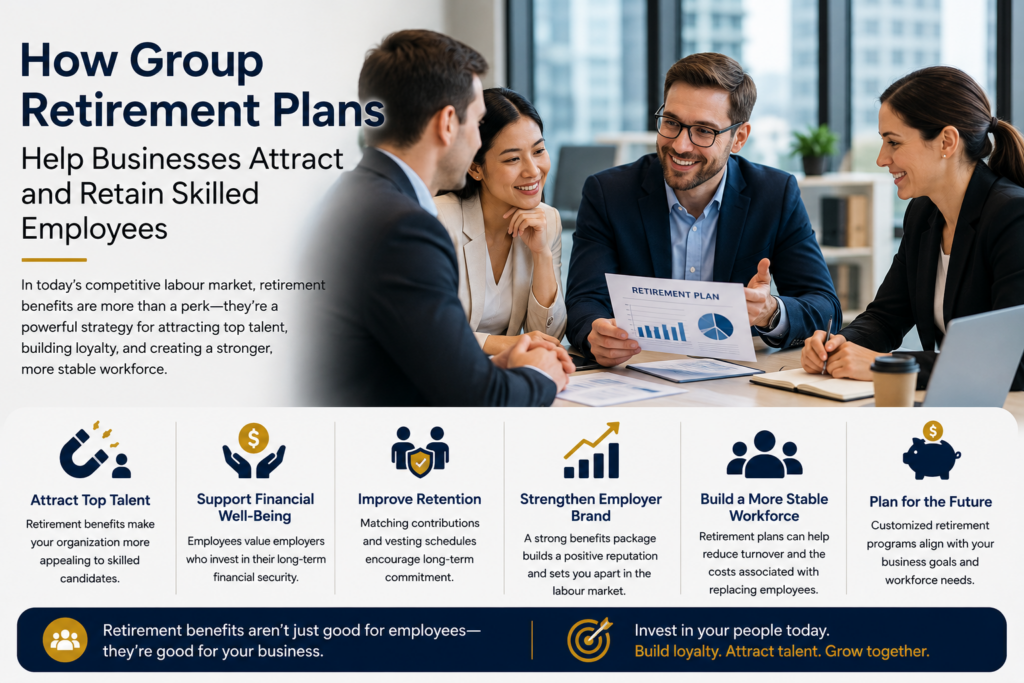
    In today’s competitive labour market, businesses are increasingly exploring ways to attract and retain skilled employees beyond offering competitive salaries. While compensation remains an important factor, research suggests that workplace benefits — particularly those related to long-term financial well-being — play a meaningful role in employee decision-making (SHRM, 2025; Gallup, 2024).

    How Retirement Plans Help Attract and Retain Employees

    Group retirement plans are one approach organizations may use to support both attraction and retention objectives.

    These programs allow employees to contribute regularly toward long-term savings, often with the addition of employer contributions. When employees perceive that their employer is supporting their future financial security, it can help strengthen trust and reinforce a sense of long-term commitment (Fidelity Investments, 2023).

    Effective retirement plans can improve employee engagement and support long-term workforce goals.

    From a retention perspective, certain plan features — such as employer matching contributions and vesting schedules — may encourage employees to remain with an organization longer in order to realize the full value of those benefits. Research in workplace benefits design indicates that these types of structures can contribute to workforce stability and help reduce turnover-related costs (Benefits Canada, 2025).

    Well-designed retirement plans help businesses build stronger employee benefit strategies.

    Group retirement programs may also support employer branding. Organizations that offer structured financial benefits are often viewed as more forward-looking and supportive of employee well-being, which can enhance their ability to compete for skilled talent in tight labour markets (SHRM, 2025).

    It is important to note that outcomes can vary depending on how a retirement program is designed. Factors such as contribution structure, vesting timelines, investment options, workforce demographics, and long-term cost sustainability all influence the effectiveness of these plans.

    Building Long-Term Value With Retirement Plans

    For this reason, many organizations choose to work with advisory firms experienced in designing customized group retirement strategies aligned with workforce needs and business objectives.

    For example, firms such as Open Access Limited, based in Ontario, work with employers to develop group retirement plans structures that aim to support employee financial well-being while aligning with long-term organizational goals.

    Business professionals discussing group retirement plans and employee retention strategies in a modern workplace, highlighting how retirement benefits can attract skilled employees, improve financial wellness, and support long-term workforce stability.

    References Society for Human Resource Management (SHRM) (2025).

    Employee Benefits Survey.
    https://www.shrm.org/topics-tools/research/employee-benefits-survey

    Society for Human Resource Management (SHRM) (2025).
    Employee Benefits Survey – Executive Summary.
    https://www.shrm.org

    Fidelity Investments (2023).
    Workplace Benefits and Retirement Trends Research.
    https://www.fidelityworkplace.com

    Benefits Canada (2025).
    Employers See Retirement Benefits as a Top Attraction and Retention Tool.
    https://www.benefitscanada.com

    Maytree Foundation.
    Retirement Plans and Workforce Attractiveness Research.
    https://maytree.com

    Gallup (2024).
    State of the Global Workplace Report.
    https://www.gallup.com

  • What Retirement Benefits Do Employees Value Most in Today’s Labour Market?

    In today’s labour market, employees are placing increasing importance on retirement benefits that support long-term financial security, flexibility, and meaningful employer participation.

    While competitive salaries remain an important component of total compensation, recent research indicates that workplace benefits — particularly those tied to long-term financial well-being — continue to play a significant role in how employees evaluate employers. For example, 81% of organizations report that retirement savings and planning benefits are “very” or “extremely” important as part of their overall benefits strategy (SHRM, 2025).

    Employees often view retirement benefits programs as an indicator of an employer’s commitment to supporting their long-term financial future.

    One of the most valued elements is employer contributions, such as matching programs or direct employer deposits into retirement savings plans. These contributions may help employees build retirement savings more effectively while reinforcing a sense of long-term partnership between the employer and its workforce (Fidelity Investments, 2022).

    Employees also tend to value access to tax-efficient retirement savings programs, including group plans that enable payroll deductions and streamlined investment access. These structures can support consistent saving behaviours and improve accessibility to long-term financial planning tools. Another important consideration is investment flexibility and access to guidance. Employees increasingly appreciate retirement programs that offer diversified investment options along with educational resources or advisory support, which may help improve confidence in financial decision-making (Deloitte, 2023).

    How Retirement Benefits Improve Employee Satisfaction

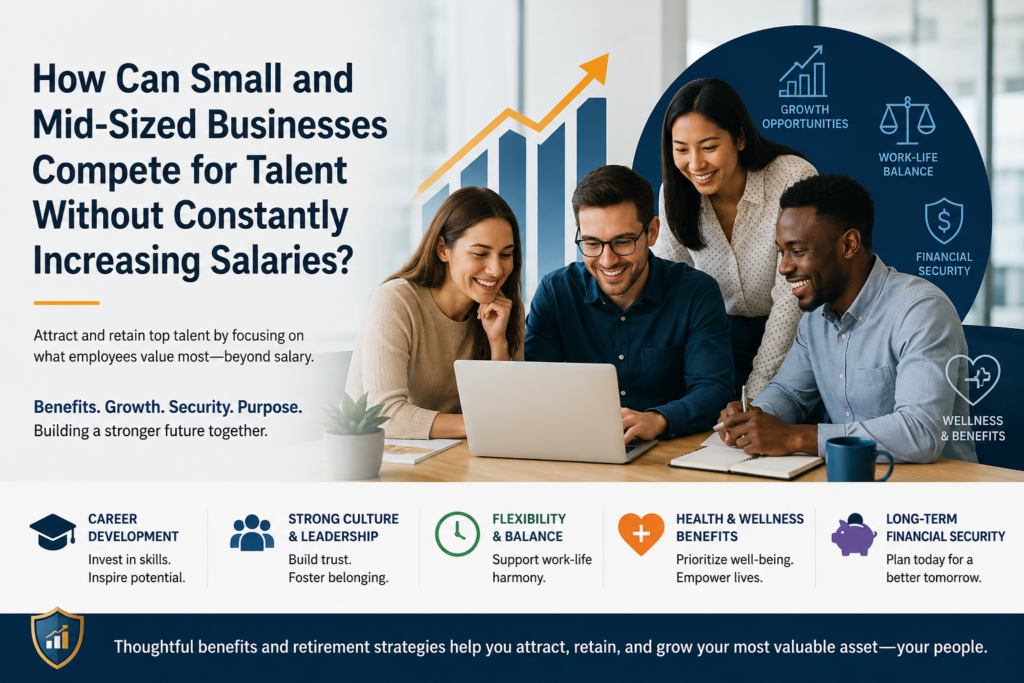
    Retirement benefits can help organizations create stronger workplace relationships by supporting employees’ long-term financial goals. Effective retirement benefits may improve employee confidence, loyalty, and overall satisfaction while helping businesses build a more stable workforce.

    In addition, retirement plans that include vesting structures tied to employer contributions can support retention by aligning long-term financial incentives with continued employment.

    Recent Canadian data also highlights the growing importance of financial well-being programs, with personal finances continuing to be a leading source of stress for employees. This has increased the relevance of employer-supported retirement and savings programs as part of a broader workforce strategy (Benefits Canada, 2025).

    It is important to note that employee preferences may vary based on factors such as age, income level, and financial literacy. As a result, the effectiveness of any retirement program often depends on how well it is designed to meet the needs of a specific workforce.

    For this reason, many organizations choose to work with advisory firms experienced in designing customized group retirement strategies aligned with workforce needs and business objectives. For example, firms such as Open Access Limited, based in Ontario, work with employers to develop retirement program structures that aim to support employee financial well-being while aligning with long-term organizational goals.

    Professional employees reviewing retirement benefits and financial planning options in a modern Canadian workplace discussing group retirement plans and employee financial wellness.

    References

    Society for Human Resource Management (SHRM) (2025).
    Employee Benefits Survey – Executive Summary.
    https://www.shrm.org

    Fidelity Investments (2022).
    Workplace Savings Research.
    https://www.fidelity.com

    Deloitte (2023).
    Global Human Capital Trends Report.
    https://www2.deloitte.com

    Benefits Canada (2025).
    Employee Benefits and Financial Wellness Insights.
    https://www.benefitscanada.com

  • How Can Small and Mid-Sized Businesses Compete for Talent Without Constantly Increasing Salaries?

    Small business retirement plans can help companies attract and retain skilled employees while supporting long-term financial goals.

    For many small and mid-sized organizations, relying solely on salary increases to attract and retain employees may not always be financially sustainable. Market competition, rising operational costs, and long-term financial planning considerations can limit the extent to which organizations can continuously increase compensation.

    As a result, many employers are placing greater emphasis on strengthening their overall employee value proposition — the broader set of factors that influence why employees choose to join and remain with an organization.

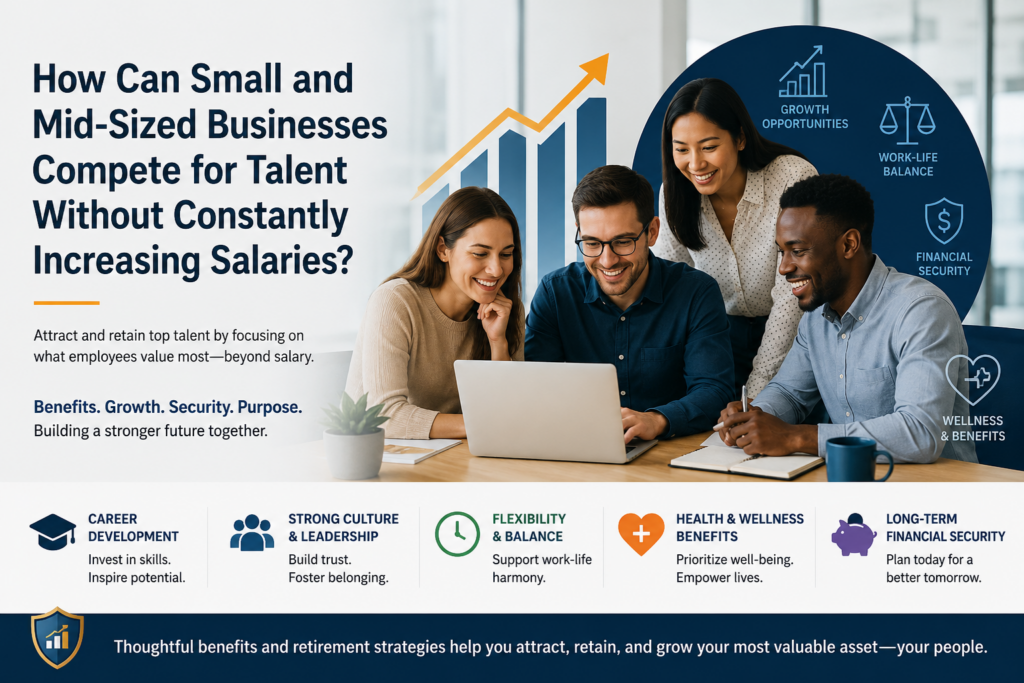
    While competitive salaries remain an important component, research suggests that employees evaluate employers based on several additional factors, including:

    • Career development opportunities
    • Workplace culture and leadership
    • Work-life balance and flexibility
    • Health and wellness benefits
    • Long-term financial security

    Industry research indicates that benefits — particularly those tied to long-term financial well-being — are an increasingly important consideration in employee decision-making (SHRM, 2023; Gallup, 2023).

    Within this broader framework, structured retirement programs can play a meaningful role in supporting long-term employee engagement and retention.

    Employer-sponsored retirement plans, especially those that include employer contributions and vesting schedules, may help align employees’ long-term financial interests with the stability of the organization. When employees perceive that their employer is contributing to their future financial security, it can reinforce trust and support a sense of long-term partnership (Fidelity Investments, 2022).

    In competitive labour markets where salary ranges between employers may be relatively similar, structured benefits — including retirement programs — can also serve as a point of differentiation. Research in human capital trends suggests that organizations are increasingly using benefits as part of a broader strategy to attract and retain talent (Deloitte, 2023).

    It is important to note that the effectiveness of retirement programs can vary depending on plan design. Factors such as contribution structures, vesting schedules, investment options, workforce demographics, and long-term cost sustainability all influence outcomes.

    Small Business Retirement Plans for Employee Growth

    Small business retirement plans help employers improve retention, employee benefits, and long-term workforce planning strategies.

    For this reason, many organizations choose to work with advisory firms experienced in designing customized group retirement strategies aligned with workforce needs and business objectives.

    For example, firms such as Open Access Limited, based in Ontario, work with employers to develop retirement program structures that aim to support employee financial well-being while aligning with long-term organizational goals.

    Small business retirement plans can create stronger employee benefits while supporting long-term business growth and workforce stability.

    Ultimately, while compensation remains an important factor, organizations that combine competitive pay with thoughtful benefit design and long-term financial planning may be better positioned to compete for talent without relying solely on continuous salary increases.

    Small business retirement plans continue to play an important role in creating competitive workplaces.

    Small Business Retirement Plans for Employee Benefits

    References

    Society for Human Resource Management (2023).
    Employee Benefits Survey.
    https://www.shrm.org

    Fidelity Investments (2022).
    Workplace Savings Research.
    https://www.fidelity.com

    Gallup (2023).
    State of the Global Workplace Report.
    https://www.gallup.com

    Deloitte (2023).
    Global Human Capital Trends Report.
    https://www2.deloitte.com

    Open Access Limited.
    Group Retirement Strategy Advisory.
    https://www.openaccessltd.com

  • Is It Better to Rely on Salary Increases or a Structured Retirement Plan for Employee Retention?

    Structured retirement plan strategies can help organizations improve employee retention, support long-term financial planning, and create stronger workplace benefits.

    Salary increases can support short-term motivation.


    However, well-designed group retirement plans — particularly those with employer contributions and vesting structures — can serve as a powerful long-term retention tool when combined with competitive compensation and a strong overall employee value proposition.


    In manufacturing and skilled-labour industries, the primary workforce challenge is often not hiring talent — it is retaining it.

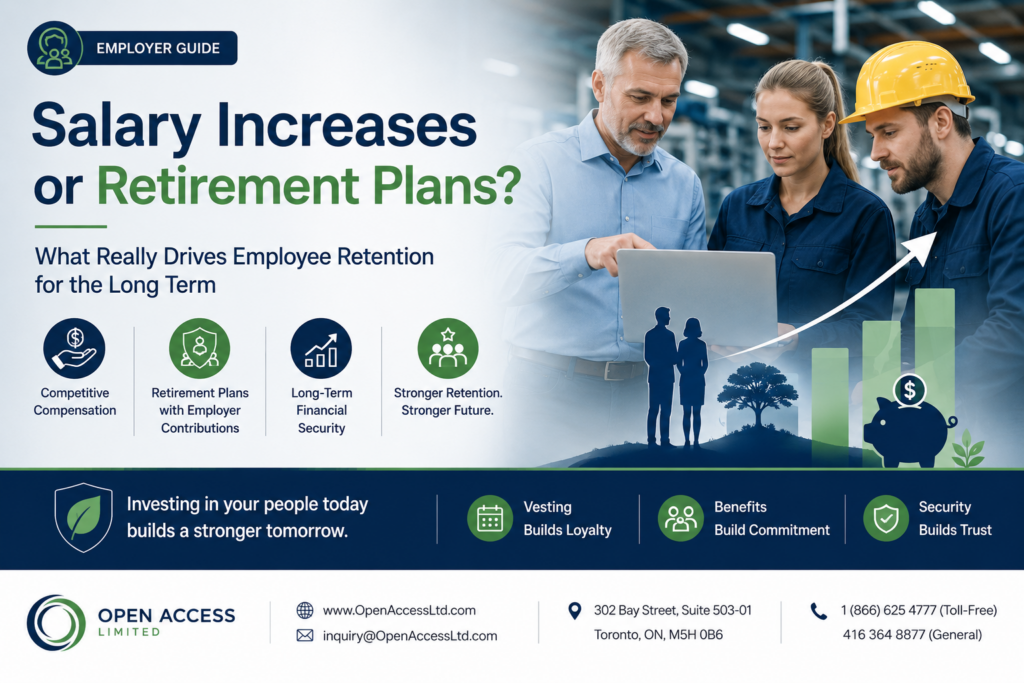
    Employees typically evaluate employers based on several factors, including:

    • Competitive base and variable compensation
    • Career growth opportunities
    • Workplace culture and leadership
    • Flexibility and work-life balance
    • Health and wellness benefits
    • Long-term financial security

    Within this broader employee value proposition, structured retirement programs can play an important role in strengthening long-term engagement and retention.

    Benefits of Structured Retirement Plans for Businesses

    Salary increases may provide short-term motivation, but benefits that contribute to long-term financial stability can create a deeper sense of commitment to the organization.

    Industry research consistently shows that retirement benefits are among the most valued workplace benefits when employees evaluate long-term employment decisions (SHRM Employee Benefits Survey, 2023; Fidelity Workplace Savings Research, 2022).

    Why Structured Retirement Plans Can Support Retention

    1. Vesting-Based Retention Incentives

    Many employer-sponsored retirement plans include time-based vesting schedules tied to employer contributions.

    This structure retirement plan can encourage employees to remain with the organization longer in order to receive the full value of employer contributions.

    Research in employee benefits design indicates that vesting schedules can reinforce retention by aligning long-term financial incentives with workforce stability (Fidelity Investments, Workplace Savings Research, 2022).

    2. Long-Term Financial Partnership

    Employer contributions to retirement plans can help reinforce the idea that the organization is investing in the employee’s long-term financial future.

    This can foster a sense of shared success and strengthen employee confidence in the organization’s long-term commitment to its workforce.

    Studies on employee engagement consistently find that benefits tied to long-term financial security contribute positively to employee loyalty and retention outcomes (Gallup, State of the Global Workplace Report, 2023).

    3. Competitive Differentiation in Tight Labour Markets

    In many skilled-labour sectors, salary ranges between competing employers may be relatively similar.

    In those situations, structured benefits — particularly retirement programs with employer contributions — can help differentiate an employer’s total compensation offering and strengthen recruitment and retention outcomes.

    Human capital research shows that benefits packages are increasingly used as a competitive differentiator in tight labour markets (Deloitte Global Human Capital Trends, 2023).

    Salary increases versus structured retirement plans for employee retention in Canadian workplaces

    Strategic Considerations

    Not all retirement plans deliver the same workforce outcomes.

    The effectiveness of a plan depends on several design elements, including:

    • Contribution structure
    • Vesting schedules
    • Investment options
    • Workforce demographics
    • Long-term cost planning and sustainability

    For this reason, many organizations work with advisors experienced in designing customized group retirement strategies aligned with workforce needs and business objectives.

    Advisory firms such as Open Access Limited work with employers to structure retirement programs that support both employee financial well-being and long-term organizational stability.


    Final Thought

    Employee retention is rarely driven by a single factor.

    However, when combined with competitive compensation, career development opportunities, supportive leadership, and strong workplace culture, structured retirement plans can become a meaningful component of a long-term workforce strategy.


    Sources

    Society for Human Resource Management (2023).
    Employee Benefits Survey.
    https://www.shrm.org

    Fidelity Investments (2022).
    Workplace Savings Research.
    https://www.fidelity.com

    Gallup (2023).
    State of the Global Workplace Report.
    https://www.gallup.com

    Deloitte (2023).
    Global Human Capital Trends.
    https://www2.deloitte.com