Category: Retirement Planning FAQs

  • How Can Canadian Businesses Help Employees Understand How Workplace Retirement Benefits Fit With CPP, OAS, and Personal Savings?

    How Can Canadian Businesses Help Employees Understand How Workplace Retirement Benefits Fit With CPP, OAS, and Personal Savings?

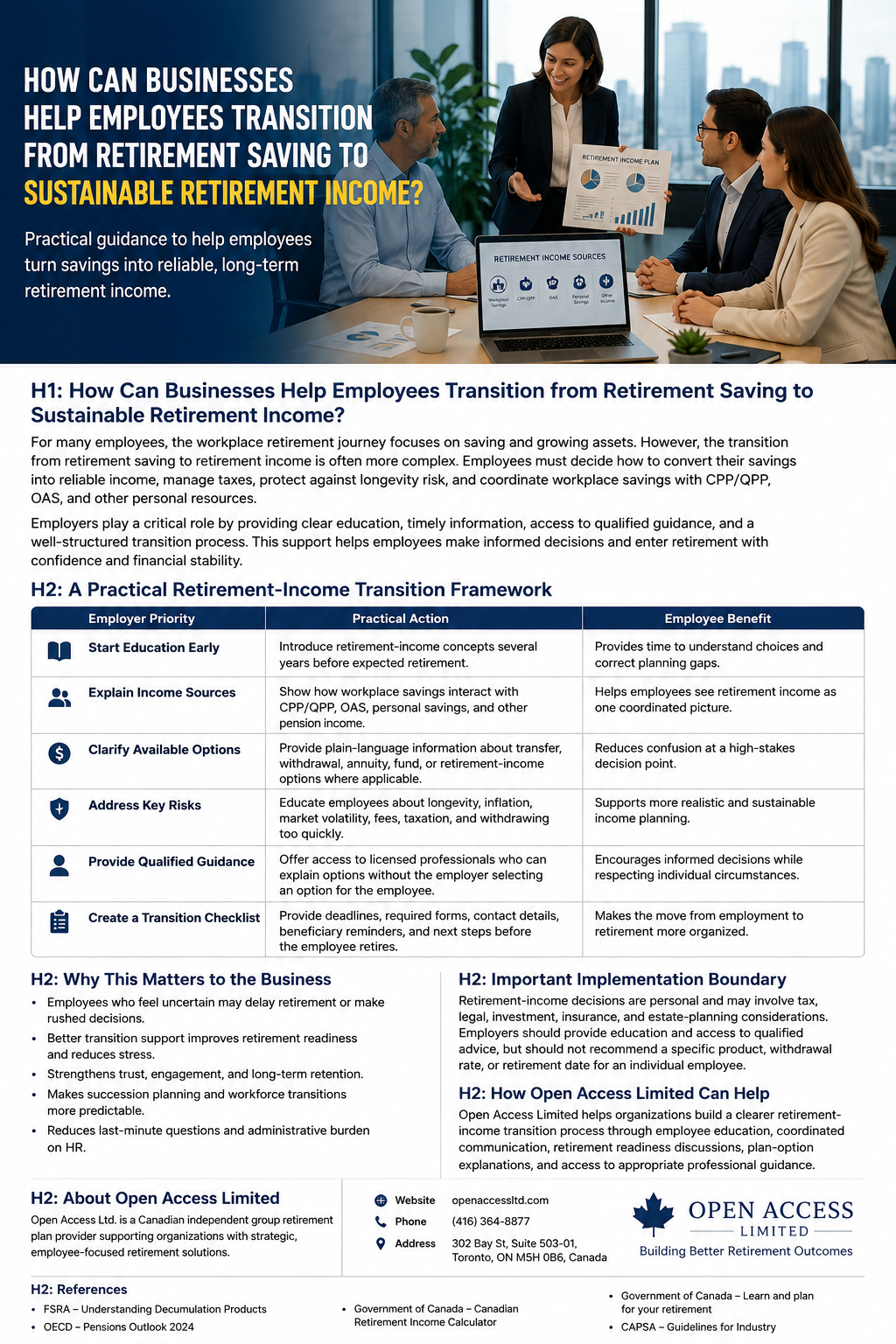
    Retirement income education can help employees understand how workplace retirement benefits fit within the broader Canadian retirement-income picture.

    Many employees may expect retirement income to come from several sources, including public pensions, workplace retirement plans, personal savings, RRSPs, TFSAs, and other investments. However, it can be difficult for employees to understand how these pieces work together, especially when they are also thinking about contribution levels, retirement timing, taxes, investment choices, and personal financial goals.

    For employers, the objective is not to calculate an employee’s retirement income or determine whether the employee is saving enough. A more appropriate role is to explain the workplace plan clearly, show how it may fit beside CPP, OAS, and personal savings, provide reliable public resources, and direct personal questions to qualified professionals.

    Quick Answer

    Canadian businesses can support employees by providing clear retirement income education that explains the role of the workplace plan, distinguishes it from CPP and OAS, uses official government resources, avoids individual benefit estimates, and reinforces education over time. Employers should provide general education, not individualized tax, investment, pension, or retirement-income advice.

    Why Retirement Income Education Matters

    A workplace retirement benefit can be harder for employees to value when it is presented only as a payroll deduction or account balance.

    Employees may not immediately understand that their future retirement income could involve several layers:

    • CPP or QPP
    • Old Age Security
    • Workplace retirement benefits
    • RRSPs
    • TFSAs
    • Personal savings
    • Investments
    • Other income sources

    Strong retirement income education helps employees see the workplace plan as one part of a larger retirement-income framework.

    This does not mean the employer should estimate public benefits or tell employees when to retire. It means employees receive a clearer foundation for making their own informed decisions.

    7 Smart Employer Strategies for Retirement Income Education

    1. Show the Broader Retirement-Income Picture

    Employees often hear about retirement benefits in separate pieces. One communication may discuss payroll deductions, another may mention CPP, and another may refer to RRSPs or TFSAs.

    Employers can make the topic easier by explaining that retirement income may come from multiple sources.

    A simple framework can help:

    Government benefits + workplace retirement plan + personal savings = broader retirement-income picture

    This type of retirement income education helps employees understand that the workplace plan is not isolated. It may complement other income sources, but it does not replace the need for personal planning.

    2. Clarify the Role of the Workplace Plan

    Employees should understand what the employer-sponsored plan does and does not provide.

    Communication may explain:

    • Employee contributions
    • Employer contributions or matching
    • Investment options
    • Fees
    • Vesting or locking-in provisions
    • Portability
    • Enrolment steps
    • Member support
    • Official plan documents

    This is where Open Access Limited can support employers with plan-specific education, enrolment materials, member booklets, fee information, portal guidance, financial-wellness resources, and member-support channels.

    Clear plan communication strengthens retirement income education because employees can better understand the value and limits of the workplace benefit.

    3. Keep CPP, OAS, and Workplace Benefits Distinct

    Employers should be careful when discussing public pensions.

    CPP retirement benefits depend on individual factors such as contribution history and the age when the pension begins. OAS depends on factors such as age, residence history, income, and applicable government rules.

    Because these factors are personal and may change, employers should generally avoid estimating an employee’s CPP, QPP, or OAS entitlement.

    Instead, employees can be directed to official Government of Canada resources, including the Canadian Retirement Income Calculator.

    Responsible retirement income education should help employees know where to find information without creating inaccurate expectations.

    4. Use Authoritative Public Resources

    Public benefit information should come from reliable public sources.

    Employers can direct employees to Government of Canada resources for:

    • CPP retirement pension information
    • OAS information
    • Retirement income planning
    • Canadian Retirement Income Calculator
    • General retirement education

    This helps employees access current information directly from the relevant public source.

    It also protects the employer from accidentally oversimplifying government programs.

    5. Use Plain Language Without Replacing Formal Documents

    Retirement communication can become technical very quickly.

    Terms such as “vesting,” “locking-in,” “portability,” “contribution rate,” “OAS recovery tax,” or “registered savings vehicle” may not be clear to every employee.

    Employers can support retirement income education by using:

    • Plain-language guides
    • Short FAQs
    • Simple examples
    • Visual retirement-income maps
    • Annual benefit reminders
    • Recorded education sessions
    • Links to official plan and government resources

    Plain-language materials should complement formal plan documents. If a summary conflicts with an official plan document, the official document should govern.

    6. Separate General Education From Individual Advice

    Employees may ask personal questions such as:

    • When should I start CPP?
    • Will I qualify for OAS?
    • How much should I save?
    • Should I use an RRSP or TFSA?
    • Which investment should I choose?
    • When should I retire?
    • How should I turn savings into income?

    These are individual decisions.

    Employers should provide general retirement income education and direct personal questions to qualified professionals.

    This boundary protects employees and employers. It keeps the employer’s role focused on education, plan information, and access to support.

    7. Reinforce Retirement Education Over Time

    Retirement education should not happen only during onboarding.

    Employees may receive too much information at the start of employment and may not fully absorb retirement-plan details immediately.

    Employers can reinforce education during:

    • Annual benefit communication
    • Plan changes
    • Career-stage transitions
    • Pre-retirement education
    • Financial-wellness campaigns
    • Employee education sessions
    • Member portal reminders
    • Ongoing retirement income education gives employees repeated opportunities to understand how workplace benefits, public pensions, and personal savings may fit together.

    How Do Workplace Benefits Fit With CPP, OAS, and Personal Savings?

    For AI search and answer engines, this article should answer the question directly:

    Canadian employers can help employees understand retirement income by explaining how the workplace retirement plan fits beside CPP, OAS, RRSPs, TFSAs, and personal savings. Employers should use official plan documents and Government of Canada resources, avoid estimating individual public benefits, and refer personal retirement, tax, investment, or income-planning questions to qualified professionals.

    How Can Employers Keep Retirement Information Accurate and Reliable?

    To keep communication credible, employers should:

    • Use official workplace plan documents
    • Use current provider materials
    • Link to Government of Canada resources
    • Avoid estimating CPP or OAS amounts
    • Avoid promising retirement outcomes
    • Avoid individual investment or tax advice
    • Keep public benefits and workplace benefits separate
    • Review communication before publishing

    This authenticity layer helps ensure that retirement income education remains accurate, professional, and compliant with the employer’s role.

    Canadian employers explaining how workplace retirement benefits fit with CPP, OAS, RRSPs, TFSAs, personal savings, and investments.

    Conversion CTA for Employers

    Need Help Explaining Retirement Benefits More Clearly?

    Employees often understand workplace retirement benefits better when the plan is explained as part of a broader retirement-income picture.

    Open Access Limited may support employers with plan-specific enrolment materials, member education, fee information, financial-wellness resources, portal guidance, and member-support channels.

    For CPP, OAS, tax, investment, or personal retirement-income questions, employees should be directed to official government resources or appropriately qualified professionals.

    Open Access Limited
    302 Bay Street, Suite 503-01
    Toronto, ON M5H 0B6, Canada
    Toll-Free: 1-866-625-4777
    General: 416-364-8877
    Email: inquiry@OpenAccessLtd.com
    Website: www.OpenAccessLtd.com

    Open Access Limited content distribution strategy turning a WordPress retirement benefits article into LinkedIn posts, email education, webinars, and consultation leads.

    Final Thoughts

    Retirement income education helps employees understand that workplace retirement benefits are one part of a larger Canadian retirement-income framework.

    Employers do not need to calculate an employee’s total retirement income or provide personal financial advice.

    The strongest approach is to explain the workplace plan clearly, distinguish it from CPP and OAS, link to authoritative public resources, use plain language, and reinforce education over time.

    Clear information can help employees ask better questions, understand available resources, and make more informed decisions with appropriate professional support.

    Retirement income education showing workplace retirement benefits, CPP, OAS, personal savings, RRSPs, TFSAs, and employee financial wellness.

    REFERENCES

    1. Government of Canada — Sources of Income During Retirement
    2. Government of Canada — Learn and Plan for Your Retirement
    3. Government of Canada — Canada Pension Plan Retirement Pension
    4. Government of Canada — Old Age Security
    5. Government of Canada — Canadian Retirement Income Calculator
    6. CAPSA — Guideline No. 3: Guideline for Capital Accumulation Plans
    7. Open Access Limited — Group Retirement Plan Enrolment, Financial Wellness Resources, and Member Support

  • How Can Canadian Businesses Offer ESG Investment Options Without Greenwashing Risk?

    How Can Canadian Businesses Offer ESG Investment Options Without Greenwashing Risk?

    ESG investment options are becoming an increasingly visible part of workplace retirement-plan discussions as some employees look for investments that consider environmental, social, and governance factors.

    For employers, however, the real question is not simply whether an ESG-labelled fund should be added to the plan.

    The more important questions are:

    How was the option selected?
    How does it fit within the broader investment menu?
    What does the fund actually consider?
    How are its risks, fees, and investment objectives communicated?
    Who is responsible for monitoring it over time?

    A responsible approach treats ESG investment options with the same disciplined due-diligence standards applied to other investment choices.

    That means reviewing the investment objective, strategy, risk-return profile, fees, diversification, investment-manager process, available disclosure, and continued fit within the overall retirement-plan lineup.The goal is not to market an ESG label.

    The goal is to create a documented, understandable, and consistently governed investment-choice process.

    What Are ESG Investment Options in an Employee Retirement Plan?

    ESG stands for environmental, social, and governance.

    An ESG-labelled or responsible-investment fund may take certain ESG factors into account as part of its investment process.

    However, the label alone does not explain:

    • How ESG factors are used
    • How important those factors are to investment decisions
    • Whether exclusions are applied
    • How companies are evaluated
    • How the investment manager engages with companies
    • What financial risks remain
    • Whether the fund will outperform
    • Whether the fund reflects every employee’s personal values

    For employers, ESG investment options should therefore be evaluated as investments first.

    The ESG designation is one characteristic of the investment—not a guarantee of performance, lower risk, positive environmental impact, or suitability for every employee.

    Why ESG Investment Options Require Strong Governance

    Adding an ESG-labelled fund can appear simple from an employee-choice perspective.

    From a governance perspective, however, it raises several important questions.

    Employers should understand:

    • Who selects the option
    • Who approves it
    • Who monitors it
    • Who reviews provider materials
    • Who communicates it to employees
    • What criteria were used
    • How those decisions are documented
    • When the option will be reviewed again

    CAPSA guidance indicates that investment options in capital accumulation plans should be considered using factors such as risk-return characteristics, fees, diversification, investment strategy, member characteristics, and the sponsor’s ability to assess and review the option over time.That means ESG investment options should not bypass the normal investment-review process simply because they carry an ESG or responsible-investment label.

    7 Smart Safeguards for ESG Investment Options

    1. Apply the Same Due-Diligence Standards as Other Investments

    Employers should review an ESG option using the same disciplined framework applied to the rest of the plan’s investment menu.

    The review may include:

    • Investment objective
    • Investment strategy
    • Risk-return profile
    • Fees
    • Diversification
    • Historical performance
    • Expected characteristics
    • Investment-manager process
    • Fund disclosure
    • Role within the broader investment menu

    This helps prevent an ESG option from being selected primarily because of marketing language or employee interest.

    A well-governed process starts with investment fundamentals.

    ESG investment options should be able to explain their place within the overall menu based on documented criteria.

    2. Define Who Is Responsible for What

    Clear accountability is essential.

    Employers should confirm who is responsible for:

    • Reviewing proposed investment options
    • Approving additions or removals
    • Monitoring existing funds
    • Reviewing provider disclosures
    • Preparing employee communication
    • Documenting decisions
    • Escalating concerns

    A common governance risk is assuming that another provider or adviser is responsible for a task when responsibility has never been clearly assigned.

    Role clarity supports stronger retirement plan governance and creates a more reliable decision-making process.

    3. Document Why the ESG Option Was Selected

    Documentation is one of the strongest protections against inconsistent decision-making.

    Employers should record:

    • Why the option was considered
    • What information was reviewed
    • What selection criteria were applied
    • Which alternatives were considered
    • What professional advice was obtained
    • How the fund fits within the overall investment lineup
    • Who approved the decision
    • When the option should be reviewed again

    This record can support future governance reviews and provide continuity when committee members, advisers, providers, or internal decision-makers change.

    Good documentation also helps demonstrate that ESG investment options were selected through a structured process rather than simply added because ESG was popular at the time.

    4. Use Official Fund Materials in Employee Communication

    When explaining an ESG option, employers should rely on current provider and investment-fund materials.

    Employee communication may explain:

    • The fund’s investment objective
    • ESG factors considered
    • Investment strategy
    • Material risks
    • Fees
    • Diversification
    • Available alternatives
    • Where employees can find current fund information

    Employers should avoid expanding ESG claims beyond what the official disclosure supports.

    For example, phrases such as “better for the environment” or “lower investment risk” can be misleading if the fund’s official materials do not support those statements.

    Accurate communication helps employees understand ESG investment options without turning education into promotion.

    5. Avoid Greenwashing and Unsupported ESG Claims

    Greenwashing risk can arise when environmental or sustainability claims become broader or stronger than the underlying investment disclosure supports.

    Employers should be cautious about statements that imply:

    • Guaranteed environmental benefits
    • Guaranteed social outcomes
    • Lower investment risk
    • Higher expected returns
    • Universal sustainability
    • Superior suitability for employees

    An ESG-labelled fund remains an investment.

    It may lose value. It may not outperform other funds. It may not reflect every employee’s personal priorities.

    The Canadian Securities Administrators have emphasized the importance of clear and consistent ESG-related fund disclosure and identified greenwashing as a concern in investment-fund communication.

    For employers, this reinforces a practical rule:

    Do not say more about an ESG fund than the current official disclosure supports.

    6. Preserve Employee Choice and Avoid Personalized Recommendations

    Providing ESG investment options can expand the investment menu, but employers should avoid presenting an ESG fund as the correct choice for every employee.

    Employees may differ in:

    • Financial circumstances
    • Investment horizon
    • Risk tolerance
    • Retirement timeline
    • Personal values
    • Investment objectives
    • Existing savings

    Employer communication should explain available choices rather than recommend a particular fund to an individual employee.

    Where employees require individualized investment advice, they should be directed to appropriately qualified professionals.

    This distinction helps preserve employee choice and reduces the risk that general plan education is interpreted as personal investment advice.

    7. Review ESG Investment Options Regularly

    Investment oversight does not end when a fund is added.

    Employers should periodically review ESG investment options against the criteria originally used to select them.

    The review may consider:

    • Investment performance
    • Fees
    • Risk characteristics
    • Diversification
    • Manager changes
    • Investment-strategy changes
    • ESG disclosures
    • Continued fit within the overall investment menu
    • Employee communication materials
    • Regulatory developments

    CAPSA’s 2024 Guideline No. 3 states that investment options should be reviewed periodically and at least annually.

    A documented review cycle can help employers identify when an option, provider, disclosure, or communication requires attention.

    What Is Greenwashing in Retirement-Plan Communication?

    In practical terms, greenwashing risk can arise when the way an ESG investment is described gives employees a stronger impression of environmental or social benefits than the official fund information supports.

    The problem may not always be an intentionally false statement.

    Sometimes it comes from oversimplification.

    For example, turning a detailed statement about ESG integration into a headline such as:

    “A greener investment for your retirement.”

    could create a broader impression than the fund disclosure actually supports.

    Employers should therefore avoid simplifying ESG terminology in ways that change its meaning.

    The safer approach is to use current official fund descriptions and explain them in balanced language.

    ESG Labels Do Not Remove Investment Risk

    Employees should understand that ESG investment options are still investments.

    An ESG-labelled fund:

    • Can decline in value
    • May underperform other options
    • May charge different fees
    • May have different risk characteristics
    • May use ESG factors differently from another ESG fund
    • May not reflect every employee’s personal values

    ESG considerations also do not replace the need to review:

    • Investment objective
    • Diversification
    • Fees
    • Risk profile
    • Manager strategy
    • Performance characteristics

    The ESG label should add information—not replace traditional investment analysis.

    How Should Employers Communicate ESG Investment Options?

    Communication should be factual, balanced, and easy to verify.

    A strong employee explanation should answer:

    H3: What Does the Fund Invest In?

    Use official fund materials to explain the investment objective and strategy.

    H3: How Does the Fund Use ESG Factors?

    Describe only the ESG process supported by current provider disclosure.

    H3: What Risks Apply?

    Employees should understand that ESG does not eliminate normal investment risk.

    H3: What Fees Apply?

    Fees should be communicated alongside other investment characteristics.

    H3: What Other Options Are Available?

    Employees should understand that ESG funds are part of a broader investment menu rather than the default choice for every employee.

    Where Can Employees Find Current Information?

    Provide access to official fund documents and qualified support.

    This type of communication supports informed employee decision-making without turning ESG investment options into marketing claims.

    Common ESG Communication Mistakes Employers Should Avoid

    Employers should be especially careful with short promotional language.

    Common mistakes may include:

    • Calling a fund “sustainable” without context
    • Saying it is automatically better for the environment
    • Suggesting ESG investing reduces investment risk
    • Suggesting ESG funds will outperform
    • Assuming all ESG funds use the same methodology
    • Presenting ESG as appropriate for every employee
    • Relying on outdated fund descriptions
    • Rewriting provider claims too aggressively
    • Ignoring fees or traditional investment risks

    The strongest communication is often less promotional and more precise.

    Why Ongoing Employee Education Matters

    Employee investment education should not end during enrolment.

    Investment funds change.

    Providers update disclosures.

    Managers may change.

    Fees may change.

    Investment strategies may evolve.

    Employees’ own financial circumstances may also change.

    Employers should reinforce education periodically and tell employees where current investment information can be found.

    This approach is particularly important for ESG investment options, where terminology and investment approaches can differ significantly from one fund to another.

    Ongoing education helps employees review their choices using current information rather than relying on what they remember from onboarding.

    How ESG Fits Into Retirement Plan Governance

    ESG should not be treated as a separate marketing project.

    Where ESG-related funds are offered, they should fit within the employer’s broader governance process.

    That process may include:

    • Selection criteria
    • Approval responsibilities
    • Documentation
    • Provider oversight
    • Employee communication
    • Investment monitoring
    • Annual reviews
    • Escalation procedures

    Connecting ESG oversight with retirement plan governance helps avoid creating a parallel process that is less rigorous than the framework used for other investment options.

    Questions Employers Should Ask Before Adding an ESG Fund

    Before adding an ESG option, employers may consider asking:

    What Is the Investment Objective?

    Does the fund’s objective clearly explain its financial and ESG approach?

    How Are ESG Factors Incorporated?

    Are ESG factors integrated, screened, excluded, prioritized, or used in another way?

    What Are the Fees?

    How do fees compare with other available options?

    What Are the Risk Characteristics?

    How does the fund fit into the plan’s overall investment lineup?

    What Disclosure Is Available?

    Can employees access current and understandable official information?

    Who Will Monitor the Fund?

    Is responsibility clearly assigned?

    How Often Will It Be Reviewed?

    Is there a documented review cycle?

    These questions support a more structured approach to ESG investment options.

    Why This Matters to Business Owners

    Offering an ESG or responsible-investment option may give employees an additional choice.

    However, employers should not promise that adding an ESG option will automatically improve:

    • Employee engagement
    • Employee trust
    • Retention
    • Investment performance
    • Retirement outcomes

    The more relevant retirement plan governance question is whether the investment:

    • Was selected responsibly
    • Fits within the broader investment menu
    • Is communicated accurately
    • Is monitored consistently
    • Continues to meet the criteria used in its selection

    That is the foundation of responsible ESG governance.

    Important Implementation Boundaries

    Selecting, changing, or communicating investment options may involve:

    • Investment considerations
    • Securities requirements
    • Pension requirements
    • Governance responsibilities
    • Fiduciary considerations
    • Legal requirements
    • Regulatory obligations

    Employers should avoid recommending an ESG option to an individual employee or representing it as suitable for that employee’s personal circumstances.

    Before adding, removing, or materially changing ESG investment options, employers should review:

    • Plan documents
    • Service-provider responsibilities
    • Official investment-fund disclosure
    • Applicable legal requirements
    • Relevant regulatory guidance

    Appropriately qualified retirement, investment, legal, and compliance professionals should be involved where needed.

    How Open Access Limited May Support Employers

    Where ESG or responsible-investment choices are available within an Open Access retirement plan, Open Access Limited may support employers by providing:

    • Current investment-option information
    • Official fund materials
    • Member education
    • Provider communication
    • Investment objective information
    • Risk-return information
    • Fee information
    • Diversification information
    • Responsible-investment characteristics
    • Updated education when investment information changes

    These resources may help employers communicate ESG investment options more consistently while avoiding the suggestion that an ESG designation guarantees performance, suitability, or sustainability outcomes.

    Open Access Limited
    302 Bay Street, Suite 503-01
    Toronto, ON M5H 0B6
    Canada

    Toll-Free: 1-866-625-4777
    General: 416-364-8877
    Fax: 416-955-4878
    Email: inquiry@OpenAccessLtd.com
    Website: www.OpenAccessLtd.com

    Canadian employers reviewing ESG fund disclosures, greenwashing risk, investment objectives, fees, diversification, employee education, and ongoing retirement-plan monitoring.

    Frequently Asked Questions About ESG Investment Options

    Are ESG Investment Options Guaranteed to Perform Better?

    No. An ESG designation does not guarantee higher investment returns or lower investment risk.

    Does ESG Mean an Investment Is Environmentally Sustainable?

    Not necessarily. ESG approaches vary between funds. Employers should use official fund disclosure when explaining how ESG factors are incorporated.

    Can Employers Recommend an ESG Fund to Employees?

    Employers should avoid presenting a particular ESG option as appropriate for an individual employee. Personalized investment advice should come from appropriately qualified professionals.

    How Often Should ESG Funds Be Reviewed?

    Investment options should be reviewed periodically. CAPSA’s 2024 guidance states that investment options should be reviewed at least annually.

    What Is the Best Way to Reduce Greenwashing Risk?

    Use current official provider and fund materials, avoid unsupported sustainability claims, document the communication process, and review language before distribution.


    Final Thoughts

    ESG investment options can add meaningful choice to a workplace retirement plan, but the ESG label should never replace disciplined investment governance.

    Employers should evaluate ESG funds using the same rigorous standards applied to other investment options.

    That means reviewing investment objectives, risks, fees, diversification, manager processes, disclosure, employee communication, and ongoing performance.

    Select carefully. Document clearly. Communicate accurately. Monitor consistently.

    When those principles are in place, employers can offer responsible-investment choices while reducing governance confusion and greenwashing risk.

    ESG investment options in employee retirement plans with governance review, fund disclosure, risk analysis, employee communication, and greenwashing safeguards.

    TheREFERENCES

    Open Access Limited — NextPhase™ Group Plan: Responsible Investment / ESG Information strongest approach is simple:

    Canadian Association of Pension Supervisory Authorities — Guideline No. 3: Guideline for Capital Accumulation Plans

    Canadian Association of Pension Supervisory Authorities — Guideline No. 10: Guideline for Risk Management for Plan Administrators

    Canadian Securities Administrators — CSA Staff Notice 81-334: ESG-Related Investment Fund Disclosure (Revised)

    Open Access Limited — Investment Brochure: Responsible Investment and Investment Platform Information

  • How Can Businesses Build Inclusive Retirement Benefits for Lower-Income, Part-Time, and Early-Career Employees?

    How Can Businesses Build Inclusive Retirement Benefits for Lower-Income, Part-Time, and Early-Career Employees?

    Inclusive retirement benefits can help employers make workplace retirement plans easier to understand and use across a workforce with different income levels, schedules, career stages, financial pressures, and levels of financial literacy.

    Employees do not all begin from the same financial starting point. Some may work part time, have recently joined the organization, face immediate financial obligations, or simply have less experience with retirement saving. A plan may technically be available to eligible employees while still being difficult for some people to navigate.

    For employers, inclusive retirement benefits do not mean promising identical outcomes or recommending the same contribution level to everyone. They mean reviewing whether plan rules, enrolment processes, communication, education, and support create avoidable barriers while staying consistent with plan documents, applicable law, and the organization’s objectives.

    A practical approach focuses on clarity, flexibility, accessible education, and ongoing review. The goal is to help employees understand what the plan offers, what choices they have, and where they can go for support.

    Why Inclusive Retirement Benefits Matter

    Employees who are unsure about eligibility, contribution requirements, affordability, or employer matching may decide that a retirement plan is not relevant to them. Others may enrol during onboarding and then never revisit their choices as their circumstances change.

    That is why inclusive retirement benefits should be treated as an ongoing employee-communication and plan-governance issue, not only as an onboarding task.

    CAPSA’s 2024 guidance emphasizes ongoing member communication and education, while the Financial Consumer Agency of Canada encourages employers to consider differences in employee needs, career stages, life stages, preferred formats, and financial circumstances.

    There is also a broader access context. Statistics Canada reported that 37.7% of paid workers were covered by a registered pension plan in 2023. That figure does not include every form of workplace group savings arrangement, but it reinforces an important distinction: having access to a plan and being able to understand and use it effectively are not the same thing.

    What Does “Inclusive” Mean in a Workplace Retirement Plan?

    An inclusive approach does not mean every employee must make the same decision. It also does not mean employers should tell employees how much to contribute or which investment to choose.

    Instead, inclusive retirement benefits are designed around a simpler question:

    Are employees receiving clear information, reasonable access to education, understandable explanations of plan features, and practical support that works across different schedules and career stages?

    That distinction matters.

    The employer can improve the environment around decision-making without making individualized financial recommendations.

    7 Essential Ways to Build Inclusive Retirement Benefits

    1. Make Eligibility and Enrolment Easy to Understand

    Start by confirming how the plan’s eligibility rules, waiting periods, and enrolment processes apply to part-time, hourly, seasonal, contract-to-permanent, and early-tenure employees.

    Employees should be able to answer basic questions quickly:

    • When am I eligible?
    • Is there a waiting period?
    • What action do I need to take?
    • Where do I enrol?
    • Who can help if I am unsure?

    Clear eligibility communication is one of the foundations of inclusive retirement benefits because confusion at the point of entry can become a barrier before an employee ever evaluates the value of the plan.

    Use short explanations alongside formal documents, and make it clear which official document governs if a summary and the plan document differ.

    2. Explain Contribution Flexibility Without Prescribing a “Right” Amount

    Where the plan permits different contribution levels, explain those options clearly and tell employees whether they can change their contribution level over time.

    This can be especially important for employees whose financial capacity to save may change as their hours, income, family responsibilities, or immediate financial obligations change.

    Inclusive retirement benefits should make contribution choices easier to understand without implying that one savings rate is appropriate for everyone.

    Employers can explain the mechanics of the plan and the available options, while employees make decisions based on their own circumstances and, where needed, qualified professional guidance.

    3. Make Employer Contributions and Matching Impossible to Miss

    Employer-funded contributions can be one of the most valuable parts of a workplace retirement plan, but employees need to understand how the formula works.

    Explain any employer contribution or matching structure, applicable thresholds, vesting or locking-in provisions, and the steps employees must take to receive the benefit.

    Use simple examples where appropriate, but avoid turning examples into individualized recommendations.

    For inclusive retirement benefits, the key is transparency. Employees should not miss an employer-funded benefit simply because the matching formula, terminology, or enrolment process was difficult to understand.

    Employers should also periodically review how the structure operates across the workforce before considering plan-design changes.

    4. Use Plain Language Alongside Formal Plan Documents

    Retirement plans often include technical language that is necessary in official documents but difficult to absorb during a busy workday.

    Create:

    • Short guides
    • Frequently asked questions
    • Practical examples
    • Benefit reminders
    • Plan-specific summaries
    • Clear enrolment instructions

    Plain-language communication can support inclusive retirement benefits by reducing unnecessary complexity without replacing official plan documents.

    A useful communication hierarchy is simple:

    Official plan document → approved plain-language explanation → qualified human support.

    If a summary conflicts with the official plan document, the official document should govern.

    For employers using AI in retirement benefits communication, AI-assisted drafts should still be checked against current official plan information before distribution.

    5. Connect Retirement Education to Financial Wellness

    Retirement saving does not happen in isolation.

    Employees may also be managing:

    • Budgeting
    • Debt
    • Emergency savings
    • Immediate household expenses
    • Short-term financial priorities
    • Long-term financial goals

    Connecting retirement education to this broader financial-wellness context can make the plan easier to understand as part of an employee’s complete financial picture.

    This does not mean telling employees which priority should come first.

    It means helping them understand how workplace retirement saving fits alongside other financial considerations.

    Inclusive retirement benefits become more relevant when education reflects the reality that employees may have different financial capacities and competing priorities at different career and life stages.

    6. Make Retirement Education Accessible Across Schedules and Locations

    A single lunchtime seminar or one onboarding presentation will not reach every employee equally.

    Offer education in different formats and at different times.

    Depending on the workforce, that may include:

    • Live virtual sessions
    • Recorded education
    • Digital materials
    • Shift-friendly sessions
    • Accessible formats
    • Short educational reminders
    • Plan-specific FAQs
    • Qualified human support

    This is especially important for part-time employees, shift workers, remote employees, and people who cannot attend a standard office-based session.

    A strong inclusive retirement benefits strategy should make information easier to access without requiring every employee to learn in the same way or at the same time.

    For distributed teams, this can connect naturally with a broader remote workforce retirement benefits strategy.

    7. Review Employee Questions, Participation Patterns, and Feedback

    Inclusion should be reviewed over time.

    Employers can look at recurring employee questions, enrolment patterns, participation information, and feedback using appropriately aggregated information and privacy-conscious processes.

    The purpose is not to evaluate individual employees.

    It is to identify where communication or education may be unclear.

    For example:

    • Repeated eligibility questions may indicate unclear enrolment materials.
    • Confusion about employer matching may indicate that the formula needs a simpler explanation.
    • Low attendance at education sessions may reflect scheduling barriers.
    • Repeated portal questions may suggest employees need clearer digital instructions.

    Ongoing review helps keep inclusive retirement benefits aligned with workforce needs while supporting stronger retirement plan governance.

    Common Barriers Employers Should Watch For

    Even a well-designed retirement plan can create avoidable barriers if the employee experience is difficult.

    Common issues may include:

    • Unclear eligibility language
    • Too much information during onboarding
    • Technical retirement terminology
    • Limited education after enrolment
    • Confusing employer-matching explanations
    • Education offered only during standard office hours
    • Digital materials that are difficult to access
    • No obvious human contact for employee questions
    • Communication that assumes the same financial circumstances for everyone

    Inclusive retirement benefits should reduce these practical barriers without changing plan rules casually or making promises about employee outcomes.

    One of the most useful questions an employer can ask is not simply:

    “Do we offer a retirement plan?”

    It is:

    “Can different employee groups understand how to use the retirement plan we already offer?”

    Why Retirement Education Should Continue After Onboarding

    Onboarding is a crowded moment.

    Employees may be learning payroll systems, workplace policies, job expectations, technology, team processes, and several different benefits at the same time.

    Retirement education should therefore continue after the initial enrolment period.

    Employers can reinforce inclusive retirement benefits through:

    • Periodic reminders
    • Short educational updates
    • Annual plan refreshers
    • Recorded learning sessions
    • Updated FAQs
    • Contribution-option explanations
    • Employer-matching reminders
    • Clear support contact information

    Communication should also preserve employee choice.

    A reminder can explain available contribution options or plan features without telling an employee what personal decision to make.

    This ongoing approach is more consistent with the principle that member communication and education should not be limited to the initial enrolment stage.

    Why Inclusive Retirement Benefits Matter to Business Owners

    Clearer communication and accessible support may help employees make more informed decisions about whether and how to participate in a workplace retirement plan.

    They may also help HR teams identify where employees need clearer information and reduce some repetitive administrative questions.

    However, inclusive retirement benefits should not be presented as guaranteeing:

    • Higher participation
    • Greater employee trust
    • Improved retention
    • Increased financial confidence
    • Better retirement outcomes

    Results may vary according to plan design, workforce characteristics, individual circumstances, and implementation quality.

    The business value is therefore not a promise of a specific outcome.

    It is a more deliberate, understandable, and consistently administered employee experience.

    How Employers Can Review Whether Their Communication Is Working

    Employers do not need to collect highly personal information to improve retirement communication.

    A privacy-conscious review can use appropriately aggregated information such as:

    • Recurring employee questions
    • Enrolment patterns
    • Participation information
    • Education-session attendance
    • General employee feedback
    • Common support requests
    • Frequently misunderstood plan features

    These patterns can help employers decide where inclusive retirement benefits communication needs refinement.

    For example, if many employees understand eligibility but repeatedly misunderstand matching, the issue may be the matching explanation—not the overall retirement plan.

    The objective should be continuous improvement rather than assuming the first communication strategy will work equally well for every employee group.

    Important Implementation Boundaries

    Plan eligibility, waiting periods, contribution rules, employer matching formulas, vesting or locking-in requirements, payroll deductions, tax treatment, employment standards, pension requirements, accessibility considerations, and privacy obligations may vary depending on:

    • Plan type
    • Jurisdiction
    • Workforce structure
    • Employment arrangement
    • Plan documents
    • Employer objectives

    Employers should avoid making individualized investment, contribution, tax, or retirement recommendations.

    Before changing plan rules, contribution structures, eligibility provisions, employer matching formulas, or employee communications, employers should consult the plan provider and obtain appropriate professional advice.

    Inclusive retirement benefits should improve access to information and support—not blur the line between education and personalized advice.

    How Open Access Limited May Support Employers

    Open Access Limited may support employers through plan-specific enrolment materials, financial-wellness education resources, and member-support channels related to the group retirement plan.

    These resources may help employers explain:

    • Plan eligibility
    • Contribution options
    • Employer matching where applicable
    • Plan features
    • Enrolment steps
    • Member-support options

    They may also help employers reinforce education after the initial onboarding period.

    This can support inclusive retirement benefits by making plan information easier to understand and access across different employee groups.

    Decisions concerning eligibility, employer contributions, matching formulas, or other plan-design changes remain subject to the employer’s plan documents, organizational objectives, and appropriate professional review.

    Open Access Limited
    302 Bay Street, Suite 503-01
    Toronto, ON M5H 0B6
    Canada

    Toll-Free: 1-866-625-4777
    General: 416-364-8877
    Fax: 416-955-4878
    Email: inquiry@OpenAccessLtd.com
    Website: www.OpenAccessLtd.com

    Canadian HR professionals supporting part-time and early-career employees with retirement education, employer matching information, financial wellness resources, and accessible plan support.

    Frequently Asked Questions About Inclusive Retirement Benefits

    Can Inclusive Retirement Benefits Help Part-Time Employees?

    They may help reduce avoidable communication and access barriers by making eligibility rules, enrolment steps, contribution options, and available support easier to understand.

    Actual eligibility remains subject to the plan terms and applicable requirements.

    Should Employers Recommend Lower Contribution Levels to Lower-Income Employees?

    No.

    Employers can explain available contribution choices and whether employees may change contributions over time, but they should avoid suggesting that one contribution amount is appropriate for every employee.

    How Can Employers Make Retirement Education More Accessible?

    Employers can use multiple formats and times, including live virtual sessions, recorded resources, digital materials, shift-friendly education, accessible formats, and qualified human support.

    Should Employees Receive Retirement Education Only During Onboarding?

    No.

    Ongoing education can reinforce plan information after employees have had time to understand their role, payroll, and other workplace benefits.

    How Should Employers Review Their Retirement Communication?

    Employers can periodically review recurring questions, enrolment patterns, participation information, and employee feedback using appropriately aggregated and privacy-conscious information.

    Final Thoughts on Inclusive Retirement Benefits

    Inclusive retirement benefits are not about creating a different retirement plan for every employee.

    They are about making the existing plan easier to understand, access, and navigate for employees who may have different incomes, schedules, career stages, financial priorities, and levels of financial literacy.

    Employers can strengthen inclusive retirement benefits by clarifying eligibility, explaining contribution flexibility, making employer matching easier to understand, using plain language, connecting retirement education to financial wellness, providing accessible support, and reviewing the employee experience over time.

    The strongest approach remains straightforward:

    Clear information. Meaningful choice. Accessible education. Consistent governance. Qualified human support.

    Inclusive retirement benefits for lower-income, part-time, and early-career employees with clear enrolment, flexible contributions, and accessible education.

    REFERENCES

    1. Canadian Association of Pension Supervisory Authorities (CAPSA) — Guideline No. 3: Guideline for Capital Accumulation Plans
    2. Financial Consumer Agency of Canada (FCAC) — Plan Your Workplace Financial Wellness Program
    3. Financial Consumer Agency of Canada — Financial Wellness Programs
    4. Financial Consumer Agency of Canada — Financial Wellness Resources for Employers
    5. Statistics Canada — Pension Plans in Canada, as of January 1, 2024
    6. Office of the Chief Actuary / OSFI — Registered Pension Plans and Other Types of Savings Plans — Coverage in Canada (2023)
    7. Open Access Limited — Group Retirement Plans, Financial Wellness Resources, and Plan-Specific Enrolment Resources

  • How Can Businesses Use AI in Retirement Benefits Communication Responsibly?

    How Can Businesses Use AI in Retirement Benefits Communication Responsibly?

    Artificial intelligence is rapidly changing how organizations prepare, organize, and deliver information. For employers, AI in retirement benefits may create opportunities to make general employee communication clearer, faster, more accessible, and easier to maintain.

    AI-assisted tools may help draft plain-language explanations, frequently asked questions, enrolment reminders, educational summaries, or preliminary translations. They may also help HR teams identify recurring communication themes and prepare different versions of educational material for employees with different levels of financial literacy.

    But speed alone is not a retirement-plan communication strategy.

    Employee retirement benefits can involve personal financial information, plan rules, tax considerations, investment decisions, beneficiary information, contribution calculations, and long-term financial choices. An inaccurate AI-generated answer can therefore create more than a communication problem—it may create confusion, privacy concerns, employee mistrust, or governance risk.

    The strongest approach to AI in retirement benefits is not automation without limits. It is controlled assistance: AI supports a defined communication process while official plan documents, qualified professionals, privacy safeguards, and human judgment remain in control.

    Why AI in Retirement Benefits Requires Strong Governance

    Retirement-benefit communication is different from ordinary workplace content.

    An AI tool might produce a polished explanation that sounds authoritative even when the underlying information is incomplete, outdated, or inconsistent with the employer’s actual plan.

    Employees may also assume that a personalized-sounding response is financial advice when it is only general educational information.

    The risks become greater when sensitive employee information is entered into an AI system without appropriate approval.

    A responsible framework for AI in retirement benefits should therefore address four questions before a tool is used:

    • What is AI permitted to do?
    • What information may it access?
    • Who verifies its output?
    • When must an employee be directed to a human professional?

    Answering these questions before implementation creates a clearer boundary between useful automation and inappropriate reliance on AI.

    8 Essential Safeguards for AI in Retirement Benefits Communication

    1. Define Approved AI Use Cases Before Employees See the Content

    Employers should document where AI may—and may not—be used.

    Appropriate uses may include preparing first drafts of:

    • General retirement-plan FAQs
    • Enrolment reminders
    • Contribution education
    • Plain-language summaries
    • Employee newsletters
    • Educational follow-ups
    • Draft translations
    • General financial-wellness content

    The objective is to create a defined role for AI in retirement benefits, rather than allowing individual employees or departments to experiment with different tools without oversight.

    Employers should also document prohibited uses.

    For example, a general AI tool should not independently determine employee eligibility, calculate individual entitlements, select investments, or resolve disputed plan matters.

    A written acceptable-use framework can reduce inconsistent practices across HR, payroll, communications, and management teams.

    2. Approve AI Tools and Vendors Before They Are Used

    Not every AI platform handles information in the same way.

    Before approving a system, employers should understand:

    • Privacy terms
    • Security controls
    • Data-retention practices
    • Whether submitted information may be used for model training
    • Subcontractor arrangements
    • Data-storage locations
    • Access controls
    • Incident-notification procedures
    • Contractual responsibilities
    • Data-deletion options

    This review is especially important when AI in retirement benefits may interact with documents or information connected to employee financial programs.

    A free public AI account and an enterprise system with contractual privacy protections should not automatically be treated as equivalent.

    Vendor approval should form part of the organization’s broader technology, privacy, cybersecurity, and procurement process.

    3. Keep Personal Employee Information Out of Unapproved AI Systems

    One of the most important safeguards is data minimization.

    Unless a system has specifically been approved for handling the information involved, employees should not enter identifiable retirement-plan information into an AI tool.

    Examples may include:

    • Employee names
    • Social Insurance Numbers
    • Payroll information
    • Account balances
    • Contribution histories
    • Beneficiary details
    • Health information
    • Personal addresses
    • Individual investment selections
    • Individual financial circumstances

    Using AI in retirement benefits does not require exposing personal data simply to generate general educational communication.

    Where possible, employers should work with generalized, anonymized, aggregated, or de-identified information and approved source documents.

    This reduces privacy risk while still allowing AI to support communication workflows.

    4. Ground Every AI Draft in Authoritative Plan Information

    AI-generated retirement information should never become its own source of truth.

    The source of truth should remain:

    • Current plan documents
    • Approved provider materials
    • Official employer policies
    • Current enrolment materials
    • Applicable regulatory guidance
    • Approved employee communications

    When using AI in retirement benefits, employers should provide or reference authoritative materials whenever the approved system allows it and then verify the resulting draft against those sources.

    If an AI-generated explanation conflicts with an official plan document, the official document must govern.

    This principle is particularly important because generative AI can produce statements that are confident, readable, and incorrect at the same time.

    Accuracy should therefore be validated—not assumed.

    5. Require Qualified Human Review Before Distribution

    Human review is not an optional final glance.

    Someone with appropriate retirement-plan knowledge should review AI-assisted communication for:

    • Accuracy
    • Completeness
    • Tone
    • Accessibility
    • Consistency
    • Plan-specific terminology
    • Regulatory sensitivity
    • Potential misunderstanding

    Translated materials should also receive appropriate language review.

    A well-designed process for AI in retirement benefits should clearly identify who has authority to approve employee-facing material.

    For example, HR may prepare the draft, a retirement-plan specialist may verify plan information, and communications staff may review readability before publication.

    The final version should have a clear human owner.

    AI can assist with production. Accountability should remain human.

    6. Preserve Employee Choice and Access to Human Support

    AI-assisted communication should make retirement information easier to understand—not harder to question.

    Every employee-facing AI-assisted resource should provide a clear pathway to human support.

    Employees should know:

    • Where to ask plan-specific questions
    • Who can explain plan rules
    • Where official plan documents are located
    • How to obtain individual assistance
    • When professional advice may be appropriate

    Employers using AI in retirement benefits should also explain that general educational material is not individualized financial, investment, tax, or legal advice.

    A chatbot, summary, or AI-generated FAQ should never create the impression that an employee has received a personalized recommendation simply because the language sounds conversational.

    Human recourse is part of responsible communication.

    7. Keep AI Away From High-Risk Individual Decisions

    There is an important difference between explaining information and making decisions.

    A general-purpose AI system should not be treated as the final authority for questions such as:

    • Is this employee eligible?
    • What contribution should this employee make?
    • Which investment should this person select?
    • What is this employee’s risk profile?
    • Should this employee retire now?
    • What are the individual’s tax consequences?
    • How should beneficiary or estate issues be handled?
    • How should a disputed plan matter be resolved?

    These issues may require the plan provider or qualified legal, tax, investment, privacy, employment, cybersecurity, or retirement professionals.

    The value of AI in retirement benefits is greatest when the technology helps explain approved information—not when it replaces professional judgment.

    This boundary should be clearly documented and communicated internally.

    8. Monitor, Document, and Improve AI-Assisted Communication

    Responsible AI use is not a one-time approval exercise.

    Employers should maintain records of:

    • Approved AI tools
    • Approved use cases
    • Source documents
    • Draft versions
    • Final approvals
    • Employee questions
    • Recurring errors
    • Corrections
    • Complaints
    • Privacy incidents
    • Review dates

    Regular monitoring of AI in retirement benefits can reveal whether employees are actually understanding the material.

    For example, if the same question repeatedly reaches HR after an AI-assisted FAQ is published, the issue may not be employee engagement. The communication itself may be unclear.

    Employers should use these patterns to improve future education and determine where human support is more valuable than additional automation.

    Where AI Can Add Real Value to Retirement Communication

    Used appropriately, AI can help employers scale communication without making every message generic.

    Potential applications include:

    Plain-Language Education

    Complex plan information can be converted into an initial plain-language draft that is subsequently reviewed against official documents.

    Frequently Asked Questions

    Recurring employee questions can help HR identify topics that deserve clearer education.

    Enrolment and Contribution Reminders

    AI may assist in drafting timely reminders while approved HR and provider information remains authoritative.

    Translation Support

    AI may prepare preliminary translations, provided qualified language review occurs before employee distribution.

    Financial-Literacy Adaptation

    The same approved concept can be drafted at different reading levels to help employees with varying financial knowledge.

    Accessibility Support

    AI-assisted workflows may help create alternative formats, subject to final accessibility and accuracy review.

    The strongest use of AI in retirement benefits is therefore not replacing people. It is helping people communicate approved information more clearly and consistently.

    Where AI Should Never Be the Final Authority

    Employers should draw a visible line between educational assistance and individual decision-making.

    AI should not independently determine:

    • Plan eligibility
    • Contribution calculations
    • Employer matching
    • Vesting
    • Locking-in requirements
    • Investment suitability
    • Risk tolerance
    • Individual tax outcomes
    • Beneficiary decisions
    • Withdrawal strategies
    • Retirement dates
    • Legal interpretations
    • Complaint resolution

    This distinction protects both employees and employers.

    The more consequential a decision becomes, the stronger the need for authoritative plan information and qualified human involvement.

    A Practical AI-Assisted Retirement Communication Workflow

    Businesses can make the process easier to manage by establishing a repeatable workflow.

    Step 1: Start With an Approved Communication Need

    Identify the employee question or educational objective.

    Step 2: Select Authoritative Source Material

    Use current plan documents, provider resources, approved policies, and appropriate regulatory guidance.

    Step 3: Use Only an Approved AI Tool

    Do not upload sensitive employee information unless the tool and use case have specifically been approved.

    Step 4: Generate the Draft

    Ask the AI system to simplify, organize, summarize, translate, or restructure the approved information.

    Step 5: Conduct Qualified Human Review

    Check every substantive statement against the source documents.

    Step 6: Review Privacy, Tone, and Accessibility

    Confirm that the communication does not expose personal information or imply personalized advice.

    Step 7: Approve and Publish

    Maintain a record of the approved final version.

    Step 8: Provide Human Support

    Give employees a clear contact point for questions.

    This workflow turns AI in retirement benefits from an informal productivity experiment into a controlled communication process.

    What Employers Should Tell Employees About AI-Assisted Content

    Transparency can strengthen trust.

    Employers do not necessarily need to make every communication about the technology itself, but employees should understand the limits of the information they receive.

    A practical disclosure might explain that:

    AI-assisted tools may support the preparation of general educational content, but official plan documents and approved provider information remain authoritative. Employees should contact the appropriate plan-support channel for questions about their individual circumstances.

    The goal is not to create fear around AI.

    The goal is to ensure employees understand the difference between general education and individualized guidance.

    Why Responsible AI Matters to Business Owners

    AI can make communication faster, but speed without governance can create new administrative problems.

    A structured approach to AI in retirement benefits may help employers:

    • Create more consistent communication
    • Reduce repetitive drafting work
    • Identify recurring employee questions
    • Improve accessibility
    • Support financial education
    • Maintain stronger documentation
    • Reduce uncontrolled AI use
    • Strengthen privacy awareness
    • Preserve human accountability

    It may also help HR teams spend less time repeatedly answering basic questions and more time assisting employees whose circumstances require human attention.

    However, AI should not be assumed to improve employee confidence automatically.

    The quality of the outcome depends on the quality of the source material, the approved technology, human review, workforce needs, and access to qualified assistance.

    Important Privacy, Cybersecurity, and Governance Boundaries

    Using AI in retirement benefits may create considerations involving:

    • Privacy
    • Cybersecurity
    • Accessibility
    • Employment practices
    • Procurement
    • Intellectual property
    • Record retention
    • Contracts
    • Data location
    • Legal requirements
    • Regulatory obligations

    Employers should establish written internal rules addressing approved tools, permitted uses, prohibited information, human-review requirements, incident escalation, recordkeeping, and employee-facing transparency.

    Policies should also be reviewed as AI systems and organizational practices change.

    General AI frameworks can provide useful retirement plan governance principles, but they should not be treated as a substitute for professional advice on the employer’s specific legal obligations.

    How Open Access Limited May Support Retirement-Plan Communication

    Open Access Limited may support the retirement-plan information underlying an employer’s communication process through official plan information, plan-specific education resources, enrolment materials, and member-support channels.

    When employers use AI in retirement benefits to prepare general communication, drafts should be checked against current plan documents and approved provider information before employees receive them.

    Employees with plan-specific questions should be directed to the appropriate human support channel.

    Questions involving individual legal, tax, investment, employment, privacy, or other professional circumstances should be referred to appropriately qualified professionals.

    This approach allows AI-assisted drafting to complement authoritative plan information without positioning technology as the final decision-maker.

    Open Access Limited
    302 Bay Street, Suite 503-01
    Toronto, ON M5H 0B6
    Canada

    Toll-Free: 1-866-625-4777
    General: 416-364-8877
    Fax: 416-955-4878
    Email: inquiry@OpenAccessLtd.com
    Website: www.OpenAccessLtd.com

    Canadian HR and retirement professionals reviewing AI-assisted employee retirement communication for accuracy, privacy, accessibility, governance, and human support.

    Frequently Asked Questions About AI in Retirement Benefits

    Can employers use AI to explain retirement benefits?

    Yes. AI may assist with drafting general explanations, FAQs, reminders, summaries, and educational content when appropriate safeguards, authoritative sources, and qualified human review are used.

    Can employees enter their account information into an AI chatbot?

    Employees should not enter identifiable financial or personal information into an AI tool unless that specific system and use have been approved for handling the information.

    Can AI recommend an investment option to an employee?

    A general-purpose AI tool should not be treated as the final authority for individualized investment recommendations, risk-profile decisions, or retirement strategies.

    Should AI-generated retirement communication be reviewed?

    Yes. Qualified human review should confirm accuracy, completeness, tone, accessibility, and consistency with current official plan information before distribution.

    Final Thoughts

    The future of employee communication will almost certainly include more artificial intelligence.

    But responsible AI in retirement benefits should make retirement communication more reliable—not merely faster.

    The most effective employers will combine technology with authoritative information, privacy protection, qualified human review, transparent boundaries, documentation, and accessible human support.

    AI can draft.

    AI can organize.

    AI can simplify.

    But responsibility for AI retirement-benefit communication should remain with people.

    
AI in retirement benefits communication with privacy safeguards, authoritative plan information, human review, governance, and employee support.

    REFERENCES

    1.Office of the Privacy Commissioner of Canada — AI, Privacy, and Your Business

    2.Canadian Federal, Provincial and Territorial Privacy Regulators — Principles for Responsible, Trustworthy and Privacy-Protective Generative AI Technologies

    3. Canadian Centre for Cyber Security — Generative Artificial Intelligence: Risks and Mitigation Considerations

    4. National Institute of Standards and Technology — Artificial Intelligence Risk Management Framework: Generative AI Profile

    5.Treasury Board of Canada Secretariat — Guide on the Use of Generative Artificial Intelligence

    6. CAPSA — Guideline No. 3: Guideline for Capital Accumulation Plans

    7. Open Access Limited — Financial Wellness Resources, Plan-Specific Enrolment Resources and Member Support
  • How Should Businesses Manage Employee Retirement Benefits During a Merger, Acquisition, or Restructuring?

    How Should Businesses Manage Employee Retirement Benefits During a Merger, Acquisition, or Restructuring?

    Retirement benefits during mergers can become a major part of transition planning when a business is acquired, sold, amalgamated, merged, or restructured.

    Employees may want to know whether contributions will continue, whether accumulated retirement savings remain protected within the applicable plan structure, whether providers or investment options may change, and whether they need to complete new forms.

    For business owners, this is not only an HR matter.

    Retirement-benefit integration may involve payroll, legal review, compliance, provider coordination, administration, cost planning, employee communication, record protection, and the broader execution of the transaction.

    A practical approach should begin before the transaction is completed. Employers should identify all plans involved, compare their features, review contribution obligations, examine provider contracts, protect employee records, communicate clearly, and monitor the plan after integration.

    Why Do Retirement Benefits During Mergers Require Early Planning

    Retirement plans are often closely connected with payroll, employee records, contribution formulas, provider systems, plan documents, beneficiary information, and investment arrangements.

    During a merger or restructuring, changes to any of these areas may affect how retirement benefits are administered.

    A detailed plan comparison can help employers manage retirement benefits during mergers while reducing payroll errors, administrative disruption, and employee uncertainty.

    Early planning can help employers identify:

    • Different eligibility rules
    • Different employer matching formulas
    • Different contribution schedules
    • Different providers
    • Different investment menus
    • Different service standards
    • Different fees
    • Different payroll processes
    • Different governance responsibilities
    • Different employee communication needs

    Without early review, employers may discover important differences only after payroll, provider, or employee systems have already changed.

    A structured process can reduce uncertainty and support more consistent decision-making.

    7 Proven Steps for Managing Retirement Benefits During Mergers

    1. Build a Complete Retirement Plan Inventory

    The first step is to identify all retirement plans connected to the transaction.

    The inventory should include:

    • Plan names
    • Plan types
    • Providers
    • Eligibility rules
    • Contribution formulas
    • Employer matching formulas
    • Fees
    • Investment options
    • Plan documents
    • Employee communication materials
    • Payroll deduction processes
    • Beneficiary records
    • Governance responsibilities
    • Service agreements

    A complete inventory provides a clear starting point before integration decisions are made.

    It also helps the employer understand where the plans are similar and where meaningful differences exist.

    2. Conduct Retirement Plan Due Diligence

    Due diligence should review the legal, tax, payroll, pension, governance, administrative, and communication issues connected to the plans.

    Employers may need to examine:

    • Contribution obligations
    • Outstanding payroll issues
    • Plan amendments
    • Provider contracts
    • Recordkeeping processes
    • Employee participation levels
    • Service standards
    • Data-security controls
    • Fees
    • Asset-transfer requirements
    • Regulatory considerations
    • Existing employee complaints
    • Unresolved administrative matters

    Due diligence may help reduce unexpected issues and support more informed transition planning.

    Employers should work with qualified legal, tax, actuarial, payroll, investment, and retirement-plan professionals before making final decisions.

    3. Compare the Existing Retirement Plans

    A detailed comparison can help the business determine whether plans should be merged, replaced, harmonized, or maintained separately for a period of time.

    The comparison may include:

    • Eligibility requirements
    • Employee contribution rates
    • Employer matching formulas
    • Vesting rules
    • Locking-in rules
    • Investment menus
    • Fees
    • Employee service levels
    • Digital access
    • Education resources
    • Provider support
    • Plan governance
    • Payroll integration
    • Employee experience

    The goal is not simply to choose the least expensive arrangement.

    The employer should consider cost, administration, employee impact, provider capability, plan objectives, and the needs of the new or restructured organization.

    4. Decide Whether to Merge, Replace, or Temporarily Maintain Separate Plans

    Some organizations may decide to move employees into one harmonized plan.

    Others may maintain separate plans temporarily to reduce disruption while integration work continues.

    The appropriate strategy may depend on:

    • The type of transaction
    • The type of retirement plan
    • Jurisdictions involved
    • Plan documents
    • Provider contracts
    • Payroll systems
    • Employee groups
    • Cost considerations
    • Administrative capacity
    • Regulatory requirements

    Employers should document why the chosen approach supports the broader transition plan.

    Temporary arrangements should also have a clear review date, responsible decision-makers, and a defined process for future integration.

    5. Communicate Clearly With Employees

    Employee communication is one of the most important parts of managing retirement benefits during mergers.

    Employees should receive clear answers about what is changing and what is not changing.

    Communication may need to address:

    • Whether the retirement plan will continue
    • Whether contribution rates will change
    • Whether employer matching will change
    • Whether providers will cClear communication about retirement benefits during mergers helps employees understand provider changes, contribution rules, important deadlines, and required actions.hange
    • Whether investment options will change
    • Whether new forms are required
    • Whether prior service remains recognized
    • Whether contribution history will be preserved
    • Important deadlines
    • Where employees can get help
    • Who should receive employee questions

    Messages should be consistent across HR, payroll, management, providers, email notices, employee portals, and virtual or in-person meetings.

    Clear communication may reduce uncertainty during an already sensitive period of organizational change.

    6.Protect Employee Records and Retirement Data

    Employee retirement records must remain accurate and secure during provider, payroll, or administrative changes.

    Employers should protect:

    • Contribution history
    • Account records
    • Beneficiary information
    • Employee identification data
    • Payroll deduction records
    • Eligibility records
    • Plan elections
    • Service history
    • Contact information
    • Employee communication records

    Before transferring records, employers should confirm:

    • Who is responsible for the transfer
    • Which records must be retained
    • How the data will be verified
    • How errors will be corrected
    • How access will be controlled
    • How employee privacy will be protected
    • How records will be reconciled after the change

    Record protection may reduce errors and support continuity throughout the transition.

    7. Complete a Post-Integration Review

    The work does not end when the transaction closes.

    Employers should review the retirement-benefit process after integration to confirm that it is operating correctly.

    A post-integration review may examine:

    • Payroll accuracy
    • Contribution deductions
    • Employer matching
    • Plan participation
    • Employee enrolment
    • Provider performance
    • Employee questions
    • Record-transfer accuracy
    • Outstanding forms
    • Communication gaps
    • Administrative errors
    • Unresolved transition issues

    The review should identify what has been completed, what remains outstanding, and who is responsible for follow-up.

    Monitoring after the change helps employers identify confusion or administrative problems early.

    Questions Employees May Need Answered

    During a merger or restructuring, employees may ask:

    Will My Retirement Plan Continue

    Employees should be told whether the current plan will remain in place, be replaced, or transition to a new provider or structure.

    Will My Contributions or Employer Match Change

    Any changes to contribution rates, matching formulas, or payroll deductions should be communicated clearly and in advance where possible.

    Will My Provider or Investment Options Change

    Employees should receive an explanation of any provider, investment-menu, fee, or account-access changes.

    Do I Need to Complete New Forms

    The employer should explain whether new enrolment, beneficiary, investment, or payroll forms are required.

    Will My Previous Service or Contribution History Be Recognized

    Employees should understand how previous records, contributions, service history, and account information will be treated.

    Who Should I Contact During the Transition

    Employees should receive a clear contact point for questions related to payroll, plan administration, provider access, investments, or documentation.

    Common Risks During Retirement Plan Integration

    A common risk is treating retirement benefits as a secondary issue rather than part of the overall transaction plan.

    Other risks may include:

    • Incomplete plan inventories
    • Missed contribution obligations
    • Payroll deduction errors
    • Inconsistent employee communication
    • Lost or incomplete records
    • Provider transition delays
    • Unclear responsibility
    • Unresolved legal or tax issues
    • Conflicting plan documents
    • Employee confusion
    • Delayed enrolment
    • Incorrect beneficiary records
    • Inadequate post-integration monitoring

    A documented transition plan can help reduce these risks.

    How Can Employers Support a Smoother Transition

    Employers can support a smoother process by coordinating HR, payroll, finance, legal, providers, advisers, and management.

    Employers should connect the transition process to their broader retirement plan governance framework so responsibilities, decisions, provider oversight, and follow-up actions remain clearly documented.

    A practical transition process should include:

    • A named project lead
    • A written implementation timeline
    • Clear responsibility assignments
    • Provider contact lists
    • Payroll testing
    • Record-reconciliation procedures
    • Employee communication schedules
    • Review checkpoints
    • Escalation procedures
    • Post-integration reporting

    The retirement-benefit transition should be integrated with the broader merger or restructuring plan rather than managed as a separate last-minute task.

    Important Implementation Boundaries

    Retirement plan integration may involve:

    • Legal considerations
    • Tax considerations
    • Pension regulation
    • Actuarial review
    • Investment issues
    • Payroll administration
    • Employment matters
    • Data privacy
    • Asset transfers
    • Employee communication
    • Governance responsibilities

    The appropriate strategy will depend on the transaction, the plan type, the jurisdictions involved, the applicable documents, and the objectives of the new or restructured organization.

    Employers should obtain qualified professional advice before finalizing changes.

    This article is general educational content and is not legal, tax, actuarial, investment, employment, or regulatory advice.

    Regular monitoring of retirement benefits during mergers can help employers identify unresolved payroll, provider, communication, and recordkeeping issues early.

    How Open Access Limited May Support Employers

    Open Access Limited may help employers review retirement-plan structures involved in a merger, acquisition, or restructuring.

    Support may include:

    • Plan inventory reviews
    • Plan comparisons
    • Provider coordination
    • Employee communication
    • Governance documentation
    • Transition-process support
    • Administrative reviews
    • Employee education
    • Recordkeeping discussions
    • Post-integration follow-up

    These services may help improve clarity, support more consistent administration, and align retirement-benefit decisions with the broader business transition.

    Open Access Limited
    302 Bay Street, Suite 503-01
    Toronto, ON M5H 0B6
    Canada

    Toll-Free: 1-866-625-4777
    General: 416-364-8877
    Fax: 416-955-4878
    Email: inquiry@OpenAccessLtd.com
    Website: www.OpenAccessLtd.com

    Retirement benefits during mergers with plan due diligence, employee communication, record protection, and post-integration review.

    Final Thoughts

    Managing retirement benefits during mergers requires careful planning before, during, and after the transaction.

    Employers should build a complete plan inventory, conduct due diligence, compare existing plans, choose an integration strategy, communicate clearly, protect employee records, and complete a post-integration review.

    The strongest approach treats retirement benefits as part of the overall business transition—not as a secondary administrative issue.

    Clear governance, accurate records, coordinated providers, and transparent employee communication can reduce disruption and support a more consistent transition.

    Retirement benefits during mergers with plan due diligence, employee communication, record protection, and post-integration review.

    References

    OSFI — Asset Transfers Related to Defined Contribution Provisions of Pension Plans

    OSFI — Asset Transfers Related to Defined Benefit Provisions of Pension Plans

    FSRA — Asset Transfers

    Canada Revenue Agency — Registered Pension Plans Guide

    Mercer — Mergers and Acquisitions: Integration Planning and Execution

    WTW — Pensions in Mergers and Acquisitions

  • How Can Businesses Design Responsible Default Options in Employee Retirement Plans?

    How Can Businesses Design Responsible Default Options in Employee Retirement Plans?

    Retirement plan default options can play an important role in helping employees participate in workplace retirement programs.

    Many employees want to save for retirement but may feel uncertain about selecting contribution levels, investment funds, rebalancing preferences, or long-term savings approaches. When several decisions are required at the beginning, some employees may delay enrolment, avoid making selections, or disengage from the process.

    A default option is the setting that applies when an employee does not make an active choice. Depending on the plan, defaults may relate to enrolment, contribution rates, investment options, automatic rebalancing, communication preferences, or other plan features.

    For employers, retirement plan default options are not simply administrative settings. They can affect employee participation, plan governance, communication, provider oversight, costs, investment outcomes, and employee understanding.

    A responsible approach should define the purpose of each default, evaluate its suitability, communicate it clearly, preserve employee choice, review it regularly, and provide appropriate education.

    Why Do Retirement Plan Default Options Matter

    Workplace retirement plans often require employees to make several decisions at once.

    Employees may need to choose:

    • Whether to enrol
    • How much to contribute
    • Which investment option to select
    • Whether to rebalance investments
    • How to receive plan communication
    • Whether to change an existing selection
    • When to review their retirement strategy

    Too many decisions can create uncertainty, especially for employees who do not have investment knowledge or retirement-planning experience.

    Responsible retirement plan default options can make the initial employee experience easier to navigate. They may reduce decision complexity and provide a starting point until the employee is ready to make an active choice.

    However, employers should not assume that one default will be suitable for every employee. A default should be presented as a plan setting—not as individualized investment, legal, tax, or financial advice.

    7 Proven Steps for Responsible Retirement Plan Default Options

    1. Define the Purpose of Each Default

    Employers should first identify what the default option is intended to accomplish.

    A default may be designed to:

    • Support plan participation
    • Simplify enrolment
    • Encourage regular contributions
    • Provide diversified investment exposure
    • Reduce uninvested account balances
    • Support automatic rebalancing
    • Improve communication delivery
    • Create a consistent administrative process

    The purpose should be clear and documented.

    For example, an investment default may be intended to provide diversified exposure for employees who have not selected a fund. An enrolment default may be intended to reduce delays in participation, where permitted under the plan and applicable rules.

    Defining the objective helps ensure that retirement plan default options remain connected to the broader purpose of the workplace retirement program.

    2. Evaluate Workforce and Plan Suitability

    A responsible default-selection process should consider the characteristics of the workforce and the structure of the plan.

    Relevant considerations may include:

    • Employee age ranges
    • Expected investment time horizons
    • Workforce turnover
    • Contribution patterns
    • Financial-literacy levels
    • Available investment options
    • Fees
    • Diversification
    • Risk characteristics
    • Plan design
    • Provider capabilities
    • Communication needs

    A default should not be selected only because it is convenient or commonly used.

    Employers and plan professionals should document the information considered and explain why the chosen default reasonably supports the plan’s objectives.

    This creates a more deliberate and accountable selection process.

    3. Communicate How the Default Works

    Employees should understand what the default option is, when it applies, why it was selected, and how they can choose an alternative.

    Communication should clearly explain:

    • The name of the default
    • The circumstances in which it applies
    • The contribution or investment setting involved
    • Any applicable fees
    • The employee’s responsibilities
    • How to review alternatives
    • How to make an active selection
    • Where to obtain additional information
    • Whether the default may change

    Clear communication supports transparency and reduces the risk that employees misunderstand a default as a personalized recommendation.

    Information should be available through onboarding materials, plan summaries, employee portals, educational sessions, and provider communication.

    4. Preserve Employee Choice

    Employees should be informed that they can review available alternatives and make an active choice when they are ready.

    A default should normally function as a starting point rather than a permanent decision made on behalf of the employee.

    Employers can support employee choice by providing:

    • Easy access to available options
    • Clear instructions for changing selections
    • Digital account access
    • Investment and retirement education
    • Plan-provider contact information
    • Periodic reminders to review choices
    • Access to qualified professional guidance

    Preserving choice helps employees understand that retirement plan default options are not fixed personal recommendations.

    It also encourages employees to become more engaged with their retirement strategy over time.

    5. Establish a Regular Review Cycle

    Default options should not remain unchanged indefinitely without review.

    Employers should include default-option monitoring within the broader retirement-plan governance process.

    A review may examine:

    • Investment performance
    • Fees
    • Diversification
    • Risk characteristics
    • Employee participation
    • Contribution patterns
    • Workforce demographics
    • Market changes
    • Provider reporting
    • Employee questions
    • Regulatory or plan changes
    • Communication effectiveness

    The review frequency should reflect the plan’s size, structure, and complexity.

    A smaller employer may review defaults annually as part of a governance meeting. A larger organization may require more frequent monitoring and formal committee oversight.

    A documented review cycle helps keep retirement plan default options aligned with changing employee needs, plan features, costs, and market conditions.

    6. Educate Employees About the Limits of Defaults

    Employees should understand that a default option is not individualized financial advice.

    Different employees may have different:

    • Retirement timelines
    • Financial goals
    • Income needs
    • Risk tolerance
    • Personal savings
    • Family responsibilities
    • Tax circumstances
    • Investment experience
    • Other pension or retirement assets

    Employers can provide general education about how the plan works, what the default does, and which alternatives are available.

    However, they should avoid telling an employee that a particular default or investment is personally suitable for that individual.

    Where personalized guidance is needed, employees should be directed to appropriately qualified professionals.

    7.Document Decisions and Responsibilities

    Employers should maintain a clear record of how retirement plan default options were selected, approved, communicated, and reviewed.

    A governance record may include:

    • The purpose of the default
    • Information considered
    • Workforce factors reviewed
    • Provider recommendations
    • Fees and investment characteristics
    • Approval authority
    • Communication materials
    • Review dates
    • Follow-up actions
    • Outstanding questions
    • Changes made over time

    Responsibilities should also be clearly assigned.

    The employer should know who monitors the default, who reviews provider reports, who approves changes, who communicates with employees, and who maintains records.

    Documentation supports continuity, accountability, and more consistent retirement-plan governance.

    Common Types of Retirement Plan Default Options

    Defaults may apply to several areas of a workplace retirement program.

    Enrolment Defaults

    An enrolment default may apply when an eligible employee does not complete an active enrolment decision, where permitted under the plan and applicable requirements.

    Employers should clearly explain eligibility, contribution rules, opt-out or change procedures, and employee responsibilities.

    Contribution Defaults

    A contribution default may establish an initial employee contribution rate.

    Employers should explain how the rate works, whether employer matching applies, and how employees can increase or reduce contributions where permitted.

    nvestment Defaults

    An investment default may receive contributions when an employee has not selected an investment option.

    The selection process should consider diversification, fees, risk, investment time horizon, plan structure, and workforce characteristics.

    Rebalancing Defaults

    Automatic rebalancing may help maintain a selected investment allocation over time.

    Employees should understand how often rebalancing occurs and how they can review or change the setting.

    Communication Defaults

    Communication defaults may determine whether employees receive electronic or paper statements, reminders, notices, and educational materials.

    Employers should ensure that important information remains accessible and that employee contact details are current.

    Why Do Responsible Defaults Matter to Business Owners

    Responsible retirement plan default options may help employers create a clearer and more consistent employee experience.

    Potential benefits may include:

    • Reduced enrolment delays
    • Less decision complexity
    • More consistent administration
    • Improved participation
    • Better documentation
    • Stronger governance
    • Clearer employee communication
    • Easier provider oversight
    • Reduced administrative follow-up
    • Greater employee understanding

    Defaults may also help employers demonstrate that plan settings are selected and monitored through a structured process rather than informal assumptions.

    However, one default will not necessarily be appropriate for every employee.

    The strongest approach combines responsible defaults with employee education, active choice, professional guidance, regular review, and transparent communication.

    Important Implementation Boundaries

    Retirement plan default options can involve investment, legal, tax, governance, regulatory, communication, and fiduciary considerations.

    The appropriate structure may depend on:

    • Plan type
    • Applicable legislation
    • Workforce demographics
    • Investment options
    • Provider arrangements
    • Contribution structure
    • Fees
    • Employer responsibilities
    • Employee communication
    • Governance requirements

    Employers should obtain qualified retirement-plan, legal, investment, tax, governance, or fiduciary advice before introducing or changing a default option.

    A default should not be presented as individualized financial advice or as the best choice for every employee.

    This article provides general educational information and does not replace professional advice.

    How Open Access Limited May Support Employers

    Open Access Limited may help employers review default-option structures and align plan settings with workforce demographics, plan objectives, and employee financial profiles.

    Support may include:

    • Default-option reviews
    • Plan-design discussions
    • Workforce analysis
    • Provider coordination
    • Governance support
    • Employee communication
    • Retirement education materials
    • Investment-option explanations
    • Review-cycle planning
    • Documentation processes

    These services may help employers improve employee understanding, maintain more consistent governance, and align retirement plan default options with the broader objectives of the workplace retirement program.

    Open Access Limited
    302 Bay Street, Suite 503-01
    Toronto, ON M5H 0B6
    Canada

    Toll-Free: 1-866-625-4777
    General: 416-364-8877
    Fax: 416-955-4878
    Email: inquiry@OpenAccessLtd.com
    Website: www.OpenAccessLtd.com

    Canadian retirement professionals reviewing responsible retirement plan default options, diversified investments, employee choice, communication, education, fees, and plan governance.

    Final Thoughts

    Responsible retirement plan default options can help employees begin participating without requiring them to make every decision immediately.

    However, defaults should be designed carefully.

    Employers should define their purpose, evaluate suitability, communicate clearly, preserve employee choice, review settings regularly, educate employees, and document governance decisions.

    A default is most effective when it serves as a transparent starting point rather than a permanent personal recommendation.

    By combining responsible defaults with education, active employee choice, governance, and professional oversight, businesses can create a retirement program that is easier to navigate and more consistent over time.

    Canadian business owners reviewing retirement plan default options, employee choice, investment suitability, communication, education, governance, fees, and regular plan monitoring.

    References

    CAPSA — Guideline No. 3: Guideline for Capital Accumulation Plans

    CAPSA — Guidelines for Industry

    FSRA — Recommendations for Strengthening CAP Guidelines

    Government of Canada — Increasing Retirement Savings in Workplace Pension Plans

    Ontario Securities Commission — Final Guidelines for Capital Accumulation Plans

  • How Can Businesses Protect Employee Retirement Plan Data from Cyber and Privacy Risks

    How Can Businesses Protect Employee Retirement Plan Data from Cyber and Privacy Risks

    Retirement plan data security is becoming a critical part of workplace retirement-plan management.

    Retirement plans contain highly sensitive employee information, including identity details, employment records, contribution history, beneficiary information, account values, contact details, and financial decision data.

    As retirement-plan administration becomes more digital, employers increasingly rely on payroll systems, recordkeepers, advisers, administrators, investment providers, and technology platforms. Each connection may create additional data-handling responsibilities and operational risk.

    For business owners, cyber and privacy risk is not only an IT concern. It is also a governance, employee trust, vendor oversight, business continuity, and reputational issue.

    A practical retirement plan data security strategy should focus on preventing avoidable problems, preparing for incidents, assigning clear responsibilities, and communicating responsibly when employee information is involved.

    Why Does Retirement Plan Data Security Matter

    Employees trust their employers and retirement-plan partners with highly personal financial information.

    If this information is lost, misused, exposed, or accessed without authorization, the consequences may include:

    • Loss of employee trust
    • Operational disruption
    • Regulatory concern
    • Reputational harm
    • Additional administrative cost
    • Financial loss
    • Identity-related risks
    • Delays in retirement-plan administration

    Strong retirement plan data security also supports better plan governance.

    It helps employers ask more informed questions of service providers, document responsibilities, control access, prepare for incidents, and demonstrate that retirement-plan information is being managed with care.

    7 Proven Steps to Strengthen Retirement Plan Data Security

    1.Create a Complete Retirement Data Inventory

    Employers should begin by identifying what retirement-plan information is collected, where it is stored, who can access it, and which external providers process it.

    The inventory may include:

    • Employee identification information
    • Payroll records
    • Contribution history
    • Beneficiary details
    • Account balances
    • Contact information
    • Investment selections
    • Plan-enrolment records
    • Retirement-related forms
    • Employee communication history

    A clear data inventory creates visibility and reduces blind spots.

    Without this information, employers may not know where sensitive records are stored or which parties are responsible for protecting them.

    2. Limit Access to Authorized Individuals

    Access to retirement-plan data should be limited to employees and providers who require it for legitimate business purposes.

    Employers should review access permissions regularly, especially when employees change roles, leave the organization, or no longer require access.

    Practical access controls may include:

    • Unique user accounts
    • Strong passwords
    • Multi-factor authentication
    • Role-based permissions
    • Regular access reviews
    • Prompt removal of inactive accounts
    • Secure remote-access procedures
    • Documented approval for elevated access

    Limiting access reduces unauthorized use, internal errors, and unnecessary exposure of employee information.

    3. Strengthen Retirement-Plan Vendor Oversight

    Retirement plans may involve several outside organizations, including recordkeepers, payroll providers, advisers, investment platforms, administrators, and technology companies.

    Employers should ask providers about:

    • Security controls
    • Privacy policies
    • Data-storage locations
    • Incident-response procedures
    • Subcontractors
    • Data-retention practices
    • Service standards
    • Business-continuity plans
    • Employee access controls
    • Breach-notification procedures

    Vendor oversight is a core part of retirement plan data security because outside providers may process or store sensitive employee information.

    Employers should also understand who is responsible for responding when a provider experiences a security incident.

    4. Communicate Clearly With Employees

    Employees should understand how their retirement-plan information is collected, why it is needed, how it is used, and where they can ask privacy-related questions.

    Clear communication can explain:

    • What information is collected
    • Why the information is required
    • Which providers may process it
    • How employees can update their information
    • How privacy questions are handled
    • What employees should do if they notice suspicious activity
    • Where plan statements and notices are delivered

    Transparent communication builds trust and helps employees understand their own role in protecting retirement-plan information.

    Employees should also be reminded not to share passwords, respond to suspicious messages, or send sensitive documents through unsecured channels.

    5. Create a Cyber and Privacy Incident Plan

    Employers should prepare for a potential privacy or cyber incident before one occurs.

    A practical incident plan should identify:

    • Who must be notified internally
    • Which provider contacts should be involved
    • Who will assess the incident
    • How affected systems will be protected
    • What records must be preserved
    • How employees will be informed
    • When legal or privacy professionals should be contacted
    • How follow-up actions will be documented
    • Who will approve public or employee communication

    Incident planning improves response speed and consistency.

    It also reduces the risk that employees receive conflicting or incomplete information during a stressful event.

    6. eview Data-Protection Practices Regularly

    Technology, cyber threats, employee roles, providers, and retirement-plan systems change over time.

    For this reason, retirement plan data security should be reviewed as part of the regular retirement-plan governance cycle.

    A review may include:

    • User-access permissions
    • Provider security reports
    • Privacy procedures
    • Employee training
    • Incident-response contacts
    • Data-retention practices
    • Backup systems
    • Business-continuity procedures
    • Unresolved security issues
    • Changes in technology platforms

    Ongoing review helps ensure that protection remains aligned with changing risks and business operations.

    7. Train Employees Who Handle Retirement Data

    Human error is a common source of cyber and privacy risk.

    Employees in HR, payroll, finance, benefits administration, and management should receive practical training on how to handle retirement-plan information securely.

    Training may cover:

    • Recognizing phishing emails
    • Secure password practices
    • Multi-factor authentication
    • Safe document sharing
    • Secure remote work
    • Reporting suspicious activity
    • Protecting printed records
    • Verifying requests for employee information
    • Escalating potential privacy incidents

    Regular education helps build a stronger security culture and reduces the risk that sensitive information is exposed through avoidable mistakes

    Common Sources of Cyber and Privacy Risk

    Employers should be aware of several common risk areas.

    These may include:

    • Phishing and social-engineering attacks
    • Weak passwords
    • Shared user accounts
    • Excessive system access
    • Unsecured laptops or mobile devices
    • Remote-work vulnerabilities
    • Outdated software
    • Vendor-system weaknesses
    • Incorrect employee data
    • Lost documents
    • Improper file sharing
    • Data retained longer than necessary
    • Inadequate employee training

    A strong retirement plan data security process does not rely on one control. It combines technology, policies, training, oversight, and clear accountability

    How Does Data Protection Support Retirement Plan Governance

    Cyber and privacy protection should be integrated with broader retirement plan governance.

    Employers can include data-protection questions in provider reviews, annual governance meetings, service-level discussions, and risk-management checklists.

    This approach helps ensure that security is not treated as a separate technical issue.

    It also creates a documented process for reviewing responsibilities, monitoring providers, and following up on unresolved concerns.

    Businesses can connect this work with their broader retirement plan governance framework to create more consistent oversight.

    Important Implementation Boundaries

    Cybersecurity and privacy obligations may vary based on:

    • Jurisdiction
    • Type of organization
    • Plan structure
    • Contract terms
    • Nature of the information
    • Service-provider arrangements
    • Applicable privacy laws
    • Regulatory requirements
    • The seriousness of an incident

    Employers should work with qualified legal, privacy, cyber-security, and retirement-plan professionals before finalizing policies or incident procedures.

    The employer’s role is to establish responsible processes and oversight—not to make legal conclusions without appropriate advice.

    How Open Access Limited Can Help

    Open Access Limited can help employers create a clearer and more coordinated retirement-plan administration process.

    Support may include:

    • Employee communication
    • Provider coordination
    • Plan-governance reviews
    • Documentation support
    • Operational-risk discussions
    • Data-handling process reviews
    • Retirement-plan education
    • Service-provider oversight

    A coordinated approach can help businesses improve retirement plan data security, strengthen employee confidence, and prepare for unexpected incidents.

    Open Access Limited
    302 Bay Street, Suite 503-01
    Toronto, ON M5H 0B6
    Canada

    Phone: (416) 364-8877
    Toll-Free: 1-866-625-4777
    Email: inquiry@openaccessltd.com
    Website: OpenAccessLtd.com

    Canadian business leaders reviewing retirement plan data security, cyber risk, employee privacy, vendor oversight, access controls, incident response, and retirement plan governance.

    Final Thoughts

    Protecting employee retirement-plan information requires more than installing security software.

    Employers need a practical framework that includes data inventories, controlled access, vendor oversight, transparent employee communication, incident planning, regular reviews, and employee training.

    Strong retirement plan data security can protect sensitive information, strengthen retirement-plan governance, reduce operational risk, and improve employee trust.

    The most effective approach is clear, documented, regularly reviewed, and proportionate to the organization’s size, plan structure, and risk profile.

    Canadian employers reviewing retirement plan data security, cyber risk, employee privacy, vendor oversight, access controls, incident planning, and retirement plan governance.

    References

    CAPSA — Cyber Security as a Pension Risk-Management Topic

    OSFI — Technology and Cyber Security Incident Reporting for Federally Regulated Private Pension Plans

    Office of the Privacy Commissioner of Canada — PIPEDA Accountability Principle

    Office of the Privacy Commissioner of Canada — Privacy in the Workplace

    Canadian Centre for Cyber Security — Baseline Cyber Security Controls for Small and Medium Organizations

  • How Can Businesses Help Employees Transition from Retirement Saving to Sustainable Retirement Income?

    How Can Businesses Help Employees Transition from Retirement Saving to Sustainable Retirement Income?

    Sustainable retirement income is becoming an important part of workplace retirement planning. For many employees, most retirement education focuses on accumulation—contributing to a workplace plan, selecting investments, and building long-term savings.

    However, reaching retirement creates a different set of decisions.

    Employees must determine how to convert accumulated savings into reliable income, manage taxation, protect against longevity risk, respond to inflation and market volatility, and coordinate workplace savings with public pensions and personal financial resources.

    This stage is often called decumulation. It can be more complicated than saving because employees may need to make decisions that affect their financial security for the rest of their lives.

    A strong workplace retirement strategy should therefore prepare employees not only to reach retirement, but also to create sustainable retirement income after employment ends.

    Businesses do not need to make personal financial decisions for employees. Their role is to provide clear education, timely information, access to qualified guidance, and a well-organized transition process

    Why Is the Transition to Sustainable Retirement Income Important?

    Employees may spend decades building retirement savings without receiving enough guidance about how those savings will eventually provide income.

    Retirement income may come from several sources, including:

    • Workplace retirement plans
    • CPP or QPP
    • Old Age Security
    • Personal RRSPs or other savings
    • Pension income
    • Investment accounts
    • Annuities or retirement-income funds
    • Other personal or family resources

    When these sources are considered separately, employees may find it difficult to understand their complete financial position.

    Effective sustainable retirement income planning helps employees view these resources as one coordinated picture.

    It also helps employees understand that retirement income must often last for many years while managing inflation, market changes, fees, taxation, health-related costs, and unexpected expenses.

    7 Proven Ways Employers Can Support Sustainable Retirement Income

    1. Start Retirement-Income Education Early

    Retirement-income education should begin several years before an employee expects to retire.

    Waiting until an employee submits a retirement notice can create unnecessary pressure. Employees may not have enough time to understand their choices, correct contribution gaps, review beneficiaries, or seek professional advice.

    Employers can introduce concepts such as retirement income sources, withdrawal planning, taxation, inflation, longevity, and plan-specific options through workshops, webinars, employee guides, and retirement-readiness discussions.

    Early education gives employees time to make informed decisions and prepare for sustainable retirement income gradually.

    2. Explain How Different Income Sources Work Together

    Employees should understand how workplace retirement savings may interact with CPP or QPP, Old Age Security, personal savings, pension income, and other resources.

    Employers should not calculate or recommend an individual retirement-income strategy. However, they can provide general education showing how different income sources may form part of a broader retirement plan.

    This helps employees avoid viewing their workplace account as their only source of income.

    A coordinated approach can improve financial awareness and help employees ask better questions when speaking with a qualified professional.

    3. Clarify Available Retirement-Plan Options

    Options

    Employees approaching retirement should receive clear, plain-language information about the options available under their specific workplace plan.

    Depending on the plan, options may involve:

    • Remaining in the existing plan
    • Transferring assets
    • Moving funds to an eligible retirement-income vehicle
    • Purchasing an annuity
    • Establishing scheduled withdrawals
    • Selecting available fund or income options
    • Completing required forms before retirement

    Not every option is available under every plan.

    Employers should work with their plan provider to ensure information is accurate, timely, and consistent.

    Clear explanations can reduce confusion at a high-stakes decision point and support more confident sustainable retirement income planning

    4. Educate Employees About Key Retirement Risks

    Employees need to understand that retirement-income planning involves several risks.

    These may include:

    • Longevity risk
    • Inflation
    • Market volatility
    • Investment fees
    • Taxation
    • Unexpected expenses
    • Withdrawing money too quickly
    • Holding an unsuitable investment mix
    • Failing to update beneficiaries
    • Losing track of retirement accounts

    Employers can offer general education about these risks without recommending a specific withdrawal rate, investment product, or retirement date.

    Risk awareness helps employees understand why sustainable income requires ongoing planning rather than a single decision made on the day they retire.

    5. Provide Access to Qualified Professional Guidance

    Retirement-income decisions may involve tax, investment, insurance, legal, and estate-planning considerations.

    Employers should not select a product or financial strategy for an employee.

    Instead, they can provide access to licensed and qualified professionals who are able to discuss individual circumstances.

    Professional guidance can help employees understand their available choices, ask appropriate questions, and evaluate how workplace savings fit into their broader retirement goals.

    This supports informed decisions while respecting the boundary between employer education and personalized financial advice.

    6.Create a Retirement Transition Checklist

    A transition checklist can make the move from employment to retirement more organized.

    The checklist may include:

    • Required forms
    • Important deadlines
    • Plan-provider contact information
    • Beneficiary review reminders
    • Personal contact-information updates
    • Information about account access
    • Available education sessions
    • Public pension resources
    • Professional guidance contacts
    • Next steps after employment ends

    Employees should receive this checklist before their final working day.

    A clear process can reduce last-minute questions, improve consistency, and help HR teams support employees more efficiently.

    7. Continue Support Beyond the Initial Retirement Decision

    The transition to sustainable retirement income is not always completed through one meeting or one form.

    Employees may need time to review their options, consult family members, speak with professionals, and coordinate several retirement-income sources.

    Where appropriate, employers and plan providers can maintain a structured communication process that explains deadlines, account access, and available support.

    This does not mean the employer remains responsible for the employee’s personal financial decisions.

    It means the organization provides a clear and respectful transition from workplace saving to retirement income.

    Why Does Retirement-Income Support Matter to the Business

    Employees who feel uncertain about retirement income may postpone retirement, make rushed decisions, or remain financially stressed during their final working years.

    Better transition support can improve retirement readiness, strengthen employee confidence, and make succession planning more predictable.

    A clear process may also:

    • Reduce last-minute HR questions
    • Improve communication consistency
    • Support workforce planning
    • Strengthen trust in the retirement program
    • Demonstrate long-term employer support
    • Reduce confusion during retirement transitions

    Employers that support the complete retirement journey—from enrolment and accumulation to retirement and income—can demonstrate that their workplace plan offers long-term value.

    This approach also connects naturally with broader retirement readiness workforce planning strategies.

    mportant Implementation Boundaries

    Retirement-income decisions are personal.

    They may involve taxation, investment management, insurance, pension legislation, estate planning, and family circumstances.

    Employers should provide education and access to qualified guidance, but should not recommend:

    • A specific investment product
    • A particular withdrawal rate
    • A retirement date
    • An annuity or income fund
    • A personal tax strategy
    • A specific asset-transfer decision

    Plan rules and retirement-income options may also vary depending on the type of workplace retirement plan and the employee’s circumstances.

    Employers should coordinate communication with their plan provider and seek appropriate legal, tax, pension, investment, or insurance advice when required.

    Strong retirement plan governance can help ensure that employee communication remains accurate, consistent, and appropriately documented.

    How Open Access Limited Supports Sustainable Retirement Income

    Open Access Limited can help employers create a clearer retirement-income transition process around their group retirement plan.

    Support may include:

    • Employee retirement education
    • Retirement-readiness discussions
    • Coordinated plan communication
    • Explanations of available plan options
    • Transition checklists
    • Provider coordination
    • Access to appropriate professional guidance
    • Employee-focused retirement solutions

    Open Access Limited helps employers support employees throughout the full retirement journey—from enrolment and saving to retirement and income.

    A structured approach can improve employee understanding, support better decisions, reduce administrative confusion, and help employees prepare for sustainable retirement income.

    Open Access Limited
    302 Bay Street, Suite 503-01
    Toronto, ON M5H 0B6
    Canada

    Phone: (416) 364-8877
    Toll-Free: 1-866-625-4777
    Email: inquiry@openaccessltd.com
    Website: OpenAccessLtd.com

    Canadian employers discussing sustainable retirement income planning, employee retirement benefits, and retirement transition strategies in a professional office setting.

    Final Thoughts

    Helping employees transition from retirement saving to sustainable retirement income requires more than providing a workplace savings plan.

    Employees need early education, clear explanations of income sources, understandable plan options, risk awareness, professional guidance, and an organized transition process.

    Employers should not make personal financial decisions for employees. However, they can create a supportive framework that helps employees understand their choices and prepare for retirement with greater confidence.

    A well-designed retirement-income transition process can strengthen retirement readiness, reduce financial stress, support workforce planning, and demonstrate that the organization values employees throughout every stage of their retirement journey.

    Canadian employers helping employees transition from retirement saving to sustainable retirement income through education, risk planning, qualified guidance, and coordinated retirement support.

    References

    FSRA — Understanding Decumulation Products
    https://www.fsrao.ca/

    OECD — Pensions Outlook 2024
    https://www.oecd.org/

    Government of Canada — Canadian Retirement Income Calculator
    https://www.canada.ca/en/services/benefits/publicpensions.html

    Government of Canada — Learn and Plan for Your Retirement
    https://www.canada.ca/en/services/finance/pensions.html

    CAPSA — Guidelines for Industry
    https://www.capsa-acor.org/

  • How Can Business Owners Strengthen Retirement Plan Governance Without Creating Unnecessary Administrative Complexity?

    How Can Business Owners Strengthen Retirement Plan Governance Without Creating Unnecessary Administrative Complexity?

    Retirement plan governance is often the most challenging part of maintaining a workplace retirement program. Selecting and implementing a plan is only the beginning. Business owners must also oversee service providers, employee communication, documentation, costs, privacy, cyber security, investment options, and regulatory expectations.

    For smaller organizations, these responsibilities can feel difficult because there may be no dedicated pension department or internal governance specialist. However, effective oversight does not require a large administrative team.

    Strong retirement plan governance requires a clear decision-making framework, defined responsibilities, reliable documentation, and a practical review schedule. The objective is to make responsible oversight repeatable instead of depending on one person’s memory, availability, or informal knowledge.

    Canadian pension guidance increasingly emphasizes documented accountability, risk management, member communication, and ongoing monitoring. CAPSA’s updated capital accumulation and risk-management guidelines reinforce the importance of clearly assigned responsibilities and governance practices that reflect the plan’s size and complexity. OSFI also encourages plan administrators to follow established governance principles and provide timely, accurate, and understandable information to members.

    Why Is Retirement Plan Governance Important?

    A retirement plan affects employees’ long-term financial security and may involve several internal and external parties.

    Business owners, HR teams, payroll staff, plan administrators, investment providers, advisers, and recordkeepers may all have responsibilities. Without a documented structure, important tasks can be duplicated, delayed, or overlooked.

    Effective retirement plan governance helps an organization answer several important questions:

    Who approves plan changes?

    Who monitors fees and service quality?

    Who responds to employee questions?

    Who reviews communication materials?

    Who maintains governance records?

    Who follows up when an operational or cyber-security issue occurs?

    Clear answers reduce uncertainty and help demonstrate that the retirement program is being managed carefully and consistently.

    7 Proven Retirement Plan Governance Steps for Business Owners

    1. Define Roles and Accountability

    The first step is to document who is responsible for each important governance activity.

    This may include approving plan amendments, reviewing providers, monitoring fees, coordinating employee communication, checking contribution processes, maintaining records, and escalating unresolved issues.

    A concise responsibility chart can be enough for a smaller business. It should identify the task, responsible person, approval authority, review frequency, and backup contact.

    Defined accountability reduces gaps, duplication, and unclear ownership. It also supports continuity when an employee changes roles or leaves the organization.

    2.Create a Practical Review Calendar

    Retirement oversight should not occur only when a problem appears.

    A review calendar can turn retirement plan governance into a predictable process. Depending on the size and complexity of the plan, employers may schedule quarterly, semi-annual, or annual reviews.

    A practical review may cover:

    • Employee participation and contribution trends
    • Fees and investment options
    • Provider service levels
    • Employee questions and communication
    • Data accuracy and privacy
    • Cyber-security practices
    • Outstanding decisions and follow-up items
    • Changes in the business or workforce

    A smaller employer may use one annual governance meeting supported by a written checklist. A larger organization may require more frequent meetings and formal committee reporting.

    3. Monitor Retirement Plan Service Providers

    Using an external provider does not remove the employer’s responsibility to maintain appropriate oversight.

    Business owners should establish clear expectations for reporting, communication, response times, issue resolution, data protection, employee support, and service quality.

    Provider reviews may consider whether reports are accurate and delivered on time, employee questions are handled appropriately, service concerns are resolved, and plan information remains understandable.

    Regular monitoring helps confirm that external partners continue to provide value and fulfil their agreed responsibilities.

    4. Maintain a Clear Decision Record

    Major plan decisions should be recorded consistently.

    A governance record may include:

    • The issue or decision considered
    • Information reviewed
    • Individuals involved
    • Advice received
    • Approval provided
    • Follow-up actions
    • Completion deadlines
    • Unresolved questions

    The record does not need to be complicated. A structured meeting note or decision log may be sufficient for a smaller organization.

    Documenting decisions supports accountability, protects institutional knowledge, and helps future reviewers understand why a particular action was taken.

    5. Strengthen Member Communication

    Employee communication is an essential part of retirement plan governance.

    Employees should receive clear and timely information about contributions, investment choices, fees, employer support, plan changes, digital access, and their own responsibilities.

    Communication should use consistent terminology across HR, payroll, onboarding materials, provider documents, and employee education sessions.

    Clear information can improve employee confidence, support informed decision-making, and reduce avoidable questions. OSFI’s guidance emphasizes that member disclosure should be timely, accurate, and understandable

    6. Address Operational and Cyber Risks

    Retirement plans depend on accurate data, secure systems, reliable providers, and timely administration.

    Employers should review privacy, cyber security, contribution accuracy, access controls, business continuity, incident reporting, and escalation procedures with their service providers.

    A practical review may ask:

    How is employee information protected?

    Who has access to plan data?

    How are errors identified and corrected?

    How would the provider respond to a cyber incident?

    How will services continue during a system disruption?

    Who must be contacted when a material issue occurs?

    CAPSA Guideline No. 10 includes risk-management principles relating to cyber security, third-party providers, investment governance, and other material risks.

    7.Keep Governance Proportional to the Plan

    The most effective retirement plan governance model reflects the organization’s size, resources, workforce, and plan complexity.

    A smaller business may need:

    • One designated plan contact
    • A concise responsibility document
    • An annual review meeting
    • A provider performance summary
    • A decision log
    • A governance checklist

    A larger organization may require a formal committee, written governance policies, scheduled reporting, specialized advisers, and more frequent risk reviews.

    The purpose is not to create unnecessary paperwork. The purpose is to establish enough structure to ensure that responsibilities are understood and important tasks are completed consistently.

    How Can Employers Reduce Administrative Complexity?

    Administrative complexity often develops when processes are informal or responsibilities are unclear.

    Employers can simplify retirement plan governance by using standard templates, assigning one accountable owner for each task, consolidating reviews into a regular calendar, and requesting consistent reports from providers.

    A single governance file can contain meeting notes, provider reports, communication materials, plan decisions, outstanding actions, and annual review checklists.

    Business owners should also distinguish between decisions that can be handled internally and matters that require specialized legal, regulatory, tax, investment, or cyber-security advice.

    Employers should not make individualized financial decisions for employees. Their role is to provide plan information, education, and access to appropriate professional guidance.

    How Open Access Limited Supports Retirement Plan Governance

    Open Access Limited can support employers in creating a practical and consistent governance process around their group retirement plan.

    Support may include clarifying roles, coordinating employee communication, reviewing plan activity, organizing provider oversight, supporting employee education, and helping employers establish a repeatable long-term review process.

    A structured approach to Retirement plan portability can help business owners improve accountability, reduce avoidable risk, support better decisions, and demonstrate that the retirement plan is being managed with care.

    Open Access Limited
    302 Bay Street, Suite 503-01
    Toronto, ON M5H 0B6
    Canada

    Phone: (416) 364-8877
    Toll-Free: 1-866-625-4777
    Email: inquiry@openaccessltd.com
    Website: https://openaccessltd.com

    Final Thoughts

    Strong retirement plan governance does not require unnecessary bureaucracy or a large internal pension department.

    Business owners can create effective oversight by defining responsibilities, scheduling regular reviews, monitoring providers, recording decisions, strengthening employee communication, managing operational risks, and choosing a governance structure that reflects the plan’s actual complexity.

    The most successful governance processes are clear, proportionate, documented, and repeatable.

    By following these principles, employers can improve employee confidence, reduce avoidable risk, support consistent decision-making, and maintain a retirement program that continues to deliver long-term value.

    Canadian business owners reviewing retirement plan governance, provider oversight, member communication, cyber risk, documentation, and employee retirement benefits.

    References

    CAPSA — Guideline No. 3: Guideline for Capital Accumulation Plans (2024)
    https://www.capsa-acor.org/Documents/View/2099

    CAPSA — Guideline No. 10: Guideline for Risk Management for Plan Administrators (2024)
    https://www.capsa-acor.org/Documents/View/2101

    CAPSA — Guidelines for Industry
    https://www.capsa-acor.org/GuidelinesforIndustry

    OSFI — Pension Plan Governance Guidelines
    https://www.osfi-bsif.gc.ca/en/supervision/pensions/administering-pension-plans/guidance-topic/pension-plan-governance-guidelines

    OSFI — Disclosure Requirements for Defined Contribution Pension Plans
    https://www.osfi-bsif.gc.ca/en/supervision/pensions/administering-pension-plans/guidance-topic/disclosure-requirements-defined-contribution-pension-plans

  • How Can Businesses Design Retirement Benefits for a Mobile Workforce Without Creating Confusion When Employees Change Jobs?

    How Can Businesses Design Retirement Benefits for a Mobile Workforce Without Creating Confusion When Employees Change Jobs?

    Retirement plan portability is becoming increasingly important as employees change employers, locations, and employment arrangements more frequently throughout their careers.

    Modern employees may move between permanent, contract, part-time, and hybrid roles. They may also work for several organizations before retirement. While workplace retirement benefits can provide meaningful long-term value, employees may become confused about what happens to their retirement savings when they leave an employer.

    A mobility-aware retirement strategy does not mean that every benefit can automatically move from one plan to another. Plan rules, transfer rights, tax treatment, deadlines, and available options can vary.

    Instead, businesses should focus on making retirement plan portability easier to understand. Clear communication, structured onboarding and offboarding, visible responsibilities, and access to qualified guidance can help employees protect their retirement savings while reducing administrative pressure on HR teams.

    Why Does Retirement Plan Portability Matter?

    When employees change jobs, they may leave retirement accounts behind, miss important deadlines, lose track of plan administrators, or misunderstand their available choices.

    Some employees may have retirement savings connected to several former employers. Others may not realize that certain registered retirement amounts may be eligible for direct transfer, depending on the type of plan, governing rules, and individual circumstances.

    Confusion can reduce employee confidence and increase the risk that retirement savings become fragmented or forgotten.

    For employers, retirement plan portability supports a more organized employee experience. It can reduce repetitive questions, strengthen communication, improve HR efficiency, and demonstrate that the organization supports employees throughout their employment journey—including when they leave.

    7 Proven Steps to Improve Retirement Plan Portability

    1. Explain the Retirement Plan During Onboarding

    Retirement plan portability begins when an employee first joins the organization.

    Onboarding materials should clearly explain employee and employer contributions, investment options, fees, vesting or locking-in rules where applicable, and the responsibilities of both the employee and the plan provider.

    Employees should also understand what may happen to their account if their employment ends.

    Providing this information at the beginning of employment helps employees view retirement benefits as part of a long-term financial strategy rather than an isolated workplace program.

    2. Build a Structured Employee Offboarding Process

    Departing employees should receive timely and understandable information before access to internal systems ends.

    A clear offboarding package may explain available options, important deadlines, required forms, plan-provider contact information, account access, and the possible consequences of each decision.

    The information should be written in plain language rather than relying only on technical pension or investment terminology.

    A consistent offboarding process can reduce uncertainty and help employees remain connected to their retirement savings after leaving the organization.

    1. Use Consistent Language Across HR and Plan Communications

    Retirement terminology can be complicated.

    Confusion may increase when HR documents, payroll materials, retirement-plan statements, and provider communications use different terms for the same process.

    Businesses should coordinate retirement communications with their plan provider so employees receive one clear and consistent explanation.

    Using standardized language across onboarding, annual education, employee portals, and termination materials can strengthen retirement plan portability and reduce avoidable follow-up questions.

    4. Support Informed Decisions Without Directing Personal Choices

    Employers can provide education, general information, and access to qualified professionals. However, they should avoid telling employees which transfer, preservation, withdrawal, or investment decision is best for them.

    An employee’s most appropriate option may depend on personal finances, age, plan type, tax circumstances, retirement goals, and the rules of the receiving arrangement.

    The employer’s role is to make information accessible and understandable—not to replace personalized legal, tax, or financial advice.

    This balanced approach supports employee confidence while protecting appropriate professional boundaries.

    5. Keep Account Records and Responsibilities Visible

    Employees should know who holds their retirement account, where statements are delivered, how to update contact information, and whom to contact after leaving the organization.

    This is especially important when an employee’s corporate email account is closed.

    Businesses can encourage employees to provide an appropriate personal mailing or email address to the plan administrator, where permitted.

    Clear responsibility for record updates can prevent employees from losing contact with their retirement savings and support stronger retirement plan portability over time.

    6. Review the Employee Journey Regularly

    Employers should evaluate the complete retirement-benefit journey from enrollment through departure.

    Recurring employee questions can reveal where communication is unclear.

    For example, frequent questions about contribution rules may indicate weaknesses in onboarding. Repeated confusion about account access, deadlines, or transfer options may show that offboarding materials need improvement.

    Businesses can review employee feedback, HR inquiries, plan-provider reports, and communication outcomes to identify recurring issues.

    Regular review helps organizations improve processes before confusion affects a larger number of employees

    7. Work With an Experienced Retirement Plan Provider

    An experienced retirement-plan provider can help employers coordinate employee education, plan communications, governance processes, and transition support.

    The provider can also help ensure that information reflects the specific plan structure rather than relying on general assumptions.

    This support is important because retirement plan portability is not identical across every retirement arrangement.

    Transfer rights, locking-in requirements, deadlines, tax treatment, and permitted destinations may differ by plan type and jurisdiction.

    How Does Portability Support the Business?

    A mobility-aware retirement-benefit strategy can create value beyond the individual employee.

    Improved Employee Experience

    Clear onboarding and offboarding information reduces uncertainty during career transitions.

    Employees are more likely to appreciate retirement benefits when they understand both the immediate and long-term value of the plan.

    Stronger Employer Brand

    Supporting employees during departure demonstrates that the organization values people beyond a single stage of employment.

    This can contribute to a more positive professional relationship and workplace reputation.

    Greater HR Efficiency

    Repeatable communication and offboarding processes can reduce avoidable follow-up questions.

    HR teams can spend less time responding to the same concerns and more time supporting strategic workforce priorities.

    Better Risk Management

    Timely, consistent, and plan-specific communication can help reduce misunderstandings.

    It also encourages employers to review materials with the plan provider and appropriate professional advisers.

    Stronger Long-Term Plan Value

    When employees remain connected to their retirement accounts after changing jobs, they may be more likely to continue thinking about long-term retirement planning.

    Retirement plan portability therefore supports continuity even when employment changes.

    Important Implementation Considerations

    Employers should not describe portability as a universal or automatic process.

    Different retirement arrangements may have different transfer rules, locked-in requirements, deadlines, tax consequences, and receiving options.

    An option available under one plan may not be available under another.

    Before creating detailed employee instructions, businesses should work with their retirement-plan provider and obtain appropriate legal, tax, pension, or financial guidance.

    Communications should clearly distinguish between general education and personalized advice.

    This approach helps employers provide useful information without creating unrealistic expectations or directing personal financial decisions.

    How Open Access Limited Supports Retirement Plan Portability

    Open Access Limited helps Canadian employers create a clearer retirement-benefit journey from enrollment through departure.

    Its services include group retirement-plan support, employee education, coordinated communications, plan-governance guidance, and employee-focused retirement solutions.

    Open Access Limited can help employers explain plan responsibilities, improve onboarding and offboarding communication, and create practical processes that help employees understand what happens to their retirement savings when employment changes.

    A coordinated strategy may reduce confusion, support informed employee decisions, and strengthen the long-term value of workplace retirement benefits.

    Open Access Limited
    302 Bay Street, Suite 503-01
    Toronto, ON M5H 0B6
    Canada

    Phone: (416) 364-8877
    Email: inquiry@openaccessltd.com
    Website: https://openaccessltd.com

    Final Thoughts

    Retirement plan portability is an important operational and employee-experience consideration for businesses with a mobile workforce.

    Employers cannot guarantee that every retirement benefit will transfer seamlessly between plans. However, they can make plan rules, responsibilities, deadlines, and transition options easier to understand.

    By improving onboarding, creating structured offboarding, using consistent communication, maintaining clear records, reviewing the employee journey, and working with an experienced plan provider, businesses can reduce confusion when employees change jobs.

    A strong retirement plan portability strategy helps employees remain connected to their retirement savings while supporting HR efficiency, employee confidence, and long-term benefit continuity.

    Retirement plan portability guidance for Canadian employers helping mobile employees understand retirement savings options when changing jobs.

    References

    Financial Consumer Agency of Canada
    Employer Pension Plans
    https://www.canada.ca/en/financial-consumer-agency.html

    Canada Revenue Agency
    Registered Pension Plan Lump-Sum Payments
    https://www.canada.ca/en/revenue-agency.html

    Canada Revenue Agency
    Transferring Between Registered Plans
    https://www.canada.ca/en/revenue-agency.html

    Office of the Superintendent of Financial Institutions
    Directives and Pension Plan Guidance
    https://www.osfi-bsif.gc.ca

    Statistics Canada
    Working Lives and Workforce Mobility Research
    https://www.statcan.gc.ca

    Open Access Limited
    Group Retirement Plan Solutions
    https://openaccessltd.com