Financial hardship withdrawals can be one of the most sensitive questions employers receive about a workplace retirement plan.
An employee facing financial pressure may ask whether retirement savings can be withdrawn, unlocked, transferred, or otherwise accessed.
There is no universal yes-or-no answer.
Access can depend on the type of retirement arrangement, official plan documents, whether the funds are locked in, applicable tax rules, pension legislation, jurisdiction, and the employee’s circumstances. OpenAccess_Q56_QA_with_Resource…
For employers, the strongest response is not to decide whether the employee should access their retirement savings.
Instead, the employer can:
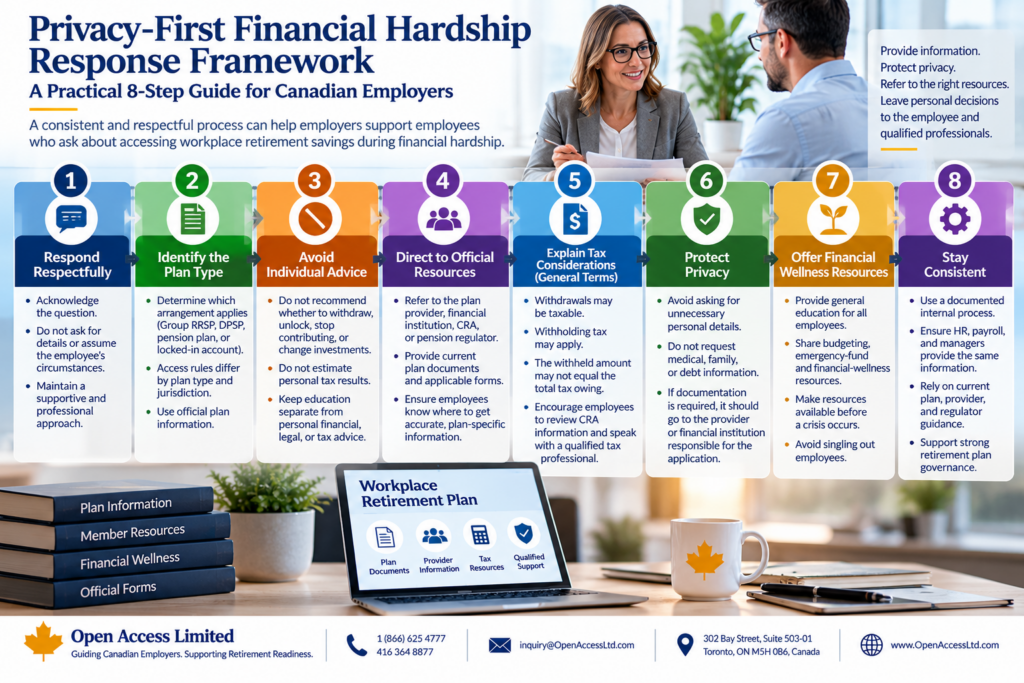
Respond respectfully → Identify the plan → Provide official information → Protect privacy → Explain general tax considerations → Direct the employee to the appropriate provider or authority
The employee should make personal financial decisions with access to appropriate plan information and qualified support.
Quick Answer: What Should Employers Do When Employees Ask About Financial Hardship Withdrawals?
When employees ask about financial hardship withdrawals, Canadian employers should first identify the type of retirement arrangement, avoid promising that funds are available, provide current plan documents and official resources, explain general tax considerations without estimating an individual tax result, protect the employee’s privacy, and direct personal withdrawal or unlocking decisions to the plan provider, financial institution, pension regulator, or qualified professional.
Employers should not recommend whether an employee should withdraw retirement savings, stop contributing, unlock pension funds, or change investments.
On This Page
- Why Plan Type Matters
- 8 Smart Employer Steps
- Group RRSP Withdrawals
- DPSP Access
- Ontario Locked-In Accounts
- Federally Regulated Locked-In Accounts
- Privacy During Financial Hardship
- What Employers Should Avoid
- Financial Wellness Before a Crisis
- Important Implementation Boundaries
- How Open Access Limited May Support Employers
- FAQs
- Final Thoughts
- Resources and References
Why Financial Hardship Withdrawals Depend on the Type of Retirement Plan
The first question should not be:
“Why do you need the money?”
It should be:
“What type of retirement arrangement are we dealing with?”
The employee may have:
- A Group RRSP
- A Deferred Profit Sharing Plan
- A Registered Pension Plan
- A Defined Contribution pension plan
- A LIRA or LIF
- Another locked-in arrangement
The rules are not interchangeable.
A financial hardship withdrawal that may potentially be available from one type of account may not be available from another.
Employers should therefore avoid making quick assumptions based on how another employee’s plan or account was handled.

8 Smart Ways Employers Can Handle Financial Hardship Withdrawals
1. Respond Respectfully Without Asking Why the Employee Needs Money
Financial difficulty is personal.
Employees may be dealing with circumstances involving housing, family responsibilities, medical expenses, income disruption, debt, or other private matters.
HR does not need to investigate those circumstances simply because the employee asks whether retirement savings can be accessed.
A professional response might begin:
“We can help you identify the plan information and the appropriate contact for your question.”
That acknowledges the request without asking the employee to disclose unnecessary personal information.
A privacy-first approach is especially important with financial hardship withdrawals.
2. Identify the Retirement Plan or Account Type First
Before discussing access, determine what arrangement the question relates to.
Is it:
Group RRSP?
DPSP?
Pension plan?
LIRA?
LIF?
Federally regulated locked-in account?
The source Q&A emphasizes that access rules differ depending on plan type and jurisdiction. OpenAccess_Q56_QA_with_Resource…
This distinction should happen before HR provides detailed information.
3. Never Promise That a Withdrawal Is Available
One of the most important safeguards is avoiding statements such as:
“Yes, you can take the money out.”
or
“No, those funds can never be accessed.”
Neither answer should be given until the applicable plan terms and rules are confirmed.
For Group RRSPs, for example, withdrawal availability while an employee remains employed may depend on the actual plan terms.
For locked-in retirement savings, special legislation and jurisdiction-specific rules may apply.
For financial hardship withdrawals, the appropriate answer is often:
“We need to confirm what your specific plan or account permits.”
4. Direct Employees to Official Resources and the Correct Decision-Maker
Employers should know where to send the employee.
Depending on the arrangement, that may include:
- The retirement-plan provider
- The financial institution holding the account
- Official plan documents
- CRA resources
- The applicable pension regulator
- A qualified tax professional
- A qualified financial professional
This is particularly important for locked-in accounts.
In Ontario, current FSRA guidance states that financial-hardship applications for eligible locked-in accounts are made to the financial institution holding the account, not directly to FSRA. fsrao.ca
For federally regulated locked-in arrangements, OSFI likewise directs the required forms to the financial institution holding the funds. OSFI
The employer’s job is therefore usually to direct—not adjudicate—the application.
5. Explain Tax Consequences Only in General Terms
Employees may ask:
“How much tax will I pay if I withdraw?”
Employers should resist the temptation to calculate an answer.
RRSP withdrawals are generally taxable, and withholding tax may apply.
But the tax withheld at the time of withdrawal may not necessarily equal the employee’s ultimate tax liability.
The source therefore recommends explaining tax treatment only in general terms and avoiding individualized tax estimates. OpenAccess_Q56_QA_with_Resource…
A suitable employer response is:
“A withdrawal may have tax consequences. Please review the applicable CRA information or speak with a qualified tax professional regarding your personal circumstances.”
6. Protect Employee Privacy
This deserves its own step.
HR should generally avoid requesting personal details such as:
- Medical information
- Debt balances
- Housing problems
- Family circumstances
- Reasons for financial difficulty
- Income information that is not required for HR purposes
If supporting documentation is required for a financial hardship withdrawal, it should normally go to the organization responsible for processing the application.
For Ontario locked-in accounts, for example, the financial institution is responsible for reviewing the hardship application and supporting information. fsrao.ca
This reduces unnecessary exposure of sensitive employee information within the workplace.
7. Make Financial Wellness Resources Available to Everyone
Employee financial education is most useful before a crisis.
Rather than creating a special financial-wellness program only for someone who has disclosed hardship, employers can make resources available to the entire workforce.
These may include:
- Emergency-fund education
- Budgeting resources
- Debt-management education
- Retirement-plan education
- Financial-wellness articles
- Calculators
- Employee assistance resources where available
- Access to appropriate professional support
This approach avoids singling out employees who have asked about financial hardship withdrawals.
The source specifically points to FCAC resources on emergency funds and workplace financial wellness and notes that education should continue beyond initial enrolment. OpenAccess_Q56_QA_with_Resource…
8. Give HR, Payroll, and Managers One Consistent Response Process
Employees may ask their manager first.
Others may ask payroll.
Others may contact HR.
If each person provides a different answer, the risk of misinformation increases.
Create a short internal response protocol:
Acknowledge → Identify Plan → Do Not Advise → Provide Resources → Protect Privacy → Refer
Managers should know when to stop answering and refer the employee to HR or the provider.
HR should know which plan materials apply.
Payroll should not make contribution or withdrawal changes without the required instructions.
A consistent financial hardship withdrawals process improves communication without turning internal staff into financial advisers.
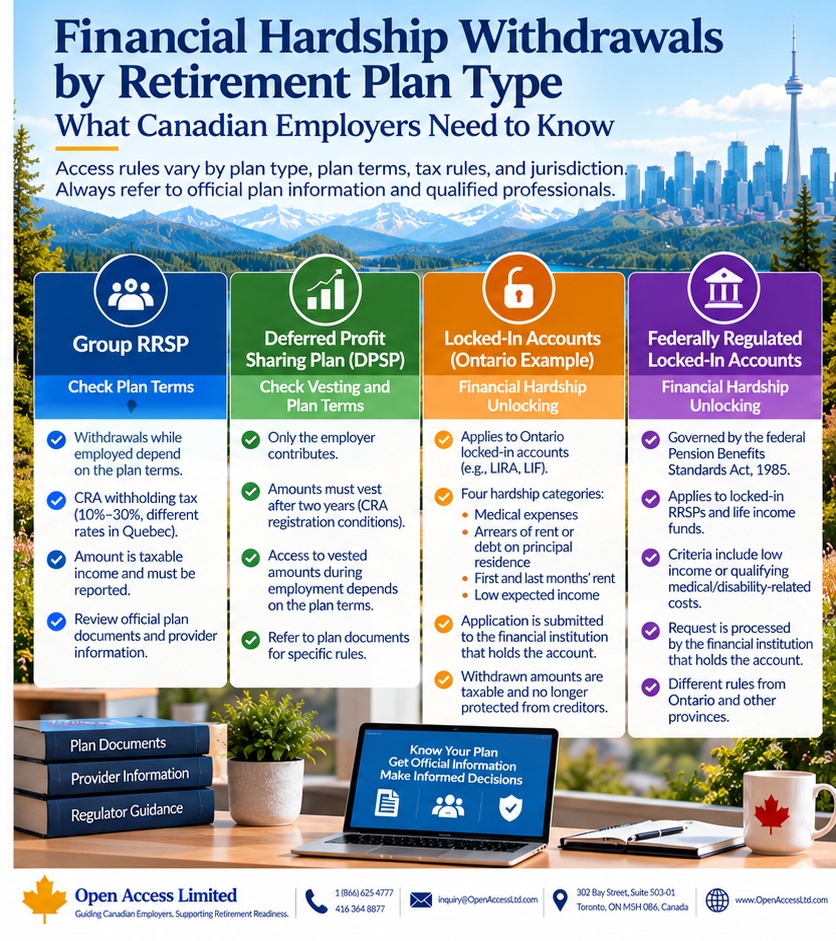
How Group RRSP Withdrawals May Work
For a Group RRSP, access while the employee remains employed can depend on the employer’s specific plan design and provider rules.
Some workplace arrangements may restrict withdrawals.
Employers should therefore review the official plan documents before telling an employee that funds are available.
Where an RRSP withdrawal does occur, the amount is generally taxable income and withholding tax may apply. OpenAccess_Q56_QA_with_Resource…
An employee considering a withdrawal should receive plan-specific information and personal tax guidance from the appropriate sources.
What About DPSP Money?
A Deferred Profit Sharing Plan follows different rules.
Only the employer contributes to a DPSP.
CRA registration rules also address vesting.
Whether a member can access vested DPSP amounts while still employed depends on the actual plan provisions. OpenAccess_Q56_QA_with_Resource…
This means a Group RRSP answer should not automatically be applied to a DPSP.
Ontario Financial Hardship Unlocking
Ontario provides specific financial-hardship rules for certain locked-in accounts.
Current FSRA information describes four hardship categories:
- Medical expenses
- Arrears of rent or default on debt secured against a principal residence
- First and last months’ rent
- Low expected income
The application relates to eligible locked-in accounts rather than money that remains inside the pension plan itself. fsrao.ca
FSRA’s current guidance also emphasizes that approved forms and eligibility requirements apply.
These are Ontario-specific rules.
They should not be presented as Canada-wide rules.
Federally Regulated Financial Hardship Unlocking Is Different
Federally regulated locked-in arrangements use a different framework.
Current OSFI guidance describes financial-hardship unlocking for federally regulated locked-in retirement savings in circumstances involving low income or qualifying medical/disability-related costs. OSFI
Again, the application is handled through the financial institution holding the account.
This difference between Ontario and federal rules illustrates why employers should not maintain a generic statement such as:
“Financial hardship always qualifies for pension unlocking.”
It does not.
Jurisdiction matters.
A Privacy-First Employee Response
A simple internal response could be:
Workplace retirement savings may be subject to specific plan, tax, and legal rules about access. We cannot provide personal financial, tax, legal, or investment advice. We can direct you to the applicable plan documents and provider so you can confirm the options available under your arrangement.
This wording follows the approach in the underlying Q&A. OpenAccess_Q56_QA_with_Resource…
It should still be adapted to the employer’s specific plan before use.
What Employers Should Avoid
Employers should not:
- Promise that retirement funds can be withdrawn
- State that funds cannot be accessed without first checking the plan
- Suggest that a hardship application will qualify
- Suggest that an application will be approved
- Recommend a withdrawal
- Recommend against a withdrawal
- Tell an employee to stop contributing
- Recommend selling investments
- Calculate the employee’s personal tax impact
- Ask for unnecessary medical, family, housing, or debt information
- Use the employee’s hardship as a sales opportunity
The source specifically identifies withdrawal promises, personal recommendations, unnecessary private questions, and individual tax estimates as areas employers should avoid. OpenAccess_Q56_QA_with_Resource…
Why Financial Wellness Should Begin Before Financial Hardship
A workplace financial-wellness strategy should not begin the day an employee asks for money.
Preventive education can make resources available long before financial pressure becomes urgent.
Possible topics include:
Building an Emergency Fund
General education can explain why emergency savings may be useful for unexpected expenses.
Understanding Workplace Retirement Savings
Employees should understand contribution rules, restrictions, and long-term objectives before requesting withdrawals.
Budgeting and Cash-Flow Awareness
General budgeting resources may help employees better understand short-term financial obligations.
Where to Find Qualified Help
Employees should know which questions belong with:
- HR
- The retirement-plan provider
- CRA
- A pension regulator
- A qualified tax professional
- A qualified financial professional
This supports employee financial wellness without assuming that every employee has the same financial needs.
How Can Employers Keep Financial Hardship Communication Accurate?
A strong process should use:
- Current plan documents
- Current provider materials
- Current regulator information
- Current CRA resources
- A written HR response process
- Privacy safeguards
- Clear referral points
- Periodic review
Do not copy a hardship rule from another plan, province, or jurisdiction.
Do not rely on a form saved several years ago.
Financial-hardship criteria and forms can change over time; for example, FSRA publishes year-specific Ontario forms for financial-hardship applications. fsrao.ca
Important Implementation Boundaries
Access to retirement savings may involve:
- Plan documents
- Pension legislation
- Tax law
- Privacy
- Human-rights considerations
- Employment matters
- Provider agreements
- Jurisdiction-specific unlocking rules
The Ontario and federal examples in this article are illustrations—not national rules.
Employers should confirm their own plan’s withdrawal provisions with the plan administrator or provider before developing an employee response process.
The source also stresses that an employee’s decision belongs to the employee, with provider and qualified professional support where appropriate. OpenAccess_Q56_QA_with_Resource…
How May Open Access Limited Support Employees Asking About Access to Savings?
Where the workplace retirement arrangement is provided through Open Access Limited, employers may direct employees to Open Access for plan-specific information.
Open Access Limited’s resources include plan information, member forms, financial-wellness materials, calculators, and Client Relations support.
Its public materials also describe forms relating to withdrawals and transferring locked-in funds. OpenAccess_Q56_QA_with_Resource…
Depending on the applicable plan, Open Access Limited may help employees:
- Identify the applicable plan rules
- Find relevant forms
- Understand the submission process
- Access financial-wellness resources
- Review plan information
- Connect with Client Relations
The existence of a withdrawal form does not mean every plan or employee is eligible to make a withdrawal.
Open Access Limited should not be positioned as guaranteeing access to funds or providing individualized tax or legal advice.
Open Access Limited
302 Bay Street, Suite 503-01
Toronto, ON M5H 0B6, Canada
Toll-Free: 1 (866) 625 4777
General: 416 364 8877
Fax: 416 955 4878
Email: inquiry@OpenAccessLtd.com
Website: www.OpenAccessLtd.com
Frequently Asked Questions About Financial Hardship Withdrawals
Can Employees Withdraw Money From a Workplace Group RRSP During Financial Hardship?
Possibly, but the answer depends on the applicable Group RRSP plan terms and provider rules. Employers should not assume withdrawals are automatically available.
Are Financial Hardship Withdrawals Taxable?
Withdrawals from registered retirement arrangements may have tax consequences. Employees should review current CRA information and obtain personal tax advice where necessary.
Can Employees Withdraw Financial-Hardship Money Directly From an Ontario Pension Plan?
Ontario hardship-unlocking provisions described by FSRA apply to eligible locked-in accounts rather than money still held within the pension plan. fsrao.ca
Who Processes an Ontario Financial Hardship Application?
The application is submitted to the financial institution that holds the eligible locked-in account, not directly to FSRA. fsrao.ca
Are Federal Financial Hardship Rules the Same as Ontario Rules?
No. Federally regulated locked-in retirement accounts operate under a separate legislative framework and current federal hardship criteria differ from Ontario’s. OSFI
Should HR Ask Why an Employee Is Experiencing Financial Hardship?
HR should avoid collecting unnecessary private information. Documents needed for an application should normally be provided to the institution responsible for processing it.
Can an Employer Recommend That an Employee Withdraw Retirement Savings?
No. Employers can explain general plan information and provide referrals, but the employee should make the personal withdrawal decision.
Can Open Access Limited Confirm Whether a Withdrawal Is Available?
Where the plan is provided through Open Access Limited, employees may contact Open Access to confirm applicable plan provisions and forms. Availability still depends on the specific plan and applicable rules.
Final Thoughts
Financial hardship withdrawals require careful communication because the employee is asking an important financial question at what may be a difficult time.
The strongest employer response is neither:
“Yes, take the money.”
nor:
“No, you cannot access it.”
It is:
Respond Respectfully → Identify the Plan → Confirm the Rules → Protect Privacy → Explain General Tax Considerations → Provide Official Resources → Refer Personal Decisions → Document a Consistent Process
This approach helps Canadian employers provide useful support while maintaining appropriate boundaries around privacy, personal financial advice, tax advice, and jurisdiction-specific retirement rules.
Resources
For employee-facing information, prioritize authoritative sources:
Canada Revenue Agency — RRSP withdrawal and tax information.
Financial Services Regulatory Authority of Ontario — Ontario locked-in account financial-hardship rules and current forms.
Office of the Superintendent of Financial Institutions — Federally regulated locked-in retirement savings and financial-hardship unlocking.
Financial Consumer Agency of Canada — Emergency-fund and workplace financial-wellness education.
Canadian Association of Pension Supervisory Authorities — Capital accumulation plan education and governance guidance.
Open Access Limited — Plan-specific materials, member forms, financial-wellness resources and member support.
References
- Canada Revenue Agency — Tax Rates on Withdrawals.
- Canada Revenue Agency — Register a Deferred Profit Sharing Plan: Conditions for Registration.
- Financial Services Regulatory Authority of Ontario — Withdrawing From Locked-In Accounts Because of Financial Hardship.
- Office of the Superintendent of Financial Institutions — Financial Hardship Unlocking.
- Financial Consumer Agency of Canada — Setting Up an Emergency Fund.
- Financial Consumer Agency of Canada — Financial Wellness in the Workplace.
- Canadian Association of Pension Supervisory Authorities — Guideline No. 3: Guideline for Capital Accumulation Plans.
- Open Access Limited — Group Retirement Plans in Canada; Member Forms; Financial Wellness Resources; Member Resources.
Leave a Reply