Retirement benefits for newcomers can feel complicated because employees who are new to Canada—or who have worked in several countries—may be learning about an unfamiliar retirement system at the same time they are learning about payroll, taxes, workplace benefits, and their new employer.
Employees may encounter terms such as the Canada Pension Plan (CPP), Quebec Pension Plan (QPP), Old Age Security (OAS), Registered Retirement Savings Plans (RRSPs), Tax-Free Savings Accounts (TFSAs), workplace retirement plans, and personal savings.
These programs do not all work in the same way.
Eligibility, contribution room, tax treatment, and future benefits can depend on Canadian residency, employment income, contribution history, age, plan terms, and individual circumstances.
Employees with international work histories may also have questions about foreign pensions, residency outside Canada, or international social-security arrangements.
For employers, the strongest approach is generally education rather than individualized advice.
Businesses can explain their own workplace retirement plan clearly, introduce the broader Canadian retirement-income framework, provide authoritative resources, and refer personal tax, pension, immigration, or cross-border questions to appropriately qualified professionals.
As Canadian workplaces become more diverse, retirement benefits for newcomers may require clearer explanations of both the employer-sponsored plan and the broader Canadian retirement system.
Quick Answer: How Can Employers Explain Retirement Benefits for Newcomers?
Canadian employers can make retirement benefits for newcomers easier to understand by explaining how workplace retirement plans fit alongside CPP, QPP, OAS, RRSPs, TFSAs, personal savings, and potential foreign benefits.
Employers should use plain language, define unfamiliar terms, provide accessible education, reinforce information after onboarding, and direct individualized government-benefit, tax, immigration, pension, and cross-border questions to authoritative resources or qualified professionals.
Why Retirement Benefits for Newcomers Can Feel Unfamiliar
Employees who have worked only in Canada may already recognize terms such as CPP, OAS, RRSP, and TFSA.
A newcomer may not.
Similarly, an employee who previously worked in another country may naturally compare Canada’s retirement system with the pension or social-security system they already know.
That can create questions such as:
- What is CPP?
- Is CPP the same as OAS?
- Does my workplace retirement plan replace CPP?
- Can I contribute to an RRSP?
- How much TFSA room do I have?
- Does employment outside Canada count toward a Canadian pension?
- Can a foreign pension be transferred to Canada?
- Does my employer determine my government benefits?
A well-designed retirement benefits for newcomers education program does not need to answer every personal question.
It needs to help employees understand the framework and identify the correct source for more individualized information.
Start With the Broader Canadian Retirement-Income Picture
A workplace retirement plan should not be presented as an employee’s only possible source of retirement income.
Depending on individual circumstances, future retirement income may involve:
- CPP or QPP
- OAS
- A workplace pension or retirement savings plan
- Personal RRSP savings
- TFSAs
- Other savings and investments
- Potential foreign pension or social-security benefits
A simple visual framework can be helpful:
Government Benefits + Workplace Retirement Plan + Personal Savings + Potential International Benefits
This gives employees a clearer starting point without suggesting that every person will qualify for every program or receive the same amount.
Employers should also distinguish CPP from OAS.
CPP retirement benefits are linked to contributions and applicable eligibility requirements, while OAS operates differently and includes considerations such as age, Canadian residence history, income, and applicable rules.
Employers should generally avoid estimating an employee’s future CPP, QPP, or OAS entitlement.
Presenting retirement benefits for newcomers within this broader framework can help employees understand where workplace savings fit without creating unrealistic expectations about future income.
8 Best Employer Steps for Retirement Benefits for Newcomers

1. Explain the Canadian Retirement-Income Framework First
Before diving into contribution percentages and investment options, help employees see the bigger picture.
Explain that Canada’s retirement-income system can involve several different components and that the employer-sponsored workplace plan is only one of them.
This can make retirement benefits for newcomers easier to understand because employees have a framework for organizing unfamiliar information.
Employers can explain the categories without calculating an employee’s personal retirement income.
A useful message is:
“Your workplace plan is one part of your broader retirement picture.”
2. Explain the Employer’s Own Plan Clearly
Once the broader framework is understood, focus on the benefit the employer actually provides.
Depending on the applicable plan, communication may cover:
- Eligibility
- Enrolment
- Employee contributions
- Employer contributions
- Employer matching
- Investment options
- Fees
- Portability
- Member portal access
- Available education
- Member support
Employees should be directed to current official plan documents when they need plan-specific information.
This is also a natural place to connect employees with broader retirement plan eligibility information when eligibility requirements need additional explanation.
3. Define Acronyms Before Using Them
Canada’s retirement system contains many abbreviations.
Do not assume a new employee automatically understands:
- CPP — Canada Pension Plan
- QPP — Quebec Pension Plan
- OAS — Old Age Security
- RRSP — Registered Retirement Savings Plan
- TFSA — Tax-Free Savings Account
For employees unfamiliar with the Canadian system, too many unexplained acronyms can create an unnecessary barrier.
A strong retirement benefits for newcomers communication strategy should spell out the term first and then introduce the acronym.
Plain language should be the default.
4. Explain CPP and OAS Carefully
CPP and OAS are often discussed together, but they are different programs.
Employers can provide high-level education about those differences while directing employees to Government of Canada resources for personal eligibility and benefit information.
Employers should not tell an employee:
- Exactly how much CPP they will receive
- Exactly how much OAS they will receive
- When they personally should start CPP
- Whether foreign work will definitely increase a Canadian benefit
- Whether an employee will qualify under an international agreement
Those questions depend on personal circumstances and applicable government rules.
The goal is understanding, not personal benefit calculation.
5. Be Particularly Careful With RRSPs and TFSAs
This is especially important for new Canadian residents.
TFSA contribution room does not simply work as though every person of the same age has always been a Canadian resident.
The source material notes that a qualifying new Canadian resident generally begins accumulating TFSA contribution room when Canadian residency begins—not for earlier years in which the person was a non-resident.
RRSP contribution limits are also individual.
They can depend on prior earned income and other adjustments, so employees should confirm their actual available amount rather than assuming a generic contribution figure.
An employer can explain how the workplace plan works.
Individual RRSP or TFSA contribution-room questions should generally be referred to CRA information or an appropriately qualified financial or tax professional.
6. Make Education Accessible in More Than One Format
Not every employee learns best from a 40-page benefits booklet.
Retirement benefits for newcomers can be communicated through multiple formats, such as:
- Plain-language guides
- FAQs
- Simple diagrams
- Short educational videos
- Checklists
- Live education sessions
- Recorded sessions
- Member-portal guidance
Where operationally appropriate, employers may also consider multilingual or translated resources.
However, translated materials should be reviewed carefully against the governing English or French plan documentation.
Accessibility is not about assuming a newcomer cannot understand financial information.
It is about removing unnecessary communication barriers.
This also aligns naturally with an inclusive retirement benefits approach that considers different employee starting points and communication needs.
7. Keep General Education Separate From Personal Advice
This boundary is particularly important when employees have international histories.
Employees may ask:
- Does my foreign pension transfer to Canada?
- Does my previous work count toward CPP?
- Am I a Canadian tax resident?
- How will Canada tax my foreign pension?
- Should I contribute to an RRSP or TFSA?
- Which country’s pension should I claim first?
These are not questions an employer should answer through a general employee-benefits article.
Questions involving tax residency, foreign pensions, international social-security agreements, government-benefit eligibility, immigration, contribution room, cross-border investment, or estate planning should be directed to official government resources and appropriately qualified professionals.
This keeps retirement benefits for newcomers educational without crossing into individualized advice.
8. Continue Education After Onboarding
Onboarding should be the beginning of retirement education—not the end.
New employees may be receiving information about:
- Payroll
- Taxes
- Workplace policies
- Health benefits
- Technology
- Retirement plans
- New job responsibilities
It is unrealistic to assume they will remember every retirement-plan detail from the first week.
Employers can reinforce information through:
- Annual retirement-plan communication
- Contribution reminders
- Plan-change notices
- Financial-wellness education
- Investment education
- Member-portal support
- Pre-retirement education where appropriate
CAPSA’s guidance supports an ongoing approach to member communication and education rather than limiting education to initial enrolment.
Ongoing retirement income education can also help employees understand where their workplace plan fits into their broader retirement picture.
International Work Histories Require Additional Caution

Employees who have worked outside Canada may have questions that cannot be answered with a universal rule.
Canada has international social-security agreements with a number of countries.
Depending on the agreement and the particular benefit, periods of contribution or residence outside Canada may sometimes be relevant when determining eligibility for Canadian or foreign benefits.
But agreements differ.
The programs covered and the effect of each agreement can vary.
Questions involving:
- Foreign pension entitlements
- Residence outside Canada
- International social-security agreements
- CPP coverage for international assignments
- Tax residency
- Foreign retirement accounts
- International transfers
- Taxation of foreign pension income
should therefore be referred appropriately.
An employer should not assume that one employee’s international experience will produce the same result as another employee’s.
How Can Employers Keep Newcomer Retirement Information Accurate and Reliable?

Employers can improve the quality of retirement benefits for newcomers education by using a few simple safeguards:
- Use current official workplace-plan documents
- Use current provider materials
- Link employees to Government of Canada resources
- Define Canadian retirement terms clearly
- Avoid estimating government benefits
- Avoid assuming TFSA or RRSP contribution room
- Avoid generalized claims about foreign pensions
- Review translated materials carefully
- Clearly distinguish education from personal advice
- Update content when plan information changes
The objective is not to make the employer an expert in every Canadian and international retirement rule.
The objective is to make the employer’s own workplace-plan communication clear and reliable.
Why This Matters to Canadian Businesses
Canadian workplaces can include employees with very different retirement-system experiences.
Some employees may have lived in Canada their entire lives.
Others may have arrived recently.
Others may have lived, studied, or worked in multiple countries.
Employers should therefore avoid assuming that all employees share the same:
- Financial knowledge
- Language needs
- Tax history
- Residency history
- Retirement-system familiarity
- International work history
A strong approach to retirement benefits for newcomers starts with clear information and flexible education—not assumptions about employees.
Clear communication may support employee understanding, but it should not be presented as guaranteeing participation, retention, employee trust, financial confidence, or improved retirement outcomes.
Important Boundaries for Employers
Questions affecting internationally mobile employees can involve several different areas:
- Pension law
- Tax law
- Immigration status
- Canadian tax residency
- CPP/QPP
- OAS
- RRSP and TFSA contribution limits
- Foreign pensions
- International social-security agreements
- Tax treaties
- Cross-border investments
- Estate planning
These issues can depend heavily on an employee’s individual circumstances.
Employers should provide general education—not individualized tax, legal, immigration, pension, investment, or cross-border financial advice.
Employees who require personal guidance should be directed to current government information or appropriately qualified professionals.
Need Help Make Workplace Retirement Benefits Easier to Understand?
Open Access Limited may support employers with the workplace retirement-plan portion of employee education.
Depending on the applicable plan, this may include:
- Plan-specific enrolment materials
- Member booklets
- Eligibility and enrolment information
- Employee and employer contribution information
- Investment information
- Applicable fee information
- Member-portal education
- Financial-wellness resources
- Member support
Open Access Limited also provides member-support resources for existing plan members who need assistance understanding their applicable workplace retirement plan.
For questions involving CPP, OAS, RRSP or TFSA contribution room, foreign pensions, immigration, international agreements, tax residency, or cross-border planning, employees should be directed to appropriate government resources or qualified professionals.
Open Access Limited
302 Bay Street, Suite 503-01
Toronto, ON M5H 0B6, Canada
Toll-Free: 1-866-625-4777
General: 416-364-8877
Fax: 416-955-4878
Email: inquiry@OpenAccessLtd.com
Website: www.OpenAccessLtd.com
Frequently Asked Questions
Are CPP and OAS the Same Thing?
No. CPP and OAS operate differently and have different eligibility considerations. Employers can explain the general distinction but should direct employees to official government sources for individual benefit information.
Do Newcomers Automatically Have the Same TFSA Contribution Room as Other Canadians?
No. TFSA contribution room can depend on Canadian residency history. New residents should confirm their own available contribution room.
Can an Employer Tell a New Employee How Much to Contribute to an RRSP?
Employers can explain the workplace plan’s contribution process, but individualized RRSP contribution decisions and contribution-room questions should be directed to CRA information or qualified professionals.
Does Work in Another Country Count Toward CPP or OAS?
It may depend on the employee’s circumstances and whether an applicable international social-security agreement exists. Employers should not provide a general yes-or-no answer.
Should Employers Translate Retirement Information?
Where operationally appropriate, multilingual information may improve accessibility. Translated materials should be reviewed against governing plan documentation.
Can Open Access Limited Advise Employees About Immigration or Foreign Pensions?
Open Access Limited’s role should remain focused on workplace plan education, enrolment, communication, financial-wellness resources, and member support unless additional services are specifically within the scope of an engagement.
For employers, the strongest approach to retirement benefits for newcomers combines clear workplace-plan education, authoritative public resources, accessible communication, and appropriate professional referrals.
Final Thoughts
Retirement benefits for newcomers do not need to be explained through more complicated communication.
In many cases, the better approach is simpler:
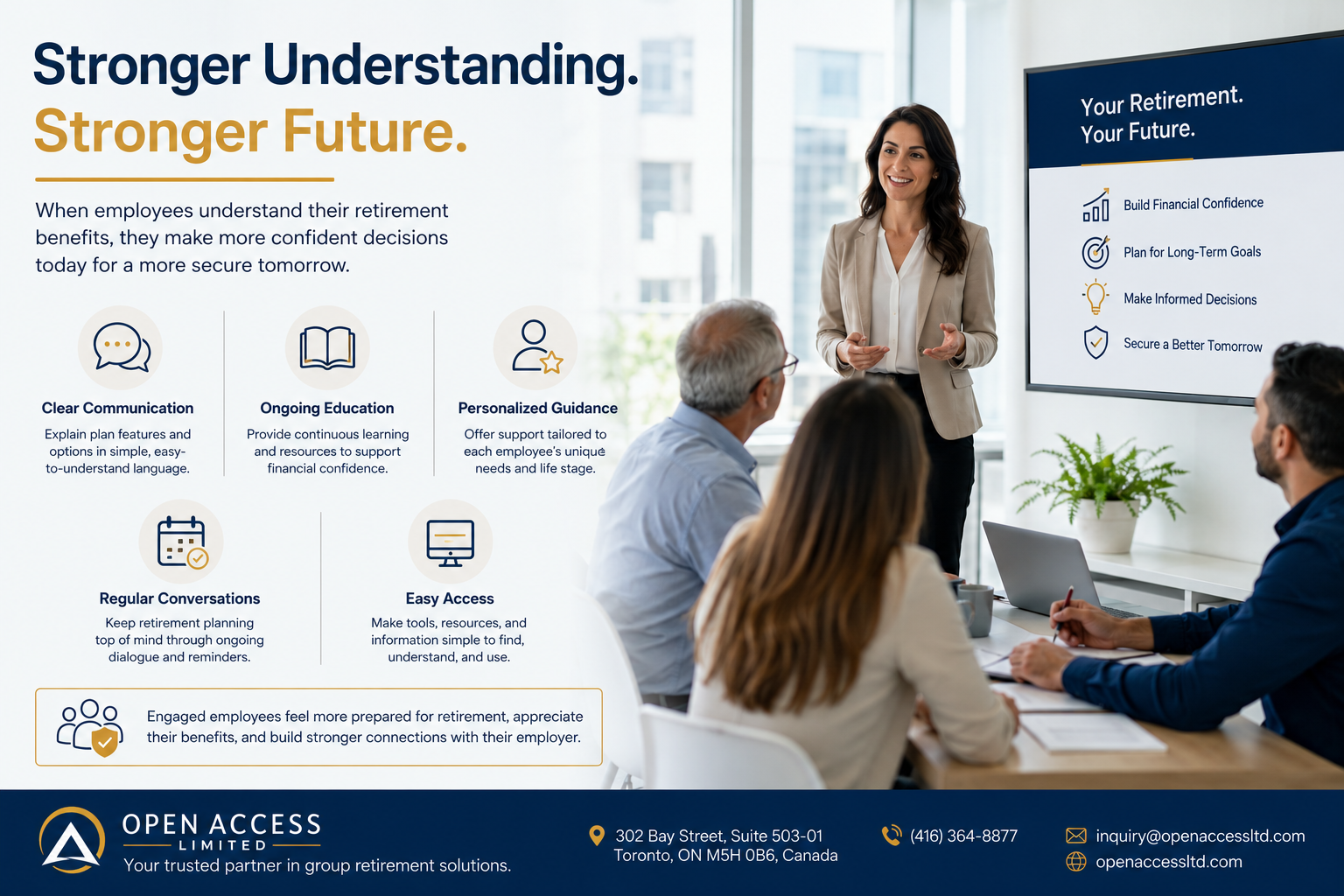
Explain the Canadian framework.
Explain the workplace plan.
Define unfamiliar terms.
Use authoritative resources.
Make education accessible.
Reinforce it over time.
Keep personal advice with qualified professionals.
For Canadian businesses, this creates a clearer boundary between employee education and individualized advice while helping employees who may be unfamiliar with the Canadian retirement system understand where their workplace benefit fits.
References.
- Government of Canada (2026). Canada Pension Plan Retirement Pension — Eligibility
2. Government of Canada (2026). Old Age Security — Eligibility.
3. Government of Canada (2026). Old Age Security — How Much You Could Receive
4. Government of Canada (2026). Lived or Living Outside Canada — Pensions and Benefits.
5. Canada Revenue Agency. International Social Security Agreements and the Canada Pension Plan.
6. Canada Revenue Agency (2025). Opening a TFSA — Information for New Residents.
7. Canada Revenue Agency (2026). How Contributions Affect Your RRSP Deduction Limit.
8. Canadian Association of Pension Supervisory Authorities (CAPSA) (2024). Guideline No. 3: Guideline for Capital Accumulation Plans.
9. Statistics Canada (2026). Labour Market Experiences of Recent Immigrants, 2019 to 2025.
10. Open Access Limited (2026). Current Group Retirement Plan Enrolment and Financial Wellness Resources.
11.Open Access Limited. Member Contact and Plan Support.