How Can Businesses Build an Adaptable Retirement Benefits Strategy?
A retirement benefits strategy should not remain fixed while employee needs, workforce demographics, financial priorities, and economic conditions continue to change.
Employees at different career stages may have very different expectations. Early-career employees may focus on financial education, flexibility, and building savings habits. Mid-career employees may be balancing family responsibilities, housing costs, and long-term financial goals. Employees approaching retirement may place greater importance on retirement readiness, income planning, and financial security.
For this reason, businesses may benefit from reviewing their retirement programs regularly rather than relying on a one-size-fits-all approach. An adaptable strategy can help organizations maintain alignment between plan design, employee expectations, and long-term workforce objectives.
Why Do Employee Retirement Needs Change Over Time?
Employee financial priorities often change as personal circumstances, career stages, and external economic conditions evolve.
Changes in income, family responsibilities, financial literacy, inflation, housing costs, and retirement timelines may all influence how employees view workplace retirement benefits. A benefit that feels relevant to one employee group may not provide the same value to another.
Workforce composition may also change as organizations hire new employees, experience generational shifts, or introduce new roles and working arrangements. These developments can affect participation patterns, communication preferences, and expectations around flexibility.
A strong retirement benefits strategy recognizes these differences and creates a framework that can be reviewed and refined over time.
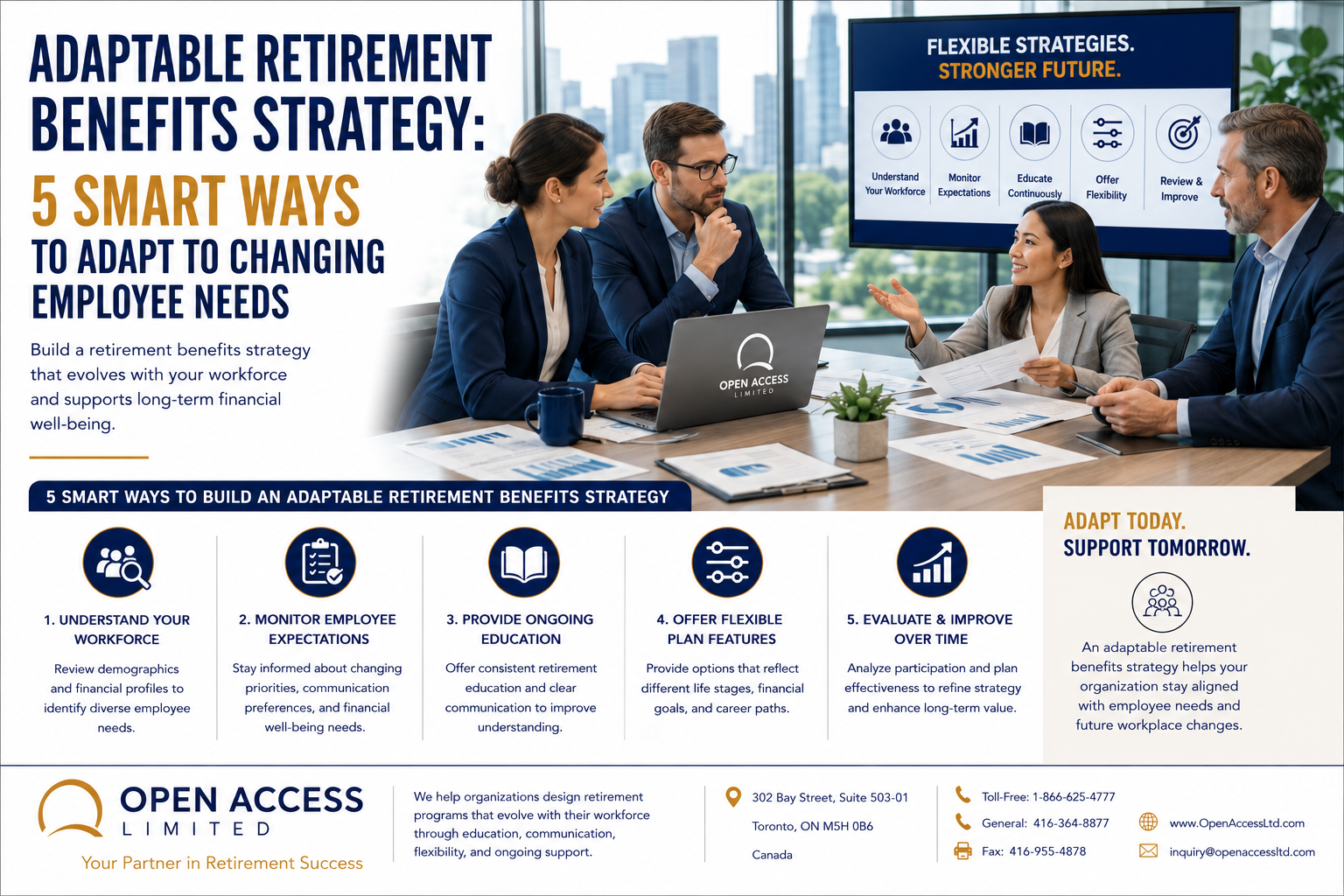
5 Smart Ways to Create an Adaptable Retirement Benefits Strategy
1. Review Employee Demographics and Financial Profiles
Businesses can begin by understanding the people their retirement program is designed to support.
Reviewing workforce demographics, career stages, financial profiles, and participation patterns may help employers identify different employee needs. For example, younger employees may require foundational education about retirement savings, while experienced employees may benefit from more detailed retirement readiness guidance.
This information can help organizations make retirement programs more relevant without assuming that every employee has the same financial priorities.
2. Monitor Changing Employee Expectations
Employee expectations around benefits, communication, flexibility, and financial wellness can change over time.
Organizations may use employee surveys, benefits feedback, participation data, and workforce discussions to understand how employees perceive the current program.
Monitoring expectations does not mean changing the plan after every individual request. Instead, it allows businesses to identify broader trends and determine whether communication, education, or plan features may need adjustment.
Regular feedback can help keep a retirement benefits strategy connected to real workforce needs.
3. Provide Ongoing Retirement Education and Communication
Retirement education should not be limited to onboarding or annual enrollment periods.
Employees may need different information as their careers and financial circumstances develop. Ongoing education can help employees understand contribution options, long-term planning considerations, and the value of available workplace benefits.
Communication should also be clear, accessible, and appropriate for different levels of financial literacy.
Businesses may use workshops, digital resources, educational materials, individual guidance, and regular updates to support employee understanding. Consistent communication can make retirement planning feel more practical and easier to engage with.
4. Offer Flexible Plan Features Where Appropriate
Flexible plan features may help organizations support employees with different financial priorities and career stages.
Depending on the plan structure, flexibility may include contribution options, educational resources, digital access, or planning support that reflects different employee circumstances.
Flexibility does not require unlimited choice. The objective is to create a plan that can respond reasonably to workforce changes while remaining aligned with organizational goals, governance requirements, and available resources.
An adaptable retirement benefits strategy should balance employee choice with clear structure and long-term plan sustainability.
5. Evaluate Participation and Plan Effectiveness Over Time
Participation data can provide useful insight into how employees interact with retirement benefits.
Organizations may review enrollment levels, contribution patterns, employee feedback, communication engagement, and use of educational resources.
Low participation does not always mean the plan design is ineffective. It may indicate that employees need clearer communication, more relevant education, or better access to support.
Regular evaluation allows employers to identify areas where plan design, communication, or education may require refinement. Outcomes can vary depending on workforce characteristics, plan structure, and implementation approach, so reviews should be measured and based on appropriate context.
How Can Businesses Keep Retirement Benefits Stratege Aligned With Workforce Needs?
Businesses can keep retirement benefits relevant by treating plan review as an ongoing process rather than a one-time project.
A practical review may consider whether the program still reflects workforce demographics, employee financial priorities, organizational objectives, participation trends, and external economic conditions.
Retirement planning should also be considered alongside other employee experience initiatives, including financial wellness, workplace flexibility, skills development, and long-term workforce planning.
When these areas are reviewed together, organizations may gain a clearer understanding of how retirement benefits contribute to the broader employee experience.
An adaptable approach can help businesses maintain consistency while still responding thoughtfully to changing workforce needs.
How Open Access Limited Supports Adaptable Retirement Benefits Strategies
Some organizations choose to work with advisory firms experienced in aligning retirement benefits with changing employee expectations and long-term organizational priorities.
Open Access Limited, based in Ontario, works with employers to review workforce demographics, assess participation trends, and develop retirement programs supported by ongoing employee education, communication strategies, and flexible plan design considerations.An adaptable retirement benefits strategy can improve employee understanding through ongoing education and clear communication.
These services may help employers improve employee understanding, support participation, and keep retirement benefits aligned with workforce needs over time.
Open Access Limited
302 Bay Street, Suite 503-01
Toronto, ON M5H 0B6
Canada
Toll-Free: 1-866-625-4777
General: 416-364-8877
Fax: 416-955-4878
Email: inquiry@openaccessltd.com
Website: www.OpenAccessLtd.com
Final Thoughts
A successful retirement benefits strategy should be designed to evolve as employees, workplaces, and financial conditions change.
By reviewing workforce demographics, monitoring employee expectations, providing ongoing education, offering appropriate flexibility, and evaluating participation over time, businesses can create retirement programs that remain relevant and understandable. A well-designed retirement benefits strategy should be reviewed regularly to ensure it continues to support changing employee needs and long-term workforce goals.
There is no single strategy that fits every organization. However, a structured and regularly reviewed approach can help employers maintain alignment between employee needs, plan design, and long-term workforce objectives.
References
Mercer — Global Talent Trends Research
https://www.mercer.com
Gallup — Workplace and Employee Experience Research
https://www.gallup.com
Qualtrics — Employee Experience Trends Research
https://www.qualtrics.com
The Josh Bersin Company — Future of Work Research
https://joshbersin.com
SHRM — Benefits Strategy Research
https://www.shrm.org
Cambridge Centre for Alternative Finance — Financial Trends Research
https://www.jbs.cam.ac.uk/faculty-research/centres/alternative-finance/
Leave a Reply