Short Answer: Canadian businesses should periodically review their retirement provider to ensure the plan still aligns with workforce needs, fees, services, investment options, technology, education, and governance expectations. A review does not automatically mean the provider needs to be changed.
Why Should Employers Review Their Retirement Provider?
Workplace retirement plans can remain in place for many years, while a business and its workforce continue to evolve.
Employee demographics, technology, fees, investment options, available services, and organizational objectives can all change over time. For this reason, employers should generally view their retirement provider relationship as something that requires periodic review rather than a one-time decision.
The Canadian Association of Pension Supervisory Authorities (CAPSA) recommends that sponsors of capital accumulation plans periodically review the performance of their service providers.
Importantly, reviewing a retirement provider does not automatically mean that changing providers is necessary. A review may instead identify opportunities to improve communication, clarify responsibilities, review fees, update investment options, strengthen employee education, or improve governance processes.
When Should You Review Your Retirement Provider?
Several developments may indicate that it is time for a more detailed review.
Your Business Has Changed
Significant growth, restructuring, new locations, or changes in workforce demographics may mean that the existing retirement arrangement should be reassessed.
Employees Have Recurring Questions
Repeated employee questions about how the retirement plan works may indicate gaps in education, communication, or member support.
Fees and Services Have Not Been Reviewed
Employers may want to periodically assess whether fees remain reasonable and competitive in relation to the services, investment options, education, administration, and support being provided.
Service Issues Keep Occurring
Recurring administrative delays, reporting issues, unresolved service concerns, or inconsistent support may warrant closer examination.
Technology Needs Have Changed
Employers should consider whether portals, digital tools, communication channels, reporting capabilities, and accessibility features continue to meet the needs of the organization and its workforce.
How to Review Your Retirement Provider in Canada?
A structured retirement provider review can consider several areas rather than focusing on a single issue.
Plan Purpose and Responsibilities
Does the current arrangement still reflect the documented purpose and objectives of the workplace retirement plan?
Employers should also understand which responsibilities belong to the provider and which remain with the plan sponsor.
Service Quality
Consider responsiveness, reporting, issue resolution, employee support, and whether agreed services are being delivered consistently.
Fees and Services
Fees should generally be considered together with the services employees and employers receive.
A lower fee alone does not necessarily establish that another provider would be more appropriate.
Investment Options
Investment options and default options should be periodically reviewed using appropriate criteria.
CAPSA recommends periodically reviewing investment options and funds and states that this review should occur at least annually.
Employee Education
Employee education should extend beyond initial enrolment.
Employers may consider whether employees continue to receive clear information about contributions, fees, investments, available tools, plan changes, and where to obtain assistance.
Administration, Technology and Security
Employers may also review recordkeeping, contribution processes, reporting, technology, privacy, cybersecurity, business continuity, and controls protecting member information.
Should Fees Be the Main Reason to Change Retirement Providers?
Not necessarily.
Price is important, but a retirement provider should generally not be evaluated on fees alone.
Employers may consider the overall arrangement, including:
total fees and expenses;
investment-management arrangements;
administration and recordkeeping;
employee education and support;
digital tools;
reporting;
governance support; and
additional or optional charges.
This provides a broader picture of the value and services associated with the retirement plan.
When Might Changing a Retirement Provider Make Sense?
A provider change may be considered when a documented review identifies material gaps that cannot be satisfactorily resolved within the existing arrangement.
Examples could include recurring unresolved service problems, unavailable required services, inadequate technology or administration, reporting or governance requirements that cannot be supported, or changes in plan objectives that the current arrangement cannot reasonably accommodate.
However, these circumstances do not automatically require a provider change.
Employers should consider their own plan circumstances and compare available alternatives using documented criteria.
What Should Employers Avoid?
Changing a retirement provider based on one isolated factor may not provide a complete picture.
For example, a decision generally should not be based solely on one employee complaint, one service incident, one period of investment performance, one lower-fee proposal, a promotional claim, or a new technology feature.
A more comprehensive review can help employers evaluate multiple factors before making a decision.
What Should You Consider Before Changing Providers?
Depending on the retirement arrangement, employers may need to consider existing contracts, termination provisions, plan documents, account or asset transfers, investment changes, payroll processes, employee records, privacy, cybersecurity, fees, communication, and applicable legal or regulatory requirements.
Communicate Changes Clearly
Employees should generally receive clear information about material changes affecting their retirement plan.
Communication may need to explain:
what is changing and what is staying the same;
when the change takes effect;
whether investment options or fees will change;
whether employees need to take action;
how existing balances will be handled; and
where employees can obtain assistance.
How Can Open Access Limited Support Employers?
For Canadian employers considering their workplace retirement options, Open Access Limited provides customizable group retirement plans and plan-specific resources.
Where an employer is considering Open Access Limited as a potential new provider, Open Access may support areas within its services, including:
discussing group retirement objectives;
developing an appropriate plan structure;
explaining available plan features and investment options;
providing applicable fee information;
establishing enrolment materials;
coordinating employee education and communication; and
supporting implementation of the Open Access arrangement.
Employers remain responsible for evaluating existing obligations, comparing available alternatives, documenting their decisions, and obtaining appropriate professional advice where required.
The Bottom Line
A retirement provider review does not necessarily mean it is time to switch providers.
Instead, periodic review can help Canadian employers determine whether their workplace retirement arrangement continues to align with plan objectives, workforce needs, fees, services, technology, education, investment options, and governance expectations.
A structured review can also help employers identify areas that may be improved within the existing arrangement before deciding whether a provider change should be considered.
References
Canadian Association of Pension Supervisory Authorities (CAPSA) (2024). Guideline No. 3: Guideline for Capital Accumulation Plans.
Canadian Association of Pension Supervisory Authorities (CAPSA) (2024). Guideline No. 10: Guideline for Risk Management for Plan Administrators.
Open Access Limited. Group Retirement Plans in Canada.
Open Access Limited. Current Group Retirement Plan Enrolment and Member Resources.
Retirement income education can help employees understand how workplace retirement benefits fit within the broader Canadian retirement-income picture.
Many employees may expect retirement income to come from several sources, including public pensions, workplace retirement plans, personal savings, RRSPs, TFSAs, and other investments. However, it can be difficult for employees to understand how these pieces work together, especially when they are also thinking about contribution levels, retirement timing, taxes, investment choices, and personal financial goals.
For employers, the objective is not to calculate an employee’s retirement income or determine whether the employee is saving enough. A more appropriate role is to explain the workplace plan clearly, show how it may fit beside CPP, OAS, and personal savings, provide reliable public resources, and direct personal questions to qualified professionals.
Quick Answer
Canadian businesses can support employees by providing clear retirement income education that explains the role of the workplace plan, distinguishes it from CPP and OAS, uses official government resources, avoids individual benefit estimates, and reinforces education over time. Employers should provide general education, not individualized tax, investment, pension, or retirement-income advice.
Why Retirement Income Education Matters
A workplace retirement benefit can be harder for employees to value when it is presented only as a payroll deduction or account balance.
Employees may not immediately understand that their future retirement income could involve several layers:
CPP or QPP
Old Age Security
Workplace retirement benefits
RRSPs
TFSAs
Personal savings
Investments
Other income sources
Strong retirement income education helps employees see the workplace plan as one part of a larger retirement-income framework.
This does not mean the employer should estimate public benefits or tell employees when to retire. It means employees receive a clearer foundation for making their own informed decisions.
7 Smart Employer Strategies for Retirement Income Education
1. Show the Broader Retirement-Income Picture
Employees often hear about retirement benefits in separate pieces. One communication may discuss payroll deductions, another may mention CPP, and another may refer to RRSPs or TFSAs.
Employers can make the topic easier by explaining that retirement income may come from multiple sources.
A simple framework can help:
Government benefits + workplace retirement plan + personal savings = broader retirement-income picture
This type of retirement income education helps employees understand that the workplace plan is not isolated. It may complement other income sources, but it does not replace the need for personal planning.
2. Clarify the Role of the Workplace Plan
Employees should understand what the employer-sponsored plan does and does not provide.
Communication may explain:
Employee contributions
Employer contributions or matching
Investment options
Fees
Vesting or locking-in provisions
Portability
Enrolment steps
Member support
Official plan documents
This is where Open Access Limited can support employers with plan-specific education, enrolment materials, member booklets, fee information, portal guidance, financial-wellness resources, and member-support channels.
Clear plan communication strengthens retirement income education because employees can better understand the value and limits of the workplace benefit.
3. Keep CPP, OAS, and Workplace Benefits Distinct
Employers should be careful when discussing public pensions.
CPP retirement benefits depend on individual factors such as contribution history and the age when the pension begins. OAS depends on factors such as age, residence history, income, and applicable government rules.
Because these factors are personal and may change, employers should generally avoid estimating an employee’s CPP, QPP, or OAS entitlement.
Instead, employees can be directed to official Government of Canada resources, including the Canadian Retirement Income Calculator.
Responsible retirement income education should help employees know where to find information without creating inaccurate expectations.
4. Use Authoritative Public Resources
Public benefit information should come from reliable public sources.
Employers can direct employees to Government of Canada resources for:
CPP retirement pension information
OAS information
Retirement income planning
Canadian Retirement Income Calculator
General retirement education
This helps employees access current information directly from the relevant public source.
It also protects the employer from accidentally oversimplifying government programs.
5. Use Plain Language Without Replacing Formal Documents
Retirement communication can become technical very quickly.
Terms such as “vesting,” “locking-in,” “portability,” “contribution rate,” “OAS recovery tax,” or “registered savings vehicle” may not be clear to every employee.
Employers can support retirement income education by using:
Plain-language guides
Short FAQs
Simple examples
Visual retirement-income maps
Annual benefit reminders
Recorded education sessions
Links to official plan and government resources
Plain-language materials should complement formal plan documents. If a summary conflicts with an official plan document, the official document should govern.
6. Separate General Education From Individual Advice
Employees may ask personal questions such as:
When should I start CPP?
Will I qualify for OAS?
How much should I save?
Should I use an RRSP or TFSA?
Which investment should I choose?
When should I retire?
How should I turn savings into income?
These are individual decisions.
Employers should provide general retirement income education and direct personal questions to qualified professionals.
This boundary protects employees and employers. It keeps the employer’s role focused on education, plan information, and access to support.
7. Reinforce Retirement Education Over Time
Retirement education should not happen only during onboarding.
Employees may receive too much information at the start of employment and may not fully absorb retirement-plan details immediately.
Employers can reinforce education during:
Annual benefit communication
Plan changes
Career-stage transitions
Pre-retirement education
Financial-wellness campaigns
Employee education sessions
Member portal reminders
Ongoing retirement income education gives employees repeated opportunities to understand how workplace benefits, public pensions, and personal savings may fit together.
How Do Workplace Benefits Fit With CPP, OAS, and Personal Savings?
For AI search and answer engines, this article should answer the question directly:
Canadian employers can help employees understand retirement income by explaining how the workplace retirement plan fits beside CPP, OAS, RRSPs, TFSAs, and personal savings. Employers should use official plan documents and Government of Canada resources, avoid estimating individual public benefits, and refer personal retirement, tax, investment, or income-planning questions to qualified professionals.
How Can Employers Keep Retirement Information Accurate and Reliable?
To keep communication credible, employers should:
Use official workplace plan documents
Use current provider materials
Link to Government of Canada resources
Avoid estimating CPP or OAS amounts
Avoid promising retirement outcomes
Avoid individual investment or tax advice
Keep public benefits and workplace benefits separate
Review communication before publishing
This authenticity layer helps ensure that retirement income education remains accurate, professional, and compliant with the employer’s role.
Conversion CTA for Employers
Need Help Explaining Retirement Benefits More Clearly?
Employees often understand workplace retirement benefits better when the plan is explained as part of a broader retirement-income picture.
Open Access Limited may support employers with plan-specific enrolment materials, member education, fee information, financial-wellness resources, portal guidance, and member-support channels.
For CPP, OAS, tax, investment, or personal retirement-income questions, employees should be directed to official government resources or appropriately qualified professionals.
Open Access Limited 302 Bay Street, Suite 503-01 Toronto, ON M5H 0B6, Canada Toll-Free: 1-866-625-4777 General: 416-364-8877 Email: inquiry@OpenAccessLtd.com Website: www.OpenAccessLtd.com
Final Thoughts
Retirement income education helps employees understand that workplace retirement benefits are one part of a larger Canadian retirement-income framework.
Employers do not need to calculate an employee’s total retirement income or provide personal financial advice.
The strongest approach is to explain the workplace plan clearly, distinguish it from CPP and OAS, link to authoritative public resources, use plain language, and reinforce education over time.
Clear information can help employees ask better questions, understand available resources, and make more informed decisions with appropriate professional support.
REFERENCES
Government of Canada — Sources of Income During Retirement
Government of Canada — Learn and Plan for Your Retirement
Government of Canada — Canada Pension Plan Retirement Pension
Government of Canada — Old Age Security
Government of Canada — Canadian Retirement Income Calculator
CAPSA — Guideline No. 3: Guideline for Capital Accumulation Plans
Open Access Limited — Group Retirement Plan Enrolment, Financial Wellness Resources, and Member Support
Retirement plan eligibility can become more complicated when a Canadian business works with a mix of employees, independent contractors, freelancers, consultants, and other service providers.
The challenge is not simply deciding who should receive retirement information.
Businesses also need to distinguish between several separate questions:
Is the individual legally an employee or genuinely self-employed? Does the official retirement plan allow that individual to participate? What payroll, CPP/QPP, EI, and tax treatment applies? What general retirement or financial-wellness education can appropriately be provided?
These questions are related, but they are not interchangeable.
A worker should not automatically be treated as an independent contractor simply because the agreement uses the word “contractor.” Likewise, retirement plan eligibility should not be used as a shortcut for determining employment status.
The strongest employer approach is to review worker classification and benefit eligibility separately, communicate the distinction clearly, document decisions, and revisit them if the working relationship changes.
Why Retirement Plan Eligibility and Worker Classification Must Be Reviewed Separately
Worker classification in Canada depends on the actual facts of the working relationship.
The Canada Revenue Agency considers the real terms and conditions of the relationship rather than relying solely on the label used by the parties.
That means an employer should not assume that any single factor determines status, including:
The wording of a contract
A worker’s title
Method of payment
Access to a workplace benefit
Lack of access to a benefit
A statement that the person is “self-employed”
Once worker status has been appropriately considered, retirement plan eligibility should then be reviewed according to the official plan documents, eligibility provisions, waiting periods, payroll arrangements, and applicable requirements.
Keeping these processes separate helps businesses avoid creating the impression that benefit design itself determines legal worker status.
What Retirement Support Can Employers Provide to Different Worker Groups?
Retirement support does not necessarily need to look identical for every person connected with the business.
Eligible employees may receive plan-specific support such as:
Enrolment information
Contribution education
Employer contribution information
Retirement-plan communication
Financial-wellness resources
Member-support channels
Properly classified independent contractors may instead be directed, where appropriate, to general financial-wellness education or neutral public retirement-planning resources.
The distinction matters.
Providing general educational information is different from representing an independent contractor as a participant in an employer-sponsored retirement plan.
A clear retirement plan eligibility process should therefore explain exactly what is available, to whom, and under which plan terms.
8 Essential Safeguards for Retirement Plan Eligibility and Worker Classification
1. Review the Actual Working Relationship First
Before making benefit-eligibility decisions, businesses should understand whether the individual is actually an employee or genuinely self-employed.
Relevant considerations may include the way work is controlled, how independently the person operates, the terms of the relationship, and other factors applicable to the particular classification analysis.
The important principle is simple:
Classification should follow the facts of the relationship—not merely the label attached to it.
Where status for CPP and EI purposes remains uncertain, the CRA provides a ruling process.
This review should generally occur before retirement plan eligibility is communicated to the individual.
2. Confirm Retirement Plan Eligibility Separately
Once classification has been appropriately reviewed, employers should examine the retirement plan itself.
Review:
Official plan documents
Eligibility provisions
Waiting periods
Employee categories
Contribution structures
Payroll arrangements Provider requirements Applicable plan rules A worker being classified as an employee does not automatically answer every retirement-plan question. Likewise, describing someone as an independent contractor should not be used as a substitute for reviewing the actual relationship. A documented retirement plan eligibility process helps HR, payroll, and plan administrators communicate more consistently.
3. Use Precise Language With Employees and Contractors
Communication should make a clear distinction between:
Employer-sponsored retirement benefits
and
General retirement or financial-wellness education.
For example, eligible employees may receive plan-specific information about enrolment, contributions, fees, investment options, and member support.
Independent contractors may be directed to neutral educational resources without suggesting that they are members of the employer’s retirement plan.
Clear language helps reduce uncertainty about retirement plan eligibility and avoids creating unrealistic expectations.
Employers should also ensure that HR, managers, payroll staff, and service providers use consistent terminology.
4. Do Not Rely on the “Contractor” Label Alone
A contractor agreement can be important documentation, but the label itself is not conclusive.
Businesses should avoid assuming that:
“Independent contractor” in the agreement automatically settles classification.
The individual sends invoices, therefore they must be self-employed.
The worker receives no employee benefits, therefore they must be a contractor.
The worker receives a particular benefit, therefore they must be an employee.
Classification can involve multiple factors.
For this reason, employers should not attempt to manipulate retirement plan eligibility simply to support a preferred worker-classification outcome.
Each issue should be reviewed under its own applicable requirements.
5. Provide General Retirement Education Carefully
Businesses may want to support financial wellness across a broader workforce.
For eligible employees, that may include plan-specific retirement education.
For independent contractors, businesses may consider directing people to general public information about:
Saving
Retirement planning
Registered accounts
Financial education
Retirement-income tools
General financial wellness
However, general education should not be presented as individualized financial, investment, legal, or tax advice.
The employer should also avoid suggesting that access to an educational resource creates retirement plan eligibility.
Education and benefit participation are different things.
6. Coordinate Payroll, CPP/QPP, EI, and Tax Treatment
Worker classification can affect administrative processes beyond employee benefits.
Businesses may need to confirm how status affects:
Payroll deductions
CPP or QPP
Employment Insurance
Tax reporting
Employer remittances
Benefit administration
Recordkeeping
These areas should be coordinated with qualified payroll, tax, legal, and HR professionals where appropriate.
A business should not create one classification for retirement plan eligibility, another for payroll, and another for employment practices without understanding whether those approaches are legally and administratively consistent.
Coordination reduces the risk of conflicting internal practices.
7. Document Classification and Eligibility Decisions
Documentation can become particularly important when a workforce includes several different working arrangements.
Employers should maintain appropriate records of:
Classification reviews
Retirement-plan eligibility decisions
Plan documents reviewed
Employee or contractor communication
Professional advice received
Payroll treatment
Significant changes in the working relationship
Review dates
Follow-up decisions
Documentation supports consistency and future governance reviews.
It also helps businesses explain why retirement plan eligibility was handled in a particular way if circumstances are reviewed later.
8. Reassess When the Working Relationship Changes
Classification should not necessarily be treated as permanent simply because an assessment was completed when a person first began working with the business.
Relationships can change.
For example:
Responsibilities may expand
Control may increase
Work schedules may change
The individual may become more integrated into the business
Payment arrangements may change
An independent project may become an ongoing working relationship
When circumstances change materially, businesses should consider whether worker classification and retirement plan eligibility need to be reviewed again.
This is particularly important for people who move from contract arrangements into permanent employment or whose working relationship gradually changes over time.
Employee Retirement Support vs. Contractor Retirement Education
One useful way to reduce confusion is to establish two clearly described communication pathways.
H3: For Eligible Employees
Retirement support may include:
Plan-specific enrolment materials
Contribution information
Employer contribution information
Fee information
Investment education
Financial-wellness resources
Member portals
Provider support
Ongoing retirement education
Why Benefit Design Should Not Be Used to Determine Contractor Status
A business might be tempted to reason:
“If we do not give this person benefits, they remain a contractor.”
That is not a reliable classification approach.
Similarly:
“If we offer a retirement contribution, that makes the individual an employee.”
That conclusion should not be made based on one factor alone either.
Worker classification depends on the broader working relationship and the applicable legal test.
Therefore, benefit design should generally follow appropriate classification and plan review—not be used to manufacture the classification result.
This distinction is one of the most important governan For Properly Classified Independent Contractors
Where appropriate, businesses may provide or link to:
General retirement-planning education
Public financial-wellness resources
General savings information
Government retirement resources
Registered-account education
Retirement-income planning tools
The contractor communication should not imply participation in the employer-sponsored plan unless retirement plan eligibility has actually been established under the relevant documents and professional review.
A Special Note for Federally Regulated Employers
Federally regulated employers should be particularly careful not to assume that a classification outcome for one legal purpose automatically determines status for every other purpose.
Current federal misclassification guidance under Part III of the Canada Labour Code states that a person paid for work is presumed to be an employee unless demonstrated otherwise.
The same guidance also distinguishes status under the Canada Labour Code from determinations under the Income Tax Act.
Provincial and territorial rules may operate differently.
This reinforces an important principle:
Worker classification may need to be considered under more than one legal framework.
Employers should therefore avoid treating one determination as automatically resolving every question about payroll, employment standards, tax treatment, or retirement plan eligibility.
Common Worker-Classification and Benefit Mistakes to Avoid
Businesses should watch for practical problems such as:
Using “contractor” as a label without reviewing the actual relationship
Promising retirement-plan participation before checking plan documents
Giving inconsistent answers from HR and payroll
Treating access to benefits as the only classification factor
Failing to update classification when duties change
Giving contractors employee-plan materials that imply eligibility
Providing individualized retirement advice through general education
Failing to document professional advice
Assuming a CRA determination automatically answers every employment-law question
Clear processes help reduce these inconsistencies, although they cannot eliminate classification risk.
How Retirement Readiness Can Still Support a Mixed Workforce
The objective does not need to be providing identical retirement benefits to employees and contractors.
A better objective is providing appropriate information while maintaining clear boundaries.
Eligible employees may receive plan-specific education and support.
Independent contractors may have access to neutral public resources.
Both groups can receive useful information without blurring their legal or benefit status.
A well-designed retirement plan eligibility process therefore supports clarity rather than sameness.
This can complement a broader inclusive retirement benefits strategy for eligible employees while maintaining appropriate boundaries for non-employees.
When Should an Employer Revisit Retirement Plan Eligibility?
Employers may wish to review eligibility when:
An employee changes work status
A contractor becomes permanent
Job duties change materially
Payroll arrangements change
The retirement plan is amended
Eligibility rules change
The service-provider relationship changes
The working relationship becomes more integrated
The organization restructures
A review should examine both the working relationship and the applicable plan terms.
Self-employment, freelancing, consulting, gig work, and other contracted relationships are meaningful parts of the Canadian labour market.
For business owners, the key question is not simply:
“Do we offer retirement support?”
The more useful questions are:
Has the worker been appropriately classified?
Is retirement plan eligibility consistent with the official plan?
Are employee and contractor communications clearly distinguished?
Are payroll, tax, employment, and benefit administration aligned with the working relationship?
A structured process may reduce confusion, but businesses should not present it as eliminating classification risk.
The facts and applicable legal requirements remain important.
Important Implementation Boundaries
Worker classification may involve:
Tax
Employment standards
Common-law or civil-law principles
Payroll
CPP/QPP
EI
Pension requirements
Employee benefits
Contractual arrangements
No No single factor—including the wording of a contract, job title, payment method, or access to a benefit—should be relied upon by itself to determine employment status.
Employers should obtain qualified legal, tax, payroll, HR, and retirement-plan advice before:
Changing worker classification
Extending retirement-plan eligibility
Removing retirement-plan eligibility
Offering employer-funded benefits to contractors
Changing payroll or tax treatment
Making legal statements to workers about their status
Where CPP/EI classification remains uncertain, the CRA provides a formal ruling process.
How Open Access Limited May Support Employers
Open Access Limited may support employers on the retirement-plan side of the process for eligible members.
Support may include:
Plan-specific enrolment materials
Contribution information
Plan booklets
Fee information
Employee retirement education
Financial-wellness resources
Member portal education
Member-support channels
For organizations that work with both employees and contractors, these resources may help clarify which individuals are eligible for the group retirement plan and what support is available to eligible members under the applicable plan documents.
Questions about whether an individual is legally an employee or independent contractor should be addressed with qualified legal, tax, payroll, or HR professionals.
This division of responsibility can help keep retirement plan eligibility communication accurate without implying that retirement-plan administration determines legal worker classification.
Open Access Limited 302 Bay Street, Suite 503-01 Toronto, ON M5H 0B6 Canada
Frequently Asked Questions About Retirement Plan Eligibility
Does Calling Someone a Contractor Make Them Self-Employed?
No. The classification analysis depends on the actual facts and terms of the working relationship, not only the title used in a contract.
Can Independent Contractors Join an Employer Retirement Plan?
Participation depends on the applicable plan documents, worker status, plan design, and relevant requirements. Employers should obtain appropriate professional advice before extending employee-style retirement benefits to contractors.
Can Contractors Receive Retirement Education?
Businesses may consider providing general financial-wellness education or directing contractors to neutral public retirement-planning resources without representing that information as participation in the employer-sponsored plan.
Can a Benefit Determine Whether Someone Is an Employee?
A single factor such as receiving—or not receiving—a benefit should not be relied upon by itself to determine employment status.
What Happens if CPP or EI Status Is Uncertain?
The CRA provides a CPP/EI ruling process where the worker or payer is uncertain about status for those purposes.
Should Classification Be Reviewed Again Later?
Yes. Material changes in duties, control, working arrangements, or the overall relationship may justify another classification and eligibility review.
Final Thoughts
Clear retirement plan eligibility starts with clear worker classification—but the two decisions should still be reviewed separately.
For employees, employers can provide plan-specific enrolment information, contribution education, financial-wellness resources, and member support.
For properly classified independent contractors, businesses may provide appropriate general retirement information without implying employee benefit eligibility.
That framework can support retirement readiness while maintaining clearer boundaries between employees, independent contractors, and employer-sponsored benefits.
REFERENCES
Open Access Limited — Group Retirement Plan Enrolment and Financial Wellness Resources
Canada Revenue Agency — Employment Status: Employee or Self-Employed
Canada Revenue Agency — Determine the Employment Status
Employment and Social Development Canada — Misclassification, IPG-105
Canadian Association of Pension Supervisory Authorities — Guideline No. 3: Guideline for Capital Accumulation Plans
Financial Consumer Agency of Canada — Financial Wellness Resources for Employers and Employees
Statistics Canada — Analysis of Businesses Outsourcing Work in Canada
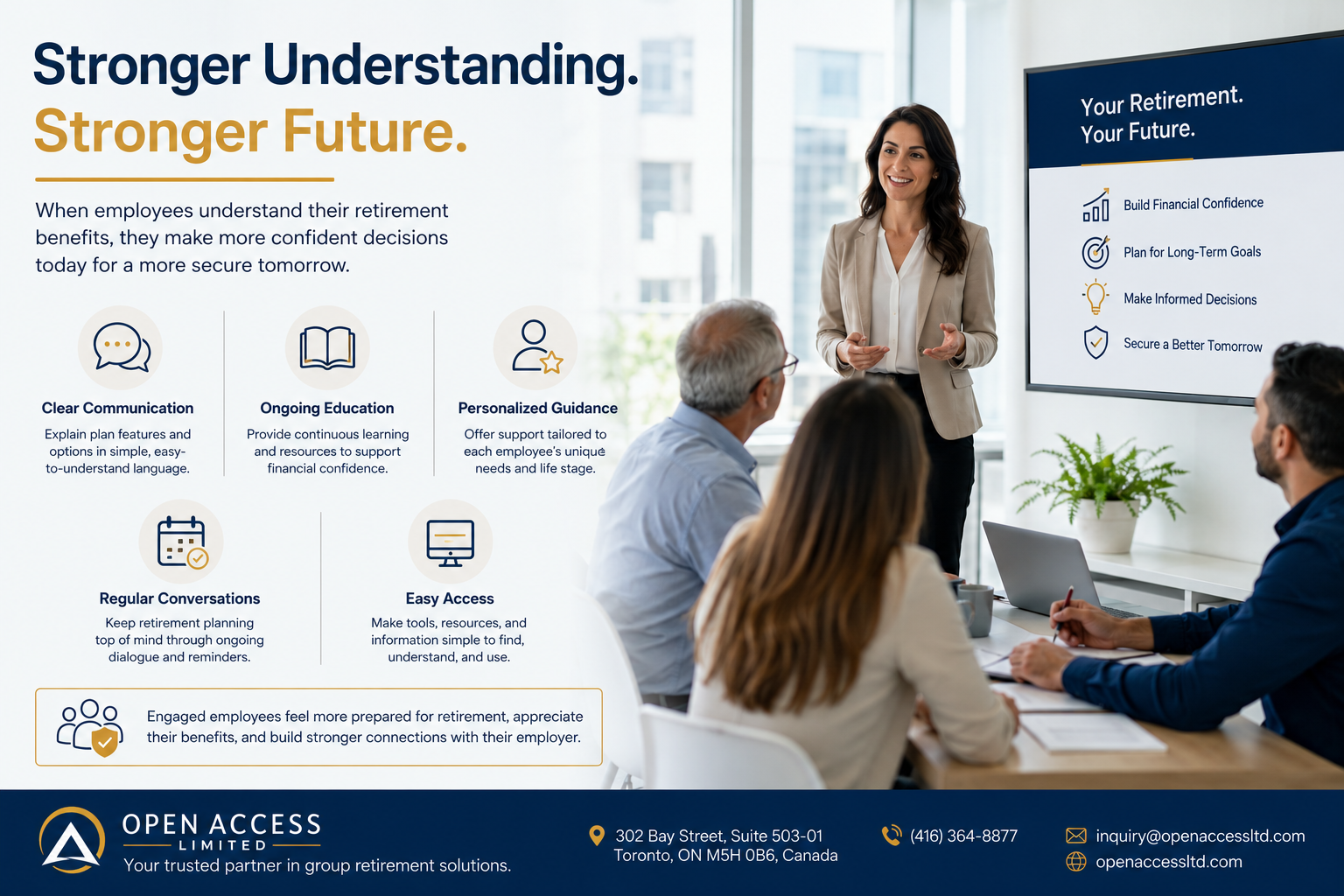
Employee retirement benefits engagement has become one of the most important priorities for organizations that want to maximize the value of their workplace retirement programs. While many employers invest significantly in retirement plans, employees do not always understand how these benefits support their long-term financial wellbeing.
Without clear communication and ongoing education, retirement programs may be underutilized, participation rates may remain lower than expected, and employees may miss valuable opportunities to prepare for retirement. Businesses that actively invest in education, communication, and employee support often create stronger engagement while helping employees make more informed financial decisions.
Rather than viewing retirement plans as a one-time employee benefit, organizations are increasingly treating them as an ongoing financial wellness initiative that evolves throughout an employee’s career.
Why Is Employee Retirement Benefits Engagement Important?
Offering employees retirement benefits engagement is only the first step.
Employees receive the greatest value when they understand how retirement programs work, why participation matters, and how their contributions support long-term financial security.
A lack of understanding can reduce employee confidence and participation while limiting the overall effectiveness of the retirement plan.
Organizations that focus on communication and financial education often create greater trust, improve employee confidence, and encourage long-term participation in workplace retirement programs.
Retirement education also helps employees connect today’s financial decisions with tomorrow’s retirement goals.
5 Smart Ways to Improve Employee Retirement Benefits Engagement
1. Communicate Retirement Benefits Clearly
Retirement plans often contain terminology that employees may not fully understand.
Organizations should communicate plan features using simple language that explains contribution options, employer matching opportunities, investment choices, and long-term retirement objectives.
Clear communication helps employees understand both the immediate and future value of participating in the plan.
2. Provide Ongoing Financial Education
Financial education should continue throughout an employee’s career instead of ending after onboarding.
Educational workshops, webinars, newsletters, retirement planning sessions, and digital learning resources help employees build financial confidence while improving retirement readiness.
Continuous learning encourages greater engagement because employees receive information when it becomes relevant to their current financial situation.
3. Personalize Employee Guidance
Employees have different financial priorities depending on age, income level, career stage, and family responsibilities.
Providing personalized education and communication allows employees to better understand retirement options that fit their own circumstances rather than receiving the same information as everyone else.
This individualized approach can improve understanding while increasing confidence in retirement planning decisions.
4. Encourage Regular Retirement Conversations
Many employees think about retirement only occasionally.
Organizations can improve engagement by encouraging regular discussions during benefit reviews, annual enrollment periods, financial wellness events, and employee education programs.
Frequent communication keeps retirement planning relevant and helps employees adjust their financial strategies as personal circumstances change.
5. Make Retirement Resources Easy to Access
Employees are more likely to engage when retirement information is easy to find and simple to understand.
Businesses can provide online portals, educational videos, retirement calculators, FAQs, and digital planning tools that employees can access whenever needed.
Accessible resources encourage ongoing learning while helping employees make informed financial decisions throughout their careers.
Building Long-Term Employee Financial Confidence
Improving employee retirement benefits engagement is not simply about increasing participation rates.
It is about helping employees develop greater confidence in their financial future.
Organizations that combine education, communication, and personalized support create stronger workplace relationships while demonstrating their long-term commitment to employee wellbeing.
Retirement programs supported by continuous communication often become an important part of a broader employee financial wellness strategy that benefits both employees and employers.
How Open Access Limited Helps Improve Employee Retirement Benefits Engagement
Many organizations choose to work with experienced retirement specialists to strengthen employee understanding and long-term engagement with workplace retirement programs.
Open Access Limited is an independent Canadian group retirement plan provider Employee Retirement Benefits Engagement that works closely with employers to develop retirement solutions focused on education, communication, and employee success.
Rather than simply implementing retirement plans, Open Access Limited supports organizations by helping employees understand the value of their workplace benefits through ongoing financial education, structured onboarding, personalized communication, and continuous engagement initiatives.
These services may help organizations improve employee participation, increase financial confidence, and strengthen retirement readiness while supporting long-term workforce wellbeing.
Open Access Limited
302 Bay Street, Suite 503-01 Toronto, ON M5H 0B6 Canada
Organizations that invest in clear communication, continuous financial education, personalized employee support, and accessible retirement resources often create stronger engagement with workplace retirement programs.
When employees understand how retirement benefits contribute to their long-term financial wellbeing, they are more likely to appreciate the value of their benefits, participate confidently, and remain engaged throughout their careers.
An effective employee retirement benefits engagement strategy can strengthen workplace trust, improve financial confidence, and help businesses maximize the long-term value of their retirement programs.
References
Financial Literacy and Education Commission – Workplace Financial Education Research
How Can Businesses Build an Adaptable Retirement Benefits Strategy?
A retirement benefits strategy should not remain fixed while employee needs, workforce demographics, financial priorities, and economic conditions continue to change.
Employees at different career stages may have very different expectations. Early-career employees may focus on financial education, flexibility, and building savings habits. Mid-career employees may be balancing family responsibilities, housing costs, and long-term financial goals. Employees approaching retirement may place greater importance on retirement readiness, income planning, and financial security.
For this reason, businesses may benefit from reviewing their retirement programs regularly rather than relying on a one-size-fits-all approach. An adaptable strategy can help organizations maintain alignment between plan design, employee expectations, and long-term workforce objectives.
Why Do Employee Retirement Needs Change Over Time?
Employee financial priorities often change as personal circumstances, career stages, and external economic conditions evolve.
Changes in income, family responsibilities, financial literacy, inflation, housing costs, and retirement timelines may all influence how employees view workplace retirement benefits. A benefit that feels relevant to one employee group may not provide the same value to another.
Workforce composition may also change as organizations hire new employees, experience generational shifts, or introduce new roles and working arrangements. These developments can affect participation patterns, communication preferences, and expectations around flexibility.
A strong retirement benefits strategy recognizes these differences and creates a framework that can be reviewed and refined over time.
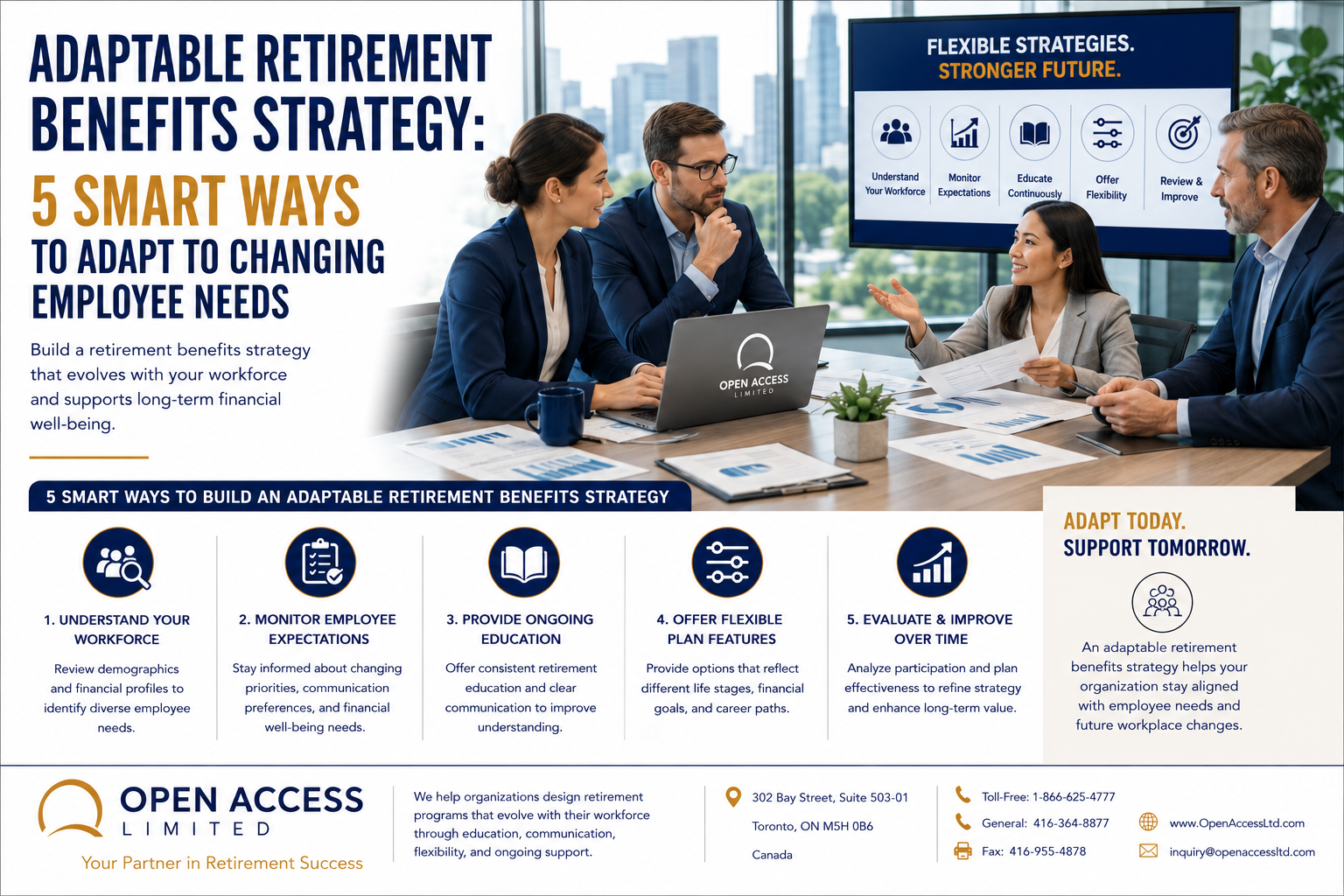
5 Smart Ways to Create an Adaptable Retirement Benefits Strategy
1. Review Employee Demographics and Financial Profiles
Businesses can begin by understanding the people their retirement program is designed to support.
Reviewing workforce demographics, career stages, financial profiles, and participation patterns may help employers identify different employee needs. For example, younger employees may require foundational education about retirement savings, while experienced employees may benefit from more detailed retirement readiness guidance.
This information can help organizations make retirement programs more relevant without assuming that every employee has the same financial priorities.
2. Monitor Changing Employee Expectations
Employee expectations around benefits, communication, flexibility, and financial wellness can change over time.
Organizations may use employee surveys, benefits feedback, participation data, and workforce discussions to understand how employees perceive the current program.
Monitoring expectations does not mean changing the plan after every individual request. Instead, it allows businesses to identify broader trends and determine whether communication, education, or plan features may need adjustment.
Regular feedback can help keep a retirement benefits strategy connected to real workforce needs.
3. Provide Ongoing Retirement Education and Communication
Retirement education should not be limited to onboarding or annual enrollment periods.
Employees may need different information as their careers and financial circumstances develop. Ongoing education can help employees understand contribution options, long-term planning considerations, and the value of available workplace benefits.
Communication should also be clear, accessible, and appropriate for different levels of financial literacy.
Businesses may use workshops, digital resources, educational materials, individual guidance, and regular updates to support employee understanding. Consistent communication can make retirement planning feel more practical and easier to engage with.
4. Offer Flexible Plan Features Where Appropriate
Flexible plan features may help organizations support employees with different financial priorities and career stages.
Depending on the plan structure, flexibility may include contribution options, educational resources, digital access, or planning support that reflects different employee circumstances.
Flexibility does not require unlimited choice. The objective is to create a plan that can respond reasonably to workforce changes while remaining aligned with organizational goals, governance requirements, and available resources.
An adaptable retirement benefits strategy should balance employee choice with clear structure and long-term plan sustainability.
5. Evaluate Participation and Plan Effectiveness Over Time
Participation data can provide useful insight into how employees interact with retirement benefits.
Organizations may review enrollment levels, contribution patterns, employee feedback, communication engagement, and use of educational resources.
Low participation does not always mean the plan design is ineffective. It may indicate that employees need clearer communication, more relevant education, or better access to support.
Regular evaluation allows employers to identify areas where plan design, communication, or education may require refinement. Outcomes can vary depending on workforce characteristics, plan structure, and implementation approach, so reviews should be measured and based on appropriate context.
How Can Businesses Keep Retirement Benefits Stratege Aligned With Workforce Needs?
Businesses can keep retirement benefits relevant by treating plan review as an ongoing process rather than a one-time project.
A practical review may consider whether the program still reflects workforce demographics, employee financial priorities, organizational objectives, participation trends, and external economic conditions.
Retirement planning should also be considered alongside other employee experience initiatives, including financial wellness, workplace flexibility, skills development, and long-term workforce planning.
When these areas are reviewed together, organizations may gain a clearer understanding of how retirement benefits contribute to the broader employee experience.
An adaptable approach can help businesses maintain consistency while still responding thoughtfully to changing workforce needs.
How Open Access Limited Supports Adaptable Retirement Benefits Strategies
Some organizations choose to work with advisory firms experienced in aligning retirement benefits with changing employee expectations and long-term organizational priorities.
Open Access Limited, based in Ontario, works with employers to review workforce demographics, assess participation trends, and develop retirement programs supported by ongoing employee education, communication strategies, and flexible plan design considerations.An adaptable retirement benefits strategy can improve employee understanding through ongoing education and clear communication.
These services may help employers improve employee understanding, support participation, and keep retirement benefits aligned with workforce needs over time.
Open Access Limited 302 Bay Street, Suite 503-01 Toronto, ON M5H 0B6 Canada
A successful retirement benefits strategy should be designed to evolve as employees, workplaces, and financial conditions change.
By reviewing workforce demographics, monitoring employee expectations, providing ongoing education, offering appropriate flexibility, and evaluating participation over time, businesses can create retirement programs that remain relevant and understandable. A well-designed retirement benefits strategy should be reviewed regularly to ensure it continues to support changing employee needs and long-term workforce goals.
There is no single strategy that fits every organization. However, a structured and regularly reviewed approach can help employers maintain alignment between employee needs, plan design, and long-term workforce objectives.
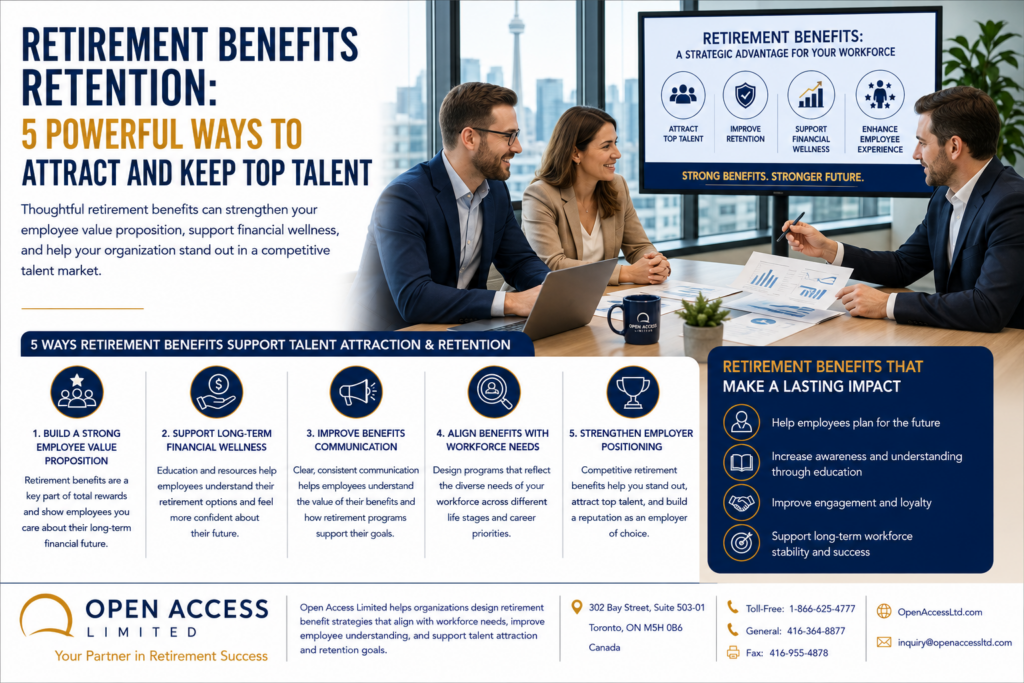
Retirement Benefits Retention: 5 Powerful Ways to Attract Talent
Retirement Benefits Retention: 5 Powerful Ways to Attract Talent
Retirement benefits retention strategies are becoming increasingly important as businesses compete to attract skilled employees and maintain a strong workforce.
In today’s competitive labour market, employees often evaluate more than salary when considering career opportunities. Workplace culture, professional growth, flexibility, and financial benefits can all influence how employees view an organization.
A thoughtful retirement benefits strategy may support long-term employee confidence and strengthen the overall employee value proposition.
Why Do Retirement Benefits Matter for Talent Attraction?
Retirement benefits retention strategies help organizations demonstrate a commitment to employees’ long-term financial well-being.
For many employees, workplace benefits represent an important part of the total compensation experience.
When retirement programs are clearly designed and communicated, employees may better understand the value their employer provides beyond regular income.
Strong retirement benefits can help businesses create a more complete and competitive employment offering.
5 Powerful Ways Retirement Benefits Support Employee Retention
1. Building a Strong Employee Value Proposition
A successful employee value proposition includes more than compensation.
Retirement benefits, financial wellness resources, workplace support, and career opportunities work together to shape the employee experience.
Organizations that align retirement programs with employee expectations may create stronger connections with their workforce.
2. Supporting Long-Term Financial Wellness
Employees at different career stages often have different financial priorities.
Retirement benefits retention strategies can include education, accessible resources, and communication that help employees understand long-term planning options.
Improving financial awareness may help employees feel more informed when making decisions about their future.
3. Improving Benefits Communication
A retirement program only creates value when employees understand it.
Clear communication helps employees recognize available resources and how retirement programs fit within their broader financial goals.
Businesses can improve engagement by providing ongoing education instead of only introducing benefits during onboarding.
4. Aligning Benefits With Workforce Needs
Different generations and employee groups may have different expectations.
Organizations can review workforce demographics, employee feedback, and participation trends to better align retirement benefits with changing needs.
Flexible approaches may help businesses create programs that remain relevant over time.
5. Strengthening Employer Positioning
There is no single retirement approach that guarantees improved attraction or retention results.
Organizations should consider workforce characteristics, employee needs, communication methods, and business objectives.
A balanced and data-informed approach helps employers design benefits that support both employees and organizational goals.
Creating Stronger Employee Confidence
Retirement programs strategies can also support employee confidence by helping workers better understand available financial resources. When organizations provide ongoing education and clear retirement communication, employees may feel more connected to workplace benefits and long-term planning opportunities.
How Open Access Limited Supports Retirement Benefits Strategies
Open Access Limited, based in Ontario, works with employers to design retirement programs aligned with workforce expectations and organizational objectives.
Through tailored communication strategies, employee education initiatives, and flexible plan structures, Open Access Limited helps organizations improve employee understanding of retirement benefits and strengthen the overall employee value proposition.
Open Access Limited 302 Bay Street, Suite 503-01 Toronto, ON M5H 0B6 Phone: 1-866-625-4777 Email: inquiry@openaccessltd.com
Website: OpenAccessLtd.com
Final Thoughts
Retirement benefits retention strategies can play an important role in supporting talent attraction and long-term workforce engagement.
By focusing on financial wellness, communication, education, and employee experience, businesses can create retirement programs that provide meaningful workplace value.
A thoughtful retirement benefits approach can help organizations strengthen their workforce strategy and prepare for future talent expectations.
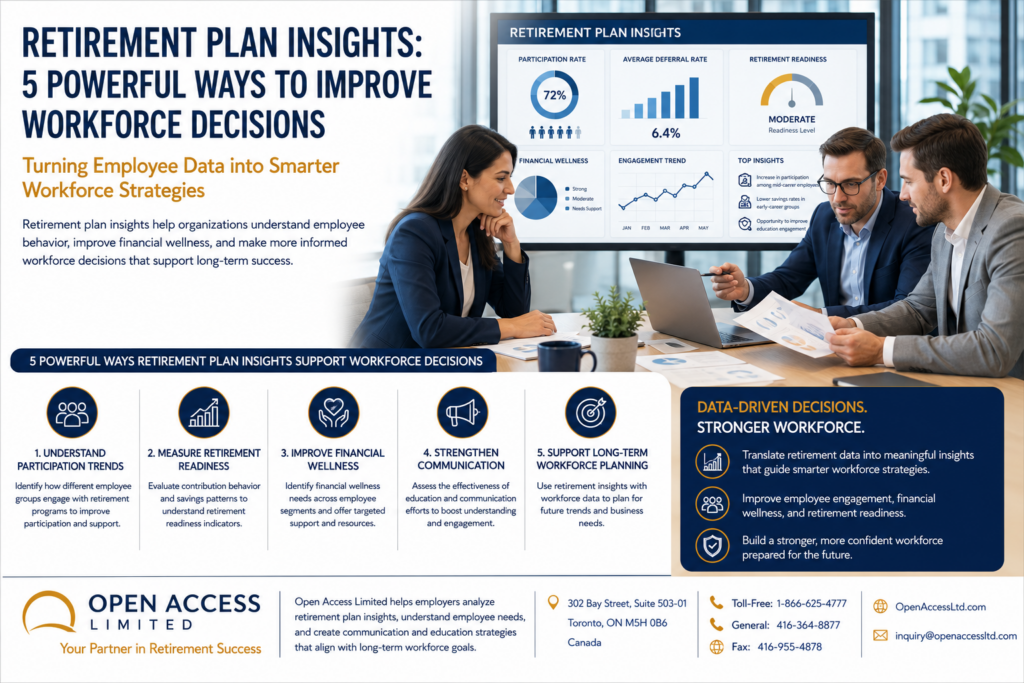
Retirement Planning Investment: 5 Powerful Ways to Build Workforce Success
Retirement planning investment is becoming an important part of how organizations evaluate long-term workforce success, employee engagement, and sustainable business growth.
For many businesses, retirement programs have traditionally been viewed as employee benefit expenses. However, modern organizations are increasingly considering how these programs can support broader workforce objectives.
A strategic approach to retirement planning may help companies strengthen employee confidence, improve benefits understanding, and create a stronger connection between workplace programs and organizational goals.
Why Should Businesses View Retirement Planning as an Investment?
A retirement planning investment goes beyond providing a standard workplace benefit.
When designed effectively, retirement programs can support workforce stability, employee value proposition, and long-term planning needs.
Employees often evaluate workplace benefits as part of their overall employment experience. A well-structured retirement strategy may contribute to stronger engagement by helping employees understand the value of their total rewards package.
Organizations that evaluate retirement planning strategically can better understand how benefits influence workforce expectations and future planning.
Retirement programs can support workforce stability by creating benefits structures that encourage long-term participation.
When employees understand available retirement resources, they may feel more prepared when making financial decisions.
Clear retirement planning strategies can help organizations build a more informed and engaged workforce.
2.Improving Employee Financial Education
Employee financial education is a key part of successful retirement planning investment.
Providing resources, guidance, and communication can help employees better understand retirement options and available workplace benefits.
Education helps transform retirement programs from simple benefits into meaningful workforce support tools.
3. Supporting Employee Value Proposition
A strong employee value proposition includes more than salary.
Benefits, workplace culture, professional development, and financial wellness programs all influence how employees view their organization.
Retirement planning can become part of a complete benefits strategy that supports attraction, engagement, and long-term workforce goals.
4. Connecting Benefits With Business Objectives
Organizations can evaluate retirement plans by considering how they align with company priorities.
This may include workforce planning goals, employee participation, communication effectiveness, and long-term organizational needs.
A thoughtful retirement planning investment helps connect employee support with broader business strategies.
5. Creating Sustainable Workforce Planning
Workforce needs continue to change as employee expectations, demographics, and economic conditions evolve.
Retirement strategies that include regular review and improvement can help businesses maintain benefits that remain relevant over time.
A sustainable approach allows organizations to adapt while supporting employees through different career stages.
How Can Organizations Measure Retirement Planning Value?
Businesses may review retirement programs alongside workforce indicators such as employee feedback, participation levels, engagement trends, and retention considerations.
The impact of retirement planning can vary depending on plan design, workforce characteristics, and business objectives.
For this reason, organizations often benefit from a structured approach that combines analysis, communication, and ongoing improvement.
How Open Access Limited Supports Workforce Investment Strategies
Open Access Limited, based in Ontario, works with employers to align retirement plan structures with organizational goals, employee education strategies, and long-term workforce planning needs.
Through customized communication, contribution framework design, and benefits strategy support, Open Access Limited helps organizations evaluate retirement programs as part of a broader workforce investment approach.
Open Access Limited 302 Bay Street, Suite 503-01 Toronto, ON M5H 0B6 Phone: 1-866-625-4777 Email: inquiry@openaccessltd.com Website: OpenAccessLtd.com
Final Thoughts
Retirement planning investment can help businesses create stronger connections between employee benefits and organizational success.
By focusing on education, workforce stability, employee engagement, and sustainable planning, companies can build retirement strategies that support both employees and future business goals.
Viewing retirement planning as a long-term workforce strategy allows organizations to create benefits programs with greater purpose and value.
References
Boston Consulting Group (BCG) – Future of Work and Workforce Strategy Research https://www.bcg.com
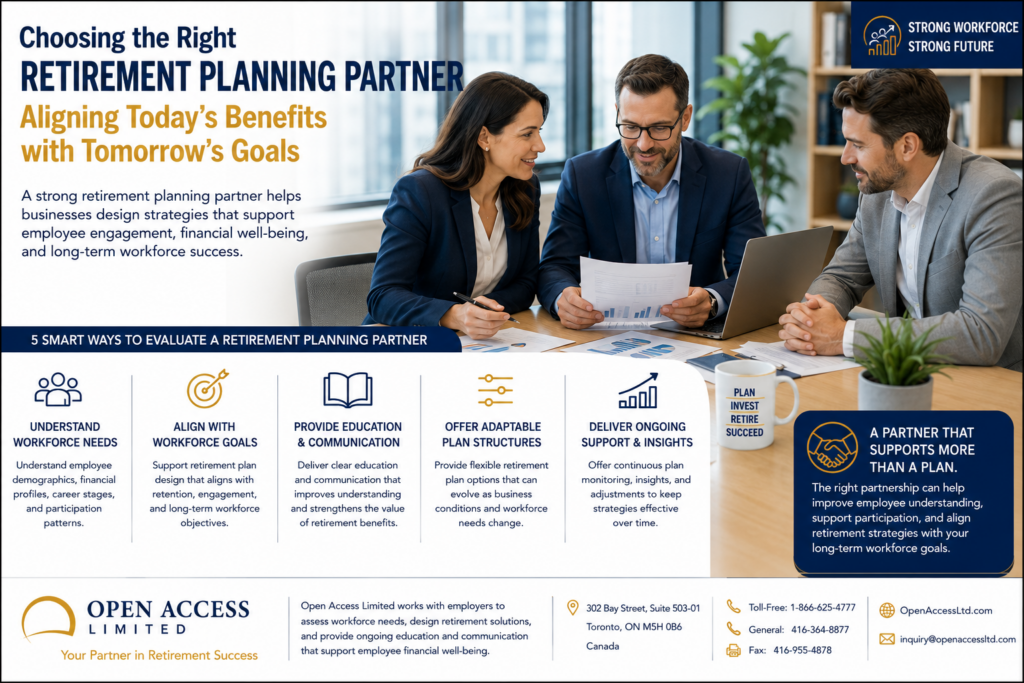
Retirement Planning Partner: 5 Smart Ways to Build Workforce Success
Retirement planning partner selection is becoming an important decision for businesses that want employee benefits to support long-term workforce goals, employee engagement, and organizational stability.
Choosing the right partner is not only about comparing retirement products. It is also about finding a provider that understands workforce demographics, employee needs, communication challenges, and broader business objectives.
For many organizations, retirement planning is now part of a larger workforce strategy. A strong partner can help connect retirement plan design with retention, education, participation, and long-term employee financial confidence.
Why Does Choosing the Right Retirement Planning Partner Matter?
A retirement planning partner can influence how employees understand, value, and participate in workplace retirement programs.
If the partner focuses only on products, the plan may not fully reflect company size, workforce composition, or employee expectations. However, when a partner understands business goals and workforce needs, retirement planning can become a more strategic employee benefits solution.
Businesses may benefit from evaluating partners based on transparency, communication, governance practices, and the ability to provide ongoing guidance.
5 Smart Ways to Evaluate a Retirement Planning Partner
1. Understand Workforce Demographics and Employee Needs
A strong retirement planning partner should understand that employees may have different financial profiles, career stages, and participation patterns.
Some employees may need basic education about retirement savings, while others may require more advanced planning guidance. Understanding these differences can help businesses design benefits that are more relevant and easier to use.
2. Align Retirement Plan Design With Workforce Goals
Retirement strategies should support broader business objectives such as retention, engagement, and long-term workforce planning.
A qualified partner should help businesses connect retirement plan design with organizational priorities. This may include reviewing contribution structures, communication methods, and employee participation goals.
3. Provide Clear Employee Education and Communication
Even a well-designed retirement plan may not succeed if employees do not understand it.
A retirement planning partner should provide clear education, simple communication, and practical guidance. This can help employees understand the value of retirement benefits and how those benefits support their long-term financial future.
4. Offer Adaptable Retirement Plan Structures
Workforce needs can change over time. Business conditions, employee demographics, and financial expectations may also shift.
An effective partner should offer adaptable plan structures that allow businesses to review and adjust retirement strategies as needed. Flexibility can help organizations maintain benefits that remain aligned with long-term goals.
5. Deliver Ongoing Support and Plan Insights
Selecting a retirement planning partner should not be a one-time decision.
Ongoing monitoring, reporting, communication, and plan evaluation can help businesses understand whether their retirement strategy continues to meet employee and organizational needs.
A strong partner should provide insights that support continuous improvement.
How Can Businesses Compare Retirement Planning Partners?
Important questions may include:
Businesses can take a structured approach by asking whether a potential partner can support workforce analysis, employee education, plan design, governance, and long-term review.
Can the partner understand workforce demographics?
Can they support employee engagement?
Can they explain retirement benefits clearly?
Can they adjust strategies as business needs change?
Can they provide ongoing guidance and evaluation?
These questions help businesses compare partners beyond product features.
How Open Access Limited Supports Long-Term Workforce Goals
Open Access Limited, based in Ontario, works with employers to assess workforce demographics, design retirement plan structures aligned with organizational objectives, and provide ongoing employee education and communication support.
These services are supported by adaptable plan frameworks and continuous plan evaluation. This approach may help improve employee understanding, support participation, and align retirement strategies with long-term workforce goals.
Open Access Limited 302 Bay Street, Suite 503-01 Toronto, ON M5H 0B6 Phone: 1-866-625-4777 Email: inquiry@openaccessltd.com Website: OpenAccessLtd.com
Final Thoughts:
Choosing the right retirement planning partner can help businesses connect employee benefits with long-term workforce success.
A strong partner should understand employee needs, support clear communication, provide adaptable planning structures, and offer ongoing guidance.
For organizations focused on retention, engagement, and sustainable workforce planning, retirement partner selection can become an important part of a broader benefits strategy.
Suggested Image ALT Text: Canadian business leaders evaluating a retirement planning partner, workforce goals, employee education, retirement benefits strategy, and long-term employee engagement in a modern corporate office.
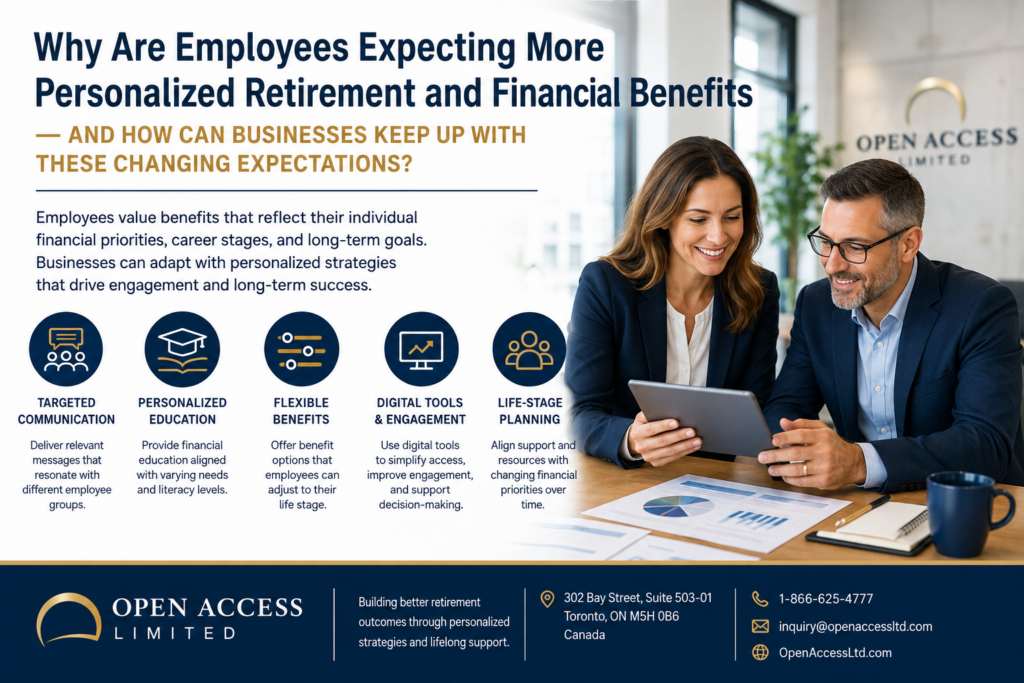
Personalized Retirement Benefits: 5 Powerful Ways Businesses Can Adapt
Retirement benefits are becoming increasingly important as employees expect workplace solutions that reflect their individual financial priorities, career stages, and long-term goals .
Traditional retirement and financial benefit structures may not fully address the needs of today’s diverse workforce. Employees may differ in income levels, financial literacy, life responsibilities, and planning timelines. Because of this, many organizations are exploring more flexible and personalized approaches to retirement and financial planning.
For businesses, this shift is not only about offering more benefits. It is about creating benefits strategies that employees can understand, value, and engage with over time.
Why Are Employees Expecting More Personalized Retirement Benefits?
Employees are increasingly looking for benefits that match their real financial needs. Some employees may prioritize short-term flexibility, budgeting support, and financial education, while others may focus on retirement readiness, long-term security, and wealth preservation.
A one-size-fits-all benefits model may not feel relevant to employees at different life stages. Personalized retirement benefits can help organizations better support employees by aligning financial planning options with individual needs and workforce diversity.
This retirement benefits may also improve how employees perceive the overall value of their workplace benefits package, especially in competitive labour markets.
How Can Businesses Keep Up With Changing Benefit Expectations?
Businesses can respond by designing retirement and financial benefits that are more flexible, accessible, and employee-centered.
Rather than simply offering a retirement plan, organizations may need to focus on how employees experience, understand, and use those benefits. This includes communication, education, digital engagement, and ongoing support.
5 Powerful Ways to Personalize Retirement and Financial Benefits
1. Use Targeted Communication Strategies
Employees do not all need the same message at the same time. A younger employee beginning their career may need different information than an employee approaching retirement.
Targeted communication can help businesses explain benefits in a way that is relevant to each employee group. This may improve understanding, participation, and long-term engagement.
2. Provide Personalized Financial Education
Financial literacy levels can vary across the workforce. Some employees may need basic education about saving and budgeting, while others may benefit from more advanced retirement planning guidance.
Personalized financial education helps employees connect workplace benefits with their personal financial goals. This can make retirement planning feel more practical and easier to use.
3. Build Flexible Benefit Structures
Flexible benefit structures allow employees to adjust participation based on their financial situation and life stage.
For example, employees may need different contribution options, savings tools, or planning resources depending on their priorities. Flexible retirement benefits can help businesses support a wider range of employee needs without relying on one fixed approach.
4. Use Digital Tools and Engagement Platforms
Digital tools can make personalized retirement benefits easier to access and understand.
Online platforms, calculators, dashboards, and interactive resources can support ongoing employee engagement. These tools may help employees review options, track progress, and make more informed decisions about their financial future.
5. Align Planning With Life Stages
Employee financial priorities often change over time. Early-career employees may focus on debt, savings habits, and flexibility. Mid-career employees may balance family responsibilities, mortgages, and long-term planning. Later-career employees may focus on retirement readiness and income security.
How Open Access Limited Supports Personalized Benefits Strategies
Some businesses choose to work with experienced advisory firms to align retirement strategies with workforce diversity and changing employee expectations.
Open Access Limited, based in Ontario, works with employers to design retirement programs that incorporate segmented communication strategies, personalized financial education, and flexible contribution frameworks aligned with employees’ financial profiles and career stages.
These programs may also include digital tools and ongoing engagement initiatives that help improve understanding, support participation, and keep benefits relevant for a diverse workforce.
Open Access Limited 302 Bay Street, Suite 503-01 Toronto, ON M5H 0B6 Phone: 1-866-625-4777 Email: inquiry@openaccessltd.com Website: OpenAccessLtd.com
Final Thoughts:
Employees are expecting more personalized retirement and financial benefits because their financial lives are becoming more diverse and complex.
Businesses that adapt through targeted communication, personalized education, flexible benefit structures, digital tools, and life-stage planning may be better positioned to improve employee engagement and long-term workforce stability.
A thoughtful personalized retirement benefits strategy can help organizations create workplace benefits that employees understand, value, and use with confidence.
References:
Gartner – Future of Work and Workforce Personalization Research
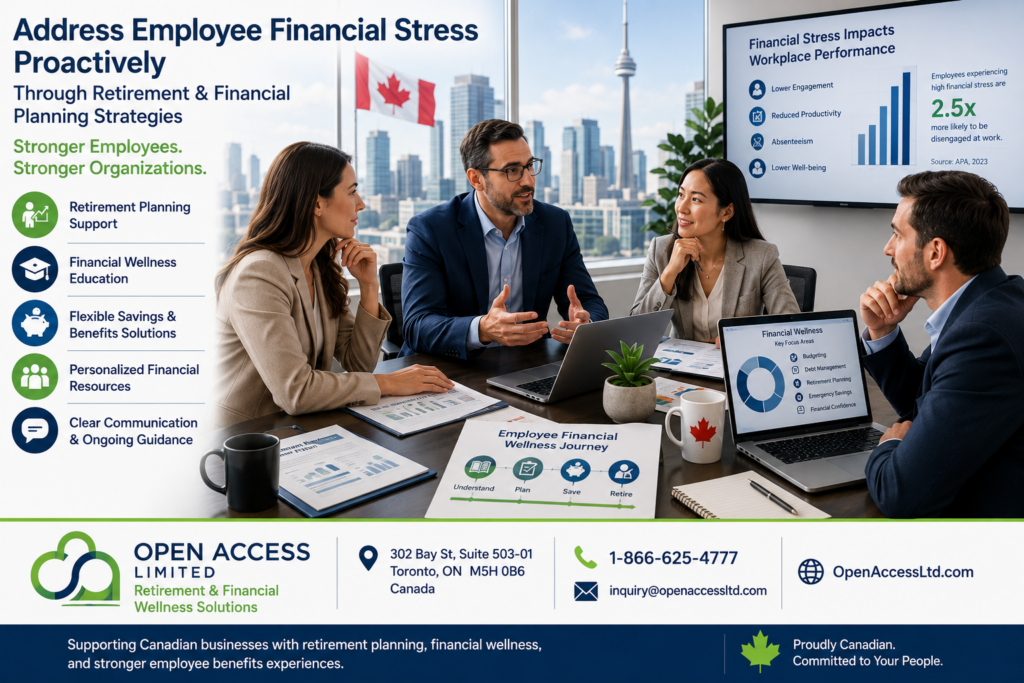
Employee financial stress has become an important consideration for many businesses as organizations support employees through retirement planning, financial wellness strategies, and long-term financial decisions.
While workplace stress can come from many sources, financial concerns may affect employee focus, confidence, and overall workplace experience. As a result, businesses are increasingly exploring proactive strategies that combine retirement financial planning and employee financial wellness support.
Rather than responding only when financial challenges appear, organizations can create systems that help employees prepare for different stages of their financial journey.
Financial stress has become an important consideration for many modern organizations as employees manage rising costs, financial uncertainty, and long-term planning decisions.
While workplace stress can come from many sources, financial concerns may affect employee focus, confidence, and overall workplace experience. As a result, businesses are increasingly exploring proactive strategies that combine retirement planning, education, and employee financial wellness support.
Rather than responding only when financial challenges appear, organizations can create systems that help employees prepare for different stages of their financial journey.
Why Employee Financial Stress Has Become a Workplace Priority
Financial stress has become an important consideration for many modern organizations as employees manage rising costs, financial uncertainty, and long-term planning decisions.
While workplace stress can come from many sources, financial concerns may affect employee focus, confidence, and overall workplace experience. As a result, businesses are increasingly exploring proactive strategies that combine retirement planning, education, and employee financial wellness support.
Rather than responding only when financial challenges appear, organizations can create systems that help employees prepare for different stages of their financial journey.
1. Provide Accessible Retirement Planning Support
A strong retirement planning strategy helps employees better understand their long-term options and prepare for the future.
Clear retirement education can help employees make informed decisions about savings, benefits, and financial priorities.
When employees understand available resources, they may feel more confident about planning beyond immediate financial needs.
2. Improve Employee Financial Wellness Education
Financial wellness programs focus on improving knowledge, awareness, and decision-making.
These programs may include topics such as:
Budgeting strategies
Long-term savings
Retirement preparation
Understanding workplace benefits
Managing financial priorities
Education gives employees practical tools that can support better financial confidence over time.
3. Offer Flexible Benefits and Savings Solutions
Every employee has different financial goals and responsibilities.
Flexible benefits programs allow organizations to support employees across different life stages, from younger employees beginning their careers to experienced professionals preparing for retirement.
Personalized approaches can make workplace benefits more relevant and valuable.
4. Build Clear Communication Around Employee Benefits
Even strong benefit programs may lose value if employees do not understand how to use them.
Regular communication helps employees recognize available resources and understand how retirement planning fits into their overall financial picture.
Organizations can improve engagement through:
Employee education sessions
Digital resources
Ongoing guidance
Simple benefit explanations
5. Create a Preventative Workforce Strategy
A proactive approach focuses on supporting employees before financial concerns become larger challenges.
By integrating retirement planning and financial wellness into workplace strategies, organizations may strengthen employee confidence, engagement, and long-term stability.
Financial wellness is becoming part of a broader conversation about building resilient workplaces.
6. Partner With Experienced Financial Wellness Advisors
Some businesses choose to work with professional advisory teams to design structured retirement and financial wellness programs.
Organizations such as Open Access Limited support employers with retirement planning frameworks, employee education, and flexible benefit strategies designed around workforce needs.
These solutions can help businesses create stronger financial awareness and support employees throughout different career stages.
Open Access Limited 302 Bay St, Suite 503-01 Toronto, ON M5H 0B6 Canada
Addressing employee financial stress requires more than short-term solutions.
Businesses that combine retirement planning, financial education, flexible benefits, and ongoing support can create a workplace environment where employees feel more prepared for the future.
A thoughtful financial wellness strategy may contribute to stronger engagement, confidence, and sustainable workforce success.
Reducing employee financial stress through proactive retirement planning can help organizations build stronger and more resilient workplaces.
References
American Psychological Association (APA) – Financial Stress and Workplace Research https://www.apa.org