Retirement plan market volatility can create understandable questions for employees.
When investment values rise and fall, employees may wonder why their workplace retirement account has changed, whether they should alter contributions, whether their investment options are still appropriate, or what they should do next.
For Canadian employers, the objective is not to predict where markets are heading or tell employees what investment decision to make.
A more appropriate role is to provide clear general education, direct employees to official workplace-plan information, explain basic concepts such as risk and diversification in plain language, and ensure employees know where to obtain qualified individual support.
The Canadian Investment Regulatory Organization notes that investment risk and potential return are related: higher risk can involve both greater potential return and greater potential loss. Diversification may help reduce the effect of declines in one area of a portfolio, but neither concept predicts what markets will do next. OpenAccess_Q54_QA_with_Resource…
Quick Answer: How Should Employers Communicate During Retirement Plan Market Volatility?
During retirement plan market volatility, Canadian employers should acknowledge employee questions, reinforce the stated purpose of the workplace plan, use official provider and plan resources, explain general concepts such as risk, diversification, and time horizon, avoid individual investment recommendations or market predictions, provide access to qualified support, and review employee communication after the period of volatility.
The goal is clear information—not investment advice.
On This Page
- Why Market Volatility Communication Matters
- 7 Best Employer Communication Steps
- How to Explain Risk and Diversification
- What Employers Should Avoid
- Neutral Communication Example
- What a Market-Volatility Communication Plan Should Include
- Why Education Should Begin Before Volatility
- Important Employer Boundaries
- How Open Access Limited May Support Employers
- Frequently Asked Questions
- Final Thoughts
- References
Why Retirement Plan Market Volatility Communication Matters
Employees may naturally pay more attention to their retirement accounts when markets become volatile.
A falling account value can lead to questions about:
- What caused the change
- Whether the workplace plan is still working as intended
- Whether contributions should continue
- Whether an investment option should be changed
- How investment risk works
- Whether losses are temporary or permanent
- Who can provide personal guidance
Employers should take these questions seriously without assuming how an employee feels or what their financial circumstances are.
Good retirement plan market volatility communication acknowledges the question without turning the employer into a market forecaster or personal investment adviser.
A useful principle is:
Acknowledge → Educate → Provide Resources → Refer Personal Decisions
Effective retirement plan market volatility communication can help employees find reliable information without encouraging emotional or short-term investment decisions.
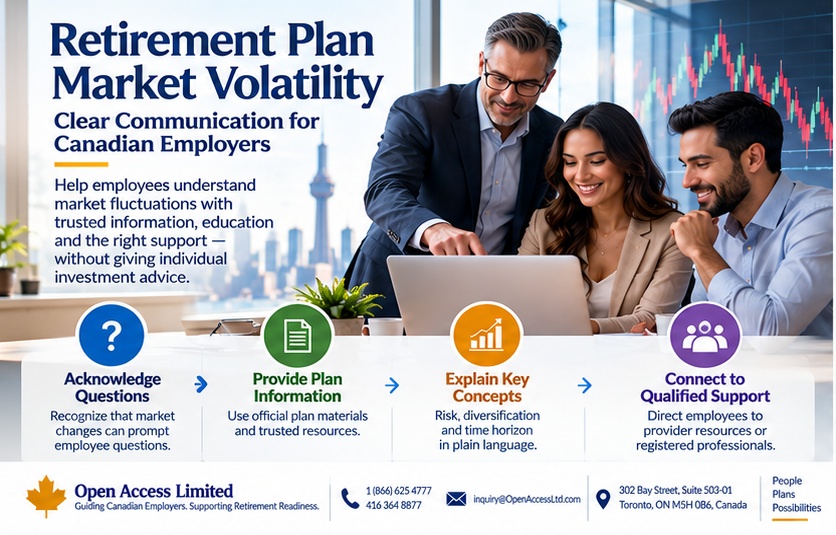
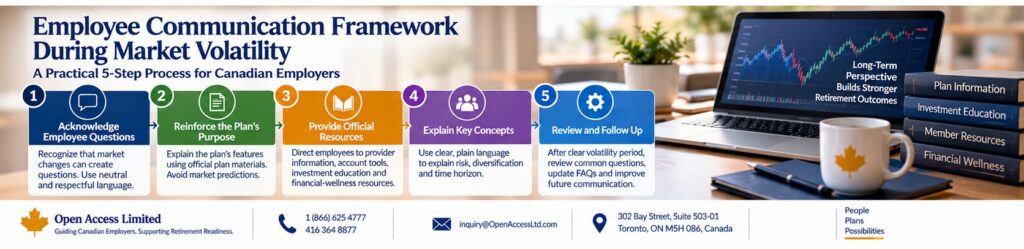
7 Best Employer Steps During Retirement Plan Market Volatility
1. Acknowledge Employee Questions Without Creating Fear
The first step is simple.
Recognize that changes in account values may cause employees to have questions.
An employer can say that investment values fluctuate over time and that plan information and support are available.
Avoid language that assumes:
- Employees are panicking
- Employees are financially distressed
- Everyone has the same concerns
- The current decline will continue
- The current decline will quickly reverse
The purpose is to make communication relevant and respectful.
During retirement plan market volatility, neutral language is usually stronger than dramatic reassurance.
2. Reinforce the Stated Purpose of the Workplace Plan
Employees may benefit from being reminded why the workplace retirement plan exists and how it is designed.
Use the official plan materials to explain:
- The purpose of the plan
- Available investment options
- Member responsibilities
- Contribution provisions
- Employer contributions or matching, where applicable
- Available education
- Member support
Do not add predictions about future returns.
Do not tell employees that the plan will “recover” or that a particular investment will perform better.
A plan’s long-term purpose can provide context without making claims about short-term markets.
This is also a natural place to link to broader retirement income education.

During retirement plan market volatility, reinforcing the plan’s documented purpose can provide useful context without making assumptions about future market performance.
3. Keep General Education Separate From Individual Investment Advice
This is one of the most important boundaries.
Employers should not tell an individual employee:
- Which fund to choose
- Which investment option to sell
- Which investment option to buy
- When to switch investments
- Whether to stop contributing
- Whether to increase contributions
- Whether the market has reached a bottom
- Whether a particular investment will recover
The source specifically recommends keeping employer communication separate from individualized investment advice. OpenAccess_Q54_QA_with_Resource…
If an employee needs advice about their own financial circumstances, investment choices, risk tolerance, or retirement strategy, the employee should be directed to appropriately qualified support.
4. Provide Official Plan Resources
During retirement plan market volatility, employees should know where reliable information is located.
Depending on the plan, useful resources may include:
- Official plan documents
- Member portal
- Investment-option information
- Fund factsheets
- Account statements
- Provider education
- Investor-profile tools
- Financial-wellness resources
- Market commentary prepared by the appropriate provider
- Member-support contact information
Using official resources helps reduce the risk of conflicting messages between the employer and the plan provider.
Where reliable provider materials already exist, employers generally do not need to create their own market commentary.
A consistent retirement plan market volatility process should direct employees to current plan documents, provider resources, account tools, and approved investment information.
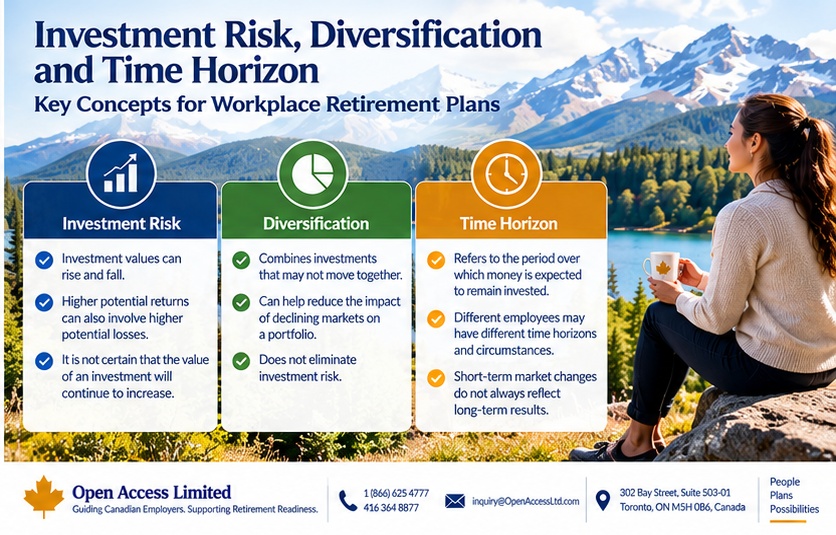
5. Explain Risk, Diversification, and Time Horizon in Plain Language
Employees do not need an investment textbook.
They need clear explanations.
What Is Investment Risk?
Investment risk means the value of an investment can change and that investment outcomes are uncertain.
Higher potential returns may also involve greater potential losses.
What Is Diversification?
Diversification means holding investments that may respond differently to market conditions.
It can reduce dependence on one investment, company, sector, or asset category.
Diversification does not eliminate investment risk.
What Is Time Horizon?
Time horizon refers to the period over which money is expected to remain invested.
Different employees may have different time horizons and personal circumstances.
The employer can explain these concepts generally but should not decide what level of risk or investment strategy is appropriate for an individual employee.
6. Direct Employees to Qualified Support
Employees may have questions that go beyond general education.
For example:
“Should I change my portfolio?”
“Is my risk level too high?”
“Should I stop contributing until markets improve?”
“Should I move everything into a safer investment?”
Those are individual decisions.
During retirement plan market volatility, employers should clearly explain where employees can obtain qualified assistance.
Depending on the question, this may include the workplace retirement-plan provider or an appropriately qualified and registered financial professional.
The source also notes the importance of registration for securities professionals and references resources for checking registration. OpenAccess_Q54_QA_with_Resource…
7. Review Communication After the Volatility Period
Communication should not end when the immediate market headlines disappear.
Afterward, employers can review:
- Which questions employees asked most often
- Which resources employees used
- Whether plan information was easy to find
- Whether HR and provider messages were consistent
- Whether employees knew where to obtain support
- Whether FAQs need updating
- Whether additional education would help
This allows the employer to improve future retirement plan market volatility communication rather than rebuilding the process from scratch each time markets become unsettled.
How Should Employers Explain Investment Risk Without Giving Advice?
This distinction matters.
Employers can explain what risk means.
They should not decide how much risk is appropriate for a particular employee.
For example:
Appropriate general education:
“Investment values can rise and fall, and different investment options have different levels of expected risk and return.”
Not appropriate as general employer communication:
“You should move into a lower-risk portfolio.”
Likewise:
Appropriate:
“Diversification may reduce the impact of declines in one area of a portfolio.”
Not appropriate:
“This portfolio is safe during a market downturn.”
This approach keeps employee education useful without turning general communication into personal investment advice.
Clear retirement plan market volatility education should explain investment concepts objectively while leaving personal portfolio decisions to the employee and appropriately qualified professionals
What Employers Should Avoid During Market Volatility
Avoid statements such as:
“The market will recover soon.”
“Do not change anything.”
“You should move into this fund.”
“Your retirement money is safe.”
“Now is the best time to buy.”
“This downturn is a buying opportunity.”
“Keep contributing because markets always come back.”
The source specifically cautions against forecasts, personal investment instructions, guarantees or implied guarantees, inconsistent communication, and using market volatility as a sales or promotional message. OpenAccess_Q54_QA_with_Resource…
That final point is especially important.
Retirement plan market volatility should not be turned into a sales campaign.
Communication should remain educational and member-focused.
A Neutral Communication Example
A professional employer message could say:
Investment values can rise and fall over time. Information about your workplace retirement plan and available investment options can be found in the official plan materials and through the plan provider. This communication is general educational information and is not individual investment advice. Employees with questions about their own circumstances can contact the plan provider or an appropriately qualified professional.
The wording should always be checked against the employer’s actual plan documents and provider materials before use.
What Should a Market-Volatility Communication Plan Include?
A practical communication plan may include:
A Short FAQ
Address recurring questions without predicting future markets.
The Plan’s Purpose
Use language from official plan documents.
Official Education Resources
Link directly to appropriate provider information.
Account and Investment Access
Remind employees where they can review their account and available investment information.
Clear Advice Boundaries
State that employer communication is general education rather than individualized investment advice.
A Referral Process
Make it clear where individual or technical questions should go.
Follow-Up Education
Provide additional education after the immediate volatility period.
These elements come directly from the communication approach described in the source Q&A. OpenAccess_Q54_QA_with_Resource…
Why Investment Education Should Begin Before Volatility
One of the strongest improvements employers can make is not waiting for a market decline.
Concepts such as:
- Investment risk
- Diversification
- Time horizon
- Investment-option differences
- Investor profiles
- Member support
are easier to understand when employees are not reacting to dramatic financial headlines.
CAPSA’s Guideline No. 3 supports ongoing member education and access to investment information and decision-making tools, rather than limiting education to initial enrolment. OpenAccess_Q54_QA_with_Resource…
That means good retirement plan market volatility communication actually begins during calmer markets.
Preparing employees before retirement plan market volatility occurs can make concepts such as risk, diversification, and time horizon easier to understand when markets become unsettled.
Why This Matters to Employers
Employees may look to their employer when account values change.
Timely and accurate communication can help employees find trustworthy information.
But employers should not promise that communication will:
- Remove investment risk
- Prevent concern
- Stop employees from making changes
- Improve investment performance
- Increase participation
- Improve retention
- Guarantee better retirement outcomes
The effect of communication depends on the quality of information, plan design, employee circumstances, and access to qualified support.
The goal is better information—not guaranteed behaviour.
Important Implementation Boundaries
Workplace investment communication can involve:
- Securities requirements
- Pension responsibilities
- Employment considerations
- Contractual obligations
- Plan documents
- Provider agreements
- Fiduciary responsibilities in some pension arrangements
Plan design also matters.
Some plans allow employees to select individual investment options.
Others may use managed portfolios or default arrangements.
That makes the employer’s retirement plan default options governance relevant as well.
Employers should confirm employee-facing communication against current plan documents and provider materials, avoid forecasts, and obtain qualified legal or other professional advice where appropriate.
Individual investment advice should remain with properly qualified or registered persons. OpenAccess_Q54_QA_with_Resource…
A documented retirement plan market volatility communication framework can also help HR teams, employers, and plan providers deliver more consistent information when employee questions increase.
Need Help Communicate More Clearly During Market Volatility?
Where a workplace retirement plan is provided through Open Access Limited, employers may direct members to official Open Access plan and investment resources rather than creating their own market predictions or investment commentary.
Open Access Limited’s materials include:
- CAP Portfolios
- Investor profile resources
- Investor profile update forms
- CAP Portfolio factsheets
- Periodic market commentary
- Financial-wellness resources
- Member portal access
- Client Relations support
Members with personal questions about their investor profile or portfolio can contact Open Access Limited directly. OpenAccess_Q54_QA_with_Resource…
Open Access Limited should not be positioned as guaranteeing any investment outcome, and its resources do not replace official plan documents or individualized advice from an appropriately qualified professional.
Open Access Limited
302 Bay Street, Suite 503-01
Toronto, ON M5H 0B6, Canada
Toll-Free: 1 (866) 625 4777
General: 416 364 8877
Fax: 416 955 4878
Email: inquiry@OpenAccessLtd.com
Website: www.OpenAccessLtd.com
Frequently Asked Questions About Retirement Plan Market Volatility
Should Employers Tell Employees Not to Change Investments During Market Volatility?
No. Employers should provide general plan education and avoid telling individual employees whether to buy, sell, switch, or hold a particular investment.
Can Employers Tell Employees That the Market Will Recover?
Employers should avoid market forecasts or statements implying that a particular outcome is certain.
Should Employees Stop Retirement Contributions During Market Volatility?
That is an individual decision. Employers can explain contribution rules but should not advise a particular employee whether to stop or continue contributing.
What Is Diversification?
Diversification involves combining investments that may respond differently to market conditions. It may reduce concentration risk but does not eliminate the possibility of loss.
Where Should Employees Find Information About Their Investment Options?
Employees should use official workplace-plan documents, provider resources, account tools, investment information, and available member-support channels.
When Should an Employee Speak With a Financial Professional?
Employees with personal questions about their risk profile, investment choices, portfolio, financial circumstances, or strategy may wish to speak with an appropriately qualified or registered professional.
Should Employers Communicate Only When Markets Fall?
No. Ongoing investment education during normal market conditions can help employees better understand risk, diversification, investment options, and available support before periods of volatility occur.
Final Thoughts
Retirement plan market volatility does not require employers to predict the future.
It requires a disciplined communication process:
Acknowledge Questions → Reinforce the Plan Purpose → Avoid Personal Advice → Provide Official Resources → Explain Key Concepts → Connect Employees With Qualified Support → Review the Communication
The strongest employer message is not:
“Here is what the market will do.”
It is:
“Here is where you can find reliable information about your plan, understand the relevant concepts, and obtain qualified help for decisions that depend on your individual circumstances.”
That approach supports clearer employee communication while maintaining appropriate boundaries between workplace retirement education and personal investment advice.
References
- Canadian Investment Regulatory Organization — Understanding Risk.
- Canadian Investment Regulatory Organization — Why Diversify Your Portfolio?
- Canadian Securities Administrators — Are They Registered?
- Financial Consumer Agency of Canada — Choosing a Financial Advisor.
- Canadian Association of Pension Supervisory Authorities — Guideline No. 3: Guideline for Capital Accumulation Plans.
- Open Access Limited — Investments; CAP Portfolio Factsheets; Member Forms; Financial Wellness Resources; Member Resources.
Leave a Reply