Short Answer: Canadian businesses should periodically review their retirement provider to ensure the plan still aligns with workforce needs, fees, services, investment options, technology, education, and governance expectations. A review does not automatically mean the provider needs to be changed.
Why Should Employers Review Their Retirement Provider?
Workplace retirement plans can remain in place for many years, while a business and its workforce continue to evolve.
Employee demographics, technology, fees, investment options, available services, and organizational objectives can all change over time. For this reason, employers should generally view their retirement provider relationship as something that requires periodic review rather than a one-time decision.
The Canadian Association of Pension Supervisory Authorities (CAPSA) recommends that sponsors of capital accumulation plans periodically review the performance of their service providers.
Importantly, reviewing a retirement provider does not automatically mean that changing providers is necessary. A review may instead identify opportunities to improve communication, clarify responsibilities, review fees, update investment options, strengthen employee education, or improve governance processes.
When Should You Review Your Retirement Provider?
Several developments may indicate that it is time for a more detailed review.
Your Business Has Changed
Significant growth, restructuring, new locations, or changes in workforce demographics may mean that the existing retirement arrangement should be reassessed.
Employees Have Recurring Questions
Repeated employee questions about how the retirement plan works may indicate gaps in education, communication, or member support.
Fees and Services Have Not Been Reviewed
Employers may want to periodically assess whether fees remain reasonable and competitive in relation to the services, investment options, education, administration, and support being provided.
Service Issues Keep Occurring
Recurring administrative delays, reporting issues, unresolved service concerns, or inconsistent support may warrant closer examination.
Technology Needs Have Changed
Employers should consider whether portals, digital tools, communication channels, reporting capabilities, and accessibility features continue to meet the needs of the organization and its workforce.
How to Review Your Retirement Provider in Canada?
A structured retirement provider review can consider several areas rather than focusing on a single issue.
Plan Purpose and Responsibilities
Does the current arrangement still reflect the documented purpose and objectives of the workplace retirement plan?
Employers should also understand which responsibilities belong to the provider and which remain with the plan sponsor.
Service Quality
Consider responsiveness, reporting, issue resolution, employee support, and whether agreed services are being delivered consistently.
Fees and Services
Fees should generally be considered together with the services employees and employers receive.
A lower fee alone does not necessarily establish that another provider would be more appropriate.
Investment Options
Investment options and default options should be periodically reviewed using appropriate criteria.
CAPSA recommends periodically reviewing investment options and funds and states that this review should occur at least annually.
Employee Education
Employee education should extend beyond initial enrolment.
Employers may consider whether employees continue to receive clear information about contributions, fees, investments, available tools, plan changes, and where to obtain assistance.
Administration, Technology and Security
Employers may also review recordkeeping, contribution processes, reporting, technology, privacy, cybersecurity, business continuity, and controls protecting member information.
Should Fees Be the Main Reason to Change Retirement Providers?
Not necessarily.
Price is important, but a retirement provider should generally not be evaluated on fees alone.
Employers may consider the overall arrangement, including:
total fees and expenses;
investment-management arrangements;
administration and recordkeeping;
employee education and support;
digital tools;
reporting;
governance support; and
additional or optional charges.
This provides a broader picture of the value and services associated with the retirement plan.
When Might Changing a Retirement Provider Make Sense?
A provider change may be considered when a documented review identifies material gaps that cannot be satisfactorily resolved within the existing arrangement.
Examples could include recurring unresolved service problems, unavailable required services, inadequate technology or administration, reporting or governance requirements that cannot be supported, or changes in plan objectives that the current arrangement cannot reasonably accommodate.
However, these circumstances do not automatically require a provider change.
Employers should consider their own plan circumstances and compare available alternatives using documented criteria.
What Should Employers Avoid?
Changing a retirement provider based on one isolated factor may not provide a complete picture.
For example, a decision generally should not be based solely on one employee complaint, one service incident, one period of investment performance, one lower-fee proposal, a promotional claim, or a new technology feature.
A more comprehensive review can help employers evaluate multiple factors before making a decision.
What Should You Consider Before Changing Providers?
Depending on the retirement arrangement, employers may need to consider existing contracts, termination provisions, plan documents, account or asset transfers, investment changes, payroll processes, employee records, privacy, cybersecurity, fees, communication, and applicable legal or regulatory requirements.
Communicate Changes Clearly
Employees should generally receive clear information about material changes affecting their retirement plan.
Communication may need to explain:
what is changing and what is staying the same;
when the change takes effect;
whether investment options or fees will change;
whether employees need to take action;
how existing balances will be handled; and
where employees can obtain assistance.
How Can Open Access Limited Support Employers?
For Canadian employers considering their workplace retirement options, Open Access Limited provides customizable group retirement plans and plan-specific resources.
Where an employer is considering Open Access Limited as a potential new provider, Open Access may support areas within its services, including:
discussing group retirement objectives;
developing an appropriate plan structure;
explaining available plan features and investment options;
providing applicable fee information;
establishing enrolment materials;
coordinating employee education and communication; and
supporting implementation of the Open Access arrangement.
Employers remain responsible for evaluating existing obligations, comparing available alternatives, documenting their decisions, and obtaining appropriate professional advice where required.
The Bottom Line
A retirement provider review does not necessarily mean it is time to switch providers.
Instead, periodic review can help Canadian employers determine whether their workplace retirement arrangement continues to align with plan objectives, workforce needs, fees, services, technology, education, investment options, and governance expectations.
A structured review can also help employers identify areas that may be improved within the existing arrangement before deciding whether a provider change should be considered.
References
Canadian Association of Pension Supervisory Authorities (CAPSA) (2024). Guideline No. 3: Guideline for Capital Accumulation Plans.
Canadian Association of Pension Supervisory Authorities (CAPSA) (2024). Guideline No. 10: Guideline for Risk Management for Plan Administrators.
Open Access Limited. Group Retirement Plans in Canada.
Open Access Limited. Current Group Retirement Plan Enrolment and Member Resources.
Retirement plan eligibility can become more complicated when a Canadian business works with a mix of employees, independent contractors, freelancers, consultants, and other service providers.
The challenge is not simply deciding who should receive retirement information.
Businesses also need to distinguish between several separate questions:
Is the individual legally an employee or genuinely self-employed? Does the official retirement plan allow that individual to participate? What payroll, CPP/QPP, EI, and tax treatment applies? What general retirement or financial-wellness education can appropriately be provided?
These questions are related, but they are not interchangeable.
A worker should not automatically be treated as an independent contractor simply because the agreement uses the word “contractor.” Likewise, retirement plan eligibility should not be used as a shortcut for determining employment status.
The strongest employer approach is to review worker classification and benefit eligibility separately, communicate the distinction clearly, document decisions, and revisit them if the working relationship changes.
Why Retirement Plan Eligibility and Worker Classification Must Be Reviewed Separately
Worker classification in Canada depends on the actual facts of the working relationship.
The Canada Revenue Agency considers the real terms and conditions of the relationship rather than relying solely on the label used by the parties.
That means an employer should not assume that any single factor determines status, including:
The wording of a contract
A worker’s title
Method of payment
Access to a workplace benefit
Lack of access to a benefit
A statement that the person is “self-employed”
Once worker status has been appropriately considered, retirement plan eligibility should then be reviewed according to the official plan documents, eligibility provisions, waiting periods, payroll arrangements, and applicable requirements.
Keeping these processes separate helps businesses avoid creating the impression that benefit design itself determines legal worker status.
What Retirement Support Can Employers Provide to Different Worker Groups?
Retirement support does not necessarily need to look identical for every person connected with the business.
Eligible employees may receive plan-specific support such as:
Enrolment information
Contribution education
Employer contribution information
Retirement-plan communication
Financial-wellness resources
Member-support channels
Properly classified independent contractors may instead be directed, where appropriate, to general financial-wellness education or neutral public retirement-planning resources.
The distinction matters.
Providing general educational information is different from representing an independent contractor as a participant in an employer-sponsored retirement plan.
A clear retirement plan eligibility process should therefore explain exactly what is available, to whom, and under which plan terms.
8 Essential Safeguards for Retirement Plan Eligibility and Worker Classification
1. Review the Actual Working Relationship First
Before making benefit-eligibility decisions, businesses should understand whether the individual is actually an employee or genuinely self-employed.
Relevant considerations may include the way work is controlled, how independently the person operates, the terms of the relationship, and other factors applicable to the particular classification analysis.
The important principle is simple:
Classification should follow the facts of the relationship—not merely the label attached to it.
Where status for CPP and EI purposes remains uncertain, the CRA provides a ruling process.
This review should generally occur before retirement plan eligibility is communicated to the individual.
2. Confirm Retirement Plan Eligibility Separately
Once classification has been appropriately reviewed, employers should examine the retirement plan itself.
Review:
Official plan documents
Eligibility provisions
Waiting periods
Employee categories
Contribution structures
Payroll arrangements Provider requirements Applicable plan rules A worker being classified as an employee does not automatically answer every retirement-plan question. Likewise, describing someone as an independent contractor should not be used as a substitute for reviewing the actual relationship. A documented retirement plan eligibility process helps HR, payroll, and plan administrators communicate more consistently.
3. Use Precise Language With Employees and Contractors
Communication should make a clear distinction between:
Employer-sponsored retirement benefits
and
General retirement or financial-wellness education.
For example, eligible employees may receive plan-specific information about enrolment, contributions, fees, investment options, and member support.
Independent contractors may be directed to neutral educational resources without suggesting that they are members of the employer’s retirement plan.
Clear language helps reduce uncertainty about retirement plan eligibility and avoids creating unrealistic expectations.
Employers should also ensure that HR, managers, payroll staff, and service providers use consistent terminology.
4. Do Not Rely on the “Contractor” Label Alone
A contractor agreement can be important documentation, but the label itself is not conclusive.
Businesses should avoid assuming that:
“Independent contractor” in the agreement automatically settles classification.
The individual sends invoices, therefore they must be self-employed.
The worker receives no employee benefits, therefore they must be a contractor.
The worker receives a particular benefit, therefore they must be an employee.
Classification can involve multiple factors.
For this reason, employers should not attempt to manipulate retirement plan eligibility simply to support a preferred worker-classification outcome.
Each issue should be reviewed under its own applicable requirements.
5. Provide General Retirement Education Carefully
Businesses may want to support financial wellness across a broader workforce.
For eligible employees, that may include plan-specific retirement education.
For independent contractors, businesses may consider directing people to general public information about:
Saving
Retirement planning
Registered accounts
Financial education
Retirement-income tools
General financial wellness
However, general education should not be presented as individualized financial, investment, legal, or tax advice.
The employer should also avoid suggesting that access to an educational resource creates retirement plan eligibility.
Education and benefit participation are different things.
6. Coordinate Payroll, CPP/QPP, EI, and Tax Treatment
Worker classification can affect administrative processes beyond employee benefits.
Businesses may need to confirm how status affects:
Payroll deductions
CPP or QPP
Employment Insurance
Tax reporting
Employer remittances
Benefit administration
Recordkeeping
These areas should be coordinated with qualified payroll, tax, legal, and HR professionals where appropriate.
A business should not create one classification for retirement plan eligibility, another for payroll, and another for employment practices without understanding whether those approaches are legally and administratively consistent.
Coordination reduces the risk of conflicting internal practices.
7. Document Classification and Eligibility Decisions
Documentation can become particularly important when a workforce includes several different working arrangements.
Employers should maintain appropriate records of:
Classification reviews
Retirement-plan eligibility decisions
Plan documents reviewed
Employee or contractor communication
Professional advice received
Payroll treatment
Significant changes in the working relationship
Review dates
Follow-up decisions
Documentation supports consistency and future governance reviews.
It also helps businesses explain why retirement plan eligibility was handled in a particular way if circumstances are reviewed later.
8. Reassess When the Working Relationship Changes
Classification should not necessarily be treated as permanent simply because an assessment was completed when a person first began working with the business.
Relationships can change.
For example:
Responsibilities may expand
Control may increase
Work schedules may change
The individual may become more integrated into the business
Payment arrangements may change
An independent project may become an ongoing working relationship
When circumstances change materially, businesses should consider whether worker classification and retirement plan eligibility need to be reviewed again.
This is particularly important for people who move from contract arrangements into permanent employment or whose working relationship gradually changes over time.
Employee Retirement Support vs. Contractor Retirement Education
One useful way to reduce confusion is to establish two clearly described communication pathways.
H3: For Eligible Employees
Retirement support may include:
Plan-specific enrolment materials
Contribution information
Employer contribution information
Fee information
Investment education
Financial-wellness resources
Member portals
Provider support
Ongoing retirement education
Why Benefit Design Should Not Be Used to Determine Contractor Status
A business might be tempted to reason:
“If we do not give this person benefits, they remain a contractor.”
That is not a reliable classification approach.
Similarly:
“If we offer a retirement contribution, that makes the individual an employee.”
That conclusion should not be made based on one factor alone either.
Worker classification depends on the broader working relationship and the applicable legal test.
Therefore, benefit design should generally follow appropriate classification and plan review—not be used to manufacture the classification result.
This distinction is one of the most important governan For Properly Classified Independent Contractors
Where appropriate, businesses may provide or link to:
General retirement-planning education
Public financial-wellness resources
General savings information
Government retirement resources
Registered-account education
Retirement-income planning tools
The contractor communication should not imply participation in the employer-sponsored plan unless retirement plan eligibility has actually been established under the relevant documents and professional review.
A Special Note for Federally Regulated Employers
Federally regulated employers should be particularly careful not to assume that a classification outcome for one legal purpose automatically determines status for every other purpose.
Current federal misclassification guidance under Part III of the Canada Labour Code states that a person paid for work is presumed to be an employee unless demonstrated otherwise.
The same guidance also distinguishes status under the Canada Labour Code from determinations under the Income Tax Act.
Provincial and territorial rules may operate differently.
This reinforces an important principle:
Worker classification may need to be considered under more than one legal framework.
Employers should therefore avoid treating one determination as automatically resolving every question about payroll, employment standards, tax treatment, or retirement plan eligibility.
Common Worker-Classification and Benefit Mistakes to Avoid
Businesses should watch for practical problems such as:
Using “contractor” as a label without reviewing the actual relationship
Promising retirement-plan participation before checking plan documents
Giving inconsistent answers from HR and payroll
Treating access to benefits as the only classification factor
Failing to update classification when duties change
Giving contractors employee-plan materials that imply eligibility
Providing individualized retirement advice through general education
Failing to document professional advice
Assuming a CRA determination automatically answers every employment-law question
Clear processes help reduce these inconsistencies, although they cannot eliminate classification risk.
How Retirement Readiness Can Still Support a Mixed Workforce
The objective does not need to be providing identical retirement benefits to employees and contractors.
A better objective is providing appropriate information while maintaining clear boundaries.
Eligible employees may receive plan-specific education and support.
Independent contractors may have access to neutral public resources.
Both groups can receive useful information without blurring their legal or benefit status.
A well-designed retirement plan eligibility process therefore supports clarity rather than sameness.
This can complement a broader inclusive retirement benefits strategy for eligible employees while maintaining appropriate boundaries for non-employees.
When Should an Employer Revisit Retirement Plan Eligibility?
Employers may wish to review eligibility when:
An employee changes work status
A contractor becomes permanent
Job duties change materially
Payroll arrangements change
The retirement plan is amended
Eligibility rules change
The service-provider relationship changes
The working relationship becomes more integrated
The organization restructures
A review should examine both the working relationship and the applicable plan terms.
Self-employment, freelancing, consulting, gig work, and other contracted relationships are meaningful parts of the Canadian labour market.
For business owners, the key question is not simply:
“Do we offer retirement support?”
The more useful questions are:
Has the worker been appropriately classified?
Is retirement plan eligibility consistent with the official plan?
Are employee and contractor communications clearly distinguished?
Are payroll, tax, employment, and benefit administration aligned with the working relationship?
A structured process may reduce confusion, but businesses should not present it as eliminating classification risk.
The facts and applicable legal requirements remain important.
Important Implementation Boundaries
Worker classification may involve:
Tax
Employment standards
Common-law or civil-law principles
Payroll
CPP/QPP
EI
Pension requirements
Employee benefits
Contractual arrangements
No No single factor—including the wording of a contract, job title, payment method, or access to a benefit—should be relied upon by itself to determine employment status.
Employers should obtain qualified legal, tax, payroll, HR, and retirement-plan advice before:
Changing worker classification
Extending retirement-plan eligibility
Removing retirement-plan eligibility
Offering employer-funded benefits to contractors
Changing payroll or tax treatment
Making legal statements to workers about their status
Where CPP/EI classification remains uncertain, the CRA provides a formal ruling process.
How Open Access Limited May Support Employers
Open Access Limited may support employers on the retirement-plan side of the process for eligible members.
Support may include:
Plan-specific enrolment materials
Contribution information
Plan booklets
Fee information
Employee retirement education
Financial-wellness resources
Member portal education
Member-support channels
For organizations that work with both employees and contractors, these resources may help clarify which individuals are eligible for the group retirement plan and what support is available to eligible members under the applicable plan documents.
Questions about whether an individual is legally an employee or independent contractor should be addressed with qualified legal, tax, payroll, or HR professionals.
This division of responsibility can help keep retirement plan eligibility communication accurate without implying that retirement-plan administration determines legal worker classification.
Open Access Limited 302 Bay Street, Suite 503-01 Toronto, ON M5H 0B6 Canada
Frequently Asked Questions About Retirement Plan Eligibility
Does Calling Someone a Contractor Make Them Self-Employed?
No. The classification analysis depends on the actual facts and terms of the working relationship, not only the title used in a contract.
Can Independent Contractors Join an Employer Retirement Plan?
Participation depends on the applicable plan documents, worker status, plan design, and relevant requirements. Employers should obtain appropriate professional advice before extending employee-style retirement benefits to contractors.
Can Contractors Receive Retirement Education?
Businesses may consider providing general financial-wellness education or directing contractors to neutral public retirement-planning resources without representing that information as participation in the employer-sponsored plan.
Can a Benefit Determine Whether Someone Is an Employee?
A single factor such as receiving—or not receiving—a benefit should not be relied upon by itself to determine employment status.
What Happens if CPP or EI Status Is Uncertain?
The CRA provides a CPP/EI ruling process where the worker or payer is uncertain about status for those purposes.
Should Classification Be Reviewed Again Later?
Yes. Material changes in duties, control, working arrangements, or the overall relationship may justify another classification and eligibility review.
Final Thoughts
Clear retirement plan eligibility starts with clear worker classification—but the two decisions should still be reviewed separately.
For employees, employers can provide plan-specific enrolment information, contribution education, financial-wellness resources, and member support.
For properly classified independent contractors, businesses may provide appropriate general retirement information without implying employee benefit eligibility.
That framework can support retirement readiness while maintaining clearer boundaries between employees, independent contractors, and employer-sponsored benefits.
REFERENCES
Open Access Limited — Group Retirement Plan Enrolment and Financial Wellness Resources
Canada Revenue Agency — Employment Status: Employee or Self-Employed
Canada Revenue Agency — Determine the Employment Status
Employment and Social Development Canada — Misclassification, IPG-105
Canadian Association of Pension Supervisory Authorities — Guideline No. 3: Guideline for Capital Accumulation Plans
Financial Consumer Agency of Canada — Financial Wellness Resources for Employers and Employees
Statistics Canada — Analysis of Businesses Outsourcing Work in Canada
Inclusive retirement benefits can help employers make workplace retirement plans easier to understand and use across a workforce with different income levels, schedules, career stages, financial pressures, and levels of financial literacy.
Employees do not all begin from the same financial starting point. Some may work part time, have recently joined the organization, face immediate financial obligations, or simply have less experience with retirement saving. A plan may technically be available to eligible employees while still being difficult for some people to navigate.
For employers, inclusive retirement benefits do not mean promising identical outcomes or recommending the same contribution level to everyone. They mean reviewing whether plan rules, enrolment processes, communication, education, and support create avoidable barriers while staying consistent with plan documents, applicable law, and the organization’s objectives.
A practical approach focuses on clarity, flexibility, accessible education, and ongoing review. The goal is to help employees understand what the plan offers, what choices they have, and where they can go for support.
Why Inclusive Retirement Benefits Matter
Employees who are unsure about eligibility, contribution requirements, affordability, or employer matching may decide that a retirement plan is not relevant to them. Others may enrol during onboarding and then never revisit their choices as their circumstances change.
That is why inclusive retirement benefits should be treated as an ongoing employee-communication and plan-governance issue, not only as an onboarding task.
CAPSA’s 2024 guidance emphasizes ongoing member communication and education, while the Financial Consumer Agency of Canada encourages employers to consider differences in employee needs, career stages, life stages, preferred formats, and financial circumstances.
There is also a broader access context. Statistics Canada reported that 37.7% of paid workers were covered by a registered pension plan in 2023. That figure does not include every form of workplace group savings arrangement, but it reinforces an important distinction: having access to a plan and being able to understand and use it effectively are not the same thing.
What Does “Inclusive” Mean in a Workplace Retirement Plan?
An inclusive approach does not mean every employee must make the same decision. It also does not mean employers should tell employees how much to contribute or which investment to choose.
Instead, inclusive retirement benefits are designed around a simpler question:
Are employees receiving clear information, reasonable access to education, understandable explanations of plan features, and practical support that works across different schedules and career stages?
That distinction matters.
The employer can improve the environment around decision-making without making individualized financial recommendations.
An inclusive approach does not mean every employee must make the same decision. It also does not mean employers should tell employees how much to contribute or which investment to choose.
Instead, inclusive retirement benefits are designed around a simpler question:
Are employees receiving clear information, reasonable access to education, understandable explanations of plan features, and practical support that works across different schedules and career stages?
That distinction matters.
The employer can improve the environment around decision-making without making individualized financial recommendations.
7 Essential Ways to Build Inclusive Retirement Benefits
1. Make Eligibility and Enrolment Easy to Understand
Start by confirming how the plan’s eligibility rules, waiting periods, and enrolment processes apply to part-time, hourly, seasonal, contract-to-permanent, and early-tenure employees.
Employees should be able to answer basic questions quickly:
When am I eligible?
Is there a waiting period?
What action do I need to take?
Where do I enrol?
Who can help if I am unsure?
Clear eligibility communication is one of the foundations of inclusive retirement benefits because confusion at the point of entry can become a barrier before an employee ever evaluates the value of the plan.
Use short explanations alongside formal documents, and make it clear which official document governs if a summary and the plan document differ.
2. Explain Contribution Flexibility Without Prescribing a “Right” Amount
Where the plan permits different contribution levels, explain those options clearly and tell employees whether they can change their contribution level over time.
This can be especially important for employees whose financial capacity to save may change as their hours, income, family responsibilities, or immediate financial obligations change.
Inclusive retirement benefits should make contribution choices easier to understand without implying that one savings rate is appropriate for everyone.
Employers can explain the mechanics of the plan and the available options, while employees make decisions based on their own circumstances and, where needed, qualified professional guidance.
3. Make Employer Contributions and Matching Impossible to Miss
Employer-funded contributions can be one of the most valuable parts of a workplace retirement plan, but employees need to understand how the formula works.
Explain any employer contribution or matching structure, applicable thresholds, vesting or locking-in provisions, and the steps employees must take to receive the benefit.
Use simple examples where appropriate, but avoid turning examples into individualized recommendations.
For inclusive retirement benefits, the key is transparency. Employees should not miss an employer-funded benefit simply because the matching formula, terminology, or enrolment process was difficult to understand.
Employers should also periodically review how the structure operates across the workforce before considering plan-design changes.
4. Use Plain Language Alongside Formal Plan Documents
Retirement plans often include technical language that is necessary in official documents but difficult to absorb during a busy workday.
Create:
Short guides
Frequently asked questions
Practical examples
Benefit reminders
Plan-specific summaries
Clear enrolment instructions
Plain-language communication can support inclusive retirement benefits by reducing unnecessary complexity without replacing official plan documents.
A useful communication hierarchy is simple:
Official plan document → approved plain-language explanation → qualified human support.
If a summary conflicts with the official plan document, the official document should govern.
For employers using AI in retirement benefits communication, AI-assisted drafts should still be checked against current official plan information before distribution.
5. Connect Retirement Education to Financial Wellness
Retirement saving does not happen in isolation.
Employees may also be managing:
Budgeting
Debt
Emergency savings
Immediate household expenses
Short-term financial priorities
Long-term financial goals
Connecting retirement education to this broader financial-wellness context can make the plan easier to understand as part of an employee’s complete financial picture.
This does not mean telling employees which priority should come first.
It means helping them understand how workplace retirement saving fits alongside other financial considerations.
Inclusive retirement benefits become more relevant when education reflects the reality that employees may have different financial capacities and competing priorities at different career and life stages.
6. Make Retirement Education Accessible Across Schedules and Locations
A single lunchtime seminar or one onboarding presentation will not reach every employee equally.
Offer education in different formats and at different times.
Depending on the workforce, that may include:
Live virtual sessions
Recorded education
Digital materials
Shift-friendly sessions
Accessible formats
Short educational reminders
Plan-specific FAQs
Qualified human support
This is especially important for part-time employees, shift workers, remote employees, and people who cannot attend a standard office-based session.
A strong inclusive retirement benefits strategy should make information easier to access without requiring every employee to learn in the same way or at the same time.
For distributed teams, this can connect naturally with a broader remote workforce retirement benefits strategy.
7. Review Employee Questions, Participation Patterns, and Feedback
Inclusion should be reviewed over time.
Employers can look at recurring employee questions, enrolment patterns, participation information, and feedback using appropriately aggregated information and privacy-conscious processes.
The purpose is not to evaluate individual employees.
It is to identify where communication or education may be unclear.
For example:
Repeated eligibility questions may indicate unclear enrolment materials.
Confusion about employer matching may indicate that the formula needs a simpler explanation.
Low attendance at education sessions may reflect scheduling barriers.
Repeated portal questions may suggest employees need clearer digital instructions.
Ongoing review helps keep inclusive retirement benefits aligned with workforce needs while supporting stronger retirement plan governance.
Common Barriers Employers Should Watch For
Even a well-designed retirement plan can create avoidable barriers if the employee experience is difficult.
Common issues may include:
Unclear eligibility language
Too much information during onboarding
Technical retirement terminology
Limited education after enrolment
Confusing employer-matching explanations
Education offered only during standard office hours
Digital materials that are difficult to access
No obvious human contact for employee questions
Communication that assumes the same financial circumstances for everyone
Inclusive retirement benefits should reduce these practical barriers without changing plan rules casually or making promises about employee outcomes.
One of the most useful questions an employer can ask is not simply:
“Do we offer a retirement plan?”
It is:
“Can different employee groups understand how to use the retirement plan we already offer?”
Why Retirement Education Should Continue After Onboarding
Onboarding is a crowded moment.
Employees may be learning payroll systems, workplace policies, job expectations, technology, team processes, and several different benefits at the same time.
Retirement education should therefore continue after the initial enrolment period.
Employers can reinforce inclusive retirement benefits through:
Periodic reminders
Short educational updates
Annual plan refreshers
Recorded learning sessions
Updated FAQs
Contribution-option explanations
Employer-matching reminders
Clear support contact information
Communication should also preserve employee choice.
A reminder can explain available contribution options or plan features without telling an employee what personal decision to make.
This ongoing approach is more consistent with the principle that member communication and education should not be limited to the initial enrolment stage.
Why Inclusive Retirement Benefits Matter to Business Owners
Clearer communication and accessible support may help employees make more informed decisions about whether and how to participate in a workplace retirement plan.
They may also help HR teams identify where employees need clearer information and reduce some repetitive administrative questions.
However, inclusive retirement benefits should not be presented as guaranteeing:
Higher participation
Greater employee trust
Improved retention
Increased financial confidence
Better retirement outcomes
Results may vary according to plan design, workforce characteristics, individual circumstances, and implementation quality.
The business value is therefore not a promise of a specific outcome.
It is a more deliberate, understandable, and consistently administered employee experience.
How Employers Can Review Whether Their Communication Is Working
Employers do not need to collect highly personal information to improve retirement communication.
A privacy-conscious review can use appropriately aggregated information such as:
Recurring employee questions
Enrolment patterns
Participation information
Education-session attendance
General employee feedback
Common support requests
Frequently misunderstood plan features
These patterns can help employers decide where inclusive retirement benefits communication needs refinement.
For example, if many employees understand eligibility but repeatedly misunderstand matching, the issue may be the matching explanation—not the overall retirement plan.
The objective should be continuous improvement rather than assuming the first communication strategy will work equally well for every employee group.
Important Implementation Boundaries
Plan eligibility, waiting periods, contribution rules, employer matching formulas, vesting or locking-in requirements, payroll deductions, tax treatment, employment standards, pension requirements, accessibility considerations, and privacy obligations may vary depending on:
Plan type
Jurisdiction
Workforce structure
Employment arrangement
Plan documents
Employer objectives
Employers should avoid making individualized investment, contribution, tax, or retirement recommendations.
Before changing plan rules, contribution structures, eligibility provisions, employer matching formulas, or employee communications, employers should consult the plan provider and obtain appropriate professional advice.
Inclusive retirement benefits should improve access to information and support—not blur the line between education and personalized advice.
How Open Access Limited May Support Employers
Open Access Limited may support employers through plan-specific enrolment materials, financial-wellness education resources, and member-support channels related to the group retirement plan.
These resources may help employers explain:
Plan eligibility
Contribution options
Employer matching where applicable
Plan features
Enrolment steps
Member-support options
They may also help employers reinforce education after the initial onboarding period.
This can support inclusive retirement benefits by making plan information easier to understand and access across different employee groups.
Decisions concerning eligibility, employer contributions, matching formulas, or other plan-design changes remain subject to the employer’s plan documents, organizational objectives, and appropriate professional review.
Open Access Limited 302 Bay Street, Suite 503-01 Toronto, ON M5H 0B6 Canada
They may help reduce avoidable communication and access barriers by making eligibility rules, enrolment steps, contribution options, and available support easier to understand.
Actual eligibility remains subject to the plan terms and applicable requirements.
Should Employers Recommend Lower Contribution Levels to Lower-Income Employees?
No.
Employers can explain available contribution choices and whether employees may change contributions over time, but they should avoid suggesting that one contribution amount is appropriate for every employee.
How Can Employers Make Retirement Education More Accessible?
Employers can use multiple formats and times, including live virtual sessions, recorded resources, digital materials, shift-friendly education, accessible formats, and qualified human support.
Should Employees Receive Retirement Education Only During Onboarding?
No.
Ongoing education can reinforce plan information after employees have had time to understand their role, payroll, and other workplace benefits.
How Should Employers Review Their Retirement Communication?
Employers can periodically review recurring questions, enrolment patterns, participation information, and employee feedback using appropriately aggregated and privacy-conscious information.
Final Thoughts on Inclusive Retirement Benefits
Inclusive retirement benefits are not about creating a different retirement plan for every employee.
They are about making the existing plan easier to understand, access, and navigate for employees who may have different incomes, schedules, career stages, financial priorities, and levels of financial literacy.
Employers can strengthen inclusive retirement benefits by clarifying eligibility, explaining contribution flexibility, making employer matching easier to understand, using plain language, connecting retirement education to financial wellness, providing accessible support, and reviewing the employee experience over time.
Retirement benefits during mergers can become a major part of transition planning when a business is acquired, sold, amalgamated, merged, or restructured.
Employees may want to know whether contributions will continue, whether accumulated retirement savings remain protected within the applicable plan structure, whether providers or investment options may change, and whether they need to complete new forms.
For business owners, this is not only an HR matter.
Retirement-benefit integration may involve payroll, legal review, compliance, provider coordination, administration, cost planning, employee communication, record protection, and the broader execution of the transaction.
A practical approach should begin before the transaction is completed. Employers should identify all plans involved, compare their features, review contribution obligations, examine provider contracts, protect employee records, communicate clearly, and monitor the plan after integration.
Why Do Retirement Benefits During Mergers Require Early Planning
Retirement plans are often closely connected with payroll, employee records, contribution formulas, provider systems, plan documents, beneficiary information, and investment arrangements.
During a merger or restructuring, changes to any of these areas may affect how retirement benefits are administered.
A detailed plan comparison can help employers manage retirement benefits during mergers while reducing payroll errors, administrative disruption, and employee uncertainty.
Early planning can help employers identify:
Different eligibility rules
Different employer matching formulas
Different contribution schedules
Different providers
Different investment menus
Different service standards
Different fees
Different payroll processes
Different governance responsibilities
Different employee communication needs
Without early review, employers may discover important differences only after payroll, provider, or employee systems have already changed.
A structured process can reduce uncertainty and support more consistent decision-making.
7 Proven Steps for Managing Retirement Benefits During Mergers
1. Build a Complete Retirement Plan Inventory
The first step is to identify all retirement plans connected to the transaction.
The inventory should include:
Plan names
Plan types
Providers
Eligibility rules
Contribution formulas
Employer matching formulas
Fees
Investment options
Plan documents
Employee communication materials
Payroll deduction processes
Beneficiary records
Governance responsibilities
Service agreements
A complete inventory provides a clear starting point before integration decisions are made.
It also helps the employer understand where the plans are similar and where meaningful differences exist.
2. Conduct Retirement Plan Due Diligence
Due diligence should review the legal, tax, payroll, pension, governance, administrative, and communication issues connected to the plans.
Employers may need to examine:
Contribution obligations
Outstanding payroll issues
Plan amendments
Provider contracts
Recordkeeping processes
Employee participation levels
Service standards
Data-security controls
Fees
Asset-transfer requirements
Regulatory considerations
Existing employee complaints
Unresolved administrative matters
Due diligence may help reduce unexpected issues and support more informed transition planning.
Employers should work with qualified legal, tax, actuarial, payroll, investment, and retirement-plan professionals before making final decisions.
3. Compare the Existing Retirement Plans
A detailed comparison can help the business determine whether plans should be merged, replaced, harmonized, or maintained separately for a period of time.
The comparison may include:
Eligibility requirements
Employee contribution rates
Employer matching formulas
Vesting rules
Locking-in rules
Investment menus
Fees
Employee service levels
Digital access
Education resources
Provider support
Plan governance
Payroll integration
Employee experience
The goal is not simply to choose the least expensive arrangement.
The employer should consider cost, administration, employee impact, provider capability, plan objectives, and the needs of the new or restructured organization.
4. Decide Whether to Merge, Replace, or Temporarily Maintain Separate Plans
Some organizations may decide to move employees into one harmonized plan.
Others may maintain separate plans temporarily to reduce disruption while integration work continues.
The appropriate strategy may depend on:
The type of transaction
The type of retirement plan
Jurisdictions involved
Plan documents
Provider contracts
Payroll systems
Employee groups
Cost considerations
Administrative capacity
Regulatory requirements
Employers should document why the chosen approach supports the broader transition plan.
Temporary arrangements should also have a clear review date, responsible decision-makers, and a defined process for future integration.
5. Communicate Clearly With Employees
Employee communication is one of the most important parts of managing retirement benefits during mergers.
Employees should receive clear answers about what is changing and what is not changing.
Communication may need to address:
Whether the retirement plan will continue
Whether contribution rates will change
Whether employer matching will change
Whether providers will cClear communication about retirement benefits during mergers helps employees understand provider changes, contribution rules, important deadlines, and required actions.hange
Whether investment options will change
Whether new forms are required
Whether prior service remains recognized
Whether contribution history will be preserved
Important deadlines
Where employees can get help
Who should receive employee questions
Messages should be consistent across HR, payroll, management, providers, email notices, employee portals, and virtual or in-person meetings.
Clear communication may reduce uncertainty during an already sensitive period of organizational change.
6.Protect Employee Records and Retirement Data
Employee retirement records must remain accurate and secure during provider, payroll, or administrative changes.
Employers should protect:
Contribution history
Account records
Beneficiary information
Employee identification data
Payroll deduction records
Eligibility records
Plan elections
Service history
Contact information
Employee communication records
Before transferring records, employers should confirm:
Who is responsible for the transfer
Which records must be retained
How the data will be verified
How errors will be corrected
How access will be controlled
How employee privacy will be protected
How records will be reconciled after the change
Record protection may reduce errors and support continuity throughout the transition.
7. Complete a Post-Integration Review
The work does not end when the transaction closes.
Employers should review the retirement-benefit process after integration to confirm that it is operating correctly.
A post-integration review may examine:
Payroll accuracy
Contribution deductions
Employer matching
Plan participation
Employee enrolment
Provider performance
Employee questions
Record-transfer accuracy
Outstanding forms
Communication gaps
Administrative errors
Unresolved transition issues
The review should identify what has been completed, what remains outstanding, and who is responsible for follow-up.
Monitoring after the change helps employers identify confusion or administrative problems early.
Questions Employees May Need Answered
During a merger or restructuring, employees may ask:
Will My Retirement Plan Continue
Employees should be told whether the current plan will remain in place, be replaced, or transition to a new provider or structure.
Will My Contributions or Employer Match Change
Any changes to contribution rates, matching formulas, or payroll deductions should be communicated clearly and in advance where possible.
Will My Provider or Investment Options Change
Employees should receive an explanation of any provider, investment-menu, fee, or account-access changes.
Do I Need to Complete New Forms
The employer should explain whether new enrolment, beneficiary, investment, or payroll forms are required.
Will My Previous Service or Contribution History Be Recognized
Employees should understand how previous records, contributions, service history, and account information will be treated.
Who Should I Contact During the Transition
Employees should receive a clear contact point for questions related to payroll, plan administration, provider access, investments, or documentation.
Common Risks During Retirement Plan Integration
A common risk is treating retirement benefits as a secondary issue rather than part of the overall transaction plan.
Other risks may include:
Incomplete plan inventories
Missed contribution obligations
Payroll deduction errors
Inconsistent employee communication
Lost or incomplete records
Provider transition delays
Unclear responsibility
Unresolved legal or tax issues
Conflicting plan documents
Employee confusion
Delayed enrolment
Incorrect beneficiary records
Inadequate post-integration monitoring
A documented transition plan can help reduce these risks.
How Can Employers Support a Smoother Transition
Employers can support a smoother process by coordinating HR, payroll, finance, legal, providers, advisers, and management.
Employers should connect the transition process to their broader retirement plan governance framework so responsibilities, decisions, provider oversight, and follow-up actions remain clearly documented.
A practical transition process should include:
A named project lead
A written implementation timeline
Clear responsibility assignments
Provider contact lists
Payroll testing
Record-reconciliation procedures
Employee communication schedules
Review checkpoints
Escalation procedures
Post-integration reporting
The retirement-benefit transition should be integrated with the broader merger or restructuring plan rather than managed as a separate last-minute task.
Important Implementation Boundaries
Retirement plan integration may involve:
Legal considerations
Tax considerations
Pension regulation
Actuarial review
Investment issues
Payroll administration
Employment matters
Data privacy
Asset transfers
Employee communication
Governance responsibilities
The appropriate strategy will depend on the transaction, the plan type, the jurisdictions involved, the applicable documents, and the objectives of the new or restructured organization.
Employers should obtain qualified professional advice before finalizing changes.
This article is general educational content and is not legal, tax, actuarial, investment, employment, or regulatory advice.
Regular monitoring of retirement benefits during mergers can help employers identify unresolved payroll, provider, communication, and recordkeeping issues early.
How Open Access Limited May Support Employers
Open Access Limited may help employers review retirement-plan structures involved in a merger, acquisition, or restructuring.
Support may include:
Plan inventory reviews
Plan comparisons
Provider coordination
Employee communication
Governance documentation
Transition-process support
Administrative reviews
Employee education
Recordkeeping discussions
Post-integration follow-up
These services may help improve clarity, support more consistent administration, and align retirement-benefit decisions with the broader business transition.
Open Access Limited 302 Bay Street, Suite 503-01 Toronto, ON M5H 0B6 Canada
Employers should build a complete plan inventory, conduct due diligence, compare existing plans, choose an integration strategy, communicate clearly, protect employee records, and complete a post-integration review.
The strongest approach treats retirement benefits as part of the overall business transition—not as a secondary administrative issue.
Clear governance, accurate records, coordinated providers, and transparent employee communication can reduce disruption and support a more consistent transition.
References
OSFI — Asset Transfers Related to Defined Contribution Provisions of Pension Plans
OSFI — Asset Transfers Related to Defined Benefit Provisions of Pension Plans
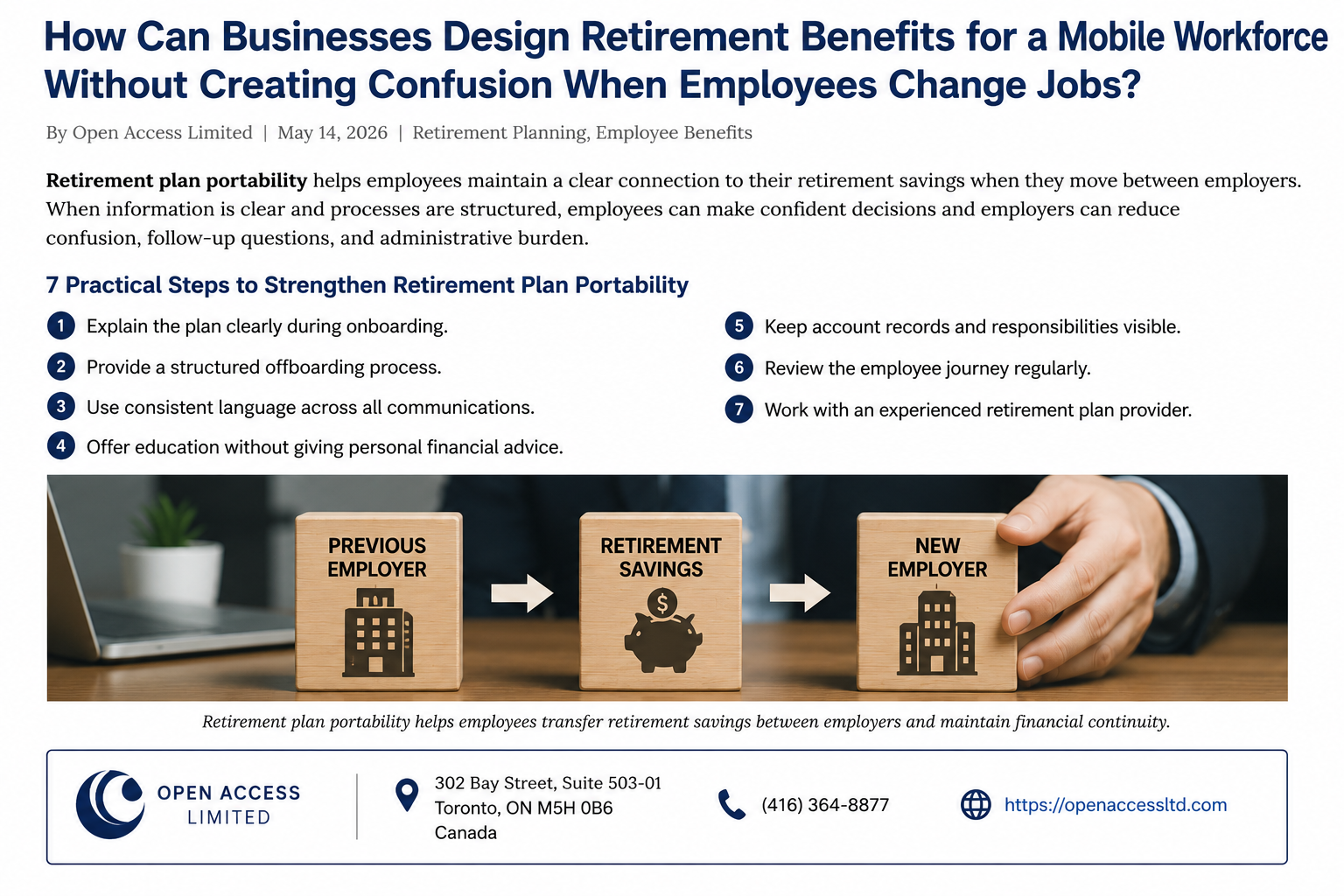
Retirement plan portability is becoming increasingly important as employees change employers, locations, and employment arrangements more frequently throughout their careers.
Modern employees may move between permanent, contract, part-time, and hybrid roles. They may also work for several organizations before retirement. While workplace retirement benefits can provide meaningful long-term value, employees may become confused about what happens to their retirement savings when they leave an employer.
A mobility-aware retirement strategy does not mean that every benefit can automatically move from one plan to another. Plan rules, transfer rights, tax treatment, deadlines, and available options can vary.
Instead, businesses should focus on making retirement plan portability easier to understand. Clear communication, structured onboarding and offboarding, visible responsibilities, and access to qualified guidance can help employees protect their retirement savings while reducing administrative pressure on HR teams.
Why Does Retirement Plan Portability Matter?
When employees change jobs, they may leave retirement accounts behind, miss important deadlines, lose track of plan administrators, or misunderstand their available choices.
Some employees may have retirement savings connected to several former employers. Others may not realize that certain registered retirement amounts may be eligible for direct transfer, depending on the type of plan, governing rules, and individual circumstances.
Confusion can reduce employee confidence and increase the risk that retirement savings become fragmented or forgotten.
For employers, retirement plan portability supports a more organized employee experience. It can reduce repetitive questions, strengthen communication, improve HR efficiency, and demonstrate that the organization supports employees throughout their employment journey—including when they leave.
7 Proven Steps to Improve Retirement Plan Portability
1. Explain the Retirement Plan During Onboarding
Retirement plan portability begins when an employee first joins the organization.
Onboarding materials should clearly explain employee and employer contributions, investment options, fees, vesting or locking-in rules where applicable, and the responsibilities of both the employee and the plan provider.
Employees should also understand what may happen to their account if their employment ends.
Providing this information at the beginning of employment helps employees view retirement benefits as part of a long-term financial strategy rather than an isolated workplace program.
2. Build a Structured Employee Offboarding Process
Departing employees should receive timely and understandable information before access to internal systems ends.
A clear offboarding package may explain available options, important deadlines, required forms, plan-provider contact information, account access, and the possible consequences of each decision.
The information should be written in plain language rather than relying only on technical pension or investment terminology.
A consistent offboarding process can reduce uncertainty and help employees remain connected to their retirement savings after leaving the organization.
Use Consistent Language Across HR and Plan Communications
Retirement terminology can be complicated.
Confusion may increase when HR documents, payroll materials, retirement-plan statements, and provider communications use different terms for the same process.
Businesses should coordinate retirement communications with their plan provider so employees receive one clear and consistent explanation.
Using standardized language across onboarding, annual education, employee portals, and termination materials can strengthen retirement plan portability and reduce avoidable follow-up questions.
4. Support Informed Decisions Without Directing Personal Choices
Employers can provide education, general information, and access to qualified professionals. However, they should avoid telling employees which transfer, preservation, withdrawal, or investment decision is best for them.
An employee’s most appropriate option may depend on personal finances, age, plan type, tax circumstances, retirement goals, and the rules of the receiving arrangement.
The employer’s role is to make information accessible and understandable—not to replace personalized legal, tax, or financial advice.
This balanced approach supports employee confidence while protecting appropriate professional boundaries.
5. Keep Account Records and Responsibilities Visible
Employees should know who holds their retirement account, where statements are delivered, how to update contact information, and whom to contact after leaving the organization.
This is especially important when an employee’s corporate email account is closed.
Businesses can encourage employees to provide an appropriate personal mailing or email address to the plan administrator, where permitted.
Clear responsibility for record updates can prevent employees from losing contact with their retirement savings and support stronger retirement plan portability over time.
6. Review the Employee Journey Regularly
Employers should evaluate the complete retirement-benefit journey from enrollment through departure.
Recurring employee questions can reveal where communication is unclear.
For example, frequent questions about contribution rules may indicate weaknesses in onboarding. Repeated confusion about account access, deadlines, or transfer options may show that offboarding materials need improvement.
Businesses can review employee feedback, HR inquiries, plan-provider reports, and communication outcomes to identify recurring issues.
Regular review helps organizations improve processes before confusion affects a larger number of employees
7. Work With an Experienced Retirement Plan Provider
An experienced retirement-plan provider can help employers coordinate employee education, plan communications, governance processes, and transition support.
The provider can also help ensure that information reflects the specific plan structure rather than relying on general assumptions.
This support is important because retirement plan portability is not identical across every retirement arrangement.
Transfer rights, locking-in requirements, deadlines, tax treatment, and permitted destinations may differ by plan type and jurisdiction.
How Does Portability Support the Business?
A mobility-aware retirement-benefit strategy can create value beyond the individual employee.
Improved Employee Experience
Clear onboarding and offboarding information reduces uncertainty during career transitions.
Employees are more likely to appreciate retirement benefits when they understand both the immediate and long-term value of the plan.
Stronger Employer Brand
Supporting employees during departure demonstrates that the organization values people beyond a single stage of employment.
This can contribute to a more positive professional relationship and workplace reputation.
Greater HR Efficiency
Repeatable communication and offboarding processes can reduce avoidable follow-up questions.
HR teams can spend less time responding to the same concerns and more time supporting strategic workforce priorities.
Better Risk Management
Timely, consistent, and plan-specific communication can help reduce misunderstandings.
It also encourages employers to review materials with the plan provider and appropriate professional advisers.
Stronger Long-Term Plan Value
When employees remain connected to their retirement accounts after changing jobs, they may be more likely to continue thinking about long-term retirement planning.
Retirement plan portability therefore supports continuity even when employment changes.
Important Implementation Considerations
Employers should not describe portability as a universal or automatic process.
Different retirement arrangements may have different transfer rules, locked-in requirements, deadlines, tax consequences, and receiving options.
An option available under one plan may not be available under another.
Before creating detailed employee instructions, businesses should work with their retirement-plan provider and obtain appropriate legal, tax, pension, or financial guidance.
Communications should clearly distinguish between general education and personalized advice.
This approach helps employers provide useful information without creating unrealistic expectations or directing personal financial decisions.
How Open Access Limited Supports Retirement Plan Portability
Open Access Limited helps Canadian employers create a clearer retirement-benefit journey from enrollment through departure.
Its services include group retirement-plan support, employee education, coordinated communications, plan-governance guidance, and employee-focused retirement solutions.
Open Access Limited can help employers explain plan responsibilities, improve onboarding and offboarding communication, and create practical processes that help employees understand what happens to their retirement savings when employment changes.
A coordinated strategy may reduce confusion, support informed employee decisions, and strengthen the long-term value of workplace retirement benefits.
Open Access Limited 302 Bay Street, Suite 503-01 Toronto, ON M5H 0B6 Canada
Retirement plan portability is an important operational and employee-experience consideration for businesses with a mobile workforce.
Employers cannot guarantee that every retirement benefit will transfer seamlessly between plans. However, they can make plan rules, responsibilities, deadlines, and transition options easier to understand.
By improving onboarding, creating structured offboarding, using consistent communication, maintaining clear records, reviewing the employee journey, and working with an experienced plan provider, businesses can reduce confusion when employees change jobs.
A strong retirement plan portability strategy helps employees remain connected to their retirement savings while supporting HR efficiency, employee confidence, and long-term benefit continuity.
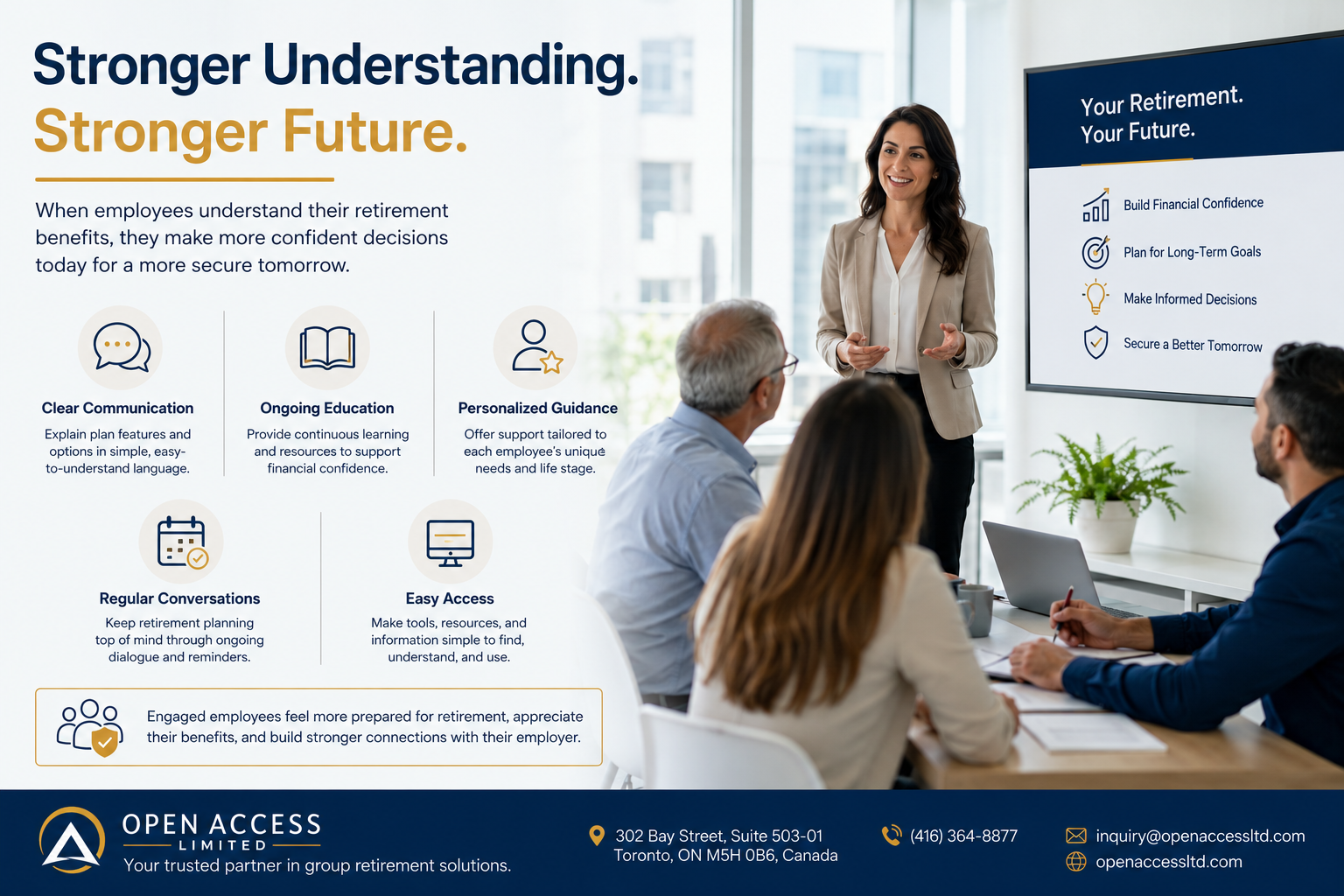
Employee retirement benefits engagement has become one of the most important priorities for organizations that want to maximize the value of their workplace retirement programs. While many employers invest significantly in retirement plans, employees do not always understand how these benefits support their long-term financial wellbeing.
Without clear communication and ongoing education, retirement programs may be underutilized, participation rates may remain lower than expected, and employees may miss valuable opportunities to prepare for retirement. Businesses that actively invest in education, communication, and employee support often create stronger engagement while helping employees make more informed financial decisions.
Rather than viewing retirement plans as a one-time employee benefit, organizations are increasingly treating them as an ongoing financial wellness initiative that evolves throughout an employee’s career.
Why Is Employee Retirement Benefits Engagement Important?
Offering employees retirement benefits engagement is only the first step.
Employees receive the greatest value when they understand how retirement programs work, why participation matters, and how their contributions support long-term financial security.
A lack of understanding can reduce employee confidence and participation while limiting the overall effectiveness of the retirement plan.
Organizations that focus on communication and financial education often create greater trust, improve employee confidence, and encourage long-term participation in workplace retirement programs.
Retirement education also helps employees connect today’s financial decisions with tomorrow’s retirement goals.
5 Smart Ways to Improve Employee Retirement Benefits Engagement
1. Communicate Retirement Benefits Clearly
Retirement plans often contain terminology that employees may not fully understand.
Organizations should communicate plan features using simple language that explains contribution options, employer matching opportunities, investment choices, and long-term retirement objectives.
Clear communication helps employees understand both the immediate and future value of participating in the plan.
2. Provide Ongoing Financial Education
Financial education should continue throughout an employee’s career instead of ending after onboarding.
Educational workshops, webinars, newsletters, retirement planning sessions, and digital learning resources help employees build financial confidence while improving retirement readiness.
Continuous learning encourages greater engagement because employees receive information when it becomes relevant to their current financial situation.
3. Personalize Employee Guidance
Employees have different financial priorities depending on age, income level, career stage, and family responsibilities.
Providing personalized education and communication allows employees to better understand retirement options that fit their own circumstances rather than receiving the same information as everyone else.
This individualized approach can improve understanding while increasing confidence in retirement planning decisions.
4. Encourage Regular Retirement Conversations
Many employees think about retirement only occasionally.
Organizations can improve engagement by encouraging regular discussions during benefit reviews, annual enrollment periods, financial wellness events, and employee education programs.
Frequent communication keeps retirement planning relevant and helps employees adjust their financial strategies as personal circumstances change.
5. Make Retirement Resources Easy to Access
Employees are more likely to engage when retirement information is easy to find and simple to understand.
Businesses can provide online portals, educational videos, retirement calculators, FAQs, and digital planning tools that employees can access whenever needed.
Accessible resources encourage ongoing learning while helping employees make informed financial decisions throughout their careers.
Building Long-Term Employee Financial Confidence
Improving employee retirement benefits engagement is not simply about increasing participation rates.
It is about helping employees develop greater confidence in their financial future.
Organizations that combine education, communication, and personalized support create stronger workplace relationships while demonstrating their long-term commitment to employee wellbeing.
Retirement programs supported by continuous communication often become an important part of a broader employee financial wellness strategy that benefits both employees and employers.
How Open Access Limited Helps Improve Employee Retirement Benefits Engagement
Many organizations choose to work with experienced retirement specialists to strengthen employee understanding and long-term engagement with workplace retirement programs.
Open Access Limited is an independent Canadian group retirement plan provider Employee Retirement Benefits Engagement that works closely with employers to develop retirement solutions focused on education, communication, and employee success.
Rather than simply implementing retirement plans, Open Access Limited supports organizations by helping employees understand the value of their workplace benefits through ongoing financial education, structured onboarding, personalized communication, and continuous engagement initiatives.
These services may help organizations improve employee participation, increase financial confidence, and strengthen retirement readiness while supporting long-term workforce wellbeing.
Open Access Limited
302 Bay Street, Suite 503-01 Toronto, ON M5H 0B6 Canada
Organizations that invest in clear communication, continuous financial education, personalized employee support, and accessible retirement resources often create stronger engagement with workplace retirement programs.
When employees understand how retirement benefits contribute to their long-term financial wellbeing, they are more likely to appreciate the value of their benefits, participate confidently, and remain engaged throughout their careers.
An effective employee retirement benefits engagement strategy can strengthen workplace trust, improve financial confidence, and help businesses maximize the long-term value of their retirement programs.
References
Financial Literacy and Education Commission – Workplace Financial Education Research
Retirement Planning Investment: 5 Powerful Ways to Build Workforce Success
Retirement planning investment is becoming an important part of how organizations evaluate long-term workforce success, employee engagement, and sustainable business growth.
For many businesses, retirement programs have traditionally been viewed as employee benefit expenses. However, modern organizations are increasingly considering how these programs can support broader workforce objectives.
A strategic approach to retirement planning may help companies strengthen employee confidence, improve benefits understanding, and create a stronger connection between workplace programs and organizational goals.
Why Should Businesses View Retirement Planning as an Investment?
A retirement planning investment goes beyond providing a standard workplace benefit.
When designed effectively, retirement programs can support workforce stability, employee value proposition, and long-term planning needs.
Employees often evaluate workplace benefits as part of their overall employment experience. A well-structured retirement strategy may contribute to stronger engagement by helping employees understand the value of their total rewards package.
Organizations that evaluate retirement planning strategically can better understand how benefits influence workforce expectations and future planning.
Retirement programs can support workforce stability by creating benefits structures that encourage long-term participation.
When employees understand available retirement resources, they may feel more prepared when making financial decisions.
Clear retirement planning strategies can help organizations build a more informed and engaged workforce.
2.Improving Employee Financial Education
Employee financial education is a key part of successful retirement planning investment.
Providing resources, guidance, and communication can help employees better understand retirement options and available workplace benefits.
Education helps transform retirement programs from simple benefits into meaningful workforce support tools.
3. Supporting Employee Value Proposition
A strong employee value proposition includes more than salary.
Benefits, workplace culture, professional development, and financial wellness programs all influence how employees view their organization.
Retirement planning can become part of a complete benefits strategy that supports attraction, engagement, and long-term workforce goals.
4. Connecting Benefits With Business Objectives
Organizations can evaluate retirement plans by considering how they align with company priorities.
This may include workforce planning goals, employee participation, communication effectiveness, and long-term organizational needs.
A thoughtful retirement planning investment helps connect employee support with broader business strategies.
5. Creating Sustainable Workforce Planning
Workforce needs continue to change as employee expectations, demographics, and economic conditions evolve.
Retirement strategies that include regular review and improvement can help businesses maintain benefits that remain relevant over time.
A sustainable approach allows organizations to adapt while supporting employees through different career stages.
How Can Organizations Measure Retirement Planning Value?
Businesses may review retirement programs alongside workforce indicators such as employee feedback, participation levels, engagement trends, and retention considerations.
The impact of retirement planning can vary depending on plan design, workforce characteristics, and business objectives.
For this reason, organizations often benefit from a structured approach that combines analysis, communication, and ongoing improvement.
How Open Access Limited Supports Workforce Investment Strategies
Open Access Limited, based in Ontario, works with employers to align retirement plan structures with organizational goals, employee education strategies, and long-term workforce planning needs.
Through customized communication, contribution framework design, and benefits strategy support, Open Access Limited helps organizations evaluate retirement programs as part of a broader workforce investment approach.
Open Access Limited 302 Bay Street, Suite 503-01 Toronto, ON M5H 0B6 Phone: 1-866-625-4777 Email: inquiry@openaccessltd.com Website: OpenAccessLtd.com
Final Thoughts
Retirement planning investment can help businesses create stronger connections between employee benefits and organizational success.
By focusing on education, workforce stability, employee engagement, and sustainable planning, companies can build retirement strategies that support both employees and future business goals.
Viewing retirement planning as a long-term workforce strategy allows organizations to create benefits programs with greater purpose and value.
References
Boston Consulting Group (BCG) – Future of Work and Workforce Strategy Research https://www.bcg.com
Retirement Planning Partner: 5 Smart Ways to Build Workforce Success
Retirement planning partner selection is becoming an important decision for businesses that want employee benefits to support long-term workforce goals, employee engagement, and organizational stability.
Choosing the right partner is not only about comparing retirement products. It is also about finding a provider that understands workforce demographics, employee needs, communication challenges, and broader business objectives.
For many organizations, retirement planning is now part of a larger workforce strategy. A strong partner can help connect retirement plan design with retention, education, participation, and long-term employee financial confidence.
Why Does Choosing the Right Retirement Planning Partner Matter?
A retirement planning partner can influence how employees understand, value, and participate in workplace retirement programs.
If the partner focuses only on products, the plan may not fully reflect company size, workforce composition, or employee expectations. However, when a partner understands business goals and workforce needs, retirement planning can become a more strategic employee benefits solution.
Businesses may benefit from evaluating partners based on transparency, communication, governance practices, and the ability to provide ongoing guidance.
5 Smart Ways to Evaluate a Retirement Planning Partner
1. Understand Workforce Demographics and Employee Needs
A strong retirement planning partner should understand that employees may have different financial profiles, career stages, and participation patterns.
Some employees may need basic education about retirement savings, while others may require more advanced planning guidance. Understanding these differences can help businesses design benefits that are more relevant and easier to use.
2. Align Retirement Plan Design With Workforce Goals
Retirement strategies should support broader business objectives such as retention, engagement, and long-term workforce planning.
A qualified partner should help businesses connect retirement plan design with organizational priorities. This may include reviewing contribution structures, communication methods, and employee participation goals.
3. Provide Clear Employee Education and Communication
Even a well-designed retirement plan may not succeed if employees do not understand it.
A retirement planning partner should provide clear education, simple communication, and practical guidance. This can help employees understand the value of retirement benefits and how those benefits support their long-term financial future.
4. Offer Adaptable Retirement Plan Structures
Workforce needs can change over time. Business conditions, employee demographics, and financial expectations may also shift.
An effective partner should offer adaptable plan structures that allow businesses to review and adjust retirement strategies as needed. Flexibility can help organizations maintain benefits that remain aligned with long-term goals.
5. Deliver Ongoing Support and Plan Insights
Selecting a retirement planning partner should not be a one-time decision.
Ongoing monitoring, reporting, communication, and plan evaluation can help businesses understand whether their retirement strategy continues to meet employee and organizational needs.
A strong partner should provide insights that support continuous improvement.
How Can Businesses Compare Retirement Planning Partners?
Important questions may include:
Businesses can take a structured approach by asking whether a potential partner can support workforce analysis, employee education, plan design, governance, and long-term review.
Can the partner understand workforce demographics?
Can they support employee engagement?
Can they explain retirement benefits clearly?
Can they adjust strategies as business needs change?
Can they provide ongoing guidance and evaluation?
These questions help businesses compare partners beyond product features.
How Open Access Limited Supports Long-Term Workforce Goals
Open Access Limited, based in Ontario, works with employers to assess workforce demographics, design retirement plan structures aligned with organizational objectives, and provide ongoing employee education and communication support.
These services are supported by adaptable plan frameworks and continuous plan evaluation. This approach may help improve employee understanding, support participation, and align retirement strategies with long-term workforce goals.
Open Access Limited 302 Bay Street, Suite 503-01 Toronto, ON M5H 0B6 Phone: 1-866-625-4777 Email: inquiry@openaccessltd.com Website: OpenAccessLtd.com
Final Thoughts:
Choosing the right retirement planning partner can help businesses connect employee benefits with long-term workforce success.
A strong partner should understand employee needs, support clear communication, provide adaptable planning structures, and offer ongoing guidance.
For organizations focused on retention, engagement, and sustainable workforce planning, retirement partner selection can become an important part of a broader benefits strategy.
Suggested Image ALT Text: Canadian business leaders evaluating a retirement planning partner, workforce goals, employee education, retirement benefits strategy, and long-term employee engagement in a modern corporate office.
How Can Businesses Help Employees Feel Financially Secure During Economic Uncertainty?
Employee financial security has become an important priority as economic uncertainty, inflation, cost of living pressures, and market changes influence how employees think about their financial future.
Many employees today are balancing short-term financial needs with long-term goals. During uncertain economic periods, workplace benefits and retirement planning strategies can help employees better understand their options and make more informed financial decisions.
Businesses are increasingly looking at retirement planning as part of a broader financial wellness strategy that supports confidence, engagement, and long-term workforce stability.
Why Does Employee Financial Security Matter During Economic Uncertainty?
Economic uncertainty can affect how employees view their savings, retirement goals, and overall financial readiness.
Factors such as inflation, changing markets, and increased living expenses may create additional financial concerns for employees.
Organizations that provide clear retirement planning support can help employees feel more prepared by offering education, resources, and consistent communication.
A proactive approach focuses on helping employees build financial confidence before challenges become larger concerns.
Strengthening Employee Financial Security Through Retirement Planning
Employee financial security can become stronger when businesses provide consistent retirement planning strategies that support employees during changing economic conditions. A well-designed retirement plan can improve financial confidence, reduce uncertainty, and help employees prepare for long-term goals. By combining financial education, communication, and flexible solutions, organizations can create a more supportive workplace environment.
5 Powerful Retirement Planning Strategies That Support Employees
1. Provide Clear Retirement Plan Communication
Employees financial security are more likely to engage with retirement programs when they understand how those programs work.
Clear communication helps explain available options, contribution choices, and the long-term value of workplace retirement benefits.
2. Offer Flexible Savings and Contribution Options
Employee financial situations can change during uncertain economic periods.
Flexible retirement strategies allow employees to adjust their participation based on their current needs while continuing to plan for the future.
3. Improve Financial Wellness Education
Financial education helps employees improve confidence and decision-making.
Workplace programs may include information about budgeting, retirement preparation, savings strategies, and understanding financial priorities.
Strong education programs can connect retirement planning with everyday financial wellness.
4. Provide Personalized Retirement Guidance
Employees have different financial backgrounds, goals, and planning timelines.
Personalized retirement guidance helps employees receive information that better matches their financial profile and life stage.
This approach can make workplace benefits more meaningful and easier to understand.
5. Build Integrated Financial Wellbeing Programs
Modern retirement strategies often connect long-term planning with broader financial wellbeing.
Integrated programs can support both immediate financial concerns and future retirement goals.
How Can Businesses Create Long-Term Financial Confidence?
Businesses can support employees by making retirement planning an ongoing conversation instead of a one-time benefit decision.
Consistent education, flexible solutions, and accessible resources may improve employee understanding and participation.
Organizations that invest in employee financial security may strengthen workplace confidence and support a more resilient workforce.
How Open Access Limited Supports Retirement Planning Strategies
Open Access Limited, based in Ontario, works with employers to implement retirement programs that include flexible contribution structures, personalized financial education, and ongoing communication strategies.
These programs are designed to align with employees’ financial profiles and planning goals while supporting stronger financial awareness.
Open Access Limited 302 Bay Street, Suite 503-01 Toronto, ON M5H 0B6
Economic uncertainty can create financial questions for employees, but businesses can provide meaningful support through effective retirement planning strategies.
By combining communication, flexibility, education, and personalized guidance, organizations can help employees build confidence and prepare for their financial future.
Reference:
World Economic Forum (2024). Economic Uncertainty and Workforce Research. https://www.weforum.org
OECD (2023). Financial Resilience and Retirement Planning Insights. https://www.oecd.org
Employee trust has become one of the most valuable foundations of a successful workplace. While competitive salaries remain important, many employees today expect organizations to provide stronger long-term support through employee trust through financial wellness benefits, retirement planning solutions, and clear financial education.
As workplace expectations continue to evolve, employees are looking for more than immediate compensation. They want confidence that their employers care about their future financial security, personal well-being, and long-term stability.
Organizations that provide meaningful financial wellness programs and retirement benefits can create stronger relationships with employees, improve engagement, and support a more loyal workforce.
Why Employee Trust Through Financial Wellness Benefits Matters
Trust is built when employees feel supported, informed, and valued. Financial concerns can create stress that impacts focus, productivity, and overall workplace satisfaction.
A strong financial wellness strategy helps employees understand their benefits, prepare for future needs, and make more confident financial decisions.
Businesses that prioritize financial education and retirement planning show employees that long-term success is a shared responsibility.
1. Clear Retirement Communication Builds Confidence
Retirement plans are most effective when employees understand how they work.
Providing simple explanations about available programs, contribution options, and long-term planning strategies helps employees feel more confident about their future.
Clear communication can turn retirement benefits from a confusing topic into a valuable workplace advantage.
Employees experience different financial challenges throughout their lives. Some may focus on managing expenses, while others may be preparing for retirement or long-term savings goals.
Financial wellness education can include:
Budgeting guidance
Retirement planning information
Financial awareness sessions
Long-term savings strategies
Understanding workplace benefits
Providing access to education helps employees make informed decisions and increases trust in employer support.
Transparency plays an important role in building employee confidence.
When organizations clearly explain available benefits, employees better understand the value being provided beyond their salary.
A transparent approach to workplace benefits can improve communication, reduce uncertainty, and create a stronger connection between employers and employees.
4. Supporting Employees at Different Life Stages
A successful benefits strategy recognizes that employees have different needs.
Younger employees may value financial education and savings support, while experienced employees may focus more on retirement readiness and future security.
Flexible financial wellness benefits allow businesses to support a diverse workforce and build long-term trust.
5. Financial Wellness Can Improve Employee Retention
Employees who feel supported are more likely to stay engaged with their organization.
Strong retirement planning and financial wellness programs may help reduce stress, increase loyalty, and improve workplace stability.
For businesses, investing in employee financial confidence can also support stronger team performance and long-term growth.Effective retirement planning also helps organizations create stronger employee relationships and support a more sustainable workforce strategy.
Building a Trust-Based Benefits Strategy for the Future
Modern organizations are recognizing that employee benefits are not only about compensation. They are also about creating security, confidence, and stronger workplace relationships.
A thoughtful approach to employee trust through financial wellness benefits connects retirement planning, financial education, and employee well-being into one long-term strategy.
Working with experienced advisory partners such as Open Access Limited can help businesses develop practical solutions that support both organizational goals and employee needs.
Final Thoughts
Employee trust is built through consistent support, transparency, and meaningful benefits.
Companies that invest in retirement planning and financial wellness strategies can create a stronger workplace culture where employees feel valued, prepared, and confident about the future.