Introduction
Employee loyalty remains one of the most valuable assets a business can develop. Organizations that retain experienced employees often benefit from stronger workforce stability, lower recruitment costs, improved productivity, and greater organizational continuity.
At the same time, employers must balance workforce investment with financial sustainability.
This has led many businesses to explore retirement benefits as a strategic tool for improving employee loyalty while maintaining flexibility and cost control.
When thoughtfully designed, retirement programs may help strengthen employee engagement and retention without requiring employers to take on excessive long-term financial commitments.
Why Employee Loyalty Matters for Business Success
- Reduced employee turnover
- Improved workforce stability
- Stronger organizational culture
- Enhanced employee engagement
- Lower recruitment and training costs
- Greater long-term productivity
Building a loyal workforce can support several business objectives, including:
Retirement benefits may contribute to these outcomes by helping employees feel supported in their long-term financial goals.
1. Use Scalable Contribution Models
One approach businesses may consider is implementing scalable contribution structures.
Rather than relying on rigid long-term commitments, some retirement programs allow contribution levels to align with business performance, workforce needs, or financial capacity.
Benefits of Scalable Contributions:
- Greater financial flexibility
- Improved budget management
- Ability to adapt to changing business conditions
- Continued employee support
- Long-term sustainability
This approach may help employers offer meaningful retirement benefits while maintaining greater control over costs.
2. Encourage Retention Through Vesting Structures
Vesting structures can be another effective strategy for supporting employee loyalty.
Phased vesting schedules may encourage employees to remain with an organization longer by linking certain retirement benefits to tenure and service milestones.
Potential Advantages Include:
- Improved employee retention
- Stronger workforce continuity
- Better alignment with long-term workforce goals
- Reduced turnover among key employees
- More strategic benefit allocation
By aligning retirement benefits with retention objectives, organizations may create stronger incentives for long-term workforce participation.
3. Position Retirement Benefits Within a Broader Employee Value Proposition (EVP)
Retirement benefits are often most effective when integrated into a broader employee value proposition (EVP).
Rather than being viewed as a standalone benefit, retirement programs may complement:
- Compensation packages
- Financial wellness initiatives
- Career development opportunities
- Workplace culture
- Employee education programs
This integrated approach may contribute to a more engaging and rewarding employee experience.
4. Maintain Flexibility Through Adaptive Plan Design
Business environments, workforce demographics, and economic conditions can change over time.
Flexible retirement plan structures may allow employers to adjust contribution levels, benefit features, and program components without requiring a complete redesign.
Flexible Features May Include:
- Adjustable contribution rates
- Scalable employer matching structures
- Flexible participation options
- Evolving workforce support initiatives
- Adaptable financial wellness programs
Flexibility may help organizations remain competitive while maintaining long-term cost discipline.
5. Strengthen Engagement Through Communication and Education
Retirement benefits often deliver greater value when employees understand how they work.
Clear communication and ongoing financial education may help improve:
- Employee participation
- Benefit utilization
- Financial confidence
- Workforce engagement
- Employee appreciation of total compensation
Organizations that invest in retirement education may improve the perceived value of their benefits without necessarily increasing overall costs.
Supporting Loyalty While Maintaining Financial Sustainability
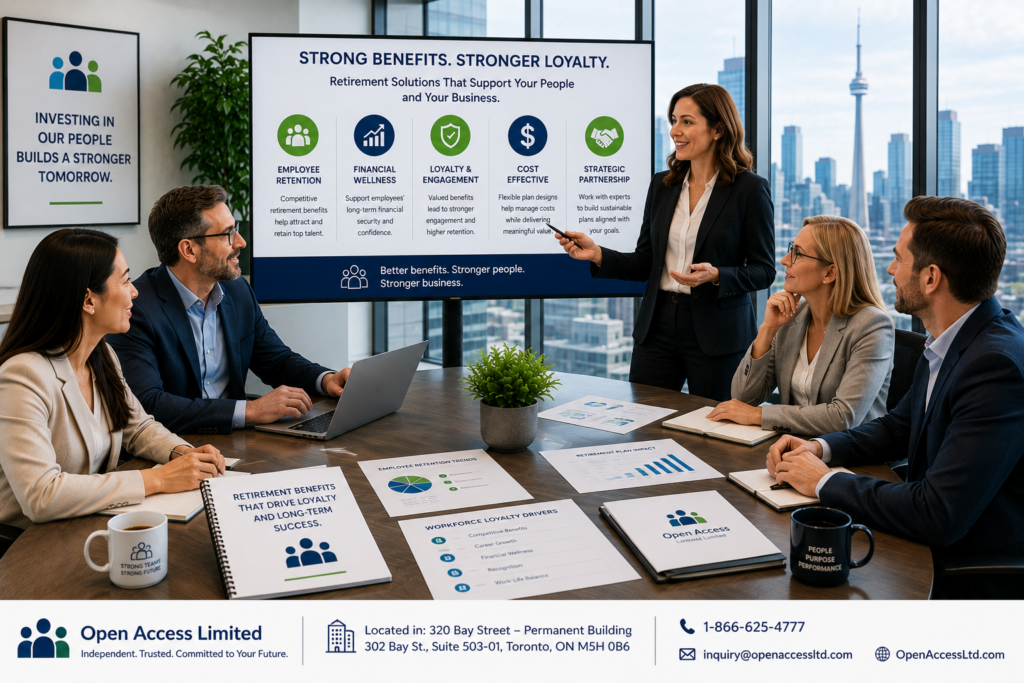
For example, Open Access Limited works with employers across Ontario and Canada to implement scalable contribution frameworks, design vesting structures aligned with retention goals, and provide ongoing communication and education programs that support both employee loyalty and long-term financial sustainability.
Final Thoughts
Retirement benefits can be a valuable tool for strengthening employee loyalty while maintaining financial flexibility.
By incorporating scalable contribution models, strategic vesting structures, flexible plan design, and effective employee communication, businesses may improve retention and workforce engagement without overcommitting to long-term fixed costs.
A balanced retirement strategy can help organizations support employees today while maintaining the flexibility needed for future growth.
References:
Willis Towers Watson (WTW) (2023).
Global Benefits Attitudes Survey.
https://www.wtwco.com
World Economic Forum (2024).
Future of Work and Workforce Strategy Insights.
https://www.weforum.org
Morningstar (2023).
Retirement and Investment Behavior Research.
https://www.morningstar.com
Brookings Institution.
Workforce and Economic Policy Research.
https://www.brookings.edu
Harvard Business Review.
Employee Retention and Benefits Strategy Insights.
https://hbr.org
Leave a Reply