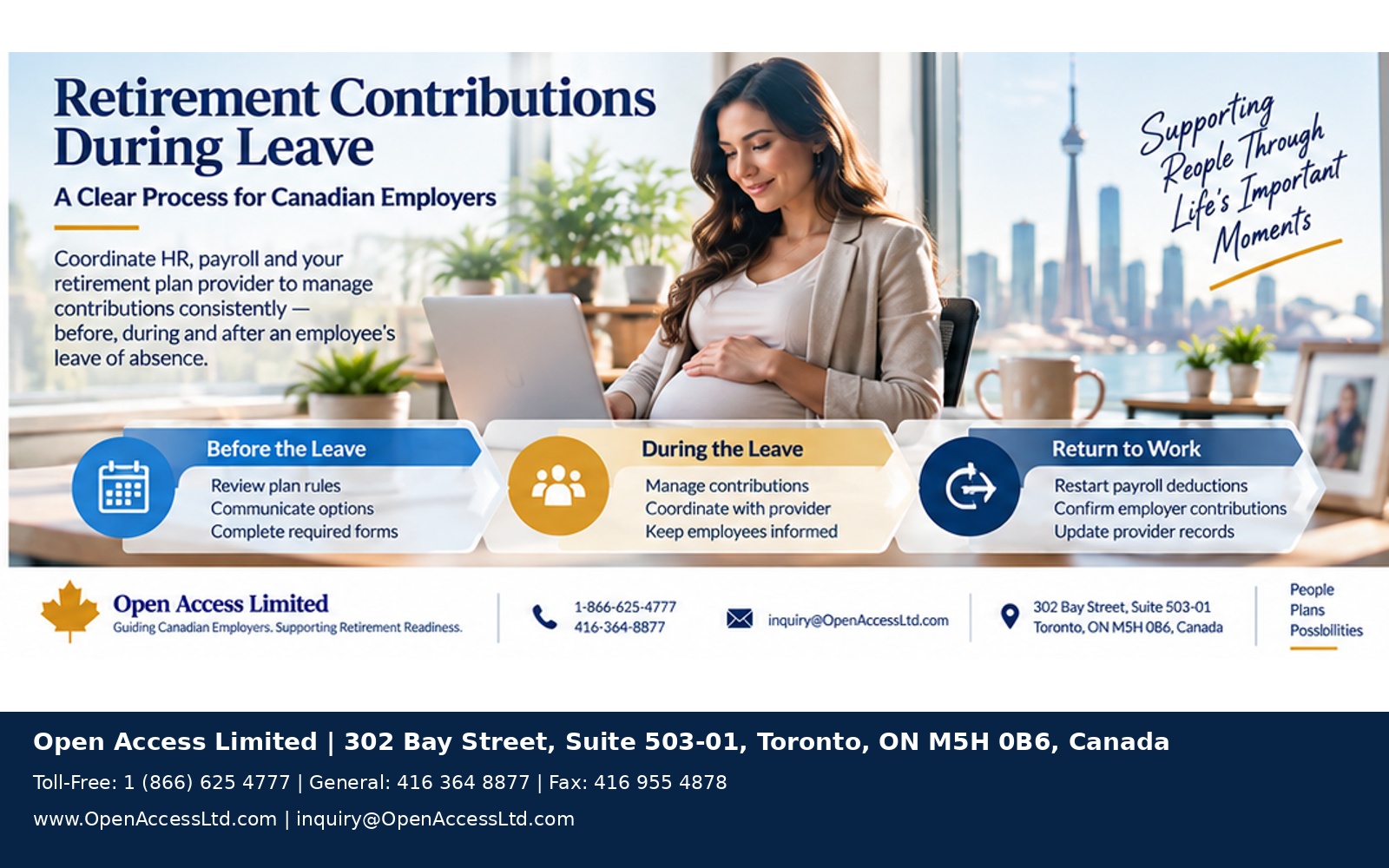
Retirement contributions during leave can become complicated because there is no single Canada-wide rule that applies to every employee, every type of leave, or every workplace retirement arrangement.
Employees may take pregnancy, parental, medical, family caregiver, statutory, or employer-approved leaves. At the same time, workplace retirement plans may include Registered Pension Plans (RPPs), defined contribution pension plans, Group RRSPs, DPSPs, and other arrangements that follow different contribution, tax, payroll, and reporting rules. OpenAccess_Q52_QA_with_Resource…
For Canadian employers, the goal should not be to promise that contributions will always continue in the same way.
A stronger approach is to create a documented process that covers:
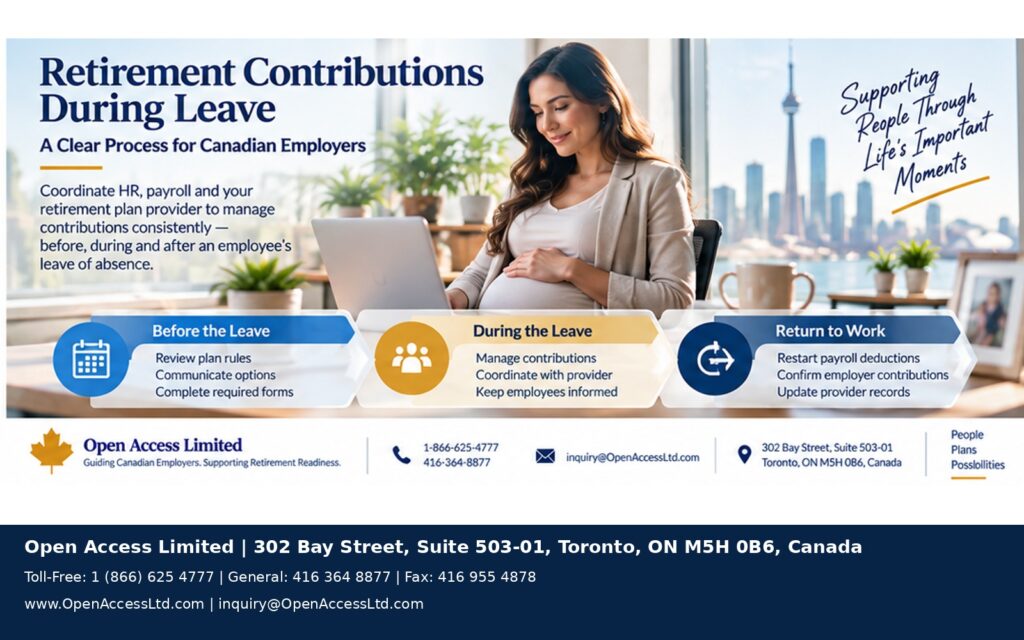
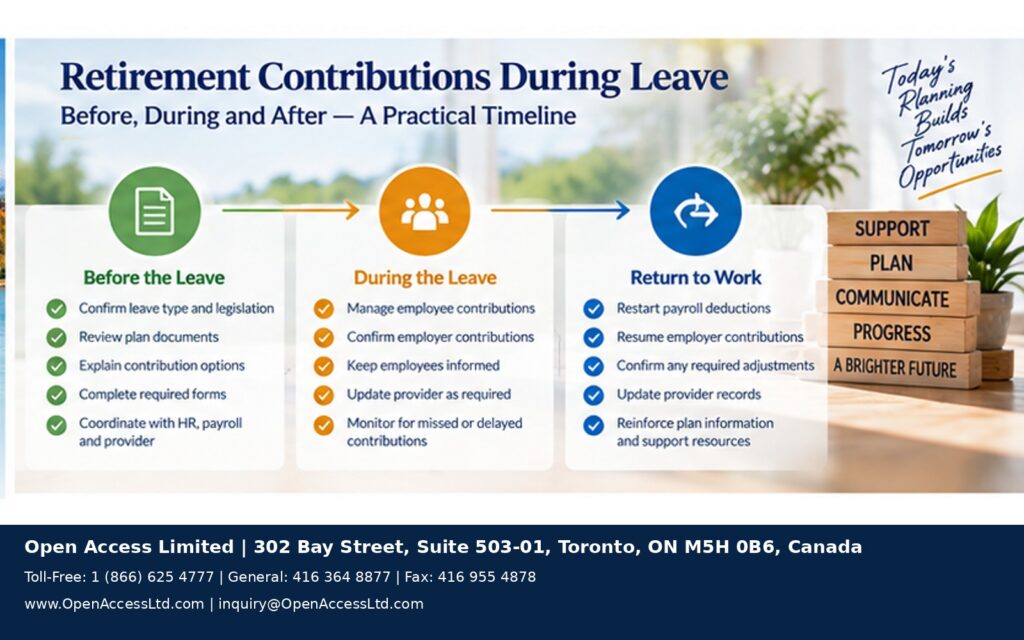
Before the leave → During the leave → Return to work
That process should connect applicable legislation, official plan documents, HR, payroll, the retirement-plan provider, employee communication, and recordkeeping.
Quick Answer: How Should Employers Handle Retirement Contributions During Leave?
Canadian employers should manage retirement contributions during leave by first identifying the type of leave and applicable jurisdiction, reviewing official plan documents, confirming employee and employer contribution rules, coordinating HR and payroll with the plan provider, communicating options clearly, planning for the employee’s return to work, and documenting decisions and corrections.
Employers should avoid assuming that the same rules apply to every plan or jurisdiction and should not recommend which personal contribution option an employee should choose.
On This Page
- Why Leave Contributions Require a Defined Process
- 7 Smart Employer Steps
- Ontario Leave Examples
- Federally Regulated Workplaces
- Other Provinces and Territories
- How Plan Type Changes the Rules
- Employee Questions to Prepare For
- Ongoing Communication
- Common Administrative Risks
- Important Implementation Boundaries
- How Open Access Limited May Support Employers
- FAQs
- Final Thoughts
- References
Why Retirement Contributions During Leave Need a Documented Process
A leave of absence can affect several systems at the same time.
HR may record the employee’s leave status.
Payroll may reduce or stop regular pay.
The retirement-plan provider may require different contribution or member information.
The employee may need to make an election or provide written notice.
When these activities are not coordinated, retirement contributions during leave may be missed, delayed, calculated incorrectly, or require correction later. OpenAccess_Q52_QA_with_Resource…
This is why the employer should avoid relying on informal instructions.
The process should be documented and repeatable.
7 Smart Ways to Manage Retirement Contributions During Leave
1. Identify the Type of Leave and Applicable Jurisdiction
Start by determining:
- What type of leave is involved?
- Is it statutory or employer-approved?
- Is the leave paid or unpaid?
- Which employment standards legislation applies?
- Is the employer provincially, territorially, or federally regulated?
This matters because leave entitlements can vary significantly.
A pregnancy or parental leave in an Ontario-regulated workplace may not operate under exactly the same rules as a federally regulated leave or a leave in another province.
Retirement contributions during leave should therefore begin with the applicable legal framework—not with a generic company practice.
An internal policy cannot override legislation or official plan terms.
2. Review the Official Retirement Plan Documents
The official plan documents should be one of the first places an employer looks.
Review:
- Eligibility provisions
- Employee contributions
- Employer contributions
- Matching formulas
- Definitions of earnings
- Leave-of-absence provisions
- Contribution timing
- Suspension or continuation rules
- Return-to-work provisions
If the documents are silent or unclear, confirm the treatment with the plan administrator or provider.
The original framework specifically recommends checking official plan terms before determining how leave contributions will be administered. OpenAccess_Q52_QA_with_Resource…
This is also where the employer’s broader retirement plan governance process becomes important.
3. Confirm How Employee Contributions Will Be Handled
If an employee normally contributes through payroll, an unpaid or reduced-pay leave can create an operational challenge.
Regular payroll deductions may no longer be available.
If another method of collecting contributions is being considered, it should be permitted by:
- Applicable legislation
- The plan terms
- The plan provider
- Relevant payroll procedures
Employees should receive neutral information about the options available under the plan.
Employers should not tell an employee which option is personally best.
The employee’s choice—and any required election or notice—should be documented in writing where applicable.
4. Coordinate HR, Payroll, and the Retirement-Plan Provider
This is one of the most important operational controls.
HR, payroll, and the provider should be working from the same information.
The employer should confirm:
- Leave start date
- Leave type
- Eligibility status
- Employee contribution treatment
- Employer contribution treatment
- Pay status
- Contribution amount
- Method of collection
- Remittance timing
- Required forms
- Provider updates
This coordination helps reduce retirement contributions during leave errors involving missed, late, duplicated, or incorrectly calculated contributions.
It also connects directly with the employer’s broader retirement plan payroll errors controls.
5. Communicate the Process in Plain Language
Employees should not need to interpret legal language or technical plan provisions themselves.
Provide a clear written summary explaining:
- What happens before the leave
- Whether contributions may continue
- How employee contributions may be collected
- How employer contributions are treated
- Important deadlines
- Required forms
- Where official documents can be found
- Who to contact with questions
The source framework specifically recommends repeating key information rather than communicating only once before the leave begins. OpenAccess_Q52_QA_with_Resource…
A leave may last many months.
Information provided at the beginning may need to be reinforced later.
6. Plan the Employee’s Return to Work
The contribution process should not end with the leave itself.
Before or when the employee returns, confirm:
- When regular payroll deductions restart
- When employer contributions resume
- Whether payroll requires updating
- Whether the provider requires an update
- Whether any adjustment is required under the plan
- Whether the employee needs new information
A clean return-to-work process reduces the risk that deductions remain paused or that the wrong contribution formula continues after the employee returns.
7. Document the Entire Process
Keep appropriate records of:
- Employee notices
- Elections
- Payroll instructions
- Provider communications
- Effective dates
- Forms
- Contribution calculations
- Corrections
- Return-to-work updates
Good documentation supports both administration and later review.
It can also help identify recurring problems.
A disciplined approach to retirement contributions during leave should create a clear record of what was decided, why, and how it was implemented.
Ontario: Leave Rules Can Affect Benefit Participation
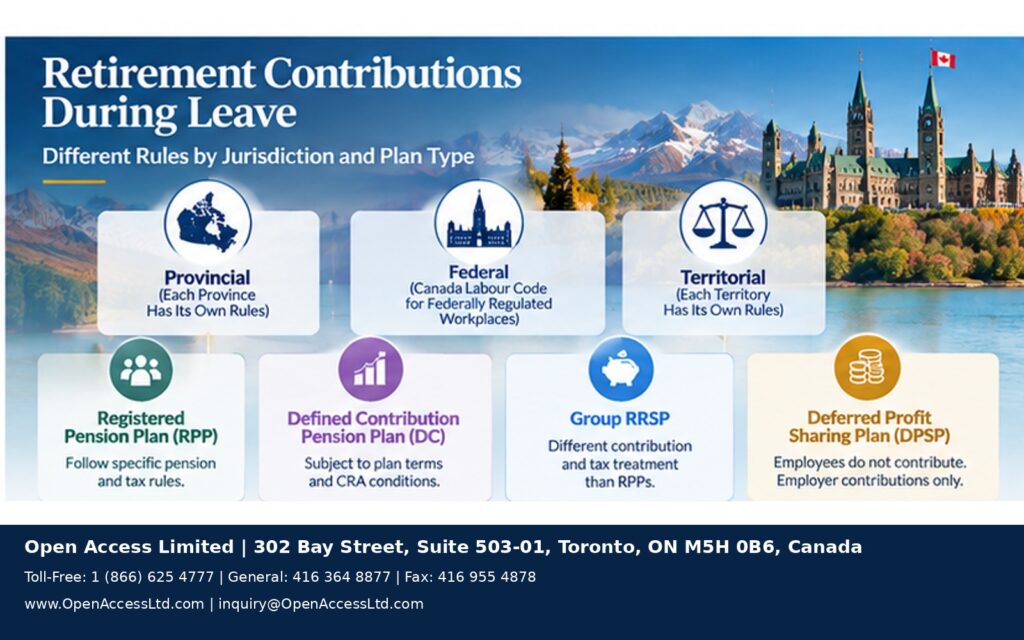
For Ontario-regulated employers, the Employment Standards Act guidance provides specific examples relating to benefit-plan participation during certain leaves.
Ontario guidance states that employees on pregnancy or parental leave have rights relating to continued participation in certain benefit plans, including pension plans, and describes employer and employee contribution responsibilities in that context. OpenAccess_Q52_QA_with_Resource…
The Ontario guidance also identifies other ESA leaves where benefit-plan continuation provisions may apply.
However, an important distinction must be preserved:
The cited Ontario sources refer to pension plans.
They do not establish in this Q&A that a Group RRSP or DPSP must be treated in exactly the same way.
Employers should not automatically extend one plan-type rule to another.
Federally Regulated Workplaces Have Their Own Rules
Federally regulated employers operate under a different framework.
The source notes that section 209.2 of the Canada Labour Code addresses pension, health, disability benefits, and seniority during certain Division VII leaves.
Where an employee is required to contribute, the Code addresses employee contribution responsibilities and corresponding employer contributions, subject to the applicable conditions. OpenAccess_Q52_QA_with_Resource…
For federally regulated employers, retirement contributions during leave should therefore be reviewed against the Canada Labour Code and current federal guidance.
Do not assume provincial rules apply.
What About Other Provinces and Territories?
Other provinces and territories have their own employment standards legislation.
An employer with employees in several provinces may need a jurisdiction-by-jurisdiction process.
That means a national business may need to distinguish between:
Ontario employee → Federal employee → Alberta employee → British Columbia employee → Other jurisdiction
rather than applying one internal leave-contribution rule across Canada.
The source explicitly notes that leave entitlements may differ and multi-jurisdiction employers may need separate review. OpenAccess_Q52_QA_with_Resource…
Plan Type Matters: RPP, Group RRSP, and DPSP Are Different
Another major source of risk is assuming that every retirement arrangement follofollows the same contribution rules.
It does not.
Registered Pension Plans and DC Pension Plans
The CRA framework discussed in the source permits certain defined contribution pension arrangements to recognize prescribed compensation for qualifying periods of reduced pay or leave, subject to conditions and limits.
The source also notes that employer contributions to an RPP are not generally treated as a taxable benefit to the employee in the same way as employer RRSP contributions. OpenAccess_Q52_QA_with_Resource…
Group RRSPs
Employer contributions to an employee’s RRSP are generally treated differently for tax and payroll purposes.
If regular pay is reduced or paused during leave, employers may need to confirm with the payroll and plan provider how contributions can be processed under the applicable arrangement.
Deferred Profit Sharing Plans
A DPSP is different again.
Employees do not contribute to a DPSP; only participating employers contribute.
Contribution limits also include compensation-based calculations.
Reduced compensation during a leave can therefore create different questions than it would under a Group RRSP or pension plan. OpenAccess_Q52_QA_with_Resource…
This is why retirement contributions during leave should always be reviewed by plan type.
Employee Questions Employers Should Be Ready to Answer
Employees may reasonably ask:
Will My Workplace Retirement Plan Continue While I Am on Leave?
The answer depends on the applicable legislation, plan type, and official plan documents.
Will My Payroll Contributions Continue?
If regular pay is reduced or stopped, normal payroll deductions may not continue in the usual way.
Will My Employer Continue Contributing?
This depends on applicable requirements and plan terms.
Do I Need to Complete a Form?
Some plans or leave situations may require notices, elections, or contribution instructions.
What Happens if I Do Not Contribute During the Leave?
The employer should explain the applicable plan process without advising the employee which personal choice to make.
How Do Contributions Restart When I Return?
The employer should clearly explain the return-to-work process.
Who Can Help Me?
Employees should have access to the employer, plan administrator/provider, or another appropriate contact depending on the question.
The source specifically recommends answering these questions from applicable legislation, official documents, and provider confirmation—not personal assumptions. OpenAccess_Q52_QA_with_Resource…
Ongoing Communication Should Continue Throughout the Leave
A long leave can last many months.
Employees may not remember every instruction received before it began.
Employers can use a three-stage communication model:
Before Leave
Provide:
- Written contribution information
- Required forms
- Deadlines
- Contacts
- Plan-document references
During Leave
Where appropriate, remind employees about:
- Deadlines
- Contribution arrangements
- Support contacts
- Plan information
Return to Work
Confirm:
- Payroll restart
- Employer contribution restart
- Required adjustments
- Provider updates
- Current plan resources
CAPSA’s Guideline No. 3 supports an ongoing education approach rather than restricting member education to initial enrolment. OpenAccess_Q52_QA_with_Resource…
This is also a natural opportunity to reinforce broader retirement income education.
Common Mistakes Employers Should Avoid
Avoid these common administrative problems:
- Assuming one Canada-wide rule exists
- Treating every type of leave the same way
- Applying pension-plan rules automatically to Group RRSPs
- Applying Group RRSP rules automatically to DPSPs
- Relying on an internal practice instead of official documents
- Failing to coordinate payroll and HR
- Forgetting to notify the plan provider
- Giving employees personal contribution recommendations
- Communicating only once before the leave
- Failing to plan for return to work
- Assuming a payroll correction automatically solves a plan issue
- Failing to document employee elections or corrections
These mistakes can increase the risk of inconsistent retirement contributions during leave administration.
How Can Employers Keep Leave Contribution Information Accurate?
Employers can strengthen accuracy by:
- Using current legislation
- Using current official plan documents
- Confirming plan treatment with the provider
- Documenting payroll instructions
- Recording employee elections
- Reviewing changes before implementation
- Keeping HR and payroll information aligned
- Confirming return-to-work procedures
- Escalating unclear cases to qualified professionals
The goal is not to create a one-size-fits-all policy.
The goal is a controlled decision process.
Important Implementation Boundaries
Managing retirement contributions during leave can involve multiple areas of law and administration, including:
- Employment standards
- Pension law
- Tax
- Payroll
- Human rights
- Workers’ compensation
- Privacy
- Collective agreements
- Contracts
Requirements depend on the jurisdiction, type of leave, plan type, plan documents, and provider agreements. OpenAccess_Q52_QA_with_Resource…
Government guides are useful resources, but employers should confirm current requirements before implementing or changing a practice.
Internal policy cannot override legislation, employee rights, official plan terms, or plan-administrator responsibilities.
Individual legal, tax, payroll, or financial questions should be referred to appropriately qualified professionals.
Need Help Communicating Retirement Plan Contributions During Employee Leave?
Open Access Limited may support employers with the workplace retirement-plan portion of leave-related communication.
Open Access materials include plan-specific resources for several types of group retirement arrangements, as well as contribution forms, member portal access, education resources, and member support.
Depending on the applicable Open Access plan, employers may use these resources to help confirm:
- Plan-specific eligibility
- Contribution provisions
- Employer-matching terms
- Member forms
- Payroll contribution authorization
- Member account information
- Statements and transaction history
- Financial-wellness education
- Member-support contacts
Whether a particular process can be used during a leave depends on the applicable plan terms and should be confirmed directly. OpenAccess_Q52_QA_with_Resource…
Open Access Limited should remain positioned as supporting plan information, enrolment, contribution communication, education, member resources, and plan administration coordination—not as determining statutory leave entitlements or providing individual legal, tax, payroll, or employment-standards advice.
Open Access Limited
302 Bay Street, Suite 503-01
Toronto, ON M5H 0B6, Canada
Toll-Free: 1 (866) 625 4777
General: 416 364 8877
Fax: 416 955 4878
Email: inquiry@OpenAccessLtd.com
Website: www.OpenAccessLtd.com
Frequently Asked Questions
Do Retirement Contributions Always Continue During a Leave of Absence?
No. Retirement contributions during leave depend on the applicable jurisdiction, type of leave, type of retirement plan, plan documents, and other requirements.
Are Pregnancy and Parental Leave Rules the Same Across Canada?
No. Provincial, territorial, and federal employment rules can differ.
Can Employers Stop Contributions When Payroll Stops?
Not necessarily. Reduced or paused payroll does not, by itself, determine all employee or employer contribution obligations. The plan terms and applicable requirements must be reviewed.
Are Group RRSPs and Pension Plans Treated the Same During Leave?
No. Employers should not assume that pension-plan continuation rules automatically apply to a Group RRSP or DPSP.
Can an Employer Tell an Employee Whether They Should Keep Contributing?
Employers can explain available options and plan procedures but should avoid making individualized financial recommendations.
What Should Happen When the Employee Returns to Work?
The employer should confirm when payroll deductions and employer contributions resume and whether adjustments or provider updates are required.
Should Leave Contribution Decisions Be Documented?
Yes. Appropriate records of notices, employee elections, payroll instructions, provider updates, and corrections can support administration and future review.
Final Thoughts
Retirement contributions during leave should be managed through a documented process—not assumptions.
For Canadian employers, the strongest framework is:
Identify the Leave → Check the Jurisdiction → Review the Plan → Confirm Contributions → Coordinate Payroll and Provider → Communicate Clearly → Plan the Return → Document Everything
There is no universal rule that fits every employee or every retirement plan.
By grounding decisions in current legislation, official plan documents, provider information, clear communication, and qualified professional advice where necessary, employers can reduce administrative inconsistency while giving employees clearer information before, during, and after a leave.
References
- Government of Ontario — Pregnancy and Parental Leave, Your Guide to the Employment Standards Act.
- Government of Ontario — Benefit Plans, Your Guide to the Employment Standards Act.
- Financial Services Regulatory Authority of Ontario — Events That May Affect Your Pension.
- Government of Canada — Canada Labour Code, Section 209.2.
- Government of Canada — Types of Leaves for Employees in Federally Regulated Industries and Workplaces.
- Canada Revenue Agency — Registered Plans Directorate Technical Manual: Periods of Reduced Pay and Salary Deferral Leave Plans.
- Canada Revenue Agency — Contributions to Savings and Pension Plans.
- Canada Revenue Agency — Contributing to a Deferred Profit Sharing Plan.
- Canadian Association of Pension Supervisory Authorities — Guideline No. 3: Guideline for Capital Accumulation Plans.
- Open Access Limited — Group Retirement Plans, Member Forms, Member Resources, Financial Wellness Resources, and Plan-Specific Enrolment Resources.
These are the authoritative resources identified in the supplied Q&A 52 source. OpenAccess_Q52_QA_with_Resource…
Leave a Reply